Is the God of Islam the same God as Elohim of the Christian Scriptures?

Medallion showing “Allah” (God) in Hagia Sophia, Istanbul, Turkey. (Courtesy Wikipedia)

By Spencer D Gear

A Roman Catholic bishop in the Netherlands, Tiny Muskens, has proposed that Dutch Catholics should pray to Allah, as ‘ God doesn’t mind what he is called’. The Catholic News reported:

Breda Bishop Tiny Muskens, who once worked as missionary in Indonesia, has proposed that Dutch Catholics should pray to Allah just as Christians already do in other countries with significant Muslim populations.
Radio Netherlands reports that Bishop Muskens says his country should look to Indonesia, where the Christian churches already pray to Allah. It is also common in the Arab world: Christian and Muslim Arabs use the words God and Allah interchangeably.

Speaking on the Dutch TV programme Network on Monday evening, Bishop Muskens says it could take another 100 years but eventually the name Allah will be used by Dutch churches. And that will promote rapprochement between the two religions.

Muskens doesn’t expect his idea to be greeted with much enthusiasm. The 71-year-old bishop, who will soon be retiring due to ill health, says God doesn’t mind what he is called. God is above such “discussion and bickering”.[1]

This view is alive and well on Christian forums on the www in the 21st century. Some claim that the Allah of Islam is the same God as the Almighty in Christianity.[2] Albert Mohler Jr. (2007), to the contrary, stated, ‘From its very starting point Islam denies what Christianity takes as its central truth claim — the fact that Jesus Christ is the only begotten Son of the Father’.

Who is correct?

The promotion of idolatry

J. C. Ryle, an evangelical and the first Anglican bishop of Liverpool, wrote in the 19th century:

‘I believe that we have come to a time when the subject of idolatry demands a thorough and searching investigation. I believe that idolatry is near us, all around us, and in the midst of us, to a very fearful extent. The second commandment, in one word, is in danger. “The plague is begun”‘.[3]

Ryle’s definition was that ‘idolatry is a worship, in which the honor due to the Triune God, and to God only, is given to some of His creatures, or to some invention of His creatures’.[4]

A lawyer once came to test Jesus with the question, “Teacher, which is the great commandment in the Law?” What was Jesus’ response? “‘You shall love the Lord your God with all your heart and with all your soul and with all your mind.’ This is the great and first commandment” (Matt 22:35-38).

Since the worship of God is of first importance to us, engaging in false worship is one of the greatest calamities Christians can practice. Worshipping a false god is a serious problem as it is worshipping an idol, something the Israelites fell into on a number of occasions according to the OT.

I’m reminded of the warning against idolatry in 1 John 5:21: “Little children, keep yourselves from idols”. Therefore, it is of vital importance that we know who God is. So the differentiation between Allah and Elohim-God is of top priority.

Knowing what is idolatry is important as it is a dangerous practice. It can involve the worship of demons (see 1 Cor. 10:20 and compare it with Deut. 32:17). From the OT, we know that people can worship another god or demons and think they are worshipping Elohim God (see Ex. 32:1-6; 1 Kings 12:28-20)

That’s why it is of decisive importance to know that Elohim, the Almighty God, is not the same god as Allah. There is only one God and He is not Allah, according to the Scriptures. Nowhere in the OT and NT is God identified as Allah in the original languages (Hebrew-Aramaic OT and Greek NT).

One writer on Christian Forums stated: “If Abraham worshiped God and Abraham is recognized as the ‘father’ of believers then Judaism, Islam and Christianity worship the same God”.[5]

My response[6] was that this person was trying to argue for the ideology of old – old-fashioned religious syncretism.

What is syncretism?

W. A. V. Hooft (1963:11) stated that

‘the syncretic approach may be defined as ‘the view which holds that there is no unique revelation in history, that there are many different ways to reach the divine reality, that all formulations of religious truth or experience are by their very nature inadequate expressions of that truth and that it is necessary to harmonise as much as possible all religious ideas and experiences so as to create one universal religion for mankind’ (in Anderson 1984:17).

Sir Norman Anderson (1984:17) observed that syncretism was not a new phenomenon but was practised in ancient Israel and was denounced by the prophets. It also was a characteristic of Hellenism, Gnosticism and had wide practice in the Roman Empire. Emperor Alexander Severus

‘had in his private chapel not only the statues of the deified emperors, but also those of the miracle worker Apollonius of Tyana, of Christ, of Abraham and of Orpheus’ (Hooft 1963:15, cited in Anderson 1984:17).

The essence of syncretism is that all paths lead to the same God. In a paper on Hinduism given to the world’s Parliament of Religions in Chicago 1893, it was stated:

‘May He who is the Brahma of the Hindus, the Ahura-Mazda of the Zoroastrians, the Buddha of the Buddhists, the Jehovah of the Jews, the Father in Heaven of the Christians, give strength to you to carry out your noble idea!’[7]

This was an example of the promotion of syncretism in the 19th century. The person on Christian Forums in the 21st century was attempting to make out that just because a religion (Islam) claims to go back to Abraham, that it represents the same religion as that of Judaism and Christianity. That is the promotion of a very old religious ideology. That is an example of support for religious syncretism, which is an old-fashioned way of encouraging theological falsehood, worship of an idol instead of the true God Almighty.

He wanted to syncretise Christianity and Islam because they go back to the one Abraham. A religion that supposedly goes back to Abraham (Islam) and tries to identify this with the Abraham of Israel and Christianity, is just pulling our theological ‘legs’. There is no way that the doctrines of Christianity can be harmonised with those of Islam, which is what syncretism tries to do.

On the Internet, this person’s theologically liberal promotion of world religions was an attempt to make the God of Judeo-Christianity look like the Allah of Islam. It sounds like and looks like religious syncretism and it is a false amalgamation – thus, idolatry.

This is one of the major areas where this attempt to syncretise Christianity and Islam fails with its effort to make Allah = Elohim. For the Muslim, one of the unforgivable sins is what is called shirk[8], which is the association of anyone or anything with the Almighty. Therefore, the very idea of the incarnation of the Deity is anathema. It is blasphemy, especially for the orthodox Sunni Muslims that make up about 90% of the world’s Muslims.[9]

The Qur’an demonstrates this theology of ‘ruin’ and ‘tremendous sin’ of those who promote Allah as being the God of Jesus’ incarnation:

‘Had there been within the heavens and earth gods besides Allah , they both would have been ruined. So exalted is Allah , Lord of the Throne, above what they describe’ (Al-Anbiya 21:22).

‘Indeed, Allah does not forgive association with Him, but He forgives what is less than that for whom He wills. And he who associates others with Allah has certainly fabricated a tremendous sin’ (Al-Nisa 4:48).

The Unitarian god of Islam

Abul A’La Mawdudi has stated:

The most fundamental and the most important teaching of Prophet Muhammad (blessings of Allah and peace be upon him) is faith in the unity of God. This is expressed in the primary Kalimah of Islam as “There is no deity but Allah” (La ilaha illallah). This beautiful phrase is the bedrock of Islam, its foundation and its essence. It is the expression of this belief which differentiates a true Muslim from a kafir (unbeliever), mushrik (one who associates others with God in His Divinity) or dahriyah (an atheist).

The acceptance or denial of this phrase produces a world of difference between man and man. The believers in it become one single community and those who do not believe in it form an opposing group. For the believers there is unhampered progress and success in this world and in the hereafter, while failure and ignominy are the ultimate lot of those who refuse to believe in it.[10]

So, the incarnation of the Son of God, Jesus Christ, in the Trinitarian God of Scripture is anathema to the Muslims. This is one clear indication that Allah does not equal Elohim. The Trinity of Christianity is incompatible with the Unitarianism[11] of Islam.

Of Jesus, the NT Scriptures state,

And the Word [Jesus] became flesh and dwelt among us, and we have seen his glory, glory as of the only Son from the Father, full of grace and truth (John 1:14 ESV).

Who is this Jesus, the Word?

In the beginning was the Word, and the Word was with God, and the Word was God. 2He was in the beginning with God. 3 All things were made through him, and without him was not any thing made that was made. 4 In him was life, and the life was the light of men (John 1:1-4 ESV).

It could be not clearer, from biblical revelation, that Jesus was and is God and never ceased to be God during his incarnation on earth.

For the Christian, the unity of God has a very different understanding to that of Islam. The unity of God can be defined as follows:

‘God is not divided into parts, yet we see different attributes of God emphasized at different times. This attribute of God has also been called God’s simplicity, using simple in the less common sense of “not complex” or “not composed of parts” (Grudem 1994:177).

When we understand both Christianity and Islam, it is impossible for Islam’s Allah to be one and the same with the Lord God Almighty of reality and as revealed in the Christian Scriptures.

Dr. Albert Mohler Jr. (2007), in his reply to Tiny Muskens’ syncretism, has rightly stated the issues when people try to identify the Trinitarian God of Christianity with that of the Unitarian god of Islam:

Those making the case for a Christian appropriation of Allah must take their argument in one of two trajectories.  The first trajectory is to argue that Allah can be used in a generic way to refer to any (presumably monotheistic) deity.  This case will be very difficult to make.  Language, theology, and worship are so closely intertwined that it is difficult, if not impossible, to argue for a generic use of Allah.  Further evidence against this trajectory is the fact that non-Arabic speaking Muslims also use Allah when referring to their god.

The second trajectory presents even more of a problem.  Those following this line of argument must make the case that Allah and God refer to the same deity.  This represents a huge problem for both Muslims and Christians.  Allah is not a personal deity in the sense that the God of the Bible is.  Furthermore, the Qur’an explicitly denies that Allah has a son, and Islam considers the notion of a triune God to be blasphemy.

Thus, from its very starting point Islam denies what Christianity takes as its central truth claim — the fact that Jesus Christ is the only begotten Son of the Father.  If Allah has no Son by definition, Allah is not the God who revealed himself in the Son.  How then can the use of Allah by Christians lead to anything but confusion . . . and worse?

To be faithful Christians, we must obey John’s exhortation: ‘Keep yourselves from idols’ (1 John 5:21). To worship Allah (as defined by Islam) is to worship another god and that is idolatry.

Appendix A: Schaff & Muir on Islam

Eminent church historian Philip Schaff noted that

Goethe and Carlyle swung from the orthodox abuse to the opposite extreme of a pantheistic hero-worshiping over-estimate of Mohammed and the Koran by extending the sphere of revelation and inspiration, and obliterating the line which separates Christianity from all other religions….

But the enthusiasm kindled by Carlyle for the prophet of Mecca has been considerably checked by fuller information from the original sources as brought out in the learned biographies of Weil, Nöldeke, Sprenger and Muir…. Sir William Muir concedes his original honesty and zeal as a reformer and warner, but assumes a gradual deterioration to the judicial blindness of a self-deceived heart, and even a kind of Satanic inspiration in his later revelations (Schaff n d: 4:92).

Schaff used the research of Muir who stated of Mahomet (Muir’s spelling)[1]:

He was delivered over to the judicial blindness of a self deceived heart; that, having voluntarily shut his eyes against the light, he was left miserably to grope in the darkness of his own choosing….

I would warn the reader against seeking to portray in his mind a character in all of Mahomet, its parts consistent with itself as the character of Mahomet. The truth is that the strangest inconsistencies blended together according to the wont of human nature) throughout the life of the Prophet. The student of the history will trace for himself how the pure and lofty aspirations of Mahomet were first tinged, and then gradually debased by a half unconscious self-deception; and how in this process truth merged into falsehood, sincerity into guile, – these opposite principles often co-existing even as active agencies in his conduct. The reader will observe that simultaneously with the anxious desire to extinguish idolatry, and to promote religion and virtue in the world, there was nurtured by the Prophet in his own heart, a licentious self-indulgence; till in the end, assuming to be the favourite of Heaven, he justified himself by “revelations” from God in the most flagrant breaches of morality. He will remark that while Mahomet cherished a kind and tender disposition, “weeping with them that wept,” and binding to his person the hearts of his followers by the ready and self-denying offices of love and friendship, he could yet take pleasure in cruel and perfidious assassination, could gloat over the massacre of an entire tribe, and savagely consign the innocent babe to the fires of hell. Inconsistencies such as these continually present themselves from the period of Mahomet’s arrival at Medina; and it is by the study of these inconsistencies that his character must be rightly comprehended. The key to many difficulties of this description may be found, I believe, in the chapter “on the belief of Mahomet in his own inspiration.” when once he had dared to forge the name of the Most High God as the seal and authority of his own words and actions, the germ was laid from which the errors of his after life freely and fatally developed themselves (Muir 4:320, 322-323).


References:

Al-Bab 2009. Arabic words and the Roman alphabet. Available at: http://www.al-bab.com/arab/language/roman1.htm (Accessed 13 February 2012).

Anderson, N 1984. Christianity and World Religions. Leicester, England: Inter-Varsity Press.

Grudem w 1994. Systematic Theology: An Introduction to Biblical Doctrine. Grand Rapids, Michigan: Zondervan Publishing House.

Hooft, W A V 1963. No Other Name: The Choice between Syncretism and Christian Universalism. London: SCM.

Krusch, D 2011. ‘Sunni Islam’, Jewish Virtual Library, available at: http://www.jewishvirtuallibrary.org/jsource/History/sunni.html (Accessed 15 September 2011).

Mohler Jr., A 2007. ‘What does God care what we call Him?’, August 22, available at: http://www.albertmohler.com/2007/08/22/what-does-god-care-what-we-call-him/ (Accessed 15 September 2011).

Muir, W 1861. The biography of Mahomet, and the rise of Islam, in W Muir, The life of Mahomet (e-book), 4 vols, 4:302-324. London: Smith, Elder, & Co. Answering Islam, available at: http://www.answering-islam.org/Books/Muir/Life4/chap37.htm (Accessed 13 February 2012).

Endnotes:


[1] ‘Pray to Allah, Dutch bishop proposes’, Catholic News, 13-17 August 2007. Available at: http://www.cathnews.com/article.aspx?aeid=5904 (Accessed 15 September 2011).

[2] For a lively discussion of this topic, see Christian Forums, “Is Allah God?”.

[3] J C Ryle, ‘Idolatry’, available at: http://www.biblebb.com/files/ryle/warn8.htm (Accessed 15 September 2011).

[4] Ibid.

[5] Christian Forums, “Is Allah God?”.#53.

[6] I’m OzSpen on Christian Forums.

[7] ‘Paper on Hinduism’ given at the world’s Parliament of Religions, Chicago, September 19, 1893. Available at: http://www.mathfundamentals.org/geocities/Religion/Vivekananda/Paper.htm (Accessed 15 September 2011).

[8] For an explanation of shirk, see ‘Shirk (Polytheism)’, available at: http://www.missionislam.com/knowledge/Shirk.htm (accessed 15 September 2011).

[9] This paragraph was based on information from Anderson (1984:17). David Krusch (2011) stated that ‘Some estimates say that Muslims constitute 20 percent of the world’s population. Although the exact demographics of the branches of Islam are disputed, most scholars believe that Sunni Muslims comprise 87-90 percent of the world’s 1.5 billion Muslims’.

[10] Abul A’La Mawdudi, Towards Understanding Islam, ‘Tawhid: Faith in the unity of God’, islamworld.net. Available at: http://islamworld.net/docs/mautaw1.html (Accessed 15 September 2011).

[11] Muslims use the term, ‘the unity of God’ in a different sense to that of Christianity and by ‘the unity of God’, Muslims mean Unitarianism. For them, God is one, but not Trinity.


Copyright © 2012 Spencer D. Gear. This document last updated at Date: 18 December 2015.
Flower21Flower21Flower21Flower21Flower21Flower21Flower21

Does 2 Peter 3:9 teach universalism?

Image result for clipart universalism public domain

(public domain)

By Spencer D Gear

Thanks to the availability of the Internet, the teaching on universalism, even ‘Christian universalism’ is being promoted on the Internet.[1]

Does 2 Peter 3:9 teach the doctrine that all human beings will eventually receive God’s salvation? ‘Christian universalism’, as promoted by Eric Stetson, believes

‘the Good News that ALL people are God’s children and NO ONE will be left behind!
There is NO burning hell of torture where billions of souls who “sinned too much” or “chose the wrong religion” will suffer forever. Contrary to what most Christians today believe, such a horrible idea was not taught by Jesus and is not found anywhere in the original Hebrew Old Testament or Greek New Testament’ (emphasis in original).

Is this biblical teaching or not? The promoter on Christian Forums claimed that 2 Peter 3:9 teaches that all human beings will be saved. Second Peter 3:9 (ESV) states:

The Lord is not slow to fulfill his promise as some count slowness, but is patient toward you not wishing that any should perish, but that all should reach repentance.

The context of 2 Peter clearly indicates that 2 Peter 3:9 does not teach the false doctrine of universalism. We know 2 Peter 3:9 is not teaching universalism for these reasons:

  • 2 Peter 3:9 includes the statement that the Lord (God) is “not wishing that any should perish” (ESV). What does this mean in the context of 2 Peter. Is it teaching the doctrine of Christian universalism or is it referring to something different?
  • We know that Peter is not teaching universalism because of 2 Peter 2:3 and 2 Peter 3:7. Verse 3 of chapter 2 says that the false prophets and false teachers (2 Pt 2:1) who teach and they “secretly bring in destructive heresies, even denying the Master who bought them” (2:1-2). What is this heretical teaching doing, “bringing upon them swift destruction” (2:1) and “their condemnation from long ago is not idle, and their destruction is not asleep” (2:3). So for the false teachers and false teachers there is no universal salvation as some want to proclaim but their “swift destruction” will be brought upon them and it is destruction that is not asleep. So, universalism for the false teachers is false teaching. The larger context of 2 Peter 3:9 clearly refutes it.
  • Romans 9:22 teaches a similar message where “vessels of wrath are prepared for destruction”. This is not universalism. That is false teaching that goes contrary to the Scriptures.
  • Does God want the false teachers to be saved according to 2 Peter 3:9? Most certainly, but they disregard God’s patience toward them and choose to reject God’s salvation and thus will suffer “swift destruction”. It’s guaranteed by the Lord.
  • Second Peter 3:7 speaks of “the destruction of the ungodly”. The ungodly cannot experience the wrath of God and any kind of universal salvation. They will experience “the day of judgment and destruction of the ungodly”. Universalism is not only a bad joke but absolutely false teaching in light of what 2 Peter states will happen to the ungodly, the false teachers and false prophets. We must be honest with the immediate context of 2 Peter 3:9 and with the entire book of 2 Peter. The ungodly person’s destiny is judgment and destruction from the Lord God.
  • God wants all to come to repentance and gives extra time for that to happen (2 Peter 3:9), but the false prophets and false teachers in Peter’s day and today, do not seek God’s salvation, God’s way. Their destiny, according to 2 Peter 2:1 is “swift destruction”. We cannot get universalism out of that verse.

This is orthodox Bible teaching – there is eternal punishment (destruction) coming to the ungodly with God’s judgment.

The CARM apologetics ministry has excellent material online to refute universalism.

Endnotes


[1] I met an example of this on Christian Forums, in the thread, “What is the point in free will?” with a person promoting the view that ‘God MORE than just “desires” none [to] perish. He INTENDS that none perish – 2 Pet 3:9.


Copyright © 2012 Spencer D. Gear. This document last updated at Date: 15 October 2015..

Flower21Flower21Flower21Flower21Flower21Flower21Flower21

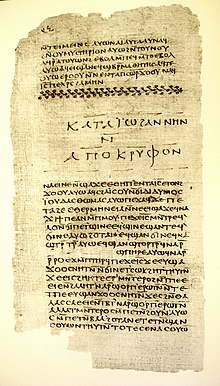
Does the Gospel of Thomas contain heretical statements?

Nag Hammadi Codex II, folio 32, the beginning of the Gospel of Thomas

Courtesy Wikipedia

By Spencer D Gear

Is the Gospel of Thomas (GThom) heretical and does it include Gnostic-type teachings?[1] Could there be anything that is heretical in this document found with Gnostic documents near Nag Hammadi[2], upper Egypt, in December 1945?

There are scholars of the Jesus Seminar who use the Gospel of Thomas as authoritative as the 4 canonical Gospels. John Dominic Crossan affirms Patterson’s view that GThom contains “rudimentary Gnosticism” and the extent of this Gnosticism “is not yet fully charted” as it “is not a full blown gnostic gospel”. Crossan’s view is that it is “a borderline text that could have been pulled either toward or away from gnosticism” (Crossan 1998:271).

Let’s check out some statements from a translation of the Gospel of Thomas that should raise issues of conflict with NT Gospels:

GThom 1-7 states:

These are the secret sayings that the living Jesus spoke and Didymos Judas Thomas recorded.

1 And he said, “Whoever discovers the interpretation of these sayings will not taste death.”

2 Jesus said, “Those who seek should not stop seeking until they find. When they find, they will be disturbed. When they are disturbed, they will marvel, and will reign over all. [And after they have reigned they will rest.]”

3 Jesus said, “If your leaders say to you, ‘Look, the (Father’s) kingdom is in the sky,’ then the birds of the sky will precede you. If they say to you, ‘It is in the sea,’ then the fish will precede you. Rather, the kingdom is within you and it is outside you.</FATHER’S>

When you know yourselves, then you will be known, and you will understand that you are children of the living Father. But if you do not know yourselves, then you live in poverty, and you are the poverty.”

4 Jesus said, “The person old in days won’t hesitate to ask a little child seven days old about the place of life, and that person will live.

For many of the first will be last, and will become a single one.”

5 Jesus said, “Know what is in front of your face, and what is hidden from you will be disclosed to you.

For there is nothing hidden that will not be revealed. [And there is nothing buried that will not be raised.”]

6 His disciples asked him and said to him, “Do you want us to fast? How should we pray? Should we give to charity? What diet should we observe?”

Jesus said, “Don’t lie, and don’t do what you hate, because all things are disclosed before heaven. After all, there is nothing hidden that will not be revealed, and there is nothing covered up that will remain undisclosed.”

7 Jesus said, “Lucky is the lion that the human will eat, so that the lion becomes human. And foul is the human that the lion will eat, and the lion still will become human” (emphasis added).

GThom 13 states,

Jesus said to his disciples, “Compare me to something and tell me what I am like.” Simon Peter said to him, “You are like a just messenger.” Matthew said to him, “You are like a wise philosopher.” Thomas said to him, “Teacher, my mouth is utterly unable to say what you are like.” Jesus said, “I am not your teacher. Because you have drunk, you have become intoxicated from the bubbling spring that I have tended.” And he took him, and withdrew, and spoke three sayings to him. When Thomas came back to his friends they asked him, “What did Jesus say to you?” Thomas said to them, “If I tell you one of the sayings he spoke to me, you will pick up rocks and stone me, and fire will come from the rocks and devour you” (emphasis added)

GThom 22 states:

Jesus saw some babies nursing. He said to his disciples, “These nursing babies are like those who enter the kingdom.”
They said to him, “Then shall we enter the kingdom as babies?”
Jesus said to them, “When you make the two into one, and when you make the inner like the outer and the outer like the inner, and the upper like the lower, and when you make male and female into a single one, so that the male will not be male nor the female be female, when you make eyes in place of an eye, a hand in place of a hand, a foot in place of a foot, an image in place of an image, then you will enter [the kingdom]” (emphasis added)

GThom 114:

Simon Peter said to them, “Make Mary leave us, for females don’t deserve life.” Jesus said, “Look, I will guide her to make her male, so that she too may become a living spirit resembling you males. For every female who makes herself male will enter the kingdom of Heaven” (emphasis added).

The Jesus of the Gospel of Thomas is radically different from the Jesus revealed in the NT Gospels. GThom has a private, esoteric emphasis throughout and presupposes the teaching of Jesus in the NT but claims to record secret, hidden words that are radically different from the NT Gospels.

Recall what Jesus said about believers (his followers) having faith (e.g. John 3:16), but GThom 1 says that Jesus’ disciples should find “the interpretation of these sayings” and for these people, they will not taste death.

This is not biblical Christianity.

There are enough statements in GThom to indicate clearly that the source of these words is not Jesus. Like the quote I gave you from GThom 114, part of which stated,

Jesus said, “Look, I will guide her to make her male, so that she too may become a living spirit resembling you males. For every female who makes herself male will enter the kingdom of Heaven” (emphasis added).

This is so contradictory to what Jesus stated in the four canonical gospels. Do you think that Jesus would say that a female must make herself a male to enter God’s kingdom?

This is heretical Gnostic teaching or Gnostic-like teaching. So, why are you wanting to accept GThom as a source of Jesus’ teaching? GThom has many places of foreign, heretical teaching when compared with the NT Gospels?

The Gnostic Society Library states:

The Gospel of Thomas, one of the Gnostic texts found preserved in the Nag Hammadi Library, gives these words of the living Jesus:

Jesus said, `I am not your master. Because you have drunk, you have become drunk from the bubbling stream which I have measured out…. 12
He who will drink from my mouth will become as I am: I myself shall become he, and the things that are hidden will be revealed to him.’ 13

Of GThom 13, the Gnostic Society Library makes this comment, ‘He who will drink from my mouth will become as I am: What a remarkably heretical image!’[3]

That’s about as good a summary as we will get of the heretical teaching in The Gospel of Thomas.

These are some quotes in the Gnostic Bible from the Gospel of Thomas? These are some examples:

  • The Gospel of Thomas (12) says that heaven and earth came into being for the sake of James (Yaakov). The Gnostic Bible, p. 47;
  • The Gospel of Thomas (31) says that a doctor does not heal those who know the doctor. Apparently those who know the Gnostic Jesus are not healed by him! The Gnostic Bible, p. 53;
  • In The Gospel of Thomas (57) Jesus mentions they have to bear the cross like he did. The Gnostic Bible, p. 57;
  • In the Gospel of Thomas (100) Jesus said to give unto Caesar what is Caesar’s, give to God what is God’s, and “give me mine.” The Gnostic Bible, p. 67.

What about these sayings from GThom?

In GThom 108, Jesus says, “Whoever drinks from my mouth will become as I am; I myself shall become that person, and the hidden things will be revealed to him.”

In GThom 70, Jesus says, “If you bring forth what is within you, what you have will save you. If you do not bring it forth, what you do not have within you will kill you.”

So the Gnostic Society and The Gnostic Bible both consider that the Gospel of Thomas has Gnostic content. This GThom radical content is far, far from biblical Christianity as revealed in the NT Gospels. It is regarded as containing heresy by the Gnostic Society Library.

Evangelical Christians should also regard The Gospel of Thomas as containing heresy.

Nicholas Perrin (2007) is a researcher on the nature of the Gospel of Thomas. He states that it ‘issued from a mid-to-late second-century Syriac milieu’ (2007:viii). Perrin’s assessment is that

the Gospel of Thomas invites us to imagine a Jesus who says, ‘I am not your saviour, but the one who can put you in touch with your true self. Free yourself from your gender, your body, and any concerns you might have for the outside world. Work for it and self-realization, salvation will be yours – in this life’. Imagine such a Jesus? One need hardly work very hard. This is precisely the Jesus we know too well, the existential Jesus that so many western evangelical and liberal churches already preach (Perrin 2007:139).

What is heresy?

In New Testament Greek, the term from which we get “heresy” is hairesis. Arndt & Gingrich’s Greek Lexicon states that hairesis means ‘sect, party, school’. It was used of the Sadduccees in Acts 5:17; of the Pharisees in Acts 15:5. Of the Christians in Acts 24:5. It is used of a heretical sect or those with destructive opinions in 2 Peter 2:1 (“destructive heresies” ESV).

The article on hairesis in Kittel’s Theological Dictionary of the New Testament (Vol. 1, p. 182ff) states that its “usage in Acts corresponds exactly to that of Josephus and the earlier Rabbis” but the development of the Christian sense of heresy does not parallel this Rabbinic use. When the ekklesia came into being, there was no place for hairesis. They were opposed to each other. This author states that “the greater seriousness consists in the fact that hairesis affect the foundation of the church in doctrine (2 Pt. 2:1), and that they do so in such a fundamental way as to give rise to a new society alongside the ekklesia” (Kittel Vol I:183).

From the NT, we see the term, heresy, being used to mean what Paul called strange doctrines, different doctrine, doctrines of demons, every wind of doctrine (See 1 Timothy 1:3; 4:1;6:3; Ephesians 4:14), as contrasted with sound doctrine, our doctrine, the doctrine conforming to godliness, the doctrine of God (See 1 Timothy 4:6; 6:1,3;2 Timothy 4:3; Titus 1:9; 2:1, 10).

I recommend Nicholas Perrin (2007) and Craig Evans (2007:52-77) for excellent assessments of the Gospel of Thomas and how it contradicts the NT Gospels.

References:

Crossan, J D 1998. The birth of Christianity: Discovering what happened in the years immediately after the execution of Jesus. New York, NY: HarperSanFrancisco. Also available (online) HERE (Accessed 13 September 2011).

Evans, C A 2007. Fabricating Jesus: How modern scholars distort the gospels. Nottingham, England: Inter-Varsity Press.

Kittel, G (ed) 1964. Theological dictionary of the New Testament, trans. & ed. by G. W. Bromiley (vol 1). Grand Rapids, Michigan: Wm. B. Eerdmans Publishing Company.

Perrin, N 2007. Thomas, the other gospel. London: SPCK.

Notes:


[1] A person stated this on Christian Forums, the thread, ‘The Gospel of Thomas’: ‘What is so heretical about the gospel of Thomas, found in the Nag Hamadi (sic) scripture. Much of what is found in the text can be found in the bible. The gospel of Thomas should be viewed as a source of Truth.
‘Afterall, if much of it is the words of Jesus then why can’t the rest of it be the words of Jesus? It places a new perspective on the word of Christ if what can be found within it can be believed to be true’.

[2] See a discussion of the Nag Hammadi Library on Wikipedia at: http://en.wikipedia.org/wiki/Nag_Hammadi_library (Accessed 13 September 2011).

[3] A person on Christian Forums, ‘The Gospel of Thomas’ thread, stated, ‘I wasn’t suggesting that the gospel of Thomas should be added to the canon. I was merely suggesting that it should not be viewed as such heresy when it clearly has value. When it clearly contains the spoken words of Jesus, it may be that the whole thing is in fact the gospel of his disciple, the one they called Thomas. It’s not so far out there and the words spoken within the text are very Christ-like’. This person does not want to view the Gospel of Thomas as heretical. Hopefully, the following quotes from GThom will help to show that there are heretical teachings in GThom when compared with the NT Scriptures.


Copyright (c) 2012 Spencer D. Gear. This document last updated at Date: 7 October 2015.

designBlue-smadesignBlue-smadesignBlue-smadesignBlue-smadesignBlue-smadesignBlue-smadesignBlue-smadesignBlue-smadesignBlue-smadesignBlue-smadesignBlue-smadesignBlue-smadesignBlue-sma

Incorrect translation of New International Version 2011 for John 11:25


(Courtesy Wikipedia)

By Spencer D Gear

In the church I attended on Sunday, 11 September 2011 (North Pine Presbyterian, Petrie, Brisbane, Qld.), John 11:25 was read publicly from the NIV 2011. This verse in the NIV 2011 edition has incorrect grammar when compared with the Greek (I read and have taught NT Greek) and in English. This is how the two versions of the NIV for this verse read.

John 11:25, NIV 2011: ‘Jesus said to her, “I am the resurrection and the life. The one who believes in me will live, even though they die”‘;

John 11:25, NIV 1974, 1984: ‘Jesus said to her, “I am the resurrection and the life. He who believes in me will live, even though he dies”‘;

John 11:25 in the English Standard Version reads: ‘Jesus said to her, “I am the resurrection and the life. Whoever believes in me, though he die, yet shall he live”‘.

The NIV 2011 rendering is incorrect grammar while the 1974 version is correct grammar. What is wrong with the grammar of “the one who believes in me will live even though they die” in NIV 2011?

(1) In English the antecedent to which the plural “they” refers is the singular, “the one”. Therefore, since “the one” is singular, “they” must be replaced with the singular. In English, these dynamic equivalent translations are possible: (a) “the one who believes in me will live even though he/she should die”, or (b) “the one who believes in me will live even though that one/person should die”.

(2) In Greek, the verb which is translated in NIV 2011 as “they die”, is an incorrect translation as the verb is apothanw, which is 3rd person singular, aorist 2, active, subjunctive of apothaneskw. Therefore, the verb needs to be translated with the singular, “that one should die”. If you want to translate with dynamic equivalence, the meaning could be, “those who believe in me will live even though they die”.

However, as it stands, the grammar in both Greek and English of the second half of John 11:25, NIV 2011, is incorrect with the words, “the one who believes in me will live, even though they die”. I urged the International Bible Society[1] (publishers of the NIV 2011) to change this for the sake of English speakers and to be consistent with the Greek language.

At the street level when I was living in theUSA, Canada and here in my home country of Australia, many people confuse the singular antecedent with a plural pronoun which follows. However it did surprise me that the NIV 2011 inserted this grammatical error. I wonder how many other times this happens in this new revision.

I consider the NIV to be an excellent translation, as long as we understand that it is a meaning-for-meaning translation (i.e. dynamic equivalence).

This is what is stated about the NIV translators on BibleGateway, “The New International Version (NIV) is a completely original translation of the Bible developed by more than one hundred scholars working from the best available Hebrew, Aramaic, and Greek texts”.

I look forward to hearing from the International Bible Society that this grammatical error is corrected in future printings of the NIV.

Here’s a list of the NIV translators. I know of many of these and they are fine Bible scholars in the evangelical Protestant tradition.

This Biblica (home of the NIV) article contains a section on “What Was Decided About Inclusive Language” for NIV 2011. In short, it means that inclusive language was used for “mankind” but definitely not for God.

Appendix A

This is the email response I received in Australia (received 13 September 2011) from the International Bible Society (Biblica) in response to my inquiry about the above information about John 11:25:

Thank you for your feedback regarding the NIV translation. We appreciate your opinion and welcome your prayers for us and the Committee on Bible Translation. We always seek to faithfully translate the meaning of the original biblical texts.

Though your grammatical explanation is correct as far as it goes, languages are inconsistent. As you know, the Greek word teknon (often “child”) is neuter, even though people of all ages have gender. What’s more, Mathew 9:2 Jesus uses it to address a seemingly a grown man. Furthermore, an inanimate plural subject in Greek often takes a singular verb (e.g., Mt. 10:2, which reads literally “the names is [sic] these”). The CBT’s response to the use of “they” as a singular referent in English is explained, along with other matters, on the following web page: http://www.niv-cbt.org/niv-2011-overview/ An excerpt is here added for easy reference:

The gender-neutral pronoun ?they” (?them” / ?their”) is by far the most common way that English-language speakers and writers today refer back to singular antecedents such as ?whoever,” ?anyone,” ?somebody,” ?a person,” ?no one,” and the like. Even in Evangelical sermons and books, where the generic ?he,” ?him” and ?his” are preserved more frequently than in other forms of communication, instances of what grammarians are increasingly calling the ?singular they” (?them” or ?their”) appear three times more frequently than generic masculine forms. In other words, most English speakers today express themselves in sentences like these: ?No one who rooted for the Chicago Cubs to be in a World Series in the last sixty years got their wish. They were disappointed time and time again,” or ?The person who eats too many hot dogs in too short a period of time is likely to become sick to their stomach.” It is interesting to observe that this development is a throwback to a usage of English that existed prior to the solidification of the generic ?he” as the only ?proper” usage during the nineteenth century in Victorian England. Even the KJV occasionally used expressions like ? . . . let each esteem other better than themselves” (Philippians 2:3). For that matter, so did the Greek New Testament! In James 2:15-16, the Greek for ?a brother or sister” (adelphos ? adelph?) is followed by plural verbs and predicate adjectives and referred back to with autois (?them”).

May the Lord bless you as you follow his Word.

Biblica, 1820 Jet Stream Dr., Colorado Springs, CO 80921, www.biblica.com

I do not find this a satisfactory explanation as it violates a fundamental of English grammar. Because other translations such as the KJV in Phil. 2:3 use this incorrect English grammar, does not justify the NIV 2011 translation of John 11:25. Because the use of they/their ‘is by far the most common way that English-language speakers and writers today refer back to singular antecedents’ is not an adequate explanation for violation of English grammar rules.

I’m not the only one with discomfort over an NIV 2011 translation. The Southern Baptist Convention in the USA resolved on June 14-15, 2011, as reported by Baptist Press:

The resolution states:

WHEREAS, Many Southern Baptist pastors and laypeople have trusted and used the 1984 New International Version (NIV) translation to the great benefit of the Kingdom; and

WHEREAS, Biblica and Zondervan Publishing House are publishing an updated version of the New International Version (NIV) which incorporates gender neutral methods of translation; and

WHEREAS, Southern Baptists repeatedly have affirmed our commitment to the full inspiration and authority of Scripture (2 Timothy 3:15-16) and, in 1997, urged every Bible publisher and translation group to resist “gender-neutral” translation of Scripture; and

WHEREAS, This translation alters the meaning of hundreds of verses, most significantly by erasing gender-specific details which appear in the original language; and

WHEREAS, Although it is possible for Bible scholars to disagree about translation methods or which English words best translate the original languages, the 2011 NIV has gone beyond acceptable translation standards; and

WHEREAS, Seventy-five percent of the inaccurate gender language found in the TNIV is retained in the 2011 NIV; and

WHEREAS, The Southern Baptist Convention has passed a similar resolution concerning the TNIV in 2002; now, therefore, be it

RESOLVED, That the messengers of the Southern Baptist Convention meeting in Phoenix, Arizona, June 14-15, 2011 express profound disappointment with Biblica and Zondervan Publishing House for this inaccurate translation of God’s inspired Scripture; and be it further

RESOLVED, That we encourage pastors to make their congregations aware of the translation errors found in the 2011 NIV; and be it further

RESOLVED, That we respectfully request that LifeWay not make this inaccurate translation available for sale in their bookstores; and be it finally

RESOLVED, That we cannot commend the 2011 NIV to Southern Baptists or the larger Christian community.

References:

[1] I sent this information to the International Bible Society, which translated the NIV, on Monday, 12 September 2011, at: http://www.biblica.com/contact-us/.


Copyright (c) 2012 Spencer D. Gear. This document last updated at Date: 9 October 2015.

designBlue-smadesignBlue-smadesignBlue-smadesignBlue-smadesignBlue-smadesignBlue-smadesignBlue-smadesignBlue-smadesignBlue-smadesignBlue-smadesignBlue-smadesignBlue-smadesignBlue-sma

Did Jesus give up his omniscience?

We see this debated on the Internet in places like the Christian Forums thread, “Was Jesus omniscient?” On writer in this thread stated, “I believe that considering the many things in the Bible that we can see that Jesus didn’t know. I believe that Jesus was not omniscient”.

It should not be surprising on a sceptical website to get this kind of comment,

“How could Jesus know that Judas would betray him, but yet not know when Jesus’ own return would be? Was Jesus omniscient, or not? The fact that the two verses cited above contradict each other is evidence that the New Testament is just a compilation of often conflicting traditional beliefs about Jesus and his attributes. It is not surprising, then, that some passages indicate that Jesus can see the future, while other passages indicate that he cannot see the future”.

On other forums, this question is asked and it seems to be confusing to some Christians. See, “Christians, was Jesus omniscient?” (Yahoo! Answers) and “Was Jesus omniscient?” (Reasonable Faith forum).

I have found evangelical theologian, Wayne Grudem’s, explanation of this in relation to a refutation of the Kenosis Theory of Philippians 2:7, to be the most satisfactory explanation of Jesus’ not exercising his all-knowledge (omniscience) on some occasions. Grudem’s explanation is in Systematic Theology.[1] His exposition is available online and it asks the question:

Did Jesus Give Up Some of His Divine Attributes While on Earth? (The Kenosis Theory).

Paul writes to the Philippians,

Have this mind among yourselves, which is yours in Christ Jesus, who, though he was in the form of God, did not count equality with God a thing to be grasped, but emptied himself taking the form of a servant, being born in the likeness of men. (Phil. 2:5–7)

Beginning with this text, several theologians in Germany (from about 1860–1880) and in England (from about 1890–1910) advocated a view of the incarnation that had not been advocated before in the history of the church. This new view was called the “kenosis theory,” and the overall position it represented was called “kenotic theology.” The kenwsis theory holds that Christ gave up some of his divine attributes while he was on earth as a man. (The word ??????? is taken from the Greek verb ?????, G3033, which generally means “to empty,” and is translated “emptied himself ” in Phil. 2:7.) According to the theory Christ “emptied himself “ of some of his divine attributes, such as omniscience, omnipresence, and omnipotence, while he was on earth as a man. This was viewed as a voluntary self-limitation on Christ’s part, which he carried out in order to fulfill his work of redemption.?27?

But does Philippians 2:7 teach that Christ emptied himself of some of his divine attributes, and does the rest of the New Testament confirm this? The evidence of Scripture points to a negative answer to both questions. We must first realize that no recognized teacher in the first 1,800 years of church history, including those who were native speakers of Greek, thought that “emptied himself “ in Philippians 2:7 meant that the Son of God gave up some of his divine attributes.

Second, we must recognize that the text does not say that Christ “emptied himself of some powers” or “emptied himself of divine attributes” or anything like that.

Third, the text does describe what Jesus did in this “emptying”: he did not do it by giving up any of his attributes but rather by “taking the form of a servant,” that is, by coming to live as a man, and “being found in human form he humbled himself and became obedient unto death, even death on a cross” (Phil. 2:8). Thus, the context itself interprets this “emptying” as equivalent to “humbling himself “ and taking on a lowly status and position. Thus, the NIV, instead of translating the phrase, “He emptied himself,” translates it, “but made himself nothing” (Phil. 2:7 NIV). The emptying includes change of role and status, not essential attributes or nature.

A fourth reason for this interpretation is seen in Paul’s purpose in this context. His purpose has been to persuade the Philippians that they should “do nothing from selfishness or conceit, but in humility count others better than yourselves” (Phil. 2:3), and he continues by telling them, “Let each of you look not only to his own interests, but also to the interests of others” (Phil. 2:4). To persuade them to be humble and to put the interests of others first, he then holds up the example of Christ: “Have this mind among yourselves, which is yours in Christ Jesus, who, though he was in the form of God, did not count equality with God a thing to be grasped, but emptied himself, taking the form of a servant…” (Phil. 2:5–7).

Now in holding up Christ as an example, he wants the Philippians to imitate Christ. But certainly he is not asking the Philippian Christians to “give up” or “lay aside” any of their essential attributes or abilities! He is not asking them to “give up” their intelligence or strength or skill and become a diminished version of what they were. Rather, he is asking them to put the interests of others first: “Let each of you look not only to his own interests, but also to the interests of others” (Phil. 2:4). And because that is his goal, it fits the context to understand that he is using Christ as the supreme example of one who did just that: he put the interests of others first and was willing to give up some of the privilege and status that was his as God.

Therefore, the best understanding of this passage is that it talks about Jesus giving up the status and privilege that was his in heaven: he “did not count equality with God a thing to be grasped” (or “clung to for his own advantage”), but “emptied himself “ or “humbled himself “ for our sake, and came to live as a man. Jesus speaks elsewhere of the “glory” he had with the Father “before the world was made” (John 17:5), a glory that he had given up and was going to receive again when he returned to heaven. And Paul could speak of Christ who, “though he was rich, yet for your sake he became poor” (2 Cor. 8:9), once again speaking of the privilege and honor that he deserved but temporarily gave up for us.

The fifth and final reason why the “kenosis” view of Philippians 2:7 must be rejected is the larger context of the teaching of the New Testament and the doctrinal teaching of the entire Bible. If it were true that such a momentous event as this happened, that the eternal Son of God ceased for a time to have all the attributes of God—ceased, for a time, to be omniscient, omnipotent, and omnipresent, for example—then we would expect that such an incredible event would be taught clearly and repeatedly in the New Testament, not found in the very doubtful interpretation of one word in one epistle. But we find the opposite of that: we do not find it stated anywhere else that the Son of God ceased to have some of the attributes of God that he had possessed from eternity. In fact, if the kenosis theory were true (and this is a foundational objection against it), then we could no longer affirm Jesus was fully God while he was here on earth.?28? The kenosis theory ultimately denies the full deity of Jesus Christ and makes him something less than fully God. S.M. Smith admits, “All forms of classical orthodoxy either explicitly reject or reject in principle kenotic theology.”?29?

It is important to realize that the major force persuading people to accept kenotic theory was not that they had discovered a better understanding of Philippians 2:7 or any other passage of the New Testament, but rather the increasing discomfort people were feeling with the formulations of the doctrine of Christ in historic, classical orthodoxy. It just seemed too incredible for modern rational and “scientific” people to believe that Jesus Christ could be truly human and fully, absolutely God at the same time.?30? The kenosis theory began to sound more and more like an acceptable way to say that (in some sense) Jesus was God, but a kind of God who had for a time given up some of his Godlike qualities, those that were most difficult for people to accept in the modern world.

Conclusion: Christ Is Fully Divine. The New Testament, in hundreds of explicit verses that call Jesus “God” and “Lord” and use a number of other titles of deity to refer to him, and in many passages that attribute actions or words to him that could only be true of God himself, affirms again and again the full, absolute deity of Jesus Christ. “In him all the fulness of God was pleased to dwell” (Col. 1:19), and “in him the whole fulness of deity dwells bodily” (Col. 2:9). In an earlier section we argued that Jesus is truly and fully man. Now we conclude that he is truly and fully God as well. His name is rightly called “Emmanuel,” that is, “God with us” (Matt. 1:23).

Here is another view: The Theological Dictionary of the New Testament (eds. Gerhard Kittel & Gerhard Friedrich, vol. 5, Eerdmans, p. 895)  states of pas (all, everything) in the NT as it applies to Jesus, the Logos:

The incarnate Logos is invested with cosmic authority even here on earth, Jn. 3:35; 13:3: the Father has put all things in His hands; 17:2: He has given Him power over all flesh. The debated Mt. 11:27 par. Lk. 10:22 is probably to be understood along these lines: “All things are delivered unto me of my Father, and no man knoweth the Son …” Though the continuation speaks of knowledge, the “all things” obviously include more than knowledge. Hence the verse is to be construed, not along the lines of Jn. 21:17 or 1 C. 2:10, but along the lines of Jn. 3:35; 13:3; 17:2: “all power,” which includes knowledge as well. Elsewhere, however, it is said of the Redeemer during His earthly life that He has laid aside His power and appeared in lowliness and humility, Mt. 11:29; 12:18–21; 2 C. 8:9; Phil. 2:5–8, ? ????? III, 661, 13–28, cf. the temptation of Jesus, Mt. 4:8 f. par. Lk. 4:5 f. Thus, when the full power of Jesus is occasionally mentioned during the time of His humiliation, it is merely a proleptic fact. (Bo Reicke, TDNT, ???)

“[I am God] declaring the end from the beginning and from ancient times things not yet done, saying ‘My counsel shall stand, and I will accomplish all my purpose” (Isa. 46:10 ESV).

For a detailed examination that affirms the omniscience of God, see Norman Geisler 2003. Systematic Theology: God, Creation (vol. 2). Minneapolis, Minnesota, BethanyHouse, pp. 180-212. Geisler defines God’s omniscience: “God knows everything-past, present, and future; He knows the actual and the possible; only the impossible (the contradictory) is outside the knowledge of God” (p. 180). Geisler goes on to state that “the contemporary debate, however, has changed the theological landscape on this doctrine. God’s unlimited knowledge is now allegedly limited; His all-knowing is no longer the knowing of all. If we adhere to this, we are left with the oxymoronic view of limited omniscience. The attack on traditional omniscience has come from both outside and inside evangelicalism” (p. 180).

Geisler states, “Granted that God has knowledge, His omniscience can be derived from a number of His other attributes. These include His infinity, His causality, His necessity, His knowledge of reality, His eternality, and His absolute perfection” (p. 181).

Notes:


[1] 1994. Grand Rapids, Michigan: Zondervan Publishing House, pp. 549-552).
Flower21Flower21Flower21Flower21Flower21Flower21Flower21
Whytehouse designs

Eternal torment for unbelievers when they die

Fire by dominiquechappard - burning, clip art, clipart, fire, flame,

(image courtesy openclipart)

By Spencer D Gear

The doctrine of annihilation or conditional immortality is gaining an increasing number of followers in evangelical circles. Some of the Christian forums on the www include people who are promoting these doctrines.[1]

Some are saying that “the wages of sin is death” (Rom. 6:23), so that is what will happen at the end of life for unbelievers – death. There will be permanent death through annihilation of conditional immortality, with no torture in hell.[2]

God told Adam in Gen. 2:17, “In the day that you eat of it you shall surely die” (ESV). But he did not physically die on that very day, but physical death came 930 years later. H. C. Leupold in his commentary on Genesis explains that “in the day” is taken literally, but not in the sense, “at the time”. The Hebrew meaning of “shall surely die” as an absolute infinitive has the thought that “the instantaneous occurrence of the penalty threatened” did happen.

Leupold asks,

“Why was this penalty not carried out as threatened?” The answer is that it was carried out “if the Biblical concept of dying is kept in mind, as it unfolds itself ever more clearly from age to age”. Since dying means separation from God, “that separation occurred the very moment when man by his disobedience broke the bond of love. If physical death ultimately closes the experience, that is not the most serious aspect of the whole affair. The more serious is the inner spiritual separation”. As Oehler accurately stated it, “For a fact, after the commission of sin man at once stepped upon the road of death”. Leupold observes “how definitely the account teaches that the first man was gifted with freedom of the will”.[3]

What do we say to those who say that “eternal punishment” (Matt. 25:46) does not mean eternal torment? In the NT, we are told what that “punishment” means. In Luke 16:23, the rich man was in Hades after death and was “being in torment”. This is clearly in focus for the unbelievers in Rev. 14:10, when John’s vision of the fate of the ungodly is that they “will be tormented with fire and sulfur in the presence of the holy angels and in the presence of the Lamb” (ESV). And please note that this torment is by the Lamb, the Son of God. God will be the one who is tormenting the ungodly.

What about the language of “destruction” in the NT?[4]

If we took some isolated Scriptures, it may be possible to take these passages to mean annihilation. I’m thinking of the word, “destroy”, in Matt. 10:28, “And do not fear those who kill the body but cannot kill the soul. Rather fear him who can destroy both soul and body in hell [Greek: Gehenna]” (ESV). Even with passages such as Matt. 7:13-14 where the broad road leads to destruction and John 3:16, “Whoever believes in him shall not perish” could be pressed to try to get the meaning of annihilation. Even if we took the following passages alone without consideration of other passages, there is a possibility that extermination/extinction of the wicked could be an interpretation: John 10:28; 17:12; Romans 2:12; 9:22; Philippians 1:28; 3:19; 1 Thessalonians 5:3; Hebrews 10:39; James 4:12 and 2 Peter 3:7, 9. However, there’s a big barrier to this kind of interpretation….

There are verses that are impossible to square with destruction meaning annihilation. Second Thessalonians 1:9 is one of those barriers. It reads, “They will suffer the punishment of eternal destruction, away from the presence of the Lord and from the glory of his might” (ESV). Who are “they”? They are “those who do not know God” and “do not obey the gospel of our Lord Jesus” (2 Thess. 1:8). This is referring to unbelievers. The words from 2 Thess. 1:9, “eternal destruction”, could hardly mean “eternal  annihilation”. This verse creates the added problem against annihilation that the ungodly will be “away from the presence of the Lord”, which indicates that their existence is continuing but they will be shut out from being in God’s presence. If one were to speak of being “destroyed” from the presence of the Lord, it would imply non-existence. Scot McKnight put it this way:

“Paul has in mind an irreversible verdict of eternal nonfellowship with God. A person exists but remains excluded from God’s good presence”.[5]

In Revelation 17:8, 11, “destruction” is prophesied of “the beast”, but in Revelation 19 the Beast and False Prophet “were thrown alive into the lake of fire that burns with sulfur” (19:20). We know that they are still alive when this is happening because they are there 1,000 years later (Rev. 20:7,10). It cannot mean what Fudge says it means, “The lake of fire stands for utter, absolute, irreversible annihilation”.[6]

Other emphases of the condition of the damned after death

Even if one were to show that certain passages teach annihilation, we would need to show that other passages that speak of hell (Sheol, Hades & Gehenna) can be interpreted consistently with the extinction of the wicked. This cannot be done. As Robert Peterson points out,

The Bible uses five main pictures to speak of hell: darkness and separation, fire, “weeping and gnashing of teeth,” punishment, and death and destruction. Only the last fits with annihilationism, and not every passage in that category fits.[7]

Jesus’ language is of those who are “thrown into eternal fire” (Matt 18:8). Paul’s was of being “punished with everlasting destruction” (2 Thess. 1:9). Jude warned of “the punishment of eternal fire” (Jude 7) and of those “for whom the gloom of utter darkness has been reserved forever” (Jude 13). Of the sinful, condemned humanity, John’s vision was that “the smoke from her goes up forever and ever” (Rev. 19:3).
As far back as 1744, Matthew Horbery wrote, “It is hard to say how any doctrine can be taught so plainly than the eternity of future punishment…. how could he have done it in plainer words or in a more emphatical manner”.[8]

In rejecting Gehenna as instantaneous annihilation and affirming that it means everlasting torment, commentator William Hendriksen stated,

The passages in which the doctrine of everlasting punishment for both body and soul is taught are so numerous that one actually stands aghast that in spite of all this there are people today who affirm that they accept Scripture and who, nevertheless, reject the idea of never-ending torment.[9]

I join with Hendriksen in my being aghast (my language would be flabbergasted) at Christians who refuse to confirm never ending torment for the ungodly in Gehenna.

Second Peter 2:9 indicates the conscious suffering of the ungodly in the intermediate state: “… the Lord knows how to rescue godly men from trials and to hold the unrighteous for the day of judgment, while continuing their punishment” (NIV 1984). R. C. H. Lenski translates the Greek tenses accurately in his translation, “The Lord knows how to rescue godly ones out of temptation but to keep unrighteous ones for judgment day while being punished“.[10] At death, the unrighteous are being kept where? Elsewhere, the Scriptures indicate that they are in Hades in the intermediate state (e.g. Matt. 11:23; 16:18ff; Luke 10:15; 1 Pet. 3:19; Rev. 20:13ff) . What is happening while they are in that state? Note two Greek words, terein (to keep, present tense, active voice, infinitive). The meaning is “to continue keeping” (present tense indicates continuous action). The second word to note is, kalozomenous (continuing punishment), a present passive participle, indicating continuous action in the present time. Since it is the passive voice, this continuing punishment is being received by these people. Robert Morey explains 2 Peter 2:9 this way:

First, Peter says that the wicked are “kept” unto the day of judgment. This word is the present, active, infinitive form, which means that the wicked are being held captive continuously. If the wicked merely pass into nonexistence at death, there would be nothing left to be “kept” unto the day of judgment. Obviously, Peter is grammatically picturing the wicked as being guarded like prisoners in a jail until the day of final judgment.

Second, Peter says that the wicked are “being tormented.” This word is in the present, passive, participle form and means that the wicked are continuously being tormented as an on-going activity.

If Peter wanted to teach that the wicked receive their full punishment at death by passing into nonexistence, then he would have used the aorist tense. Instead, he uses those Greek tenses which were the only ones available to him in the Greek language to express conscious, continuous torment. The grammar of the text irrefutably establishes that the wicked are in torment while they await their final day of judgment.

When the day of judgment arrives, Hades will be emptied of its inhabitants, and the wicked will stand before God for their final sentence (Rev. 20:13-15). Thus, we conclude that Hades is the temporary intermediate state between death and the resurrection where the wicked are in conscious torment. Hades will be emptied at the resurrection, and then the wicked will be cast into “hell (Gehenna).[11]

I find it to be irrational, based on 2 Peter 2:9 and other NT verses, to want to state that “destruction of the wicked” means instantaneous annihilation, extinction or conditional immortality as there are Scriptures that affirm the torment in the after-life of unbelievers. Second Thessalonians 1:9 makes it clear, speaking of ‘everlasting destruction’, which cannot mean ‘everlasting annihilation’.

It is impossible to make destroy = annihilate in Romans 14:15: “For if your brother is grieved by what you eat, you are no longer walking in love. By what you eat, do not destroy the one for whom Christ died” (ESV). To imply that one could annihilate a brother by eating meat is stretching my logic. To make the biblical word, “destruction”, for eternal punishment to be the equivalent of “annihilation” is an unbiblical invention. Even in the English language, if I were to run over my child’s toy with my motor vehicle, I would “destroy” the toy and it would “perish”, but it would not be annihilated.

What does Peter mean by “perish” in 2 Pet 3:9, “The Lord is not slow to fulfil his promise as some count slowness, but is patient toward you, not wishing any should perish” (ESV)? “Perish” is the aorist tense infinitive, indicating point action. The Lord does not want people to perish by any instant action.

Based on the above exposition, the eternal torment of unbelievers in Gehenna is the truth of God’s word. “Perish” and “destruction” do not mean annihilation as the Scriptures above demonstrate.

I am aghast, along with William Hendriksen, that Christians refuse to see what the Scriptures so clearly teach – eternal torment for the ungodly. And that’s what I will continue to do in association with my evangelism. I will warn people of the horrors of experiencing the wrath of God in Gehenna (hell) through eternal torment.

Matt. 25:46 does not speak of eternal annihilation, but eternal punishment – torment forever and ever.

Recommended:

Edward Fudge & Robert A. Peterson 2000. Two Views of Hell: A Biblical and Theological Dialogue. Downers Grove, Illinois: InterVarsity Press.

My article, “Are there degrees of punishment in hell?“.

Robert A. Peterson, “The Hermeneutics of Annihilationism“.

Notes:


[1] As an example, see the Christian Forums’ thread, “If there was no heaven or hell would you… (when my article was last revised on 14 October 2014, this thread was no longer available online). You may find parallel information at, Do you think you deserve eternal torment in hell?

[2] Ibid. One person in this thread stated, “The concept of God torturing anyone for all eternity is not biblical. The bible’s truth has been under fire since the idea of eternally roasting your enemies in hell-fire was dreamed up in the dark ages. Now is the time that we stand up for the bible’s truth and say that God does not torture people”. Later in the thread he acknowledged that his view was that of “conditional immortality” (no longer available online at Christian Forums.com, 14 October 2014).

[3] The above two paragraphs contain information from H. C. Leupold 1942. Exposition of Genesis. London: Evangelical Press, p. 128-129.

[4] Some of this section is based on Robert A. Peterson 1995. Hell on Trial: The Case for Eternal Punishment. Phillipsburg, New Jersey: P&R Publishing.

[5] In ibid., p. 163.

[6] In ibid., p. 164.

[7] Ibid.

[8] Henry Horbery 1744. An Enquiry into the Scripture-Doctrine concerning the Duration of Future Punishment. London: James Fletcher, pp 61-62. Partly available  as a Google book online HERE (Accessed 31 August 2011).

[9] William Hendriksen 1959. The Bible on the Life Hereafter. Grand Rapids, Michigan: Baker Book House, pp. 197-198.

[10] R. C. H. Lenski 1966. Commentary on the New Testament: The Interpretation of the Epistles of St. Peter, St. John, and St. Jude. Peabody, Mass: Hendrickson Publishers, p. 315.

[11] Robert A. Morey 1984. Death and the Afterlife. Minneapolis, Minnesota: Bethany House Publishers, pp. 86-87.


Copyright © 2012 Spencer D. Gear. This document last updated at Date: 1 July 2016.

Flower21Flower21Flower21Flower21Flower21Flower21Flower21


An Arminian view of faith in Christ

(Arminius, public domain)

By Spencer D Gear

It is not unusual to hear Calvinists state that Arminians do not believe that faith is a gift of God.[1] Is this true or false?

Part of #5 of the “Statement of Faith” of the evangelical Arminians states this about the gift of faith and the ability to believe:

In and of themselves and apart from the grace of God human beings can neither think, will, nor do anything good, including believe. But the prevenient grace of God prepares and enables sinners to receive the free gift of salvation offered in Christ and his gospel. Only through the grace of God can sinners believe and so be regenerated by the Holy Spirit unto salvation and spiritual life.

The following is a good summary of grace and faith from an Arminian perspective:

Freed by Grace {to Believe} (Article 4)

  • Because of Total Depravity and Atonement for All … God calls all people everywhere to repent and believe the gospel, and graciously enables those who hear the gospel to respond to it positively in faith.
  • God regenerates those who believe in Christ (faith logically precedes regeneration).
  • God’s saving grace is resistible, which is to say that he dispenses his calling, drawing, and convicting grace (which would bring us to salvation if responded to with faith) in such a way that we may reject it. Those who hear the gospel may either accept it by grace or reject it to their own eternal destruction.
  • Apart from the realm of pleasing the Lord and doing spiritual good, people often have free will, which means that, with respect to an action, they can at least either do the action or refrain from doing it. People often have genuine choices and are therefore correspondingly able to make choices.
  • God has ultimate and absolute free will. His choice to supernaturally free the will of sinners by his grace to believe in Christ is a matter of the exercise of his own free will and sovereignty.

I cannot find any teaching in the Bible that confirms that saving faith is for a select few people. The Bible assumes that “whoever believes” is a statement to indicate that faith is available to all. Anyone who says “yes” to Jesus, repents and receives Him, and so exercises saving faith. This is what is taught in:

  • Luke 13:3;
  • John 3:16, 18; 6:29; 11:40; 12:36;
  • Acts 16:31; 17:30; 20:21;
  • Heb. 11:6, etc.

Note especially the words of Acts 17:30 where God “commands all people everywhere to repent”. Since God commands all to repent, those who choose to respond positively to God’s command when the Gospel is presented, are saved. Those who reject, are damned. Those who respond with faith have faith as a gift of God, graciously enable by God himself. But this offer of God’s gift of salvation is able to be resisted and rejected.

We get this understanding from the Scriptures:

  • Jesus said, “Jerusalem, Jerusalem, you who kill the prophets and stone those sent to you, how often I have longed to gather your children together, as a hen gathers her chicks under her wings, and you were not willing” (Matt. 23:37 NIV). The ESV translates as, “You would not”. The meaning is the same. They could reject Jesus’ offer.
  • Jesus made a similar kind of statement of a person’s ability to reject Him in John 5:39-40: “You study the Scriptures diligently because you think that in them you have eternal life. These are the very Scriptures that testify about me, yet you refuse to come to me to have life (NIV).
  • John 1:12 is crystal clear of a person’s need to receive Christ to become children of God: “Yet to all who did receive him, to those who believed in his name, he gave the right to become children of God” (NIV).
  • John affirms this meaning in 1 John 5:1, “Everyone who believes that Jesus is the Christ is born of God…” (NIV)
  • However, this salvation, is all of God, “For it is by grace you have been saved, through faith—and this [salvation][2] is not from yourselves, it is the gift of God— not by works, so that no one can boast” (Ephesians 2:8-9 NIV).

What is the meaning of Ephesians 2:8?

This verse has been one of the battlegrounds for Arminians and Calvinists. Is faith the gift of God and does regeneration precede faith, or does faith precede regeneration? R. C. Sproul, a Calvinist, maintains that

Regeneration is the theological term used to describe rebirth…. Regeneration is the work of the Holy Spirit upon those who are spiritually dead (see Ephesians 2:1-10)…. Regeneration is not the fruit or result of faith, regeneration precedes faith as the necessary condition for faith…. We do not decide or choose to be regenerated. God chooses to regenerate us before we will ever choose to embrace Him.[3]

So, being born again (regeneration), comes as God acting sovereignly on the unbeliever before he/she can have faith in Christ. That’s the Calvinistic view.

By contrast, the Arminian theologian, John Miley, sees it quite differently:

There are prerequisites which cannot be met without our own free agency. There must be an earnest turning of the soul to God, deep repentance for sin, and a true faith in Christ. Such are the requirements of our own agency. There is no regeneration for us without them. Yet they are not possible in the unaided resources of our own nature. Hence there must be a helping work of the Spirit prior to his work of regeneration.[4]

At the lay level, this is battled out on Christian forums on the Internet.[5] Let’s look at the gender of some of the nouns and the demonstrative pronoun in this verse:

“For by grace you have been saved through faith. And this is not your own doing; it is the gift of God” (Eph. 2:8 ESV).

  • The noun, grace – charis – is feminine gender;
  • The noun, faith – pistis – is feminine gender;
  • The demonstrative pronoun, this/that – touto – is neuter gender.

So it is very clear in Greek that touto, neuter, cannot refer back to the antecedent feminine nouns – charis and pistis. If the demonstrative this/that was meant to refer to grace or faith, there is a perfectly good Greek way of expressing this. The demonstrative would be the feminine, taute.

To what does “this/that” refer if it is not to grace or faith? Verse 8 tells us that “it is the gift of God’, thus referring to salvation by grace through faith.

What did John Calvin state about Ephesians 2:8?

On one side, we must look at God; and, on the other, at man. God declares, that he owes us nothing; so that salvation is not a reward or recompense, but unmixed grace. The next question is, in what way do men receive that salvation which is offered to them by the hand of God? The answer is, by faith; and hence he concludes that nothing connected with it is our own. If, on the part of God, it is grace alone, and if we bring nothing but faith, which strips us of all commendation, it follows that salvation does not come from us.

His meaning is, not that faith in this verse is the gift of God, but that salvation is given to us by God, or, that we obtain it by the gift of God.

One of the greatest NT Greek scholars of the 20th century, Dr. A. T. Robertson, noted this of Eph. 2:8,

“Grace” is God’s part, “faith” is ours. And that (kai touto). Neuter, not feminine taute, and so refers not to pistis (feminine) or to charis (feminine also), but to the act of being saved by grace conditioned on faith on our part.[6]

If Paul wanted “that/this” to refer to grace or faith, there was a regular Greek way of doing it. He would have used the same gender for “this/that” as for “faith” or “grace”. Paul would have written taute and not tauto for the demonstrative in this Scripture. But he did not use this grammar. Instead, by using the neuter, tauto, Paul refers to the whole process of salvation by grace through faith.

Even the Calvinist, F. F. Bruce, stated of Eph. 2:8,

But the fact that the demonstrative pronoun ‘that’ is neuter in Greek (tauto), whereas ‘faith’ is a feminine noun (pistis), combines with other considerations to suggest that it is the whole concept of salvation by grace through faith that is described as the gift of God.[7]

So Ephesians 2:8, based on the Greek grammar does not teach that faith is an irresistible gift straight from God that a person has no say about and cannot reject. This verse says that salvation is of God (and affirmed by Eph. 2:9). But Eph 2:8 does not demonstrate that salvation is a deterministic born again (regeneration) experience that is imposed on a person without his/her consent – which the Calvinists believe.

To use John Miley’s language, “Regeneration is a true sphere of the divine monergism.[8] [But] there is also a sphere of synergism”.[9]

Notes:


[1] For an example of the back-and-forth on this topic, see the thread, “On what basis does God elect?” in Christian Forums.com.

[2] See what follows for an exegetical understanding of why “this” refers to salvation and not to “grace” or “faith”.

[3] R C Sproul 1992. Essential Truths of the Christian Faith. Wheaton, Illinois: Tyndale House Publishers, pp. 171-172.

[4] John Miley 1893/1989. Systematic Theology, vol 2. Peabody, Massachusetts: Hendrickson Publishers, pp. 336-337.

[5] One example is on Christian Forums.com, “What precedes what – faith regeneration” (Accessed 2 September 2011).

[6] A T Robertson 1931. Word Pictures in the New Testament: The Epistles of Paul, Vol IV. Nashville, Tennessee: Boardman Press, p. 525, emphasis in the original.

[7] F F Bruce 1961. The Epistle to the Ephesians. Old Tappan, New Jersey: Fleming H. Revell Company, p. 51.

[8] Monergism is based on the Greek, monos (meaning ‘single’), plus ergon (meaning work’). The Century Dictionary defines monergism ‘in theology as the doctrine that the Holy Spirit is the only efficient agent in regeneration – that the human will possesses no inclination to holiness until regenerated, and therefore cannot cooperate in regeneration (The Century Dictionary 1890, p. 287).

[9] Miley, vol. 2, p. 336. What is synergism? “Arminius proposed what we might call an evangelical synergism. Synergism is any belief in cooperation between the human will and agency on the one hand, and God’s will and agency on the other hand” (Roger E. Olson 2005. ‘Confessions of an Arminian Evangelical’, (Accessed 30 August 2011).


Copyright (c) 2013 Spencer D. Gear. This document last updated at Date: 11 October 2015.
Flower21Flower21Flower21Flower21Flower21Flower21Flower21

“Jacob I loved, Esau I hated". What is the meaning?[1]

Peter Paul Rubens, The Reconciliation of Jacob and Esau, 1624

(Image courtesy Wikipedia)

Spencer D Gear

There has been for centuries a debate on the means that God uses to bring people to salvation. One Calvinist takes the view that Romans 9:13 refers to ‘a declaration of the sovereign counsel of God as it is concerned with the ultimate destinies of men’ (John Murray).[2] Another Calvinist (Douglas Moo) states that this

passage gives strong exegetical support to a traditional Calvinistic interpretation of God’s election: God chooses those who will be saved on the basis of his own will and not on the basis of anything – works or faith, whether foreseen or not – in those human beings so chosen.[3]

Calvinist Charles Hodge affirmed that

God is perfectly sovereign in the distribution of his favours, that the ground of his selecting one and rejecting another is not their work, but his own good pleasure…. Thus Meyer says, “God does not act unjustly in his sovereign choice; since he claims for himself in the Scriptures the liberty to favour or to harden, whom he will.[4]

The contrasting view of Norman Geisler is that, loving Jacob and hating Esau,

one of the strongest verses used by extreme Calvinists does not prove that God hates the non-elect or even that He does not love them. It simply means that God’s love for those who receive salvation looks so much greater than His love for those who reject it that the latter looks like hatred by comparison.[5]

Lutheran exegete, the late R. C. H. Lenski, wrote of Romans 9:13 that the Israelites (national, not individual) should have recognised what God had done for them by his grace through promises to them. This grace should have caused all of them to become ‘the children of promise’ (v. 8). But it didn’t and they chose the opposite, refused faith and became stubborn in their presumptuous, outrageous unbelief.[6]

Evangelical Arminians state that:

The Calvinist methodology of interpreting Jacob and Esau as a representation of how individuals are chosen then is a decontextualized over-stretching of the analogy, and thus fundamentally flawed. The context of the chapter plainly dictates that the analogies demonstrate the choosing of one group over the other according to God’s eternal purpose in Christ.

So, what does Romans 9:13 mean? Is it promoting Calvinistic double predestination – some to salvation and the rest to damnation? Or is it contrasting election for the destinies of the nation of Israel and the nation of Edom?

Romans 9:10-13 reads:

And not only so, but also when Rebekah had conceived children by one man, our forefather Isaac, 11though they were not yet born and had done nothing either good or bad—in order that God’s purpose of election might continue, not because of works but because of him who calls— 12she was told, “The older will serve the younger.” 13As it is written, “Jacob I loved, but Esau I hated” (ESV).

There is a tendency among some Christians to understand this passage as referring to individual salvation, thus supporting a Calvinistic view of election to individual salvation, interpreting it as meaning God loved Jacob and he was saved, but hated Esau and he was lost.

However people fail to realise that the context of Romans 9 in which v. 13 appears is not referring to individual salvation but Paul is talking about nations. We know in this passage from the OT:

And the LORD said to her,
Two nations are in your womb,
and two peoples from within you shall be divided;
the one shall be stronger than the other,
the older shall serve the younger” (Gen. 25:23, emphasis added).

Back in this Genesis context, Esau as an individual did not serve Jacob. It was the opposite. The evidence from Genesis 33:1-3 is that Jacob was “bowing himself to the ground seven times, until he came near to his brother [Esau]” (Gen. 33:3) and Jacob addressed Esau as “my lord” (Gen. 33:8, 13). In fact, Jacob said to Esau that Jacob was “your servant” (Gen. 33:5). It was Jacob who wanted Esau to “accept my blessing” (presents) and Jacob said that Esau’s face was “like seeing the face of God” (Gen. 33:10-11).

So we know from this Genesis 33 context that Esau as an individual did not “serve” his younger brother, Jacob. It was the nation of Esau (Edom) that served the nation of Jacob (Israel).

So what is the point that Paul is making in Romans 9? God’s choice of Jacob was God’s choice of the nation of Israel over the nation of Edom and that choice was made while they were still in the womb before they had committed neither good nor evil. This was a plan that God had made, the choice of a nation –Israel – and it was not based on human merit. Calvinistic commentator, F. F. Bruce, stated of Rom. 9:13 that it was “from Malachi 1:2 f, where again the context indicates it is the NATIONS of Israel and Edom, rather than their individual ancestors Jacob and Esau, that are in view”.

What is the meaning of “Jacob I loved, but Esau I hated”? Does God indicate what he means by “loved” vs “hated”? We get some concept from Genesis 29:30-31,

So Jacob went in to Rachel also, and he loved Rachel more than Leah, and served Laban for another seven years. 31When the LORD saw that Leah was hated, he opened her womb, but Rachel was barren (ESV).

There is an indication here that “hated” means loved less than. We see this kind of view with the comparison of two NT passages that discuss the same event:

“If anyone comes to me and does not hate his own father and mother and wife and children and brothers and sisters, yes, and even his own life, he cannot be my disciple. (Luke 14:26 ESV, emphasis added)

The parallel passage is in Matt. 10:37,

Whoever loves father or mother more than me is not worthy of me, and whoever loves son or daughter more than me is not worthy of me (ESV).

So the comparison of these two passages shows us that the word “hate” can not be taken literally, but it implies “love more than”. Even a Calvinistic commentator, John Murray, agrees:

It has been maintained that the word “hate” means “to love less, to regard and treat with less favour“. Appeal can be made to various passages where this meaning holds (cf. Gen. 29:32, 33; Deut. 21:15; Matt. 6:24; 10:37, 38; Luke 14:26; John 12:25). It would have to be admitted that this meaning would provide for the differentiation which must be posited.[8]

So when the Bible uses the contrast of “hate” vs “love”, it signifies that hate means “love less than”. This is the meaning we find in the passage from which Paul seems to have quoted in Malachi 1:2-3,

“I have loved you,” says the LORD. But you say, “How have you loved us?” “Is not Esau Jacob’s brother?” declares the LORD. “Yet I have loved Jacob 3but Esau I have hated. I have laid waste his hill country and left his heritage to jackals of the desert” (ESV).

In Malachi 1, the prophet dresses down Israel in a firm – even angry – way, so he cannot be seeing any merit in the nation of Israel. The parallel in Romans 9 has Paul to correct is opponents who believed that the works of the law were the reason God chose Israel and provided them with the way to holiness (Rom. 9:30-33).

Lenski, provides this exegesis of Romans 9:13:

The statement cited from Mal. 1:2, 3: “Jacob I treated with an act of love but Esau with an act of hate,” is used by Paul as corroborating the promise of Genesis: “Even as it has been written” (the perfect: and is thus still on record). The [Greek] aorists egapesa and emisesa might be constative and summarize God’s different treatment of the two nations until Malachi’s time. But Paul treats this passage in the same way as he treated Gen. 25:23; he takes out of each only what pertains to Jacob and to Esau personally and omits the rest. So we translate the two aorists with reference to the two individual acts when God took Jacob and did not take Esau. The passage is excellently chosen for bringing out what we have repeatedly said regarding Paul’s illustrating how the Israelites got all the gifts mentioned in v. 4, 5. When Israel asked wherein the Lord had loved them they were answered: “Was not Esau Jacob’s brother? Yet I loved Jacob and hated Esau.” Had Jacob a greater claim to be the next patriarch than Esau? Why, they were twin brothers! Let the Israelites look at their array of blessings (v. 4, 5) and see in them God’s gratuitous gifts of love.

That is the great point here. The Israelites should have recognized what God had done for them with his grace and his gratuitous promises. They should have recognized the gratuity that made these the pure promises they were. They should, every last one of them, have become “the children of the promise” (v. 8). They did nothing of the kind. They did the exact opposite. They refused faith; they became obdurate in unbelief and in their unbelief grew presumptuous. Outrageous! When Paul thought of it, it nearly broke his heart. To use such blessings only for their own damnation – incredible but, alas, a fact!

“I did hate” is highly anthropopathic but refers to the effect that Esau was not made the third patriarch and not the affect. Hate is used comparatively to love. On this use compare Gen. 29:30, 31; Deut. 21:15-17; Prov. 13:24; Matt. 10:37 and its restatement in Luke 14:26; finally, John 12:25…. Sufficient has been said regarding the Calvinistic interpretation.[9]

Both OT and NT demonstrate that God’s choice of the nation of Israel (Jacob) over the nation of Edom (Esau) was not because of Israel’s good works, but because of God’s choice – His plan. So in Rom. 9:13, God’s love of Jacob and hatred of Esau meant that God chose to give the nation of Israel a special place in His plan for history. It was not based on any goodness or righteousness of the nation of Israel. It was God’s way of planning the unfolding of history.

Anglican commentator, the late Leon Morris, in his commentary on the book of Romans gave this meaning of Romans 9:13:

Characteristically Paul backs up his argument with a quotation from Scripture, this one from Malachi 1:2-3: “Jacob I loved, but Esau I hated”…. We have just seen that the Genesis passage refers primarily to nations and we would expect that to continue here. That this is the case seems clear from what Malachi writes about Esau: “Esau I have hated, and I have turned his mountains into a wasteland and left his inheritance to the desert jackals (Mal. 1:3). Both in Genesis and Malachi the reference is clearly to nations, and we should accept this as Paul’s meaning accordingly.[10]

Norman Geisler pointedly summarised the facts from Romans 9 to contradict the view that God is not perfectly good [11] or does not have moral perfection in Romans 9:13, “Jacob I loved, Esau I hated”. This is the objection that Geisler is answering:

According to Romans 9, God loved Jacob and hated Esau (v. 13); He has mercy on some but not on others (v. 15) (v. 15); He destines some to destruction and not others (v. 18). From these examples, it seems obvious that God is not omnibenevolent when it comes to salvation.[12]

Geisler provides these responses:[13]

1. The passage in Romans 9 is not speaking of election of individuals but of nations, the nation of Edom that came from Esau (cf. Mal. 1:2) and the nation of Israel that came from Jacob (cf. Rom. 9:2-3).

2. Individuals and their election to salvation are not being addressed, but Israel is chosen as a nation, a ‘channel through which the eternal blessing of salvation, through Christ, would come to all (cf. Gen. 12:1-3; Rom. 9:4-5)’. However, even though Israel as a nation was chosen by God, not all individuals in Israel were elected to salvation (Rom. 9:6).

3. The use of the word, hate (Greek emisesa, from miseo) means ‘to love less’ or ‘to regard with less affection’ and does not mean ‘not to love at all’ or ‘not to will the good of a person’.[14] This is seen in the phrases used in Gen. 29:30-31, ‘loved Rachel more than Leah’ which is used as equivalent to ‘Leah was hated’ (see also Matt. 10:37).

4. See the example of Pharaoh hardening his own heart against God (see Ex. 7:13-14; 8:15, 19, 32) before God hardened Pharaoh’s heart (Ex. 9:12). Why were the 10 plagues sent on Egypt? They were to convince Pharaoh to repent. He refused to repent and so his heart was hardened as a result of Pharaoh’s own actions. Geisler uses the example of how sun melts wax but hardens clay. ‘The problem is not with the source but with the receptivity of the agent on which it is acting’.[15]

5. The ‘vessels of wrath’ (Rom. 9:22 ESV, NKJV) were not destined to be destroyed against their own will. They were destroyed because they rejected God and 2 Peter 3:9 states that the Lord ‘is patient toward you, not wishing that any should perish, but that all should reach repentance’ (ESV).

Even such a prominent Calvinist as Charles H. Spurgeon stated,

I cannot imagine a more ready instrument in the hands of Satan for the ruin of souls than a minister who tells sinners it is not their duty to repent of their sins [and] who has the arrogance to call himself a gospel minister, while he teaches that God hates some men infinitely and unchangeably for no reason whatever but simply because he chooses to do so. O my brethren! May the Lord save you from the charmer, and keep you ever deaf to the voice of error.[16]

Conclusion

We can conclude that Romans 9:13 does not refer to double-predestination of the Calvinists (some predestined to salvation and the rest predestined to damnation). Rather, it refers to two nations, Israel (Jacob) and Edom (Esau) that were chosen when the individual men were in the womb. It is not referring to God’s unconditional election of some to salvation – those whom God loved – and the remainder, whom God hated, to damnation. With Charles Spurgeon we echo the theme that it is ‘the voice of error’, an instrument of Satan, to not tell all people (sinners) that it is their duty to repent of their sins.


Notes:

[1] Much of this material has been gleaned from Roger T. Forster & V. Paul Marston 1973. God’s Strategy in Human History. Wheaton, Illinois: Tyndale House Publishers, Inc., ch. 9, pp. 59-62. This is by far the finest explanation I have read of the meaning of “Jacob I loved, Esau I hated” in Rom. 9:13.

[2] John Murray 1968. The Epistle to the Romans (vol. 2). Grand Rapids, Michigan: Wm. B. Eerdmans Publishing Co., p. 24. This is the one-volume edition that contains Vol. 1 and Vol. 2, but the page numbers start at the beginning for each volume.

[3] Douglas J. Moo 1996. The Epistle to the Romans (The New International Commentary on the New Testament. Grand Rapids, Michigan/Cambridge, U.K.: William B. Eerdmans Publishing Company, p. 587.

[4] Charles Hodge 1972. A Commentary on Romans (The Geneva Series of Commentaries). London: The Banner of Truth Trust, p. 312. The original edition was in 1835, with a revised edition in 1864.

[5] Norman Geisler 1999. Chosen But Free. Minneapolis, Minnesota: Bethany House Publishers, p. 83. Dave Hunt considers that Rom. 9:13 is ‘not about salvation of individuals but concerning blessing and judgment upon nations descended from Jacob and Esau’ (Dave Hunt & James White 2004. Debating Calvinism. Sisters, Oregon: Multnomah Publishers, p. 105).

[6] R. C. H. Lenski 1936. Commentary on the New Testament: The Interpretation of St. Paul’s Epistle to the Romans. Peabody, Mass: Hendrickson Publishers (this edition was published by Hendrickson in 2001), pp. 604-605.

[7] Christian Forums, Baptists, “Questions for Arminians on their assurance of salvation”, Skala #208, available at: http://www.christianforums.com/t7584042-21/ (Accessed 28 August 2011).

[8] John Murray 1968, The Epistle to the Romans, Part 2 (The New International Commentary on the New Testament). Grand Rapids, Michigan: Wm. B. Eerdmans Publishing Co., p. 21. This is a one-volume edition that consists of Part 1 (published 1959) and Part 2 (published 1965). The numbering for the two parts is retained as two separate volumes in this one-volume edition. Part 1 covers Romans, chapters 1-8; Part 2, chapters 9-16.

[9] R. C. H. Lenski op cit, pp. 604-605.

[10] Leon Morris 1988. The Epistle to the Romans. Grand Rapids, Michigan: William B. Eerdmans Publishing Company / Leicester, England: Inter-Varsity Press, pp.356-357.

[11] Geisler used the term, “omnibenevolent”. Reference.com gives the meaning of omnibenevolence as ‘defined by the Oxford English Dictionary as “unlimited or infinite benevolence“. It is a technical term used in the academic literature on the philosophy of religion, often in the context of the problem of evil and in theodical responses, and even in such context, the phrases “perfect goodness” or “moral perfection” are often preferred’. Available at: http://www.reference.com/browse/wiki/Omnibenevolence (Accessed 28 August 2011).

[12] Dr. Norman Geisler 2004. Systematic Theology (vol. 3: Sin, Salvation). Minneapolis, Minnesota: BethanyHouse, p. 195.

[13] Ibid., pp. 195-196.

[14] Geisler uses the comparison with Luke 14:26 where Jesus stated, ‘If anyone comes to me and does not hate his father and mother, his wife and children, his brothers and sisters-yes, even his own life-he cannot be my disciple’.

[15] Ibid., p. 196.

[16] Iain H. Murray 1995. Spurgeon v. Hyper-Calvinism: A Battle for Gospel Preaching. Edinburgh: The Banner of Truth Trust, pp. 155-156.

Copyright © 2014 Spencer D. Gear. This document last updated at Date: 08 May 2020.

Flower25Flower25Flower25Flower25Flower25Flower25Flower25

Isn’t it obvious what a literal interpretation of Scripture means?

By Spencer D Gear

File:Gutenberg Bible, New York Public Library, USA. Pic 01.jpg

Gutenberg Bible (image courtesy Wikimedia Commons)

It is not uncommon to be in discussion with evangelical Christians who state that the Bible should not be read literally and that it should be read allegorically or figuratively. Some have even interacted with me and said that when we consider the customs of the first century, we know that these shouldn’t be applied to the 21st century. How should we respond?

We need to investigate the meaning of “literal” interpretation. Does a literal understanding include the use of figures of speech or should we adopt another view of hermeneutics?

I have been an evangelical for about 50 years and I have never belonged to an evangelical church in Australia, Canada and the USA[1] that had/has this view of what “literal” means for evangelical.

I’m a graduate of an evangelical theological college and seminary in the 1970s and 1980s. My courses in hermeneutics (biblical interpretation) made it very clear what “literal interpretation” meant and it is not what Max was accusing evangelicals of believing.

We need to understand that there was a differentiation of meaning in the early church between the School of Alexandria and the School of Antioch. The Alexandrian School did not include metaphorical meaning while the School of Antioch insisted that the literal meaning cannot exclude metaphor. This difference was there in the early days of the church. There’s no need to blame it on the evangelicals. In fact I’ve been to quite a few liberal churches where allegorical interpretation was alive and well.

However, the Antiochian School, which was the one followed in the seminary I attended, used A. Berkeley Mickelsen’s text Interpreting the Bible (1963. Grand Rapids, Michigan: Wm. B. Eerdmans Publishing Company). Here the definition of Antiochian literal interpretation is that it

means the customarily acknowledged meaning of an expression in its particular context. For example, when Christ declared that he was the door, the metaphorical meaning of “door” in that context would be obvious. Although metaphorical, this obvious meaning is included in the literal meaning (p. 33).

Therefore, Mickelsen rightly states that literal interpretation means that “the writer refers to the usual or customary sense conveyed by words or expressions (p. 179).

Therefore, the true meaning of literal interpretation is that it incorporates metaphor, simile, hyperbole, any figure of speech. That’s what I mean by literal interpretation and I’m an evangelical. But don’t blame it on the evangelicals. The distinction was alive and well in the early church. Too often the concept of “letterism” is used as a synonym for literal interpretation. Letterism means.

What does letterism mean? Don Closson provides this definition:

“While often ignoring context, historical and cultural setting, and even grammatical structure, letterism takes each word as an isolated truth. A problem with this method is that it fails to take into account the different literary genre, or types, in the Bible. The Hebrew poetry of the Psalms is not to be interpreted in the same way as is the logical discourse of Romans. Letterism tends to lead to legalism because of its inability to distinguish between literary types. All passages tend to become equally binding on current believers”.[2]

My college text in hermeneutics was Bernard Ramm, Protestant Biblical Interpretation.[3] Ramm rightly states that “literal” interpretation uses literal in its dictionary sense,

The natural or usual construction and implication of a writing or expression; following the ordinary apparent sense of words; not allegorical or metaphorical (Webster’s New International Dictionary).[4]

By contrast, “letterism … fails to recognize nuances, plays on words, hidden metaphors, figures of speech, lamination of meanings in a word”.[5][6]

It seems to me that there is some confusion about an evangelical literal interpretation of Scripture versus a wooden letterism which some evangelicals could use. It is not unusual for this to happen by those from the liberal stream of theology, but it is a false characterisation as I’ve explained above.

The literal method of interpretation is what I use when I read my local newspaper, when I used to read Shakespeare when in high school, and when I read the Bible. You may have met some evangelicals who do not follow what I’ve outlined above, but it certainly is not what was taught in the evangelical institutions I attended.

Don Closson’s conclusion is pointed:

[Martin] Luther argued that a proper understanding of what a passage teaches comes from a literal interpretation. This means that the reader must consider the historical context and the grammatical structure of each passage, and strive to maintain contextual consistency. This method was a result of Luther’s belief that the Scriptures are clear, in opposition to the medieval church’s position that they are so obscure that only the church can uncover their true meaning.[6]


Notes:


[1] My family and I have lived in all three countries, but I’m a citizen of Australia.

[2] Don Closson, Hermeneutics, Probe Ministries, available at: http://www.leaderu.com/orgs/probe/docs/hermen.html (Accessed 18 August 2011).

[3] 1970. Grand Rapids, Michigan: Baker Book House.

[4] Ibid., p. 119.

[5] Ibid., p. 122.

[6] See bibliographic details in footnote 2.


Copyright © 2012 Spencer D. Gear. This document last updated at Date: 21 May 2016.

Flower25Flower25Flower25Flower25Flower25Flower25Flower25

Will you be ready when your death comes?

By Spencer D Gear

The life-death ratio is 100%, no matter where you live in the world. All people who are born eventually die – everyone of them.[1]

There are times when one is caused to think of life after death issues. The death of a loved one or friend precipitates this for me. I did this recently when my Canadian friend, Monte, died on 9 June 2011, aged 79, after a long battle with cancer.

image Photo: Monte Manzer

What happens to all people who die? In contrast to Monte’s vibrant Christian faith, there are always exceptions. And some of them are dogmatically anti-God: “I believe that when I die I shall rot, and nothing of my ego will survive”,[2] said British philosopher Bertrand Russell. He ought to know now of the truth of his statement as he died in 1970. Was Russell telling the truth in his atheistic belief, or is there evidence that he did not accept? Russell left no doubt about his view of God, so could he have rejected some vital evidence? It was Russell who stated:

The whole conception of God is a conception de­rived from the ancient Oriental despotisms. It is a concep­tion quite unworthy of free men. When you hear people in church debasing themselves and saying that they are miserable sinners, and all the rest of it, it seems contempti­ble and not worthy of self-respecting human beings.[3]

Could Russell’s conclusions about God have clouded his view of life after death? What do the Christian Scriptures teach that Russell was discarding?

New Testament believers and death

The souls/spirits of New Testament believers go immediately into God’s presence at death. The cessation of bodily life means that there is a separation of the soul from the body. We know this because the Scriptures teach it. This is what Paul says about death in 2 Cor. 5:8, “We would rather be away from the body and at home with the Lord“. Phil. 1:23 affirms that Paul’s desire (and it is my desire) “to depart and be with Christ for that is far better”. To the thief on the cross beside Jesus, Jesus said: “Today you will be with me in Paradise” (Luke 23:43).

I am not convinced that the Bible teaches these doctrines at death: purgatory, soul sleep and annihilation.

Old Testament believers and death

What happened to Old Testament believers at death? Did they go immediately into the presence of the Lord as is stated of NT believers? There are not many OT passages that discuss the state of believers at death, but there is an indication of waiting away from God’s presence: “Enoch walked with God; and he was not, for God took him” (Gen. 5:24; see also Heb. 11:5). What happened to Elijah? He “went up by a whirlwind into heaven” (2 Kings 2:11; cf Matt 17:3 where Moses and Elijah appear and they were talking with Jesus). David says that he will “dwell in the house of the Lord for ever” (Ps. 23:6; cf. 16:10-11; 17:15).

When Jesus spoke with the Sadducees he reminded them that God says, “I am the God of Abraham, and the God of Isaac, and the God of Jacob” but he continues: “He is not God of the dead, but of the living” (Matt. 23:32). The implication is that Abraham, Isaac and Jacob were living at that very moment when Jesus spoke and God was their God. From this information, it seems that the OT believers entered immediately into heaven to fellowship with God when they died.

Unbelievers and death

What happens to unbelievers at death? There is no second chance. The parable of the rich man and Lazarus teaches us there is no hope of going from hell to heaven after death. The rich man was in anguish in the flame (obviously speaking metaphorically) but nonetheless indicating that the souls of unbelievers go to punishment at death.

Heb. 9:27 links death with judgment, “just as it is appointed to men to die once, and after that comes judgment”. That final judgment is based on nothing that we do after death, but on what happens in this life (e.g. Matt. 25:31-46; Rom. 2:5-10; cf. 2 Cor 5:10).

Thus, there is conscious punishment for unbelievers at death and this punishment goes on forever: “They will go away into eternal punishment, but the righteous into eternal life” (Matt. 25:46).

Conclusion

My friend, Monte, lived to an older age. Monte’s church, Bethel Temple, paid him this tribute on Facebook:

Bethel says goodbye to one of our faithful longstanding members. Monte Manzer passed away June 9th at 79 years old. Monte has been a member of Bethel Church since his teens and had continued to be active in all areas of the life of the church. Always energetic and always positive, Monte has left us a legacy of living life with a sense of purpose and joy.

We look forward to seeing you again one day… Your Bethel Family

But you and I know of people who die at a much younger age. My Queensland cane farmer father died of a heart attack at age 57. There are deaths of the young and old around us, but the key issue is, “Where will you spend eternity?” If you are interested in examining eternal issues further from a Christian perspective, see HERE.

Recommended:

I commend Dan Lioy’s article, “Life and death in biblical perspective“. See also John Lawrence, “Death and the word of God“.

Endnotes:


[1] There will be an exception for one group of people in the future and we don’t know how soon or distant that future will be. These are those who are still alive when Jesus Christ returns. See 1 Thessalonians 4:13-18 in the New Testament for what will happen to those who are alive at the time of Christ’s second coming.

[2] Cited in Richard Dawkins 2006. The God Delusion. London: Black Swan (Transworld Publishers), p. 397). This is from Bertrand Russell’s 1925 essay, “What I believe”. It is available for free download HERE.

[3] Bertrand Russell, Why I am not a Christian, available at: http://www.skeptically.org/thinkersonreligion/id7.html (Accessed 17 August 2011). It was originally published in 1927 in London by Watts, originating as a talk on 6th March 1927 at Battersea Town Hall, the talk sponsored by the South London Branch of the National Secular Society. Then it emerged as a pamphlet to be published later with other Russell writings as, Why I Am Not a Christian: And Other Essays on Religion and Related Subjects.


Copyright (c) 2012 Spencer D. Gear.  This document last updated at Date: 11 October 2015.
Flower25Flower25Flower25Flower25Flower25Flower25Flower25