Author Archives: spencer

Juno spacecraft, God and a ‘debt’ crisis

By Spencer D Gear

Could this be an application of Psalm 2:4,”He who sits in the heavens laughs; the Lord holds them in derision” (ESV)?

This report from Fox News of 5 August 2011, “NASA’s Juno Spacecraft Blasts Off on Mission to Jupiter” stated:

Once at Jupiter, Juno will study the huge planet from orbit for one Earth year, helping scientists better understand how and when Jupiter came to be. Such information could shed light on planet formation processes and the evolution of our solar system, researchers said.

“We’re getting the ingredients of Jupiter,” Juno principal investigator Scott Bolton, of the Southwestern Research Institute in San Antonio, told reporters Wednesday (Aug. 3). “We’re going to understand what the structure is like inside — how is it built — and that’ll kind of give us guidance as to what happened in that early time that eventually led to us”….

And it’s unclear exactly how — and where — Jupiter formed. The $1.1 billion Juno mission was designed to investigate these and other mysteries…. Juno will measure the water content of Jupiter’s thick, swirling atmosphere to gain insights about the planet’s birth.

Another report was so brazen as to state that this is a goal of the Juno program: “Key to Origin of the Solar System to be Probed by Jupiter”.

And the Juno mission costs $1.1 billion. I think that this is permission enough to speak of a ‘debt’ crisis that is bigger than just spending money and the USA government being 14 trillion dollars in debt nationally.

When scientists think that a rocket mission to Jupiter will try to “shed light on planet formation processes and the evolution of our solar system” and “to gain insights about the planet’s birth”, what are they saying about God’s creative reality, “In the beginning, God created the heavens and the earth” (Genesis 1:1)? This seems to be an insufficient statement for these scientists who are wanting to examine the evolutionary processes that led to the formation of Jupiter. Because evolution is the presupposition, they don’t need any theistic explanation.

Why not leave the explanation with the simple way that God put it? “In the beginning, God created….” (Genesis 1:1)? But who or what is God? In defining God, why can’t we start with a definition like this? God is the uncaused Cause of everything else that exists and He has no potential for non-existence. God simply exists, pure and simple (Geisler 2003:32). This kind of definition is a logical conclusion from the cosmological argument for God’s existence.

God is pure actuality and exists independently of everything else, e.g. “In the beginning, God” (Gen. 1:1). As Geisler puts it, God is the Being who existed prior to and independently of everything else and God gives existence to everything else that was created (2003:31) as in His creating every living and moving thing (Gen. 1:21).

The idea of God being “pure existence” comes from passages such as Exodus 3:14, “God said to Moses, ‘I AM WHO I AM’” and Jesus’ affirmation of this in John 8:58, “Before Abraham was, I am” (ESV).

This God of all creation who controls the universe, surely must “laugh” at NASA’s attempts to probe the beginning of Jupiter’s birth with the Juno spacecraft.

Here is the ‘debt’ crisis, as I see it, as stated by NASA in “Juno: Unlocking Jupiter’s mysteries”. It stated: “Juno will improve our understanding of our solar system’s beginnings by revealing the origin and evolution of Jupiter“.

These scientists of NASA, if the Fox News and NASA reports are correct, want to search for the formation of the planet Jupiter and the origin of the solar system – without God. This is a classic example of the secular humanistic assumptions of evolution driving scientific discovery, without the knowledge of God. The end result will be a human inspired result without the perfect knowledge of God, hence the ‘debt’ of human opinion versus God’s knowledge.

Notes:

Geisler, Norman 2003. Systematic Theology, Vol 2. Minneapolis, Minnesota: Bethany House.


Copyright © 2015 Spencer D. Gear. This document last updated at Date:  9 October 2015.

designBlue-smadesignBlue-smadesignBlue-smadesignBlue-smadesignBlue-smadesignBlue-smadesignBlue-sma

Whytehouse Graphics

Calvinists, free will and a better alternative

Butterfly Heart
ChristArt

By Spencer D Gear

Let’s examine some well known Calvinists and their views on free will.

C. H. Spurgeon, in Sermon No. 52, “Free Will – A Slave”, wrote:

“It has already been proved beyond all controversy that free-will is nonsense. Freedom cannot belong to will any more than ponderability can belong to electricity. They are altogether different things. Free agency we may believe in, but free-will is simply ridiculous”. Elsewhere he preached, “Free-will doctrine—what does it? It magnifies man into God; it declares God’s purposes a nullity, since they cannot be carried out unless men are willing. It makes God’s will a waiting servant to the will of man, and the whole covenant of grace dependent upon human action” (Spurgeon on Free-Will).

Here is an article, “John Calvin on Free Will”. Calvin affirms that

“Whenever we are prompted to choose something to our advantage, whenever the will inclines to this, or conversely whenever our mind and heart shun anything that would otherwise be harmful, that is the Lord’s special grace.” (Institutes of the Christian Religion (2.4.6) “The human will does not obtain grace by freedom, but obtains freedom by grace ; …Controlled by grace, it will never perish, but if grace forsake it, it will straightway fall; …The direction of the human will toward good, and after direction its continuation in good, depend solely upon God’s will, not upon any merit in man; … and whatever it can do it is able to do only through grace” (Institutes 2.4.14).

R. C. Sproul in “The Pelagian captivity of the church”, wrote:

“Do we have a will? Yes, of course we have a will. Calvin said, if you mean by a free will a faculty of choosing by which you have the power within yourself to choose what you desire, then we all have free will. If you mean by free will the ability for fallen human beings to incline themselves and exercise that will to choose the things of God without the prior monergistic work of regeneration then, said Calvin, free will is far too grandiose a term to apply to a human being”.

Martin Luther wrote, The Bondage of the Will.

John Piper: “God’s merciful treatment of anyone is never initiated by or in any way ultimately influenced by the person’s will” (John Piper on free will).

A better alternative

I have found the best refutation of the Calvinistic view of lack of freedom of the will in choosing to believe, to be Norman Geisler’s, Chosen But Free. Geisler wrote: “The Bible sees no contradiction between God’s predetermination and human free will” (p. 133) and he defends this position biblically.

‘Arminian theology, when rightly understood, teaches that salvation is monergistic. God alone does the saving. God alone regenerates the soul that is dead in sin. God alone forgives and justifies on the merits of Christ’s blood. God alone makes us holy and righteous. In all of these ways salvation is entirely monergistic. The difference between Calvinism and Arminianism is whether or not God’s saving work is conditional or unconditional. Arminians believe that God will not save until we meet the God ordained condition of faith. Faith may be understood as synergistic only in the sense that God graciously enables us to believe, but we are the ones who must decide whether or not we will believe” (Society of Evangelical Arminians, “Is Arminian theology synergistic?”).

Copyright © 2015 Spencer D. Gear. This document last updated at Date: 25 September 2019.

Flower25Flower25Flower25Flower25Flower25Flower25Flower25

God says atheists are fools

Lady on a Donkey Backwards by j4p4n

openclipart

By Spencer D Gear

This is an expected and sensible question: Why does the Bible say “A fool has said in his heart there is no God”?[1]

The reason that God can state through David (Psalm 14:1; 53:1) that a person who says in his/her heart, “There is no God”, is a fool is because: GOD DOES NOT BELIEVE IN ATHEISTS[2] for these reasons:

1. Creation provides evidence for the existence of God.

Psalm 19:1, “The heavens declare the glory of God, and the sky above proclaims his handiwork” (ESV);

Romans 1:19-20, “For what can be known about God is plain to them, because God has shown it to them. For his invisible attributes, namely, his eternal power and divine nature, have been clearly perceived, ever since the creation of the world, in the things that have been made. So they are without excuse” (ESV).

In what God has made in creation, we may not see the full demonstration of all of the attributes of God, but God says that there is enough information in the world of His creation to say that the person who denies this intricate design as a pointer to God’s existence is a fool if he/she says that there is no God.

2. God’s existence is revealed in the person of Jesus Christ.

According to John 14:9, Jesus stated, ‘Jesus said to him, “Have I been with you so long, and you still do not know me, Philip? Whoever has seen me has seen the Father. How can you say, “Show us the Father?”‘ (ESV).

John 1:14 makes it clear: “And the Word became flesh and dwelt among us, and we have seen his glory, glory as of the only Son from the Father, full of grace and truth”.

If we want an example of God’s existence, take a look at who Jesus is and what he demonstrated when on earth. However, those who have not heard of Jesus Christ through the Gospel proclamation and the Christian Scriptures are also without excuse because….

3. ALL people know of God internally and resist that knowledge.

Romans 1:21 states, “For although they knew God, they did not honor him as God or give thanks to him, but they became futile in their thinking, and their foolish hearts were darkened”.

Rom. 1:18 says that people “by their unrighteousness suppress the truth”.

So God provides the evidence in the conscience, this truth is suppressed and people have “foolish” hearts that are darkened and they do evil deeds.

So, God does not believe in atheists because God’s truth of His existence is within every human being and they suppress this truth so that they can continue to do all kinds of evil things. So all pagan people who have never heard the Gospel have the truth of God’s existence within them but they suppress it and deny it. When they stand before God at judgment, they will not be able to say, “We did not know of Your existence”. God will not take that as an honest answer because of the evidence of His existence that God has provided to all people.

God’s reply will be, “You are without excuse” (Rom. 1:20).

Because of this evidence, of those who reject it, God declares through Scripture: ‘The fool says in his heart, “There is no God”‘.

Endnotes:


[1] Granturissimus #1, Christian Forums, Theology (Christians Only), Christian Apologetics, “Why does the Bible say “A fool has said in his heart there is no God”, available at: http://www.christianforums.com/t7575781/ (Accessed 10 July 2011).

[2] See John Blanchard’s highly recommended book, Does God Believe in Atheists? Faverdale North, Darlington:Evangelical Press, 2000.


Copyright © 2011 Spencer D. Gear. This document last updated at Date: 15 October 2015.

Flower25Flower25Flower25Flower25Flower25Flower25Flower25
Whytehouse designs

Entertainment versus Worship

By Spencer D Gear

The controversy over entertainment songs in Christian ‘worship’ services is represented by this comment by MysterE:

“I believe that worship team musicians are aware of the show off tendancies (sic). I know I am because that is where I converted from. The difference between secular entertainment and worship is mostly about crowd focus.

“If a musician starts showing off in church the church stops singing and puts their focus on that musician or singer, and worship becomes entertainment.

“My team is more conserned (sic) with participation than recognition. My church knows that the musicians are capable (sic). There is no desire to show off”.[1]

My response was as follows:[2]

The difference between secular entertainment and worship should NOT BE about crowd focus. It should be about God-focus.

I find much of the current entertainment, contemporary Christian music to be trite in the lyrics. Take this as an example:

Heart Of Worship

when the music fades
all is stripped away
and i simply come
longing just to bring
something that’s of worth
that will bless your heart

i’ll bring you more than a song
for a song in itself
is not what you have required
you search much deeper within
through the way things appear
you’re looking into my heart

chorus

I’m coming back to the heart of worship
and it’s all about you
It’s all about you, Jesus
I’m sorry Lord for the things i’ve made it
when it’s all about you
it’s all about you, Jesus

King of endless worth
no one could express
how much you deserve
though i’m weak and poor
all i have is yours
every single breath

chorus

Where do we find the glories of the Christ focus of hymns like this:

Crown Him with many crowns

Crown Him with many crowns, the Lamb upon His throne.
Hark! How the heavenly anthem drowns all music but its own.
Awake, my soul, and sing of Him who died for thee,
And hail Him as thy matchless King through all eternity.

Crown Him the virgin’s Son, the God incarnate born,
Whose arm those crimson trophies won which now His brow adorn;
Fruit of the mystic rose, as of that rose the stem;
The root whence mercy ever flows, the Babe of Bethlehem.

Crown Him the Son of God, before the worlds began,
And ye who tread where He hath trod, crown Him the Son of Man;
Who every grief hath known that wrings the human breast,
And takes and bears them for His own, that all in Him may rest.

Crown Him the Lord of life, who triumphed over the grave,
And rose victorious in the strife for those He came to save.
His glories now we sing, who died, and rose on high,
Who died eternal life to bring, and lives that death may die.

Crown Him the Lord of peace, whose power a scepter sways
From pole to pole, that wars may cease, and all be prayer and praise.
His reign shall know no end, and round His piercèd feet
Fair flowers of paradise extend their fragrance ever sweet.

Crown Him the Lord of love, behold His hands and side,
Those wounds, yet visible above, in beauty glorified.
No angel in the sky can fully bear that sight,
But downward bends his burning eye at mysteries so bright.

Crown Him the Lord of Heaven, enthroned in worlds above,
Crown Him the King to Whom is given the wondrous name of Love.
Crown Him with many crowns, as thrones before Him fall;
Crown Him, ye kings, with many crowns, for He is King of all.

Crown Him the Lord of lords, who over all doth reign,
Who once on earth, the incarnate Word, for ransomed sinners slain,
Now lives in realms of light, where saints with angels sing
Their songs before Him day and night, their God, Redeemer, King.

Crown Him the Lord of years, the Potentate of time,
Creator of the rolling spheres, ineffably sublime.
All hail, Redeemer, hail! For Thou has died for me;
Thy praise and glory shall not fail throughout eternity.

The stark contrast between the content of the lyrics of these two songs should be obvious to the discerning Christian. Existentialism versus God-exalting is the contrast.

No wonder Christianity is being dumbed-down in many of the churches that have swallowed the hook that contemporary music[3] is the way to go in the modern church. I inquired of a Christian leader in my state for recommendations of a church that was not promoting rock ‘n roll Christianity. One of his responses was a church that  has “quite an older congregation and would probably be quite conservative”. The inference is that the hymn-singing with content is part of the “older” generation that continues to be “conservative” in music style.

What about the content of the lyrics sung and the singability of the tunes. I find many of the contemporary songs to be very difficult for a congregation to sing, while most of the old hymns are designed for congregational singing.

The Berean Call provides this observation by Gary Gilley,

“It would appear, when it comes to entertainment, Christianity has caught up with the culture at large.  One social observer, Neal Gabler, who has no ax to grind in this regard, making no pretense to be a Christian, has noticed, “Evangelical Protestantism, which had begun as a kind of spiritual entertainment in the nineteenth century, only refined its techniques in the twentieth, especially after the advent of television.  Televangelists like Oral Roberts and Jimmy Swaggart recast the old revival meeting as a television variety show, and Pat Robertson’s 700 Club was modeled after The Tonight Show, only the guests on this talk show weren’t pitching a new movie or album; they were pitching salvation.”  Christianity on television, by necessity, has always been presented in the form of entertainment.  Theology, rituals, sacred worship, prayer, and most other true components of the Christian faith, simply do not “play” well on television” [Gary Gilley, This Little Church Went to Market, Xulon Publishers, 2002 pp. 35-36].

This website provides what it considers are ….

Basics of Entertainment Christianity:

The entertainment church is stunting the growth of millions.

There is a growing trend to substitute entertainment for ministry and emotion for the Holy Spirit. The Holy Spirit is powerful. Let Him rule and reign in the service. Entertainment can never satisfy the desire that you have to be fulfilled in Jesus. There is no exciting speaker or singer who can satisfy that need and longing. The enemy of your soul would love to deceive you into seeking after entertainment rather than seeking after Jesus.

Jesus moves in simple ways. His orders are clear in His Word. 1 Corinthians 14 is the description of a Scriptural church service, but it isn’t compatible with the modern entertainment church. It’s pretty risky to let the Holy Ghost plan and execute the service without any professional entertainers, if you want to build a big, popular church organization.

The reality is that God doesn’t care a thing about building any big organization of any kind. He works through a remnant who will be obedient to His voice. He seeks those who desire Him. He doesn’t need too many of those to usher in the Kingdom age.

Nancy Pearcey has exposed some of the pitfalls of entertainment Christianity in, “When churches try to be cool“.

Notes:


[1] MysterE #24, Christian Forums, Worship Ministry, “Entertainment vs worship”, available at: http://www.christianforums.com/t7557482-3/ (Accessed 26 June 2011).

[2] OzSpen #25, ibid.

[3] For some, it is rock ‘n roll Christianity. For others it is hard rock noise with lots of gyrations by lead singers and congregational involvement.


Copyright © 2013 Spencer D. Gear. This document last updated at Date: 15 October 2015.

Flower25Flower25Flower25Flower25Flower25Flower25Flower25

Alleged discrepancies between Genesis 1 and 2

By Spencer D Gear

A self-proclaimed atheist has made these allegations against the Bible on Christian Forums:

Genesis 1:11-12 and 1:26-27 Trees came before Adam.
Genesis 2:4-9 Trees came after Adam.

Genesis 1:20-21 and 26-27 Birds were created before Adam.
Genesis 2:7 and 2:19 Birds were created after Adam.

Genesis 1:24-27 Animals were created before Adam.
Genesis 2:7 and 2:19 Animals were created after Adam.

Genesis 1:26-27 Adam and Eve were created at the same time.
Genesis 2:7 and 2:21-22 Adam was created first, woman sometime later.

How do you answer these accusations? If you have struggles with alleged discrepancies or contradictions in the Bible, I encourage you to obtain one of the books available to answer some of the arguments against some portions of the Bible, dealing with alleged discrepancies. I use three of them:

1. Gleason L. Archer 1982. Encyclopedia of Bible Difficulties. Grand Rapids, Michigan: Zondervan Publishing House.

2. Norman Geisler & Thomas Howe 1992. When Critics Ask: A Popular Handbook on Bible Difficulties. Grand Rapids, Michigan: Baker Books.

3. Walter C. Kaiser Jr., Peter H. Davids, F. F. Bruce and Manfred T. Brauch 1996. Hard Sayings of the Bible. Downers Grove, Illinois: InterVarsity Press.

In dealing with some of the issues of the apparent contradictions between Genesis 1 and 2, Gleason L. Archer wrote:

Doesn’t Genesis 2 present a different creation order than Genesis 1?

Genesis 2 does not present a creation account at all but presupposes the completion of God’s work of creation as set forth in chapter 1. The first three verses of Genesis 2 simply carry the narrative of chapter 1 to its final and logical conclusion, using the same vocabulary and style as employed in the previous chapter. It sets forth the completion of the whole primal work of creation and the special sanctity conferred on the seventh day as a symbol and memorial of God’s creative work. Verse 4 then sums up the whole sequence that has just been surveyed by saying, `These are the generations of heaven and earth when they were created, in the day that Yahweh God made heaven and earth.’

Having finished the overall survey of the subject, the author then develops in detail one important feature that has already been mentioned: the creation of man. Kenneth Kitchen says,

`Genesis 1 mentions the creation of man as the last of a series, and without any details, whereas in Genesis 2 man is the center of interest and more specific details are given about him and his setting. Failure to recognize the complementary nature of the subject-distinction between a skeleton outline of all creation on the one hand, and the concentration in detail on man and his immediate environment on the other, borders on obscurantism’ (Ancient Orient, p. 117)….

As we examine the remainder of Genesis 2, we find that it concerns itself with a description of the ideal setting that God prepared for Adam and Eve to begin their life in, walking in loving fellowship with Him as responsive and obedient children. Verses 5-6 describe the original condition of the ‘earth,’ or ‘land,’ in the general region of the Garden of Eden before it had sprouted verdure under the special watering system the Lord used for its development. Verse 7 introduces Adam as a newly fashioned occupant for whom Eden was prepared. Verse 8 records how he was placed there to observe and enjoy the beauty and richness of his surroundings. Verses 9-14 describe the various kinds of trees and the lush vegetation sustained by the abundant waters of the rivers that flowed out of Eden to the lower regions beyond its borders. Verse 15 indicates the absorbing activity that Adam had assigned to him as keeper and warden of this great natural preserve.

From the survey of the first fifteen verses of chapter 2, it becomes quite apparent that this was never intended to be a general creation narrative. Search all the cosmogonies of the ancient civilizations of the Near East, and you will never find among them a single creation account that omits all mention of the formation of sun, moon, and stars or ocean or seas-none of which are referred to in Genesis 2. It is therefore quite obvious that Genesis 1 is the only creation account to be found in the Hebrew Scripture and that it is already presupposed as the background of Genesis 2. Even the animals are not referred to until Adam is assigned the task of examining them carefully, one by one, in order to decide on an appropriate name for each species or bird and beast that was brought before him (vv. 18-20). But before this phase of Adam’s experience begins, he is brought into covenant relationship with God, who grants him permission to eat of the fruit of every tree in the garden except one: the tree of the knowledge of good and evil (vv. 16-17). Verse 18 then shows how Yahweh proceeded to fill Adam’s foreseen need of companionship-first by the fellowship with the animals and birds (vv. 19-20), then, after that proves to be unsatisfying, by the companionship of a wife, who is fashioned from the bone that was closest to Adam’s heart (vv. 21-22). The chapter closes with a vivid portrayal of Adam’s joyous acceptance of his new helpmate and his unreserved commitment to her in love.

The structure of Genesis 2 stands in clear contrast to every creation account known to comparative literature. It was never intended to be a creation account at all, except insofar as it related the circumstances of man’s creation as a child of God, fashioned in His image, infused with His breath of life, and brought into an intimate personal relationship with the Lord Himself. Quite clearly, then, chapter 2 is built on the foundation of chapter 1 and represents no different tradition than the first chapter or discrepant account of the order of creation” (Archer 1982, pp.68-69).

E. J. Young has written that Genesis 2 was not intended to be chronological:


“It should be noted that there are no contradictions between [Genesis] chapters 1 and 2…. According to chapter 2 the order of creation is said to be man (v. 7), vegetation (v. 9), animals (v. 19), woman (v. 21f.). But in answer to this it should be noted that the order of statement is not chronological. Can we seriously think that the writer intended us to understand that God formed man (v. 7) before there was any place to put him? To insist upon a chronological order in chapter 2 is to place a construction upon the writer’s words that was never intended. In reality, chapter 2 declares nothing regarding the relative priority of man and vegetation. Nor does chapter 2 teach the creation of man before the animals. Here again, the chronological order is not stressed. The chapter has described the formation of Eden and the placing of man in the garden. It now speaks more particularly of man’s condition, showing his need of a help meet for himself, and that such a help meet was not found among the animals. Verse 1 may rightly be paraphrased, `and the LORD GOD having formed out of the ground every beast of the field, and every fowl of heaven, brought them unto the man.'” (E. J. Young 1949. An Introduction to the Old Testament. London: Tyndale Press, p. 55).

The theological liberals love to play up the “contradictions” between Genesis 1 and 2.  The above explanations provide some ammunition to demonstrate that there are no confirmed discrepancies between Genesis 1 and 2.


Copyright © 2015 Spencer D. Gear. This document last updated at Date:  8 June 2015.

designBlue-smadesignBlue-smadesignBlue-smadesignBlue-smadesignBlue-smadesignBlue-smadesignBlue-sma

Sinful nature or sinful environment?

image

By Spencer D Gear

From where did my sinful actions come? With my parents? The evil environment around me whether at school, work, TV, radio, Internet or anywhere else in our sin-soaked society?

The Bible’s teaching on original sin (a misunderstood term) and the sinful human nature being the cause of sin, has caused much controversy down through the centuries. Evangelical theologian, Wayne Grudem, prefers to use the phrase “inherited sin” instead of “original sin” because ‘the phrase “original sin” seems so easily to be misunderstood to refer to Adam’s first sin, rather than to the sin that is ours as a result of Adam’s fall’.[1]

One of church history’s early rejections of the teaching on inherited sinful nature or original sin came from the Pelagians (followers of Pelagius, ca. AD 360-420[2]), Pelagius being engaged in controversy on the topic with St. Augustine. What did the Pelagians believe? The late Yale University church historian, Kenneth Scott Latourette, summarised:

“In general Pelagians differed from Augustine in denying In general Pelagians differed from Augustine in denying that the taint of Adam’s sin and the impairment of the will brought by it have been transmitted to all Adam’s de- scendants, but, in contrast, declared that each man at birth at, has the ability to choose the good. In other words, they denounced “original sin.” Some seem to have held that Adam was created mortal and that his His death was not due to his sin, that new-born children need not be baptized, for they have no original sin inherited from Adam which needs to be washed away, and that some men before and after Christ have so used their free will that they have been sinless. God’s grace, so at least some Pelagians held, is seen in giving man free will at his creation, in giving man the law as a guide to his choice, and in send- ing Jesus Christ who by his teaching and good example assists men to do good. From Augustine’s standpoint, this view made grace unnecessary and differed little from Stoic morality”.[3]

R. C. Sproul leaves no doubt about how much of the Christian church is practising Pelagian theology, in his view. He states:

“Modern Evangelicalism almost uniformly and universally teaches that in order for a person to be born again, he must first exercise faith. You have to choose to be born again. Isn’t that what you hear? In a George Barna poll, more than seventy percent of “professing evangelical Christians” in America expressed the belief that man is basically good. And more than eighty percent articulated the view that God helps those who help themselves. These positions — or let me say it negatively — neither of these positions is semi-Pelagian. They’re both Pelagian. To say that we’re basically good is the Pelagian view. I would be willing to assume that in at least thirty percent of the people who are reading this issue, and probably more, if we really examine their thinking in depth, we would find hearts that are beating Pelagianism. We’re overwhelmed with it. We’re surrounded by it. We’re immersed in it. We hear it every day. We hear it every day in the secular culture. And not only do we hear it every day in the secular culture, we hear it every day on Christian television and on Christian radio.

“In the nineteenth century, there was a preacher who became very popular in America, who wrote a book on theology, coming out of his own training in law, in which he made no bones about his Pelagianism. He rejected not only Augustinianism, but he also rejected semi-Pelagianism and stood clearly on the subject of unvarnished Pelagianism, saying in no uncertain terms, without any ambiguity, that there was no Fall and that there is no such thing as original sin. This man went on to attack viciously the doctrine of the substitutionary atonement of Christ, and in addition to that, to repudiate as clearly and as loudly as he could the doctrine of justification by faith alone by the imputation of the righteousness of Christ. This man’s basic thesis was, we don’t need the imputation of the righteousness of Christ because we have the capacity in and of ourselves to become righteous. His name: Charles Finney, one of America’s most revered evangelists. Now, if Luther was correct in saying that sola fide is the article upon which the Church stands or falls, if what the reformers were saying is that justification by faith alone is an essential truth of Christianity, who also argued that the substitutionary atonement is an essential truth of Christianity; if they’re correct in their assessment that those doctrines are essential truths of Christianity, the only conclusion we can come to is that Charles Finney was not a Christian. I read his writings and I say, “I don’t see how any Christian person could write this.” And yet, he is in the Hall of Fame of Evangelical Christianity in America. He is the patron saint of twentieth-century Evangelicalism. And he is not semi-Pelagian; he is unvarnished in his Pelagianism”.[4]

Elsewhere, Sproul wrote: “Pelagianism has a death grip on the modern church”.[5]

Pelagianism is alive and well today. A contemporary Pelagian, Verticordious, wrote on Christian Forums:

“People are not born with a sinful nature, they are taught a sinful nature by other sinful people. That’s why the Bible places such an importance on parents and marriage, as they are responsible for teaching their children. If you don’t teach your children right from wrong then they’re just going to get their behavior from society. Everyone has a choice, to obey God or to not obey God. Why would be a good parent matter if you child was inherently sinful from birth? People are responsible for their own choices, which is why they are punished when they wrong choices”.[6]

Is this a biblical perspective?[7]

The Bible says through Psalm 51:5, “Behold, I was brought forth in iniquity, and in sin did my mother conceive me” (ESV). The NIV translates as, “Surely I was sinful at birth, sinful from the time my mother conceived me“.

Again from the Psalms, “Even from birth the wicked go astray; from the womb they are wayward and speak lies” (Psalm 58:3 NIV)

Isaiah wrote, “Well do I know how treacherous you are; you were called a rebel from birth” (48:8 NIV)

Then we have the NT. Paul wrote to the Ephesians:

“As for you, you were dead in your transgressions and sins, in which you used to live when you followed the ways of this world and of the ruler of the kingdom of the air, the spirit who is now at work in those who are disobedient. All of us also lived among them at one time, gratifying the cravings of our sinful nature and following its desires and thoughts. Like the rest, we were by nature objects of wrath” (2:1-3 NIV).

Two important points come out of this passage:

1. Considering the Ephesian readers life before coming to Christ (which can be applied to all people before they experience salvation), Paul insists that these unsaved folks were dead in transgressions and sins and followed the world’s ways in disobedience, gratifying the cravings of the sinful nature with desires and thoughts. Surely most of us can recognise this before coming to Christ! I can!

2. From where did this sinful condition come? Paul does not say that this sinful condition was taught by other people, including parents. Paul deliberately says that we were “by nature” objects of God’s wrath. The problem did not have its initiation through sinful actions in our environment. The core cause of our sinful problems is that it is “by nature” – sinful nature.

And where did it originate? The Psalms and Isaiah are clear that it comes from conception/birth. We are rebels from birth – before any sinful environment had an influence on us.

How did we come to be rebels from conception? Some of the clearest biblical statements are in Romans 5:12, 18-19:

“Therefore, just as sin came into the world through one man, and death through sin, and so death spread to all men because all sinned…. Therefore, as one trespass led to condemnation for all men, so one act of righteousness leads to justification and life for all men. For as by the one man’s disobedience the many were made sinners, so by the one man’s obedience the many will be made righteous” (ESV)

These verses provide not only the cause of inherited sin, one man’s [Adam’s ] transgression, but also the solution, justification and life for people “by one man’s [Jesus Christ’s] obedience” through his death on the cross.

People may object: “God is unjust for making all people sinners through Adam’s original sin”. Are you also going to object, “God is unfair in providing the God-man, Jesus Christ, as a sacrifice for sin”. Remember Romans 5:19, “As one trespass led to condemnation for all men, so one act of righteousness leads to justification and life for all men” (ESV).

That’s my clearest, but brief, understanding of the issue from the Scriptures.

image

Endnotes:


[1] Wayne Grudem 1994. Systematic Theology. Grand Rapids, Michigan: Zondervan Publishing House, p. 494, note 8.

[2] E. E. Cairns 1981. Christianity through the centuries: A history of the Christian church. Grand Rapids, MI: Zondervan Publishing House, p. 137.

[3] K.S. Latourette 1975. A history of Christianity: To A.D. 1500, vol 1, rev ed.

New York: Harper & Row, Publishers, p. 181. Also available at: http://www.scribd.com/doc/26953799/6/Christianity-Takes-Shape-in-Organization-and-Doctrine#outer_page_151 (Accessed 25 May 2011).

[4] R. C. Sproul 2001. ‘The Pelagian captivity of the church’, Modern Reformation, Vol 10, Number 3 (May/June 2001), pp. 22-29, available at: http://www.bible-researcher.com/sproul1.html (Accessed 25 May 2011).

[5] Available at: http://www.monergismbooks.com/Freedom-of-the-Will-p-16186.html (Accessed 25 May 2011).

[6] Verticordious #14, 24 May 2011. Christian Forums, Theology (Christian only), Christian Apologetics, “But what about those who never hear about Christ?”, available at: http://www.christianforums.com/t7562188-2/ (Accessed 25 May 2011).

[7] The following was my response to Verticordious at OzSpen #22, 25 May 2011, available at: http://www.christianforums.com/t7562188-3/ (Accessed 25 May 2011).


Copyright © 2011 Spencer D. Gear. This document last updated at Date: 13 October 2015.

Flower21Flower21Flower21Flower21Flower21Flower21Flower21

Believer’s baptism or infant baptism?

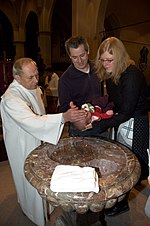
Evangelical Protestant baptism by immersion (Wikipedia) Baptism of a child by affusion, (Wikipedia)

By Spencer D Gear

Should infants be baptised or is baptism only for believing adults? Roman Catholic, Eastern Orthodox and some Protestant churches advocate and practise infant baptism. Baptists, many Pentecostals, Churches of Christ (Australia) and some other denominations consider baptism is only for Christians who have believed in Christ for salvation. Which is it?

But let me say at the outset that this is not core Christian doctrine. I will not use baptism as a divisive issue to separate Christians who love the Lord.

I was doing some posts on Christian Fellowship Forum and I stated: “Infant baptism is an addition from about the third century onwards”.[1] Tertullian was the first to mention infant baptism around AD 200 (see below).

Richard wrote:

“Unproven statement. Some evidence to the contrary exists, particularly the Biblical evidence that whole households were baptised, which would likely include infants. There is no evidence that a whole household excluded young children.

“You may want to maintain your position based on your doctrinal understanding, but you do not have a historically sound basis for it. Likewise, I may want to maintain my position, and I do have hints of a historical basis for it, although those hints do not rise to the level of historical proof”.[2]

Since he and his church (Roman Catholic) are advocates of and practise infant baptism, I expected this kind of response. I was baptised as an infant by my religious, but not born-again, parents in the Methodist church. When they came to faith in Christ in 1959, through the preaching ministry of Billy Graham, they investigated infant vs believer’s baptism. Why? The weight of evidence from the Scriptures supports believer’s baptism. When I came to faith in Christ alone for salvation, I investigated this issue and was baptised as a believer by immersion – even though I had been sprinkled as an infant.

This debate has been going on for centuries, so I am well aware of the baptism issues: infant baptism vs believer’s baptism. I’m aware of the “household” advocacy to include children in baptism that Richard was using (Reformed people will use the covenantal issue). Let’s look at the NT evidence.

A.  New Testament precedent

The Book of Acts demonstrates by example that those who were believers, following a confession of faith, were baptised. In the early chapters of Acts we read:

  • “Those who received his word were baptized, and there were added that day about three thousand souls” (Acts 2:41 ESV).[3]
  • “But when they believed Philip as he preached good news about the kingdom of God and the name of Jesus Christ, they were baptized, both men and women” (Acts 8:12).

B.  Household baptisms

Do household baptisms indicate that infants are included? We have three confirmed cases of “household” baptisms in the NT and one where there is a strong inference that an entire household was included. The implied inference is that of Cornelius (Acts 10:47-48; 11:14). Those of definite household baptism are: Lydia (Acts 16:15), the Philippian jailer (Acts 16:33-34, and Stephanas in 1 Cor. 1:16. The argument has been going on for centuries as to whether these “households” included children.

Let’s examine these:

1.  Cornelius (Acts 10:47-48; 11:14)

We know from Acts 11:14 that Peter “he will declare to you [Cornelius] a message by which you will be saved, you and all your household” (ESV). However, we know that infants could not have been included in the household because Acts 10:46 tells us that when Peter preached the Word and the Holy Spirit fell on them and they were speaking in tongues and extolling God (ESV). Then they were commanded to be baptised.

This could NOT have included infants because they could not speak in tongues and magnify the Lord by speaking. Peter commanded those who spoke in tongues and extolled the Lord to be baptised. This is impossible for infants. As I say, it is a strong inference from Acts 11:14 that those who spoke in tongues and praised the Lord were Cornelius and his household. If that inference is correct, there is no way that these believers could have been infants. Therefore, no infants could be baptised.

2.  Lydia (Acts 16:15)

Lydia was a worshipper of God (16:14) and “after she was baptized and her household”, Timothy, Paul and Silas were invited into her house to stay “if you have judged me to be faithful to the Lord” (16:15). There is nothing here to indicate that infants were baptised. Besides, Jesus required baptism to be part of discipleship (Matt. 28:19-20). This is impossibility for infants.

Let’s check out a few people who support infant baptism for their views on the “household” baptism of Lydia.

  • Henry Alford: “It may be that no inference of infant baptism is hence deducible”;
  • Paton J. Gloag: “Evidently the passage in itself cannot be adduced as a proof either for or against baptism; there is in it no indication whether there were or were not infants in the household of Lydia”.
  • H. A. W. Meyer: “No trace is to be found in the New Testament, speaking of the baptism of the children of Christians”.

However, it would not be inconsistent to use another example from Acts 16 as a template for whether or not “household” baptism included infants. Let’s examine….

3.  The Philippian jailer (Acts 16:33-34)

In the context, it states that “they spoke the Word of the Lord to him and to all who were in his house” (Acts 16:32 ESV). Then 16:34 tells us that “he [the Philippian jailer] rejoiced along with his entire household that he had believed”. It is impossible for infants to do this rejoicing over the jailer’s positive response to the speaking of the Word of the Lord. It is impossible for babies to have believed in the Lord. Therefore, this is another example of believer’s baptism.

4.  Stephanas (1 Cor. 1:16)

In the context of 1 Corinthians, we know that “the household of Stephanas were the first converts in Achaia and that they have devoted themselves to the service of the saints” (1 Cor. 16:15).

Imagine that coming from infants! The household of Stephanas later devoted themselves to ministry to the saints. No theology of children’s baptism can be found in this passage. If we are to be consistent interpreters of Scripture (and we need to be), the children who are part of household baptism must also be devoted to service to Christian saints. This is impossibility, so the example of Stephanas proves again that it did not include infant baptism but believer’s baptism.

5. Jesus’ view on baptism after His resurrection

Jesus gave a very clear understanding of the association of baptism with Christian believing in Matt. 28:19-20:

Go therefore and make disciples of all nations, baptizing them in the name of the Father and of the Son and of the Holy Spirit, teaching them to observe all that I have commanded you. And behold, I am with you always, to the end of the age (ESV).

Jesus is crystal clear that baptism is associated with making disciples of all nations. Discipleship is an impossible task for infants. The foundational requirement cannot be achieved by infants.

Therefore, the consistent picture of the NT is that “household” baptism does not include infants, but, based on the words of Jesus, baptism is an important dimension of Christian discipleship. Infants are incapable of becoming disciples of Christ.

C.  Wayne Grudem on household baptism

Grudem’s view of household baptism is:

The examples of household baptisms in the New Testament are really not decisive for one position or another. When we look at the actual examples more closely, we see that in a number of them there are indications of saving faith on the part of all of those baptized. For example, it is true that the family of the Philippian jailer was baptized (Acts 16:33), but it is also true that Paul and Silas “spoke the word of the Lord to him and to all that were in his house” (Acts 16:32). If the Word of the Lord was spoken to all in the house, there is an assumption that all were old enough to understand the word and believe it. Moreover, after the family had been baptized, we read that the Philippian jailer “rejoiced with all his household that he had believed in God” (Acts 16:34). So we have not only a household baptism but also a household reception of the Word of God and a household rejoicing in faith in God. These facts suggest quite strongly that the entire household had individually come to faith in Christ.

With regard to the fact that Paul baptized “the household of Stephanas” (1 Cor. 1:16), we must also note that Paul says at the end of 1 Corinthians that “the household of Stephanas were the first converts in Achaia, and they have devoted themselves to the service of the saints” (1 Cor. 16:15). So they were not only baptized; they were also converted and had worked at serving other believers. Once again the example of household baptism gives indication of household faith.

In fact, there are other instances where baptism is not mentioned but where we see explicit testimony to the fact that an entire household had come to faith. After Jesus healed the official’s son, we read that the father “himself believed, and all his household” (John 4:53). Similarly, when Paul preached at Corinth, “Crispus, the ruler of the synagogue, believed in the Lord, together with all his household” (Acts 18:8).

This means that of all the examples of “household baptisms” in the New Testament, the only one that does not have some indication of household faith as well is Acts 16:14-15, speaking of Lydia: “The Lord opened her heart to give heed to what was said by Paul. And when she was baptized, with her household.” The text simply does not contain any information about whether there were infants in her household or not. It is ambiguous and certainly not weighty evidence for infant baptism. It must be considered inconclusive in itself.

With regard to Peter’s statement at Pentecost that “the promise is to you and to your children,” we should note that the sentence continues as follows: “For the promise is to you and to your children and to all that are far off, every one whom the Lord our God calls to him” (Acts 2:39). Moreover, the same paragraph specifies not that believers and unbelieving children were baptized, but that “those who received his ward were baptized, and there were added that day about three thousand souls”(Acts 2:41).[4]

For an extended discussion on baptism, see chapter 49 of Wayne Grudem’s Systematic Theology (1994), which is available HERE. He concludes in favour of believer’s baptism:

We have argued above that baptism symbolizes regeneration or spiritual rebirth. But does it only symbolize? Or is there some way in which it is also a “means of grace,” that is, a means that the Holy Spirit uses to bring blessing to people? We have already discussed this question in the previous chapter,23 so here it only is necessary to say that when baptism is properly carried out then of course it brings some spiritual benefit to believers as well. There is the blessing of God’s favor that comes with all obedience, as well as the joy that comes through public profession of one’s faith, and the reassurance of having a clear physical picture of dying and rising with Christ and of washing away sins. Certainly the Lord gave us baptism to strengthen and encourage our faith—and it should do so for everyone who is baptized and for every believer who witnesses a baptism.[5]

But Grudem also urges Christians not to make baptism a divisive issue:

Do Churches Need to Be Divided Over Baptism? In spite of many years of

division over this question among Protestants, is there a way in which Christians who differ on baptism can demonstrate greater unity of fellowship? And is there a way that progress can be made in bringing the church closer to unity on this question?

One way forward could be for paedobaptists and advocates of believers’ baptism both to come to a common admission that baptism is not a major doctrine of the faith, and that they are willing to live with each other’s views on this matter and not allow differences over baptism to be a cause for division within the body of Christ.29 Specifically, this would mean allowing both views of baptism to be taught and practiced in denominations on both sides of the question.[6]

D.  Evidence from the early church fathers

What do the early church fathers have to say about infant baptism?

1. Justin Martyr (ca. 100-165):

“As many as are persuaded and believe that what we teach and say is true, … are brought by us where there is water, and are regenerated [born-again] in the same manner in which we were ourselves regenerated. For, in the name of God, the Father and Lord of the universe, and of our Savior Jesus Christ, and of the Holy Spirit, they then receive the washing with water. For Christ also said, “Except ye be born again, ye shall not enter into the kingdom of heaven. . . And for this we have learned from the apostles this reason. Since at our birth we were born without our own knowledge or choice, by our parents coming together, and were brought up in bad habits and wicked training; in order that we may not remain the children of necessity and of ignorance, but may become the children of choice and knowledge, and may obtain in the water the remission of sins formerly committed, there is pronounced over him who chooses to be born again, and has repented of his sins, the name of God the Father, . . . the name of Jesus Christ, . . . and in the name of the Holy Ghost. . .”.[7]

2. Tertullian (ca. 130-230) speaks of baptism for children who believe:

“Consequently in view of the circumstances and will, even the age of each person, a postponement of Baptism is most advantageous, particularly, however, in the case of children. For what need is there, if it is not so urgent, that the sponsors also should be brought into danger, being as they are themselves also by reason of their mortality capable of falling short of their promises and being deceived by the development of an evil disposition? The Lord indeed says: ‘Forbid them not to come unto Me.’ Let them come, then, while they are growing up; let them come while they are learning, while they are being taught whither to come; let them become Christians, when they have been able to know Christ. Why hurries the age of innocence to the remission of sins? Shall we act more cautiously in worldly matters? Shall one to whom earthly substance is not entrusted, be entrusted with heavenly? Let them know how to seek salvation, that you may be seen ‘to give to him that asketh'”.[8]

3. The Didache (ca. 95-150)

We don’t learn much about baptism and salvation from this document:

” CHAPTER 7

7:1 But concerning baptism, thus baptize ye: having first recited all these precepts, baptize in the name of the Father, and of the Son, and of the Holy Spirit, in running water;

7:2 but if thou hast not running water, baptize in some other water, and if thou canst not baptize in cold, in warm water;

7:3 but if thou hast neither, pour water three times on the head, in the name of the Father, and of the Son, and of the Holy Spirit.

7:4 But before the baptism, let him who baptizeth and him who is baptized fast previously, and any others who may be able. And thou shalt command him who is baptized to fast one or two days before. . .

9:5 And let none eat or drink of your Eucharist but such as have been baptized into the name of the Lord, for of a truth the Lord hath said concerning this, Give not that which is holy unto dogs”.[9]

4. Hippolytus of Rome (died ca. 235)

In his writing, ‘The Apostolic Tradition’, he wrote:

At the hour in which the cock crows, they shall first pray over the water. 2When they come to the water, the water shall be pure and flowing, that is, the water of a spring or a flowing body of water. 3Then they shall take off all their clothes. 4The children shall be baptized first. All of the children who can answer for themselves, let them answer. If there are any children who cannot answer for themselves, let their parents answer for them, or someone else from their family. 5After this, the men will be baptized. Finally, the women, after they have unbound their hair, and removed their jewelry. No one shall take any foreign object with themselves down into the water.

” 6At the time determined for baptism, the bishop shall give thanks over some oil, which he puts in a vessel. It is called the Oil of Thanksgiving. 7He shall take some more oil and exorcise it. It is called the Oil of Exorcism. 8A deacon shall hold the Oil of Exorcism and stand on the left. Another deacon shall hold the Oil of Thanksgiving and stand on the right.

9When the elder takes hold of each of them who are to receive baptism, he shall tell each of them to renounce, saying, “I renounce you Satan, all your service, and all your works.” 10After he has said this, he shall anoint each with the Oil of Exorcism, saying, “Let every evil spirit depart from you.” 11Then, after these things, the bishop passes each of them on nude to the elder who stands at the water. They shall stand in the water naked. A deacon, likewise, will go down with them into the water. 12When each of them to be baptized has gone down into the water, the one baptizing shall lay hands on each of them, asking, “Do you believe in God the Father Almighty?” 13And the one being baptized shall answer, “I believe.” 14He shall then baptize each of them once, laying his hand upon each of their heads. 15Then he shall ask, “Do you believe in Jesus Christ, the Son of God, who was born of the Holy Spirit and the Virgin Mary, who was crucified under Pontius Pilate, and died, and rose on the third day living from the dead, and ascended into heaven, and sat down at the right hand of the Father, the one coming to judge the living and the dead?”

16When each has answered, “I believe,” he shall baptize a second time. 17Then he shall ask, “Do you believe in the Holy Spirit and the Holy Church and the resurrection of the flesh?” 18Then each being baptized shall answer, “I believe.” And thus let him baptize the third time.

19Afterward, when they have come up out of the water, they shall be anointed by the elder with the Oil of Thanksgiving, saying, “I anoint you with holy oil in the name of Jesus Christ.” 20Then, drying themselves, they shall dress and afterwards gather in the church.

21The bishop will then lay his hand upon them, invoking, saying, “Lord God, you who have made these worthy of the removal of sins through the bath of regeneration, make them worthy to be filled with your Holy Spirit, grant to them your grace, that they might serve you according to your will, for to you is the glory, Father and Son with the Holy Spirit, in the Holy Church, now and throughout the ages of the ages. Amen”.[10]

Verse 4 notes: ‘The children shall be baptized first. All of the children who can answer for themselves, let them answer. If there are any children who cannot answer for themselves, let their parents answer for them, or someone else from their family‘. This statement alone does not indicate that children who were baptised were not believers. In fact, defacto people (parents or relatives) could speak for those children who could not speak for themselves. This verse does not state that these children were infants who could not believe.

If we want to emulate Hippolytus exactly, then one would need to do all baptisms in pure running water and not in some baptismal font in a church building. In addition, with all baptisms, adults and children shall take off all of their clothes. I could not imagine that being acceptable in twenty-first century Western society. A fellow on a Christian forum (in a private message) challenged me with using Hippolytus to support believers’ baptism when Hippolytus was alleged to have included infant baptism. I could imagine that that fellow would create quite a ruckus if he were to go onto this public forum and be a full advocate of what Hippolytus recommended. As you know from what I’ve written above, I’m committed to what the Scriptures state about the nature of baptism.

I take up the challenge of this fellow in my inclusion of Hippolytus in support of believers’ baptism. However, from this passage in Hippolytus, there is no guarantee that he is supporting paedobaptism as practised by the infant baptism promoters in contemporary society. If we accept what Hippolytus wrote in relation to baptism, we would need to conclude:

(a) He was confused in his understanding of baptism (thus making Hippolytus just another author, but with no scriptural authority).

(b) He recommended baptism in the nuddy, and

(c) There shall be no baptism of anyone using a baptismal font in a church; the water MUST be pure and flowing.

I am convinced from the biblical evidence that a strong case can be made for believer’s baptism, but there are many Christians who love the Lord who support infant baptism. I will not use the mode of baptism as a means to cause division in the body of Christ.

Notes


[1] Fellowship Forum, The Fellowship Hall, “David Wilkerson killed”, #170, available at: http://community.compuserve.com/n/pfx/forum.aspx?tsn=162&nav=messages&webtag=ws-fellowship&tid=120662 (Accessed 15 May 2011).

[2] Ibid., #172, available at: http://community.compuserve.com/n/pfx/forum.aspx?webtag=ws-fellowship&nav=messages&msg=120662.172 (Accessed 15 May 2011). On 7 August 2019 this link was not working. The website has been closed down.

[3] Unless otherwise stated, all Bible quotations are from the English Standard Version of the Bible, available from Biblegateway.

[4] Wayne Grudem 1994. Systematic Theology: An Introduction to Bible Doctrine. Grand Rapids, Michigan: Zondervan Publishing House, p. 978.

[5] Ibid., pp. 980-981.

[6] Ibid., p. 982.

[7] First Apology, Chapter LXI, available from: http://www.ccel.org/s/schaff/anf01/htm/viii.ii.lxi.htm (Accessed 15 May 2011).

[8] Concerning Baptism, para 18, available at: http://www.tertullian.org/articles/souter_orat_bapt/souter_orat_bapt_04baptism.htm (Accessed 15 May 2011).

[9] Available at: http://www.ocf.org/OrthodoxPage/reading/St.Pachomius/Liturgical/didache.html (Accessed 15 May 2011).

[10] Available at: http://www.bombaxo.com/hippolytus.html, emphasis added (Accessed 15 May 2011).

Copyright © 2011 Spencer D. Gear.  This document last updated at Date:  07 August 2019.

Compare Charles Wesley’s hymn with a Hillsong song

By Spencer D Gear

Have you compared the biblical content of the hymns/songs of Charles Wesley with the hymns/songs of Hillsong? Here is but one example.


Charles Wesley

And Can It Be

And can it be that I should gain
An interest in the Savior’s blood?
Died He for me, who caused His pain
For me, who Him to death pursued?
Amazing love! How can it be,
That Thou, my God, shouldst die for me?

Refrain:

Amazing love! How can it be,
That Thou, my God, shouldst die for me?

‘Tis mystery all: th’Immortal dies:
Who can explore His strange design?
In vain the firstborn seraph tries
To sound the depths of love divine.
‘Tis mercy all! Let earth adore,
Let angel minds inquire no more.

RefrainHe left His Father’s throne above
So free, so infinite His grace
Emptied Himself of all but love,
And bled for Adam’s helpless race:
‘Tis mercy all, immense and free,
For O my God, it found out me!

RefrainLong my imprisoned spirit lay
Fast bound in sin and nature’s night;
Thine eye diffused a quickening ray,
I woke, the dungeon flamed with light;
My chains fell off, my heart was free;
I rose, went forth, and followed Thee.

RefrainStill the small inward voice I hear,
That whispers all my sins forgiven;
Still the atoning blood is near,
That quenched the wrath of hostile Heaven.
I feel the life His wounds impart;
I feel the Savior in my heart.

RefrainNo condemnation now I dread;
Jesus, and all in Him, is mine;
Alive in Him, my living Head,
And clothed in righteousness divine,
Bold I approach th’eternal throne,
And claim the crown, through Christ my own.

Refrain


Hillsong

All I Do

I wanted to find
Where I was going
Everything I tried
It took me nowhere
I was so tired of just living my life
Waiting for a sign
You came to my side
Gave me direction
Strong on the inside
I shine for You Lord
Now it’s my time
Now I’ve made up my mind
To be all You want for me
All I do
Is live my life for You
I know it’s true
I’ll never let You go
All I do
I’d anything for You
Everything is in Your Hands
So I get up
Get up and praise You
And I know where I’m going
I know where I’m going

I posted this comparison to Christian Fellowship Forum, “Charles Wesley vs Hillsong”. Janet (#2) replied:

>>I wanted to find
Where I was going
Everything I tried
It took me nowhere
I was so tired of just living my life
……
And I know where I’m going
I know where I’m going.<<

Oh, the depth, the profundity!  What marks modern church music (I can’t bring myself to call it sacred music) is the shallowness of lyrics, the general tunelessness, and the incessant returns to I, me, my, and mine.

Of the nearly three hundred words in Wesley’s hymn, 24 refer to I, me, my, or mine, and 23 refer directly to deity.  The second piece of fluff manages to mention self 24 times in only 111 words, plus another one in the title; of its 24  lines, memorable only because there is nothing one would care to remember about them, only two do not contain a reference to self.  In contrast, God is referenced only 8 times.  I find this emphasis on self to be a common feature of modern so-called church music.

Do you remember this hymn? What about the parody which follows it?

DEAR LORD AND FATHER OF MANKIND

By John Greenleaf Whittier

Dear Lord and Father of mankind,
Forgive our foolish ways;
Reclothe us in our rightful mind,
In purer lives Thy service find,
In deeper reverence, praise.

In simple trust like theirs who heard,
Beside the Syrian sea,
The gracious calling of the Lord,
Let us, like them, without a word,
Rise up and follow Thee.

O Sabbath rest by Galilee,
O calm of hills above,
Where Jesus knelt to share with Thee
The silence of eternity,
Interpreted by love!

With that deep hush subduing all
Our words and works that drown
The tender whisper of Thy call,
As noiseless let Thy blessing fall
As fell Thy manna down.

Drop Thy still dews of quietness,
Till all our strivings cease;
Take from our souls the strain and stress,
And let our ordered lives confess
The beauty of Thy peace.

Breathe through the heats of our desire
Thy coolness and Thy balm;
Let sense be dumb, let flesh retire;
Speak through the earthquake, wind, and fire,
O still, small voice of calm.


This parody of the hymn appeared in the Anglican Advocate (July 2000):


DEAR LORD AND FATHER OF MANKIND (a parody)

To be sung to the tune Repton:
Dear Lord and Father of mankind, forgive our foolish ways;
For most of us, when asked our mind,
admit we still most pleasure find
In hymns of ancient days, in hymns of ancient days.

The simple lyrics, for a start, of many a modern song
Are far too trite to touch the heart;
enshrine no poetry, no art;
And go on much too long, and go on much too long.

O, for a rest from jollity and syncopated praise!
What happened to tranquillity?
The silence of eternity
Is hard to hear these days, is hard to hear these days.

Send Thy deep hush, subduing all those happy claps that drown
The tender whisper of Thy call;
triumphalism is not all,
For sometimes we feel down, for sometimes we feel down.

Drop Thy still dews of quietness till all our strummings cease;
Take from our souls the strain and stress
of always having to be blessed;
Give us a bit of peace, give us a bit of peace.

Breathe through the beats of praise-guitar Thy coolness and Thy balm;
Let drum be dumb, bring back the lyre,
enough of earthquake, wind and fire,
Let’s hear it for some calm, let’s hear it for some calm.


Copyright © 2011 Spencer D. Gear. This document last updated at Date: 17 July 2018.

Image of cool flower with sunglasses Image of cool flower with sunglasses Image of cool flower with sunglasses Image of cool flower with sunglasses Image of cool flower with sunglasses Image of cool flower with sunglasses Image of cool flower with sunglasses Image of cool flower with sunglasses Image of cool flower with sunglasses

Sudden death of David Wilkerson

David Wilkerson Tribute

(courtesy World Challenge)

By Spencer D Gear

My friend and Christian colleague, Aeron Morgan, posted this information on his website: [1]

Today, Thursday 28 April 2011, here in Australia we have received the sad news of the sudden and tragic death of our dear Brother David Wilkerson, a beloved, humble and faithful servant of our Lord Jesus Christ. The following web-link will take you to a fuller report, put out so promptly by Charisma magazine, of the fatal accident.

This will be a tremendous shock and loss to our fellow believers at Times Square, but believe that God will graciously undertake for Pastor Carter Conlan as he now has the task of guiding the saints there through this hour of sorrow and immense loss. The added painful news is that Brother Wilkerson’s wife, Gwendolyn, was with him in the car and is in hospital with injuries which are reported to be critical.

I am sure that YOU will join the many thousands around the world in prayer for Sister Wilkerson and the family in their bereavement and that she will be fully recovered from her injuries. Pray also for the dear saints at Times Square Church, that God will comfort their saddened hearts, losing an outstanding champion for truth and holiness. We salute the memory of such a dedicated servant of Christ. We are the poorer for his passing, but we cannot question God’s goodness and wisdom, committing the things we don’t understand to HIM “who doeth all things well.” Many of us have been privileged to visit Times Square Church, tremendously impressed with what God has wrought there. TO GOD BE THE GLORY!

The Pentecostal world in particular will miss such a needed voice for God in these days of compromise and worldliness, and that faithful prophetic call back to the “old paths” our brother was known for. May God visit us in this late hour prior to the coming of our Lord Jesus. David Wilkerson longed for such a move of God’s Holy Spirit, not only across his beloved America, but in the nations of our world at this troublesome time. Let’s be part of the remnant that will manifest something of the same godliness and passion as our dear brother, together bear something of the burden he shouldered for so long – for without question: IT IS TIME TO SEEK THE LORD.

You can read further details on the Charisma magazine website, “David Wilkerson killed in car crash“. The Christian Broadcasting Network has also reported the tragedy in, “Rev. David Wilkerson killed in TX car crash”. Christianity Today reported the sad news in, “David Wilkerson killed in car crash“. Beliefnet reported that “Famed New York City street preacher, author David Wilkerson killed in car crash“.

This Associated Press (USA Today) news item, “Times Square church founder dies in Texas crash”, stated that David Wilkerson was not wearing a seat belt in the car that crashed, when the USA requires the wearing of seat belts:

Wilkerson was not wearing a seat-belt at the time of the crash, according to the Texas Department of Public Safety. His wife, Gwendolyn, was also in the car and was wearing a seat-belt, Mange said. She was taken to a hospital, where she was in stable condition with cuts and bruises, Mange said.

I have a particular affinity with Teen Challenge as I was part of its training ministry in drug rehabilitation in Canberra, Australia, for a couple of years in the early 1990s and in the early 1970s I engaged in ministry from a Teen Challenge coffee shop with the needy on the streets of The Valley, Brisbane.

David Wilkerson will be remembered for his pioneering work in Christian drug rehabilitation that was described in his seminal publication, The Cross and the Switchblade. Its story became the film, The Cross and the Switchblade that starred Pat Boone as David Wilkerson.

Image may contain: one or more people, night, suit and close-up
(Courtesy David Wilkerson, Facebook)

Here is what he wrote in his very last blog, “David Wilkerson Today” of 27 April 2011, the very day he died:

To believe when all means fail is exceedingly pleasing to God and is most acceptable. Jesus said to Thomas, “You have believed because you have seen, but blessed are those that do believe and have not seen” (John 20:29).

Blessed are those who believe when there is no evidence of an answer to prayer—who trust beyond hope when all means have failed.

Someone has come to the place of hopelessness—the end of hope—the end of all means. A loved one is facing death and doctors give no hope. Death seems inevitable. Hope is gone. The miracle prayed for is not happening.

That is when Satan’s hordes come to attack your mind with fear, anger, overwhelming questions: “Where is your God now? You prayed until you had no tears left. You fasted. You stood on promises. You trusted.”

Blasphemous thoughts will be injected into your mind: “Prayer failed. Faith failed. Don’t quit on God—just do not trust him anymore. It doesn’t pay!”

Even questioning God’s existence will be injected into your mind. These have been the devices of Satan for centuries. Some of the godliest men and women who ever lived were under such demonic attacks.

To those going through the valley and shadow of death, hear this word: Weeping will last through some dark, awful nights—and in that darkness you will soon hear the Father whisper, “I am with you. I cannot tell you why right now, but one day it will all make sense. You will see it was all part of my plan. It was no accident. It was no failure on your part. Hold fast. Let me embrace you in your hour of pain.”

Beloved, God has never failed to act but in goodness and love. When all means fail—his love prevails. Hold fast to your faith. Stand fast in his Word. There is no other hope in this world (my emphasis).

Australian Christian cultural apologist, Bill Muehlenberg, has written this fitting tribute to David Wilkerson, “David Wilkerson RIP”.

Messages from David Wilkerson

1.   A Call to Anguish, by David Wilkerson

23 August 2009

This message is a partially transcribed excerpt from an original message spoken by David Wilkerson.  The full message is titled: “A Call to Anguish.”  and can be downloaded from www.sermonindex.net.”

And I look at the whole religious scene today and all I see are the inventions and ministries of man and flesh.  It’s mostly powerless.  It has no impact on the world.  And I see more of the world coming into the church and impacting the church, rather than the church impacting the world.  I see the music taking over the house of God.  I see entertainment taking over the house of God.  An obsession with entertainment in God’s house.  A hatred of correction and a hatred of reproof.  Nobody wants to hear it any more.  Whatever happened to anguish in the house of God?

Whatever happened to anguish in the ministry? It’s a word you don’t hear in this pampered age.  You don’t hear it.  Anguish means extreme pain and distress.  The emotions so stirred that it becomes painful.  Acute deeply felt inner pain because of conditions about you, in you, or around you.  Anguish.  Deep pain.  Deep sorrow.  The agony of God’s heart.

We’ve held on to our religious rhetoric and our revival talk but we’ve become so passive.  All true passion is born out of anguish.  All true passion for Christ comes out of a baptism of anguish.  You search the scripture and you’ll find that when God determined to recover a ruined situation… He would share His own anguish for what God saw happening to His church and to His people.  And He would find a praying man and take that man and literally baptize him in anguish.  You find it in the book of Nehemiah.  Jerusalem is in ruins.  How is God going to deal with this?  How is God going to restore the ruin?  Now folks, look at me… Nehemiah was not a preacher, he was a career man.  But this was a praying man.

And God found a man who would not just have a flash of emotion.  Not just some great sudden burst of concern and then let it die.  He said: “No.  I broke down and I wept and I mourned and I fasted.  And then I began to pray night and day.  Why didn’t these other men… why didn’t they have an answer?  Why didn’t God use them in restoration?  Why didn’t they have a word?  Because there was no sign of anguish.  No weeping.  Not a word of prayer.  It’s all ruin.

Does it matter to you today? Does it matter to you at all that God’s spiritual Jerusalem, the church, is now married to the world?  That there is such a coldness sweeping the land?  Closer than that… does it matter about the Jerusalem that is in our own hearts?  The sign of ruin that’s slowly draining spiritual power and passion.  Blind to lukewarmness, blind to the mixture that’s creeping in.  That’s all the devil wants to do is to get the fight out of you and kill it.  So you won’t labor in prayers anymore, you won’t weep before God anymore.  You can sit and watch television and your family go to hell.

Let me ask  you… is what I just said convicting to you at all?  There is a great difference between anguish and concern. Concern is something that begins to interest you.  You take an interest in a project or a cause or a concern or a need.  And I want to tell you something.  I’ve learned over all my years… of 50 years of preaching.  If it is not born in anguish, if it had not been born of the Holy Spirit.  Where what you saw and heard of the ruin that drove you to your knees, took you down into a baptism of anguish where you began to pray and seek God.  I know now.  Oh my God do I know it.  Until I am in agony.  Until I have been anguished over it…  And all our projects, all our ministries, everything we do… Where are the Sunday school teachers that weep over kids they know are not hearing and are going to hell?

You see, a true prayer life begins at the place of anguish. You see, if you set your heart to pray, God’s going to come and start sharing His heart with you.  Your heart begins to cry out:  “Oh God, Your name is being blasphemed.  The Holy Spirit is being mocked.  The enemy is out trying to destroy the testimony of the Lord’s faithfulness and something has to be done.”

There is going to be no renewal, no revival, no awakening, until we are willing to let Him once again break us.  Folks, it’s getting late, and it’s getting serious.  Please don’t tell me… don’t tell me you’re  concerned when you’re spending  ours in front of internet or television.  Come on.  Lord, there are some that need to get to this alter and confess: “I am not what I was, I am not where I am supposed to be.  God I don’t have Your heart or Your burden.  I wanted it easy.  I just wanted to be happy.  But Lord, true joy comes out of anguish.”  There’s nothing of the flesh that will give you joy.  I don’t care how much money, I don’t care what kind of new house, there is absolutely nothing physical that can give you joy.  It’s only what is accomplished by the Holy Spirit when you obey and take on His heart.

Build the walls around your family. Build the walls around your own heart.  It will make you strong and impregnable against the enemy.  God, that’s what we desire.

This kind of statement gets near the heart of the passion of our late brother in Christ, David. May God so move upon us that His Holy Spirit so ignites our passion for the lost and unlovely that we will move in a ministry of compassion, but with the boldness of a Christ-infused passion.

2.   An Urgent Message

Saturday, March 7, 2009

AN URGENT MESSAGE

I am compelled by the Holy Spirit to send out an urgent message to all on our mailing list, and to friends and to bishops we have met all over the world.

AN EARTH-SHATTERING CALAMITY IS ABOUT TO HAPPEN. IT IS GOING TO BE SO FRIGHTENING, WE ARE ALL GOING TO TREMBLE – EVEN THE GODLIEST AMONG US.

For ten years I have been warning about a thousand fires coming to New York City. It will engulf the whole megaplex, including areas of New Jersey and Connecticut. Major cities all across America will experience riots and blazing fires—such as we saw in Watts, Los Angeles, years ago.

There will be riots and fires in cities worldwide. There will be looting—including Times Square, New York City. What we are experiencing now is not a recession, not even a depression. We are under God’s wrath. In Psalm 11 it is written,

“If the foundations are destroyed, what can the righteous do?” (v. 3).

God is judging the raging sins of America and the nations. He is destroying the secular foundations.

The prophet Jeremiah pleaded with wicked Israel, “God is fashioning a calamity against you and devising a plan against you. Oh, turn back each of you from your evil way, and reform your ways and deeds. But they will say, It’s hopeless! For we are going to follow our own plans, and each of us will act according to the stubbornness of his evil heart” (Jeremiah 18:11-12).

In Psalm 11:6, David warns, “Upon the wicked he will rain snares (coals of fire)…fire…burning wind…will be the portion of their cup.” Why? David answered, “Because the Lord is righteous” (v. 7). This is a righteous judgment—just as in the judgments of Sodom and in Noah’s generation.
WHAT SHALL THE RIGHTEOUS DO? WHAT ABOUT GOD’S PEOPLE?

First, I give you a practical word I received for my own direction. If possible lay in store a thirty-day supply of non-perishable food, toiletries and other essentials. In major cities, grocery stores are emptied in an hour at the sign of an impending disaster.

As for our spiritual reaction, we have but two options. This is outlined in Psalm 11. We “flee like a bird to a mountain.” Or, as David says, “He fixed his eyes on the Lord on his throne in heaven—his eyes beholding, his eyelids testing the sons of men” (v. 4). “In the Lord I take refuge” (v. 1).

I will say to my soul: No need to run…no need to hide. This is God’s righteous work. I will behold our Lord on his throne, with his eye of tender, loving kindness watching over every step I take—trusting that he will deliver his people even through floods, fires, calamities, tests, trials of all kinds.

Note: I do not know when these things will come to pass, but I know it is not far off. I have unburdened my soul to you. Do with the message as you choose.

God bless and keep you,

In Christ,

DAVID WILKERSON

The amazing thing about David Wilkerson and the people he inspired (I am one of them) was that he loved the unlovely and ministered at street level with them.

In the 1970s, I was on the streets of downtown Brisbane, running a coffee shop with some other workers, and ministering to the junkies and prostitutes. Why? David alerted me to the need and God moved upon my heart.

That’s an amazing statement he made on his blog, “David Wilkerson Today”, on the very day he entered the presence of the Lord.

Yes, like me, he was a frail man with failings. I wish he had not made that false prophesy about New York City in 2009. But have a guess what? Even with God’s Word before me in written form, I can make errors of interpretation as a fallible human being. The redeemed on this earth are not perfect. That time is still ahead of us in our elevation to glory.

Overall, I judge David Wilkerson to be a humble man of God with a vision that took effect in the lives of those who needed the Saviour.

3.  Message to the USA after September 11 attack

After the September 11, 2001 attack on New York City, David Wilkerson wrote, “The towers have fallen but we missed the message.

Part of that message reads:

Here Is the Message I Believe God Is Trumpeting in Our Calamities.

Deep in my spirit, I hear the Lord saying, “I’ve prospered you above all nations. Yet, for years you’ve persisted in worshipping idols of gold and silver. I’ve endured your shameless sensuality, your mockery of holy things, your shedding of innocent blood, your tireless efforts to remove me from your society. Now time is running out for you.

“I’ve sent you prophet after prophet, watchman after watchman. You’ve been warned again and again. Yet still you won’t open your eyes to your wicked ways. Now I’ve stricken you, in hopes of saving you. I want to heal your land, to destroy your enemies, to bring you back into my blessing. But you don’t have eyes to see it.”

If God wouldn’t spare other nations that have outlawed him, why would he spare America? He’ll judge us even as he judged Sodom, Rome, Greece and every other culture that has turned its back on him.

On “David Wilkerson Today”, David’s son, Gary Wilkerson, has written this tribute to his Dad:

Friday, April 29, 2011

by Gary Wilkerson

“David served the purposes of God in his generation, then he died” (Acts 13:36).
On Wednesday afternoon my father, David Wilkerson, passed away in a car accident. We grieve the loss of a beloved father, a faithful husband and a holy man of God. My mother, Gwen, his wife of 57 years, was in the car also, but we are told she will recover fully.

Dad’s 60-plus years of ministry have impacted the lives of those closest to him and extended to millions around the world. Today we feel a personal loss, but at the same time we rejoice knowing Dad lived life to the fullest, obeying God with devotion and loving Jesus radically.
He was known for his unlimited faith. He believed God could change the lives of gang members and transform the most desperate drug addicts. He believed that a dynamic church could be launched in the heart of Times Square, New York City. He believed he could be a man who loved his wife and children well. And he did.

Dad was not one for fanfare, acclaim or ceremony. He turned down invitations to meet with world leaders yet would give everything he owned to support a poor orphan or a widow in distress.

Like King David of old, Dad served God’s purposes in his generation. He preached with uncompromising passion and relentless grace. He wrote with amazing insight, clarity and conviction. He ran his race well and when his work was done, he was called home.

I don’t think my father would have retired well. I don’t think he was one to sit in a rocking chair and reminisce about times past. I believe that Jesus, knowing this, graciously called him home.

Dad’s last mission on earth was to be an advocate for the poorest of the poor—to provide relief and support for hungry children and widows and orphans. After founding Teen Challenge, World Challenge and Times Square Church, he sought to feed starving children in the most impoverished countries in the world. Today, Please Pass the Bread is saving the lives of thousands of children, through 56 outreaches in 8 countries.

Like King David of old, after having served God’s purpose, he died. I know if my father were able to encourage you with his words today, he would invite you to give your all to Jesus, to love God deeply and to give yourself away to the needs of others.

The works he began outlive him. We can all attest to his impacting us—not only in his preaching, writing and founding of world-changing ministries, but in his love, devotion, compassion and ability to stir our faith for greater works.

David Wilkerson, you have run the race with exceptional faithfulness to your Lord and Master, Jesus Christ. You are now blessed to be in His presence. To those who mourn, there is this message of hope: “Precious in the sight of the LORD is the death of his saints” (Psalm 116:15 ESV). Life and death depend on the sovereignty of God. There is no sudden, accidental death with God. “Your eyes saw my unformed substance; in your book were written, every one of them, the days that were formed for me, when as yet there was none of them” (Psalm 139:16).

For David’s wife, Gwen, and the family, they have this assurance from Jesus: “”Blessed are those who mourn, for they shall be comforted” (Matthew 5:4).

(David Wilkerson photo, courtesy, ‘David Wilkerson Today

 Notes

[1] Since uploading this article in 2013, my friend, the godly Aeron Morgan, has entered his rest in Paradise & the citation is no longer available online at his homepage.

Copyright © 2013 Spencer D. Gear. This document last updated at Date: 23 April 2020.

Flower21Flower21Flower21Flower21Flower21Flower21

Should the Apocrypha be in the Bible?[1]

Tobit

By Spencer D Gear

What is the Apocrypha? The Apocrypha (the deutero-canonical books) refers to the extra books in the Greek version of the Old Testament, the Septuagint, that are not in the Hebrew canon of Scripture. Bruce Metzger wrote of the Apocrypha:

‘With the exception of 2 Esdras these books appear in the Greek version of the Old Testament which is known as the Septuagint, but they are not included in the Hebrew Canon of Holy Scripture’ (Metzger 1965:vii).

The books listed in the RSV edition of the Apocrypha (Metzger 1965:iii) are:

  • The First Book of Esdras[2]
  • The Second Book of Esdras[3]
  • Tobit
  • Judith
  • The Additions to the Book of Esther
  • The Wisdom of Solomon
  • Ecclesiasticus, or the Wisdom of Jesus the Son of Sirach
  • Baruch
  • The Letter of Jeremiah
  • The Prayer of Azariah and the Song of the Three Young Men
  • Susanna
  • Bel and the Dragon
  • The Prayer of Manasseh
  • The First Book of the Maccabees
  • The Second Book of the Maccabees

In all of this discussion about the Apocrypha, it is important to understand why there is some confusion among Roman Catholic, Eastern Orthodox and Protestant Christianity in discussing this topic.
Some of the confusion surrounds two traditions for the Old Testament canon:[4]

  1. The Palestinian Canon contains 22 books in the Hebrew (39 in English);
  2. The Alexandrian Canon contains 14 additional books (or 15).

The Palestinian Canon was the Hebrew canon that arose in Palestine and was acknowledged by the Jews. The Alexandrian Canon is the Greek list of OT books and is supposed to have arisen in Alexandria, Egypt, where the Hebrew OT Scriptures were translated into the Greek Septuagint (LXX) about 250 BC and following years.

It is considered by some that there were really two Old Testament canons.[5] There was the broader one that included the Apocrypha and the other was the more narrow one without the Apocrypha. This two-canon hypothesis is built around the fact that the earliest extant copies of the Greek Septuagint that we have are from about the fourth century AD and they contain some of the apocryphal books. On the other hand, the Hebrew Bible has only the 39 books that we now have in the Protestant English Bible.
This latter canon seems to have been the canon of Jesus, Josephus and Jerome. There is no quote from Jesus, to my knowledge, that is from the Apocrypha.

Added confusion: The Apocrypha in and out of the Bible

To add to the confusion, the Geneva Bible of 1560, produced by English Protestants taking refuge in Geneva, contained apocryphal books but there was an introduction that stated that these ‘bokes, which were not receiued by a commune consent to be red and expounded publikely in the Church’[6]. Note the spelling of antiquity!

F. F. Bruce states that this is a repetition and expansion of Jerome’s position that apocryphal books were not for the confirmation of doctrine, unless based on the canonical books, and were for the instruction of godly manners. Some who used the Geneva Bible did not appreciate the Apocrypha, so some copies of the 1599 edition printed on the Continent and in London ‘were bound up without the section containing the Apocrypha’. In 1640, an edition of the Geneva Bible was published in Amsterdam that eliminated the Apocrypha, with an explanation between the Old and New Testaments, giving the reason for its deletion. However, the Prayer of Manasseh was appended to 2 Chronicles. The Bishop’s Bible, published in London in 1568, also contained the Apocrypha, but unlike the Geneva Bible, it had no comment about distinguishing between the canonical books and the Apocrypha (Bruce 1988:107-108).

The English Bible that became the standard English translation was the King James (Authorised) Version, published in 1611, and it contained the Apocrypha. However, in 1615 the Archbishop of Canterbury who was a convinced Calvinist in theology, George Abbot, demanded that all Bibles must contain the Apocrypha. To refuse to include the Apocrypha would earn a year’s imprisonment. Why was this a necessary move? It seemed to be a measure to silence the growing influence of the Puritans who objected to the Apocrypha. In spite of this penalty, copies of the KJV without the Apocrypha started appearing as early as 1626. Since the Puritans were gaining influence, the Long Parliament in England in 1644 gave permission for the Apocrypha to cease to be read in Church of England services (Bruce 1988:108-109).

The Westminster Confession of Faith, drawn up in 1646 by the Westminster Assembly, consisting mainly of Church of England ministers, contained this statement in the chapter I.3, ‘Of the holy Scripture’,

The books commonly called Apocrypha, not being of divine inspiration, are no part of the Canon of Scripture; and therefore are of no authority in the Church of God, nor to be any otherwise approved, or made use of, than other human writings.

When was the Apocrypha written?

A variety of dates has been given. Matt Slick states, ‘The Apocrypha consists of a set of books written between approximately 400 B.C. and the time of Christ.  The word “apocrypha” means “Hidden”‘. R. Laird Harris is of the view that ‘the Apocryphal books were written in Hebrew during the period from 200-50 B.C., and yet they were not revered by the Jews of Palestine, who did revere the others’ (1969:138). F. F. Bruce calls the Apocrypha a ‘really varied assortment of Jewish literature of the period 300 B.C.—A.D. 100…. While none of these books is included in the Hebrew Old Testament, they do (with one exception) form part of the Greek Old Testament’ (1963:164).[7]

As for Josephus, in his Complete Works (1867) in the writing Against Apion (1867:607-638), he defines the Jewish canon as 22 books in Hebrew that correspond to our 39 books in the English Old Testament. He did not include the Apocrypha. This is what he wrote in Against Apion 1.8:

8. For we have not an innumerable multitude of books among us, disagreeing from and contradicting one another, [as the Greeks have,] but only twenty-two books, which contain the records of all the past times; which are justly believed to be divine; and of them five belong to Moses, which contain his laws and the traditions of the origin of mankind till his death. This interval of time was little short of three thousand years; but as to the time from the death of Moses till the reign of Artaxerxes king of Persia, who reigned after Xerxes, the prophets, who were after Moses, wrote down what was done in their times in thirteen books. The remaining four books contain hymns to God, and precepts for the conduct of human life. It is true, our history hath been written since Artaxerxes very particularly, but hath not been esteemed of the like authority with the former by our forefathers, because there hath not been an exact succession of prophets since that time; and how firmly we have given credit to these books of our own nation is evident by what we do; for during so many ages as have already passed, no one has been so bold as either to add any thing to them, to take any thing from them, or to make any change in them; but it is become natural to all Jews immediately, and from their very birth, to esteem these books to contain Divine doctrines, and to persist in them, and, if occasion be willingly to die for them. For it is no new thing for our captives, many of them in number, and frequently in time, to be seen to endure racks and deaths of all kinds upon the theatres, that they may not be obliged to say one word against our laws and the records that contain them; whereas there are none at all among the Greeks who would undergo the least harm on that account, no, nor in case all the writings that are among them were to be destroyed; for they take them to be such discourses as are framed agreeably to the inclinations of those that write them; and they have justly the same opinion of the ancient writers, since they see some of the present generation bold enough to write about such affairs, wherein they were not present, nor had concern enough to inform themselves about them from those that knew them; examples of which may be had in this late war of ours, where some persons have written histories, and published them, without having been in the places concerned, or having been near them when the actions were done; but these men put a few things together by hearsay, and insolently abuse the world, and call these writings by the name of Histories.

The canon of Scripture

There are a significant number of reasons for accepting the Palestinian canon of the OT (without the Apocrypha). Here are a few:

  1. Some of the Apocryphal books have teachings that contradict the NT. Two of these teachings that were raised at the time of the Reformation are promoted in the Apocrypha but denied in the NT. The Apocrypha promotes praying for the dead (2 Macc 12:45-46) and salvation by works (Tobit 12:9). The Bible is against praying for the dead. See 2 Sam. 12:19; Luke 16:25; Heb. 9:27. The Bible is strongly opposed to salvation by works (see Gen. 15:6; Rom. 4:5; Gal 3:11).[8]
  2. Some of the apocryphal narratives promote non-biblical, fanciful stories. Take a read of Bel and the Dragon, Tobit, and Judith.[9]
  3. Philo, the Alexandrian Jewish philosopher, who lived from about 20 BC – AD 40, quotes extensively from the OT and even recognised the three-fold classification of the OT books, but not once did he quote from the Apocrypha as containing inspired books.[10]

There has been quite a battle among the Roman Catholic, Eastern Orthodox and Protestant Christians over whether the 14/15 books of the Apocrypha should be included in the Old Testament. The Roman Catholic Church canonised the Apocrypha with the other books of the Bible at the Council of Trent, 1545-1563. The Anglican Church and the Eastern Orthodox have given the Apocrypha a status between that of the Roman Catholics and the remainder of Protestants.

In the Catholic Encyclopedia’s article on Jerome, it states,

“He never either categorically acknowledged or rejected the deuterocanonical books as part of the Canon of Scripture, and he repeatedly made use of them”.

That is not the view of the Encyclopedia Britannica article on Jerome and the Apocrypha (only the introduction to the article is available to me online) which states,

“The Septuagint was an important basis for St. Jerome’s translation of the Old Testament into Latin for the Vulgate Bible; and, although he had doubts about the authenticity of some of the apocryphal works that it contained (he was the first to employ the word apocrypha in the sense of “noncanonical”), he was overruled, and most of them were included in the Vulgate”.

My research indicates that Jerome argued against including the Apocrypha (he coined that term), deuteron-canonical books in the Bible. He denied the inspiration of the Apocrypha. Why? When he studied Hebrew with the Palestinian rabbis, they influenced his rejection of the Apocrypha BECAUSE they were not in the original Hebrew canon of OT Scripture. Yes, there were Jews in other parts of the world who accepted the longer canon with the Apocrypha. However, because of the decree by Pope Damasus and the Synod of Rome in AD 382 that favoured the longer canon, Jerome began to translate the Apocrypha, based on the Greek Septuagint text.

However, Jerome regarded the Apocrypha only “for example of life and instruction in manners” but he did not use the Apocrypha to “apply them to establish any doctrine”. In fact, he argued across the Mediterranean Sea with St. Augustine of Hippo on this very point. To begin with, Jerome refused to translate the Apocrypha for the Latin Vulgate, but he eventually did translate a few. After his death, the apocryphal books were all brought into the Latin Vulgate from the Old Latin Version.

The Roman Catholic Church did not officially admit the Apocrypha into the RCC canon of Scripture until the Council of Trent in 1546. This article from Roman Catholic resources states: “1546: Council of Trent: Apocrypha added to the canon, tradition, states the same authority with the Bible”.

In justforcatholics.org there is this brief response:

Jerome and the Apocrypha

Question: St Jerome was persuaded, against his original inclination, to include the deuterocanonicals in his Vulgate edition of the Scriptures. What are your comments?

Answer: True, yet he classed the Apocrypha in a separated category. He differentiated between the canonical books and ecclesiastical books, which he did not recognize as authoritative Scripture. This is admitted by the modern Catholic church:

“St. Jerome distinguished between canonical books and ecclesiastical books. The latter he judged were circulated by the Church as good spiritual reading but were not recognized as authoritative Scripture. The situation remained unclear in the ensuing centuries…For example, John of Damascus, Gregory the Great, Walafrid, Nicolas of Lyra and Tostado continued to doubt the canonicity of the deuterocanonical books. According to Catholic doctrine, the proximate criterion of the biblical canon is the infallible decision of the Church. This decision was not given until rather late in the history of the Church at the Council of Trent. The Council of Trent definitively settled the matter of the Old Testament Canon. That this had not been done previously is apparent from the uncertainty that persisted up to the time of Trent” (The New Catholic Encyclopedia, The Canon).

The practice of the Church up to the time of the Reformation was to follow the judgment of Jerome who rejected the Old Testament apocrypha on the grounds that these books were never part of the Jewish canon. These were permissible to be read in the churches for the purposes of edification but were never considered authoritative for establishing doctrine. The Protestants did nothing new when they rejected the apocrypha as authoritative Scripture. It was the Roman church that rejected this tradition and ‘canonized’ the ecclesiastical books.

Please read the following explanation from the Roman Catholic Cardinal Cajetan, a contemporary of Martin Luther:

“Here we close our commentaries on the historical books of the Old Testament. For the rest (that is, Judith, Tobit, and the books of Maccabees) are counted by St. Jerome out of the canonical books, and are placed amongst the apocrypha, along with Wisdom and Ecciesiasticus, as is plain from the Protogus Galeatus. Nor be thou disturbed, like a raw scholar, if thou shouldest find anywhere, either in the sacred councils or the sacred doctors, these books reckoned as canonical. For the words as well of councils as of doctors are to be reduced to the correction of Jerome. Now, according to his judgment, in the epistle to the bishops Chromatius and Heliodorus, these books (and any other like books in the canon of the Bible) are not canonical, that is, not in the nature of a rule for confirming matters of faith. Yet, they may be called canonical, that is, in the nature of a rule for the edification of the faithful, as being received and authorised in the canon of the Bible for that purpose. By the help of this distinction thou mayest see thy way clearly through that which Augustine says, and what is written in the provincial council of Carthage.” (Cardinal Cajetan, “Commentary on all the Authentic Historical Books of the Old Testament,” cited by William Whitaker in “A Disputation on Holy Scripture,” Cambridge: Parker Society (1849), p. 424)

The apocrypha are useful for edification, but canonical in the sense that they are the rule for confirming matters of faith, no!

Copyright Dr Joe Mizzi. Permission to copy and distribute this article without textual changes.

Here are “Some reasons why the Apocrypha does not belong in the Bible“. Here are examples of theological and historical “Errors in the Apocrypha“.

The Apocrypha and Scripture?

Geisler and Nix (1986:274-275) conclude with a responsible summary:

Whereas there is no doubt a devotional and even homiletical and historical value in them [the apocryphal books], yet they are not part of the theological canon to which the other thirty-nine books of the Old Testament belong because:

1. Some of their teaching is unbiblical or heretical.

2. Some of their stories are extra-biblical or fanciful.

3. Much of their teaching is sub-biblical, at times even immoral.

4. Most of the Apocrypha was written in the post-biblical or intertestamental period.[11]

5. Finally, all of the Apocrypha is non-biblical or uncanonical, because it was not received by the people of God.

Works consulted

Bruce, F F 1963. The Books and the Parchments: Some Chapters on the Transmission of the Bible, rev. ed. Old Tappan, New Jersey: Fleming H. Revell Company.

Bruce, F F 1988. The Canon of Scripture. Glasgow: Chapter House.

Geisler, N L and Nix, W E 1986. A General Introduction to the Bible (rev & exp). Chicago: Moody Press.

Harris, R L 1969. Inspiration and Canonicity of the Bible. Grand Rapids, Michigan: Zondervan Publishing House.

Josephus F 1867. Josephus: Complete Works. Tr by W Whiston. Grand Rapids, Michigan: Kregel Publications.

Metzger, B (ed) 1973. The Apocrypha of the Old Testament: Revised Standard Version. New York: Oxford University Press.

Surburg, R F 1975. Introduction to the Intertestamental Period. St. Louis / London: Concordia Publishing House.

Notes:


[1] For this brief article, I have gained considerable information from Geisler and Nix (1986). When I attended Summit Pacific College in 1975-1976, this was the text used for a subject on bibliology and I have gained great benefit from it since then.

[2] This was previously known as The Third Book of Esdras (Bruce 1963:163).

[3] This was previously known as The Fourth Book of Esdras (Bruce 1963:163).

[4] Geisler and Nix (1986:264).

[5] Ibid.

[6] Note the early English spelling. Today the quote would be: ‘books, which were not received by a common consent to be read and expounded publicly in the Church’.

[7] Surburg (1975:92) almost quotes F. F. Bruce (1963:164) word-for-word, but without bibliographical acknowledgement, affirming the Apocrypha’s writing over the period, 300 B.C. to A.D. 100. It reads like plagiarism to me as F. F. Bruce’s book was published in 1963 and Surburg’s in 1975.

[8] Geisler and Nix (1986:270).

[9] Ibid.

[10] Geisler and Nix (1986:272).

[11] The intertestamental period is considered to be the time between the close of the Hebrew Old Testament and the beginning of writing of the Christian New Testament.. This is the period from the writing of Malachi (ca. 420 BC) and the early first century AD. It’s a period of about 400 years. Surburg (1975:9).placed the intertestamental period between Malachi and the appearance of John the Baptist, a period of 400 years that some have called the ‘silent centuries’.


Copyright (c) 2013 Spencer D. Gear. This document last updated at Date: 7 October 2015.

Flower21Flower21Flower21Flower21Flower21Flower21Flower21