Author Archives: spencer

Differences between orthodox theism and panentheism

One God

(image courtesy ChristArt)

By Spencer D Gear

Within liberal Christianity, there is a false theology of panentheism that is practised. On the scholarly level, there are books such as that by Episcopalian Marcus Borg (1997) that support this redefinition of God. He stated that this is his view of God:

Panentheism as a way of thinking about God affirms both the transcendence of God and the immanence of God. For panentheism, God is not a being “out there.” The Greek roots of the word point to its meaning: pan means “everything,” en means “in,” and theos means “God.” Panentheism thus means “everything is in God.” God is more than everything (and thus transcendent), yet everything is in God (hence God is immanent). For panentheism, God is “right here,” even as God is also more than “right here”[1] (Borg 1997:32).

(Marcus Borg, courtesy Wikipedia)

The New York Times (26 January 2015) reported the death of liberal historical Jesus scholar at the age of 72.  He had suffered from pulmonary fibrosis.

Anglicans Down Under ask:

May Anglicans be panentheists?

Many Episcopalians are panentheists, at least according to no lesser an authority than Presiding Bishop Katharine Jefferts Schori (on an interview on Lutheran radio, with transcript via Virtue Online):

“WILKEN: On that issue of “people-of-faith” the subtitle of the book is “Finding the Sacred in the Middle of Everything.” so it might sound to some like pantheism. Do you believe that the “sacred”, as you define it, is found in all religions?
JEFFERTS SCHORI: Yes, I think it probably is. We’re not pantheists, many Episcopalians might be understood to as “panentheists”. The difference being that pantheists see everything as God and panentheists see God reflected in all of God’s creation. When we talk about human beings being made in the image of God that’s a piece of what we are talking about and we would extend that to all of creation. “

But being part of a ‘diversity-in-unity’ Communion, if it is okay for Episcopalians to be panentheists, it is okay for any Anglicans to be panentheists.

On the popular level, there are comments like these to support panentheism:

I believe that all are in God and God is in all. There is nowhere that God is not. No place, no moment, no thing where God is not present. Thus, in the end, we are in God and we return to God (though, to be honest, our separateness from God is illusion)….[2]

I believe that all are in God and God is in all and to God we all return. I don’t know the details. It is not given for me to know the details. So, I can explain no further. I have never been to the afterlife. Thus, I cannot say what it is, where it is, what it is like, or furnish any other detail.[3]

I’m not “saved” through the redemptive work of the Christ. I don’t believe in substitutionary atonement or many other theories of atonement. Jesus was Savior and Christ for me because his life was truly a “with God life.” He exemplifies a life lived completely an fully in the transformative-relational power of God. As, such he is my exemplar.[4]

The approach to salvation I take (that I live and move and have my being in God, and thus can never be separate from God and to God I will return…whatever that may mean in the end of my life.) does come from scripture, as interpreted by process theology and my own experience. I’m not very concerned about the afterlife. Like Reform Judaism (which has profoundly influenced both my theology and view of end of life things), I think that our lives as lived now are far more important than what will happen when we die. Whether I cease to exist or there is a conscious afterlife existence, I will love God, work with God, and serve my fellow human beings, other creatures, and the earth that God created and continues to create in every moment of existence. I trust in God that “all that can be saved will be saved (myself included).”[5]

He explained further: ‘Christianity is the language, the symbolism, the lens through which I am able to approach divinity, because it’s symbols and language are what I know and what speak to me’.[6]

Panentheism, not to be confused with pantheism, has the literal meaning, ‘all in God’. It is also known as process theology, ‘since it views God as a changing Being’. It is sometimes called bipolar theism as ‘it believes God has two poles’ (Geisler 1999:576). By contrast, pantheism means ‘all is God’.

Panentheists agree that God has two poles: (1) an actual pole, which is the world; and (2) a potential pole – beyond the world. This is not the view of Almighty Yahweh God revealed in Scripture. It is a liberal invention of God that does not line up with Scripture as the article by Geisler demonstrates.

What is theism? Briefly, ‘theism is the worldview that an infinite personal God created the universe and miraculously intervenes in it from time to time. God is both transcendent over the universe and imminent in it’ (Geisler 1999:722). However, that kind of description could apply to the three dominant theistic religions Judaism, Islam and Christianity.

What is the difference between theism and panentheism?

Norman Geisler has provided this helpful summary of the main contrast with the orthodox doctrine of God:

Theism Panentheism
God is Creator. God is director.
Creation is ex nihilo. Creation is ex materia.
God is sovereign over world. God is working with world
God is independent of world God is dependent on world.
God is unchanging. God is changing.
God is absolutely prefect. God is growing more perfect.
God is mono-polar. God is bi-polar.
God is actually infinite. God is actually finite.

From Norman L. Geisler 1999. Baker Encyclopedia of Christian Apologetics. Grand Rapids, Michigan: Baker Books, p. 576. Geisler’s article can be found at: Panentheism – Part One; Panentheism – Part Two.

Panentheists agree that God has two poles: (1) an actual pole, which is the world; and (2) a potential pole – beyond the world (Geisler 1999:576).

(Photo courtesy Southern Evangelical Seminary)


Pantheism: The god of syncretism [7]

When Episcoboi supports panentheism, he is picking and choosing from the Bible and he is really a syncretist with regard to God. His God is not the God revealed in Scripture and made manifest through Christ’s life and death. He admitted his syncretism:

I guess my way is syncretic. I come from a background that includes significant time in Reform Judaism. In Reform Judaism, God is affirmed as being One, but what is meant by “God” is different to different Jews in the Reform movement. Also, in Reform Judaism, afterlife beliefs are of secondary importance to this life and the way it is lived. Actually, my definition of God, defined as panentheism, is definitely found in Scripture. Or else, where did the early Chassidic Jews get it. Or, where do many modern and historic Rabbi’s get it from. Rabbi Bradley Shavit Artson of Conservative Judaism, Abraham Joshua Heschel’s theology was deeply grounded in Torah and his Deep Theology shares many aspects with process theism. Rabbi Michael Lerner. I’m using these examples as proof that there is biblical (at least in the Hebrew Bible and Tradition) for my theology, agnosticism about the afterlife, etc. It may not be apparent in the NT, but it is definitely scriptural.

Again, my way is syncretic. But, that also stems from my belief that all religions have truth and the divine in them.
You can learn more about the God I’m talking about by talking with Rabbi’s, especially of the Conservative, Reform, and Reconstructionist Movements in Judaism. And, from biblical scholars, theologians, and teachers from the Christian tradition such as John Cobb, Catherine Keller, Bruce Epperly, David Ray Griffin, Marjorie Suchocki, Rita Nakashima Brock, and Charles Hartshorne.[8]

If he is not interested in what happens when he dies, he again affirms that he is not a supporter of biblical Christianity. His definition of god is from a different source than the Scriptures of the OT and NT. This is his agnosticism about what happens at death:

I’m not a total agnostic. Only about the afterlife. I never say that I’m the ultimate authority. I’m only saying that I leave afterlife to God who knows. I think that how we live in this life is of much more importance than spending time speculating about what the afterlife is or what it may be like. From God we come and to God we return. The Hebrew Bible is not very clear and really doesn’t deal overmuch with the afterlife. The new testament also does not deal a lot with what the afterlife may or may not be like. In the NT there is much talk about redemption and salvation, but not much detail about the afterlife.

A study of Jewish theological development shows that the idea of an afterlife of reward and punishment only began to develop after the Babylonia Captivity and only came to be truly developed in the Hellenistic period and the early Rabinnic (sic) period. To this day even Orthodox Jews will tell you that they believe in Olam Haba, but cannot go into great detail about what it is.

I don’t seek honor by being agnostic about the afterlife. I only seek to say, “I don’t know.” That is not a matter of pride, just a simple statement of fact about my life experience.[9]

This is false! The NT does speak considerably about life after death. See the exposition by Robert A. Morey 1984. Death and the Afterlife. Minneapolis, Minnesota: Bethany House Publishers. See the article by Robert Morey, ‘Sheol, Hades and Gehenna’. See also Death and the Afterlife, Terence Nichols. I also refer you to my articles on this homepage, Truth Challenge:

Episcoboi says he loves God? Which God is he talking about? What are this God’s attributes and how can we learn about his God? Where do I go to find this God’s attributes? The summary by Geisler above is an adequate overview to know that this is not the God of Scripture who was manifest in Jesus Christ. He’s another god. This is not the view of Almighty Yahweh God revealed in Scripture. It is a liberal invention of god, derived from theism, that does not line up with Scripture as the articles by Geisler demonstrate.

What is biblical theism?

Henry Thiessen has provided a brief definition of biblical theism as

the belief in one personal God, both immanent and transcendent, Who exists in three personal distinctions, known respectively as Father, Son, and Holy Spirit. This is the position of Christian Theism…. It is a form of monotheism, yet not of the Unitarian, but of the Trinitarian type. The Christian holds that since all the other [theistic] beliefs … have a false conception of God, his view is the only truly theistic view (Thiessen 1949:49).

References

Borg, M 1997. The God we never knew. San Francisco: HarperSanFrancisco.

Carson, D A 1996. The gagging of God: Christianity confronts pluralism. Grand Rapids, MI: Zondervan Publishing House.

Thiessen, H C 1949. Introductory lectures in systematic theology. Grand Rapids, Michigan: Wm. B. Eerdmans Publishing Company.

Notes


[1] At this point he had the endnote,

I sometimes seek to explain the difference between supernatural theism and panentheism by inviting my students to imagine how one might diagram God in relationship to the universe. I suggest representing the universe as an oval. Where is God in relationship to the universe? Supernatural theism thinks of God as being outside the oval; God and the universe are spatially separate. Panentheism would represent God as a larger oval that includes the oval of the universe; God encompasses the universe, and the universe is in God. Of course, these diagrams cannot be taken literally. It does not make sense to think of either the universe or God has having borders, as the ovals suggest (Borg 1997:51, n.2).

[2] Christian Forums, Theology, Soteriology, ‘What is your view of salvation?’, Episcoboi #44, available at: http://www.christianforums.com/t7685449-5/ (Accessed 14 September 2012). I have interacted with him as OzSpen.

[3] Episcoboi, ibid., #58

[4] Ibid., #68.

[5] Ibid., #70.

[6] Ibid., #46.

[7] Syncretism is used here to mean ‘attempts to merge alien or opposing practices or beliefs from diverse religious systems’ (Carson 1996:249, n.109).

[8] Episcopboi, #72.

[9] Ibid., #74.


Copyright © 2012 Spencer D. Gear. This document last updated at Date: 18 June 2016.

clip_image001clip_image001[1]clip_image001[2]clip_image001[3]


Are unthinking Christians normal for Christianity?

Think

ChristArt

By Spencer D Gear

I was reading Bill Muehlenberg’s excellent article on the need for more Christians to think. It was his call to have a renewed mind and respond to the challenges of our secular world in, ‘Let my people think’.

Then came Kurt Skelland’s ‘troll’ by way of response:

If Christians starting thinking there would be no Christians left!

“Most people would rather die than think. And most do.”
Bertrand Russell.

Thinking is inimical to the fanciful claims of religion.[1]

Secularists’ false claims

It is not uncommon to read these kinds of statements on websites of skeptics or atheists. Take a read of a leading skeptic, Paul Kurtz, ‘Why I am a skeptic about religious claims’.

How do we respond to Kurt Skelland’s skeptical claims?

1. ‘If Christians starting thinking there would be no Christians left!’

This is a clear example of someone who doesn’t know the content of the Christian Scriptures. If Kurt’s claim were true, there would be absolutely no use for these Christian statements:

  • Luke 10:27, Jesus said, ‘You shall love the Lord your God with all your heart and with all your soul and with all your strength and with all your mind, and your neighbor as yourself’ (ESV).
  • Ephesians 4:22-24, ‘to put off your old self, which belongs to your former manner of life and is corrupt through deceitful desires, and to be renewed in the spirit of your minds, and to put on the new self, created after the likeness of God in true righteousness and holiness’ (ESV).
  • Romans 12:2, ‘Do not be conformed to this world, but be transformed by the renewal of your mind, that by testing you may discern what is the will of God, what is good and acceptable and perfect’ (ESV)

It is obvious that the Bible teaches: (1) Loving God with our whole beings, and (2) After we become Christians, we are to put off the old way of thinking and be transformed by renewed thinking in the mind.

This is the problem which non-Christian people (unbelievers) face, ‘The god of this world has blinded the minds of the unbelievers, to keep them from seeing the light of the gospel of the glory of Christ, who is the image of God’ (2 Cor. 4:4).

Kurt has another problem with the Christian faith.

2. Why choose a Bertrand Russell quote?

Honourable Bertrand Russell.jpg

Bertrand Russell 1916. Courtesy Wikipedia

Kurt cited Bertrand Russell, “Most people would rather die than think. And most do”. What’s significant about that? Russell is a friend of skeptics, agnostics and atheists.

On the practical level, this quote may be true for a lot of people. But who was Bertrand Russell? Was Russell an agnostic or atheist? This is what Russell stated:

I never know whether I should say “Agnostic” or whether I should say “Atheist”. It is a very difficult question and I daresay that some of you have been troubled by it. As a philosopher, if I were speaking to a purely philosophic audience I should say that I ought to describe myself as an Agnostic, because I do not think that there is a conclusive argument by which one can prove that there is not a God.[2]

Even in this article, Russell admitted, ‘On the other hand, if I am to convey the right impression to the ordinary man in the street I think I ought to say that I am an Atheist, because when I say that I cannot prove that there is not a God, I ought to add equally that I cannot prove that there are not the Homeric gods’.[3]

I have quoted Bertrand Russell at times, but this is to refute his claim on a topic. He said, ‘I believe that when I die I shall rot, and nothing of my ego will survive’[4], and I cited it in my article, ‘Will you be ready when your death comes?’ Bertrand Russell now knows the truth of what happens after death and he will have found that it is very different from what his agnosticism/atheism taught him. Bertrand Russell died on 2nd February 1970.

How do I know? Jesus died and rose from the dead. He has assured all people of what will happen at the Final Judgment (Matthew 25:31-46). I commend to you Dan T. Lioy’s article, ‘Life and death in biblical perspective’.

Kurt’s Bertrand Russell quote would have only passing significance if it were not for his other emphases in his troll statement. His other emphasis was:

3. ‘Thinking is inimical[5] to the fanciful claims of religion’

In other words, thinking and Christianity do not go together. Notice what Kurt does. He provides not one shred of evidence to support his claim. He is into sloganeering by giving us his opinion. Whenever somebody does this, we need to call them to account by asking things like these:

  • So you are giving us your opinion in one foul swoop of a slogan. That carries as much weight as a car driver, with no engineering experience, going over Brisbane’s Gateway Bridge and saying, ‘That’s not the proper way to build a bridge. Those fanciful engineers didn’t know what they were doing when they built that bridge that way’. You know such a statement had fanciful, irrational overtones. So has Kurt’s claim about thinking being hostile to religion come with evidence?
  • You would never win good grade in any exam with that kind of evidence. You gave zero evidence to prove your point. You’ve made a nonsense statement because it is your idiosyncratic opinion that comes with nothing to back up your claim.
  • Get real. I’m a thinking Christian and I don’t buy into your thoughtless comments.
  • Your statement really is antagonistic to what you are trying to prove. Your statement is inimical (hostile) to thoughtful people who might want to take you seriously.

However, Kurt’s kind of statement can be found all over the www in relation to religion. These are a few grabs that Google helped me find quickly.

  • Freud, ‘religion was our “collective neurosis”’ (HERE);
  • ‘When it comes to magic, religion, politics, geography, on and on, you can write whatever you can dream up as long as you make it consistent within your world’ (HERE).
  • ‘Religion is fantasy. Everything that you have been taught about religion is wrong’ (HERE).
  • ‘The ties between fantasy and religion are quite strong’ (HERE).
  • ‘Religions, like everything else, evolved from earlier myths’ (HERE).

Kurt is echoing the statements of other skeptics. The Los Angeles Times published an article, ‘Thinking can undermine religious faith, study finds’ (April 26, 2012). The article begins with this statement:

Scientists have revealed one of the reasons why some folks are less religious than others: They think more analytically, rather than going with their gut. And thinking analytically can cause religious belief to wane — for skeptics and true believers alike.

The study, published in Friday’s edition of the journal Science, indicates that belief may be a more malleable feature of the human psyche than those of strong faith may think.

Another report on this research stated,

In some ways this confirms what many people, both religious and nonreligious, have said about religious belief for a long time, that it’s more of a feeling than a thought,” says Nicholas Epley, a psychologist at the University of Chicago. But he predicts the findings won’t change anyone’s mind about whether God exists or whether religious belief is rational. “If you think that reasoning analytically is the way to go about understanding the world accurately, you might see this as evidence that being religious doesn’t make much sense,” he says. “If you’re a religious person, I think you take this evidence as showing that God has given you a system for belief that just reveals itself to you as common sense (The Huffington Post, 27 April 2012).

So religion is more of a feeling than a thought! That’s not what Jesus thought when he told us that we are to love God with our mind. Also, there is no point in the Christian renewing the mind if thinking is unimportant for the believer. I’m reminded of how the Bereans were commended for their Christian faith:

The brothers[6] immediately sent Paul and Silas away by night to Berea, and when they arrived they went into the Jewish synagogue. Now these Jews were more noble than those in Thessalonica; they received the word with all eagerness, examining the Scriptures daily to see if these things were so (Acts 17:10-11).

So these Bereans were thoughtful Jews who checked out the apostle Paul to see if what he stated agreed with their Scriptures. Jews/Christians who think have been part of Christianity from the beginning of the Christian era.

4. Conclusion

Kurt is an example of a fly-by-night sceptical, sloganeering person who is motivated to present slogans on a Christian website (Bill Muehlenberg’s Culture Watch). These kinds of people are stirrers who don’t want to present sustainable content with which we can dialogue.

In fact, they are self-refuting in their approach. Kurt wanted to condemn Christians for not being thinkers but his actual post demonstrated to us that he is the one who is not a thinker. If he were thinking about his post, he would be providing sustainable arguments to demonstrate that religion (Christianity especially) is fanciful. And these would be arguments with which we Christians could interact.

Kurt has demonstrated that he is not seeking truth and he did not present truthful statements about why he thinks that Christianity is fanciful.

What is truth?

See:

Preference or truth?’ (Greg Koukl)

What is truth?’ (Paul Copan & Mark Linville)

The nature of truth and exclusivity’ (Ravi Zacharias, YouTube)

Embodied truth’ (Ravi Zacharias)

Why truth matters’ (Os Guinness)

What is truth?’ (J P Moreland, YouTube)

Notes:


[1] Kurt Skelland, 14 September 2012, available at: http://www.billmuehlenberg.com/2012/09/13/let-my-people-think-2/comment-page-1/#comment-269299 (Accessed 15 September 2012).

[2] Russell, Bertrand. “Am I An Atheist Or An Agnostic? A Plea For Tolerance In The Face Of New Dogmas.” Positive Atheism Web Site, available at: http://www.positiveatheism.org/hist/russell8.htm (Accessed 14 September 2012).

[3] Ibid.

[4] Cited in Richard Dawkins 2006. The God Delusion. London: Black Swan (Transworld Publishers), p. 397. This is from Bertrand Russell’s 1925 essay, “What I believe”. It is available for free download HERE.

[5] ‘Inimical’ means ‘unfriendly; hostile’, according to dictionary.com at: http://dictionary.reference.com/browse/inimical?s=t (Accessed 14 September 2012).

[6] The footnote in the ESV at this point stated, ‘Or brothers and sisters’.


Copyright © 2012 Spencer D. Gear. This document last updated at Date: 29 October 2015.

6pointMetal 6pointMetal 6pointMetal 6pointMetal 6pointMetal 6pointMetal

The creation of the sun on day 4: Actual days or day-age of millions of years

Sunset

(image courtesy ChristArt)

By Spencer D Gear

If the common evolutionary perspective is accepted, then the days of Genesis 1 are considered very long periods of time. An example of this explanation is that of Rich Deem, with his support for the Day-Age theory,

I believe in what has been called the “day-age” interpretation of Genesis one – that is, that each “day” is actually a long period of time during which God created life. This interpretation is not figurative in any way, but adheres to the scientific method in its analysis of the biblical texts. At its foundation is a literal translation of the Hebrew word, yom, which can mean a twelve hour period of time, a twenty-four hour period of time, or a long, indefinite period of time. The biblical basis for the translation of the word yom as long periods of time appear on another page.

Evidence to believe’ claims the following:

Based on the evidence, we submit:

  •  That the Day-Age interpretation is the more reasonable interpretation
  •  That when one properly reads Genesis 1, going back to the original language, one find(s) no contradiction with the findings of modern science.  In fact, one finds confirmation of the Biblical record in modern scientific findings!
  •  That one can fully accept from a literal perspective the Genesis 1 record, accept the proofs from science of an old universe and old earth, and still be consistent in their beliefs about God and science

Consistency between the Bible and science is what we should expect.  For if the Creator of the heavens and the earth also inspired the writers who penned the words of the Bible, why shouldn’t we expect the discoveries of science to support the Bible?  It would be surprising if they did not.[1]

Brad Bromling gives a contrary view:

The ancient Hebrews hardly could have imagined that the creation week was any different from theirs. Thus when the Ten Commandments were issued, requiring them to observe a day of rest, it was natural for the creation week to serve as their model (Exodus 20:11). It is doubtful that any of the Jews who heard this command raised a hand to inquire about the duration of either their week or God’s. Regardless of what the astronomers and cosmologists may say about the age of the Universe, Genesis describes a creation week comprised of ordinary days. Contemporary efforts to reinterpret these days succeed neither to enhance confidence in the truthfulness of Scripture nor to accommodate current age calculations.

For a similar view that supports literal 24-hours for the days of Genesis 1, see ‘How long were the days of Genesis 1?’ from Creation Ministries International.

An exegetical understanding, based on Genesis 1 grammar

There is an explanation that harmonises Genesis 1:1 and Genesis 1:14-19 that John H. Sailhamer (1990:33-34) has suggested. This is involved with the meaning of ‘the heavens and the earth’ in  Gen. 1:1  which reads, ‘In the beginning God created the heavens and the earth’ (NIV)

If the phrase, ‘the heavens and the earth’, refers to the universe or the cosmos (which seems to be the most likely understanding), then it is taken in the same sense as throughout the Bible as in passages like Joel 3:15-16. Thus, the creation of the universe would include the sun, moon and stars according to Gen. 1:1.

This is the kind of objection that is commonly raised:

According to the Bible, on what day was the sun created?[2]…. I’ve read conflicting opinions. Most of which say the 4th day but that begs the question “How can you have 3 days without a sun?”[3]….

[4]Sailhamer’s exegesis and exposition stated that the place to begin with an understanding of the fourth day of creation (Genesis 1:14-18) is to view the whole of the universe (including the sun, moon and stars) to have been created ‘in the beginning’ (Gen. 1:1) and NOT on the fourth day.

If we try to understand the syntax of Gen. 1:14 and it is compared with the creation of the expanse in 1:6, the verses have two different senses. The syntax of 1:6 suggests that God said, ‘Let there be an expanse’. God was creating an expanse where there had not been any previously. So the author of Genesis clearly wanted to state that God created the expanse on the first day.

But when we come to 1:14, the syntax in the Hebrew is different though in English the translations are often very similar to 1:6. Gen. 1:14 states:

And God said, “Let there be lights in the vault of the sky to separate the day from the night, and let them serve as signs to mark sacred times, and days and years (NIV).

In 1:14, God did not say, ‘Let there be lights … to separate’ in the Hebrew language, as if there were no lights before that and the lights were created. Instead, the Hebrew text reads, ‘And God said, “let the lights in the expanse of the sky separate”‘. So, instead of the syntax of 1:6, in 1:14 God’s command is assuming that the lights were already in the expanse and that in response to the command of 1:14 they were given a purpose, ‘to separate the day from the night’ AND ‘to mark seasons and days and years’. However, this grammar is not seen in the English translations. Let’s look at a few of them:

  • NIV, ‘Let there be lights in the vault of the sky to separate the day from the night….’;
  • ESV, ‘And God said, “Let there be lights in the expanse of the heavens to separate the day from the night….’
  • NLT, ‘Then God said, “Let lights appear in the sky to separate the day from the night….’
  • KJV, ‘And God said, Let there be lights in the firmament of the heaven to divide the day from the night….’
  • NASB, ‘Then God said, “Let there be lights in the expanse of the heavens to separate the day from the night….’
  • NRSV, ‘And God said, ‘Let there be lights in the dome of the sky to separate the day from the night….’
  • New Jerusalem Bible, ‘God said, ‘Let there be lights in the vault of heaven to divide day from night….’
  • NET, ‘God said, “Let there be lights in the expanse of the sky to separate the day from the night….’

None of these actual translations conveys the grammatical difference that causes us to understand the Hebrew grammar, ‘Let the lights in the expanse of the sky separate…’ The New Living Translation (NLT) comes closest with, ‘Then God said, “Let lights appear in the sky to separate the day from the night….’

What is the grammatical difference? The syntax of Genesis 1:6 uses hayah alone, while in Genesis 1:14, it is hayah + l infinitive (Sailmaher 1990:34).

Conclusion

The exegetical response, with God’s revelation (Scripture being the decider), is that if we are to understand the grammar of Gen 1:14 correctly, the author does not state that this was the creation of the lights, but the narrative assumes that the heavenly lights were already created. What is the assumption? The lights were created ‘In the beginning’ as stated in Genesis 1:1.

I’m indebted to John Sailhamer for this explanation and it makes sense when the grammar is considered.

I leave that for your consideration. I do not find the regular secular, scientific, and doubting argument about literal days to hold much theological ‘water’. It is designed to create doubt when the Hebrew grammar seems to solve the supposed problem.

Works consulted

Sailmaher, John H 1990. Genesis, in Frank E Gaebelein (gen. ed.), The Expositor’s Bible Commentary, vol. 2, pp. 1-284.

Notes:


[1] This conclusion is based on science being the final arbiter over the Bible’s exegetical statements from Genesis 1. The alleged scientific, evolutionary conclusion is the decider. Human reason usurps the role of God’s revelation. It makes Scripture fit into the scientific framework, which is intolerable for biblical revelation.

[2] RayComfort #1, 9 September 2012. Christian Forums, Christian Apologetics, ‘On what day was the sun created’, available at: http://www.christianforums.com/t7686289/ (Accessed 10 September 2012).

[3] Ibid #8.

[4] Much of the following response was given by me as OzSpen at ibid #16.


Copyright © 2013 Spencer D. Gear. This document last updated at Date: 25 April 2018.

snowflake-gold-small snowflake-gold-small snowflake-gold-small snowflake-gold-small snowflake-gold-small snowflake-gold-small snowflake-gold-small snowflake-gold-small snowflake-gold-small snowflake-gold-small

Did John Calvin believe in limited atonement?

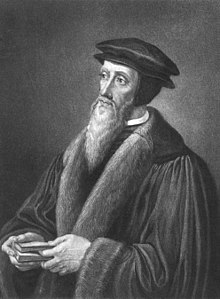
John Calvin: Barcelona, Spain (1554)

Courtesy Wikipedia

By Spencer D Gear PhD

Did John Calvin (AD 1509-1564) support limited atonement? In the early days of his writing when he was aged 26, he completed the first edition of The Institutes of the Christian Religion. In the Institutes, he wrote:

I say with Augustine, that the Lord has created those who, as he certainly foreknew, were to go to destruction, and he did so because he so willed. Why he willed it is not ours to ask, as we cannot comprehend, nor can it become us even to raise a controversy as to the justice of the divine will. Whenever we speak of it, we are speaking of the supreme standard of justice (Institutes 3.23.5).

Here Calvin affirmed that God willed the destruction of unbelievers. Calvin continues:

their perdition depends on the predestination of God, the cause and matter of it is in themselves. The first man fell because the Lord deemed it meet that he should: why he deemed it meet, we know not. It is certain, however, that it was just, because he saw that his own glory would thereby be displayed (Institutes 3.23.8)

While this description is tied up with Calvin’s view of double predestination, it is linked with the doctrine of limited atonement in that it would be impossible for God to predestine unbelievers to eternal damnation and yet provide unlimited atonement that was available to them, unto the possibility of salvation. That is the logical connection, as I understand it.

Roger Nicole has written an article on “John Calvin’s view of the extent of the atonement”. This indicates that Calvin did not believe in limited atonement, but that it was a doctrine originated by Calvinists following Calvin. But at the end of the article he stated, ‘Our conclusion, on balance, is that definite [limited] atonement fits better than universal grace into the total pattern of Calvin’s teaching’.

Calvin’s first edition of The Institutes was in Latin in 1536 and this was published in a French edition in 1560.

John Calvin did progress in his thinking when he wrote his commentaries on the Bible later in life. His first commentary was on the Book of Romans in 1540 and his commentaries after 1557 were taken from stenographer’s notes taken from lectures to his students.

Calvin wrote in his commentary on John 3:16,

Faith in Christ brings life to all, and that Christ brought life, because the Heavenly Father loves the human race, and wishes that they should not perish….

That whosoever believeth on him may not perish. It is a remarkable commendation of faith, that it frees us from everlasting destruction. For he intended expressly to state that, though we appear to have been born to death, undoubted deliverance is offered to us by the faith of Christ; and, therefore, that we ought not to fear death, which otherwise hangs over us. And he has employed the universal term whosoever, both to invite all indiscriminately to partake of life, and to cut off every excuse from unbelievers. Such is also the import of the term World, which he formerly used; for though nothing will be found in the world that is worthy of the favor of God, yet he shows himself to be reconciled to the whole world, when he invites all men without exception to the faith of Christ, which is nothing else than an entrance into life.

Let us remember, on the other hand, that while life is promised universally to all who believe in Christ, still faith is not common to all. For Christ is made known and held out to the view of all, but the elect alone are they whose eyes God opens, that they may seek him by faith (bold emphasis added).

Thus, John Calvin himself is very clear here. He believed in unlimited atonement because a limited atonement would not make sense in light of his statement about John 3:16 that ‘he has employed the universal term whosoever, both to invite all indiscriminately to partake of life, and to cut off every excuse from unbelievers’. If unbelievers were destined for eternal destruction by the predestination of God, they would have an excuse, ‘God destined it that way, so I have no alternative but to go to eternal condemnation’. Calvin’s language is unequivocal in John 3:16 that the ‘whosoever’ meant ‘all indiscriminately’ and that no unbeliever would have an excuse before God.

What about his commentary on 1 John 2:2? This verse states, ‘He is the propitiation for our sins, and not for ours only but also for the sins of the whole world’ (ESV). This is speaking of Jesus’ blood sacrifice. Was his suffering for the sins of the entire world or only for the elect, as Calvinists teach?

Calvin believed unlimited atonement

In his commentary on 1 John 2:2, John Calvin wrote:

Christ suffered for the sins of the whole world and in the goodness of God is offered unto all men without distinction; His blood being shed not for a part of the world only but for the whole human race. For although in the world nothing is found worthy of the favor of God yet He holds out the propitiation to the whole world, since without exception He summons all to the faith of Christ which is nothing else than the door unto hope.[1]

I was alerted to this content of Calvin in Augustus Hopkins Strong’s systematic theology (1907:778). I have the hardcover edition, but it is available online at: Google Books (Accessed 28 August 2012). Strong begins his introduction to this quote from Calvin in 1 John 2:2, ‘In later days Calvin wrote in his Commentary on 1 John 2:2….’ (Strong 1907:778). However, I have not been able to source this quote from Calvin online, although one poster in a Forum stated that it was from an earlier edition of Calvin’s commentaries published by Eerdmans.

However, Strong’s statement is not what Calvin wrote earlier in his commentary on this verse as the succeeding quote demonstrates.

Roger Nicole’s assessment of Calvin on the atonement is in, ‘Calvin’s view of the extent of the atonement’.

To try to uncover the original source of Calvin’s quote, I started a thread on Christian Forums, ‘Calvin on the Atonement’ (29 August 2012). The only helpful comment in trying to identify this quote has been from LamorakDesGalis:

I believe Eerdman’s was founded in 1911, so its unlikely that they were the publisher. I think it likely that Strong had access to Calvin’s Opera Omnia[2], a massive Latin work of 59 volumes, and probably translated it from the Latin.
The quote from Strong is consistent with what Calvin has stated in many places. The early Reformers – Luther, Zwingli, Bullinger – held to universal atonement. Calvin was no exception, and his comments throughout his works are very clear. For example Calvin’s commentary for Romans 5:18 where he states that Christ suffered for the sins of the whole world:

He makes this favor common to all, because it is propounded to all, and not because it is in reality extended to all; for though Christ suffered for the sins of the whole world, and is offered through God’s benignity indiscriminately to all, yet all do not receive him.[3]

Also Calvin’s commentary for Mark 14:24, where Calvin clarifies what is meant by “many”:[4]

Which is shed for many. By the word many he means not a part of the world only, but the whole human race[/b]; for he contrasts many with one; as if he had said, that he will not be the Redeemer of one man only, but will die in order to deliver many from the condemnation of the curse.[5]

How would a Calvinist reply to these citations from Rom. 5:18 and Mark 14:24 in support of universal atonement? Here is one example:

This is the quote from Calvin’s Commentaries on Romans 5:18:
“He makes this favor common to all, because it is propounded to all, and not because it is in reality extended to all; for though Christ suffered for the sins of the whole world, and is offered through God’s benignity indiscriminately to all, yet all do not receive him.”

What Calvin is saying is that the OFFER is to all, but all do not receive him, so even though the offer is to all, the atonement is not extended to all.

[Of Mark 14:24],

What Calvin means is simply that Christ died for the world, in the sense that He died not just for Jews, or for the French, etc. but that He died for peoples from every nation tribe and tongue, which together represent the entire human race. Similar to reading Scripture, to properly understand an author, we have to read them in their proper context. To say that John Calvin held to a “universal atonement” is simply not consistent within the context of his writings as a whole.[6]

Why would Augustus Strong do this?

It is important to understand that Augustus Strong was a Calvinist. The Reformed Reader states:

Augustus Hopkins Strong is perhaps the most notable Baptist theologian of the nineteenth and early-twentieth centuries.  His place in a compendium of Baptist theologians is central.  In some cases he must be read in order to understand the theological writings of others.   Strong taught and wrote his orthodox theology from a committed, reformed, Baptist perspective, while at the same time rigorously engaging intellectual developments within his cultural context.  Strong’s magnum opus, the Systematic Theology, embodied the best of his own theological reflection and of Baptist theological thought prior to the momentous crisis (the Fundamentalist/Modernist controversy).

The Hall of Church History: The Baptists notes that ‘Augustus Strong, another well-known Baptist theologian, was an Amyraldian (four-point Calvinist)’. Elwell’s Handbook of Evangelical Theologians states that ‘The dominant influence at Rochester Theological Seminary when Strong was a student there was Ezekiel Robinson. As a preacher and theologian, Robinson made a great impression on Strong, shaping his theology into a Calvinist mold’.

Strong was writing from a perspective of sympathy with Calvinism. We don’t know the reasons for this amalgamation of Calvin’s teaching against limited atonement (from a synthesis of comments in his commentaries), but it may have been to show that Calvin did not support limited atonement. We know this from Calvin’s commentaries on Mark 14:24, John 3:16, Romans 5:18 and 1 John 2:2.

Calvin believed limited atonement

However, Calvin’s online edition of 1 John 2:2 states:

And not for ours only He added this for the sake of amplifying, in order that the faithful might be assured that the expiation made by Christ, extends to all who by faith embrace the gospel.

Here a question may be raised, how have the sins of the whole world been expiated? I pass by the dotages of the fanatics, who under this pretense extend salvation to all the reprobate, and therefore to Satan himself. Such a monstrous thing deserves no refutation. They who seek to avoid this absurdity, have said that Christ[7] suffered sufficiently for the whole world, but efficiently only for the elect. This solution has commonly prevailed in the schools. Though then I allow that what has been said is true, yet I deny that it is suitable to this passage; for the design of John was no other than to make this benefit common to the whole Church. Then under the word all or whole, he does not include the reprobate, but designates those who should believe as well as those who were then scattered through various parts of the world. For then is really made evident, as it is meet, the grace of Christ, when it is declared to be the only true salvation of the world.

In earlier days, did Calvin believe limited atonement? See the Institutes.

See the quotes at the beginning of this article from Institutes 3.23.5 and Institutes 3.23.8. However, these have to do with double predestination and not limited atonement. In Calvin’s works, I cannot read support for limited atonement, but I have not read all of his voluminous writings.

On Christian Forums a person alerted me to this article that helps to explain how Strong got his quote, ‘Augustus H. Strong (1836-1921) on Calvin on the Extent of the Atonement’. This is part of what that author wrote:

There is no evidence that Calvin held to limited atonement early in his life, and then moved to embrace unlimited atonement later. 2) Regarding the second comment, Strong’s formatting leaves much to be desired. At first glance, it may appear that Strong is extracting a single quotation from Calvin, and that from his commentary on 1 John 2:2. Strong is quoting free separate sources from Calvin’s commentaries. Firstly, Calvin’s comments on 1 John 2:2, and then the three separate references: Romans 5:18, Mark 14:24, and lastly John 3:16. For the last, Strong appears to be citing an older unknown translation of Calvin on John 3:16, or perhaps his own translation. Early English translations of Calvin on John 3:16 translated propitium as reconciliation or propitiation. 4) Thus Strong has extracted multiple comments from Calvin and then collapsed them into an apparently single quotation string.

That helps me to understand that Calvin never believed in limited atonement and that Strong’s assessment is from a variety of Calvin’s commentaries.

Here is further information on Calvin’s teaching on unlimited expiation.

Here I update the above assessment where further research has discovered that Calvin did not believe Jesus’ death was for the whole world of sinners. See my further assessment in:

Was John Calvin a TULIP Calvinist?

Further research

In my further investigation of Calvin on his view of the atonement, I discovered he was a fence-sitter. Sometimes he believed in universal atonement for the whole world and at other times it was limited to the elect. See the further research at: Was John Calvin a TULIP Calvinist?

I am left to conclude this was his conclusion concerning the atonement:

https://i0.wp.com/i.pinimg.com/originals/c1/06/86/c106860e30037481bfe6f3fbc6775341.jpg?resize=157%2C209&ssl=1

(photo courtesy Linda Sumruld)

What did the early church fathers say?

Church Fathers, 11th century Kievan minature: Wikipedia

Quotations from the Early Church Fathers

In this link you will find quotations by Ron Rhodes from church fathers affirming universal atonement. However, Ron has gathered these quotes from secondary sources. Not once in this link does he acknowledge the primary sources for these quotes. However, he does give secondary sources (in footnotes) in ‘The extent of the atonement’, but he is quoting other Christian authors and not directly from the church fathers. In what follows, I have attempted to follow up his quotes from the primary sources available on the www. What I found in some cases was that many of these quotes from the secondary sources were not confirmed in a www search. But Rhodes’ quotes from the early church fathers seem to have been accepted by many people using his quotes from his article.[8]

Let’s check out the primary sources online to see if some of the early church fathers (the ones mentioned by Ron Rhodes) supported unlimited atonement!

clip_image002Clement of Alexandria (150-220):‘He bestows salvation on all humanity abundantly’ (Paedagogus 1.11). ‘For instruction leads to faith, and faith with baptism is trained by the Holy Spirit. For that faith is the one universal salvation of humanity’ (Paedagogus 1.6). Elsewhere it has been stated by Ron Rhodes that Clement of Alexandria taught, ‘Christ freely brings… salvation to the whole human race’.[4][9] However, I’ve been unable to find these exact quotes in the writings of Clement of Alexandria.

clip_image002[1]Eusebius (260-340): ‘the Lamb of God that takes away the sin of the world, and of His human body…. This Sacrifice was the Christ of God, from far distant times foretold as coming to men, to be sacrificed like a sheep for the whole human race’ (Demonstratio Evangelica, Bk 1, Introduction, ch. 10). ‘His Strong One forsook Him then, because He wished Him to go unto death, even “the death of the cross,” and to be set forth as the ransom and sacrifice for the whole world…. to ransom the whole human race, buying them with His precious Blood from their former slavery to their invisible tyrants, the unclean daemons, and the rulers and spirits of evil’ (Demonstratio Evangelica, Bk 10, ch 8).

clip_image002[2]Athanasius (293-373), in The Incarnation of the Word, wrote: ‘None could renew but He Who had created. He alone could (1) recreate all, (2) suffer for all, (3) represent all to the Father’ (7, heading). ‘all creation was confessing that He that was made manifest and suffered in the body was not man merely, but the Son of God and Saviour of all’ (19.3); ‘or who among those recorded in Scripture was pierced in the hands and feet, or hung at all upon a tree, and was sacrificed on a cross for the salvation of all?’ (37.1)

It has been quoted frequently across the www that Athanasius stated, ‘Christ the Son of God, having assumed a body like ours, because we were all exposed to death [which takes in more than the elect], gave Himself up to death for us all as a sacrifice to His Father’.[5] [10]However, I have been unable to find this exact quote in Athanasius.

clip_image002[3]Cyril of Jerusalem (315-386): ‘And wonder not that the whole world was ransomed; for it was no mere man, but the only-begotten Son of God, who died on its behalf’ (Catacheses – or Catehetical Lectures 13.2).

clip_image002[4]Cyril of Alexandria (A.D. 376-444) taught that we confess that he is the Son, begotten of God the Father, and Only-begotten God; and although according to his own nature he was not subject to suffering, yet he suffered for us in the flesh according to the Scriptures, and although impassible, yet in his Crucified Body he made his own the sufferings of his own flesh; and by the grace of God he tasted death for all…. he tasted death for every man, and after three days rose again, having despoiled hell.’ (Third epistle to Nestorius). ‘Giving His own Blood a ransom for the life of all’ (That Christ is one).

On the Internet, I have read many examples of this quote, “The death of one flesh is sufficient for the ransom of the whole human race, for it belonged to the Logos, begotten of God the Father.” (Oratorio de Recta Fide, no. 2, sec. 7). I have not yet located it on the www.

clip_image002[5]Gregory of Nazianzen (324-389): ‘He is sold, and very cheap, for it is only for thirty pieces of silver; but He redeems the world, and that at a great price, for the Price was His own blood.  As a sheep He is led to the slaughter, but He is the Shepherd of Israel, and now of the whole world also’ (Oration XXIX, The third theological oration on the Son, XX).

I was unable to locate the quote, ‘the sacrifice of Christ is an imperishable expiation of the whole world’, allegedly from Oratoria 2 in Pasch., i.e., Passover.

clip_image002[6]Basil of Caesarea, Basil the Great(330-379): “But one thing was found that was equivalent to all men….the holy and precious blood of our Lord Jesus Christ, which He poured out for us all” (On Ps. 49:7, 8, sec. 4 or Psalm 48, n.4). I have been unable to track down this quote on the www.

clip_image002[7]Ambrose (340-407): “Christ suffered for all, rose again for all. But if anyone does not believe in Christ, he deprives himself of that general benefit.” He also said, “Christ came for the salvation of all, and undertook the redemption of all, inasmuch as He brought a remedy by which all might escape, although there are many who…are unwilling to be healed” [supposedly from Ps. 118, Sermon 8]. I have not yet located it online.

clip_image002[8]Augustine (AD 354-430): Though Augustine is often cited as supporting limited atonement, there are also clear statements in Augustine’s writings that are supportive of unlimited atonement. For example: ” The Redeemer came, and gave a price; He poured forth His Blood, and bought the whole world. You ask what He bought? You see what He has given; find out then what He bought. The Blood of Christ was the price. What is equal to this? What, but the whole world? What, but all nations?” (Exposition on Psalm 96.5). He also stated, “For the blood of Christ was shed so efficaciously for the remission of all sins” (Tractates on the Gospel of John, Tractate 92.1).

clip_image002[9]Prosper of Aquitaine (a friend and disciple of Augustine, ca. AD 390-455): “As far as relates to the magnitude and virtue of the price, and to the one cause of the human race, the blood of Christ is the redemption of the whole world: but those who pass through this life without the faith of Christ, and the sacrament of regeneration, do not partake of the redemption” (Responses on Behalf of Augustine to the Articles of Objections Raised by the Vincentianists, 1, part of this quote is available at, Classical Christianity). Unfortunately, I have not been able to source this online from a site for Prosper of Aquitaine.

He also wrote: ‘Wherefore, the whole of mankind, whether circumcised or not, was under the sway of sin, in fetters because of the very same guilt. No one of the ungodly, who differed only in their degree of unbelief, could be saved without Christ’s Redemption. This Redemption spread throughout the world to become the good news for all men without any distinction’ (Prosper of Aquitaine, The Call of All Nations, p. 119).

The following are citations from secondary sources for Prosper of Aquitaine, but I have been unable to locate primary sources on the www: He also said, “The Savior is most rightly said to have been crucified for the redemption of the whole world.” He then said, “Although the blood of Christ be the ransom of the whole world, yet they are excluded from its benefit, who, being delighted with their captivity, are unwilling to be redeemed by it.”

For an assessment of the biblical material, see my article, ‘Does the Bible teach limited atonement or unlimited atonement?

See also:

References

Strong, A H 1907. Systematic Theology, three vols in one. Philadelphia: The Judson Press.

Notes:


[1] This quote also is cited by other writers online but no reference is given to the primary source by Calvin, examples being:

(1) http://www.theologyweb.com/campus/showthread.php?4239-Did-John-Calvin-Change-his-views-on-Limited-Atonement;

(2) http://www.theologyonline.com/forums/showthread.php?t=80286&page=3;

(3) http://ronleigh.com/bible/calarm/index.htm;

(4) http://www.biblestudymanuals.net/1jn2.htm;

(5) http://www.baptistbanner.org/Working /What%20Should%20Southern%20Baptist%20have%20to%20do%204884.htm;

(6) http://www.doffun.com/index.cfm?article_num=493;

(7) http://the212partnerscalvinism.blogspot.com.au/;

[2] He gave this information about this source: Ioannis Calvini opera quae supersunt omnia. Edited by G. Baum, E. Cunitz, and E. Reuss. 59 vols. Corpus Reformatorum 29–87. Brunswick: Schwetschke, 1863–1900. Calvin’s Opera Omnia is available online at PRDL | Welcome to The Post-Reformation Digital Library – in Latin. I’m not really aware of any English translations.

[3] I located this quote online from Calvin’s commentary on Romans 5:18, available at: http://m.ccel.org/ccel/calvin/calcom38.ix.x.html?highlight=romans#highlight (Accessed 31 August 2012).

[4] I sourced this quote of Calvin from: http://www.sacred-texts.com/chr/calvin/cc33/cc33028.htm (Accessed 31 August 2012).

[5] Christian Forums, General Theology, Soteriology, ‘Calvin on the atonement’, LamorakDesGalis#18. Available at: http://www.christianforums.com/t7683551-2/ (Accessed 31 August 2012).

[6] Apologetic Warrior #19, available at: http://www.christianforums.com/t7683551-2/#post61293992 (Accessed 31 August 2012).

[7] The footnote at this point was, ‘“It seems to me that the Apostle is to be understood as speaking only of all those who believe, whether Jews or Gentiles, over the whole world.” — Doddridge. — Ed’. This seems to be an imposition on the text in light of Calvin’s comments about “all the world”, “the whole human race”, “extended to all”, etc. in Mark 14:24; John 3:16; Rom. 5:18 and 1 John 2:2.

[8] Here are a few examples: http://www.gracemessenger.com/index.php?id=612; http://209.157.64.201/focus/religion/2661138/replies?c=1248; http://www.baptistboard.com/showpost.php?p=938642&postcount=27.

[9] Ron Rhodes 1996. The extent of the atonement: Limited atonement versus unlimited atonement (Part 2), available at: http://chafer.nextmeta.com/files/v2n3_rhodes.pdf (Accessed 28 August 2012). Rhodes gives the reference as Paedagogus, ch. 11. However, there is no such reference as there are three books (online) each with a ch. 11, but the quote is not to be found in any of these chapters.

[10] One example is in Ron Rhodes cited above at: http://chafer.nextmeta.com/files/v2n3_rhodes.pdf (Accessed 28 August 2012).

Copyright © 2012 Spencer D. Gear. This document last updated at Date: 21 July 2019.

cubed-redmattecubed-redmattecubed-redmattecubed-redmattecubed-redmattecubed-redmatte

I can’t do it on my own – the testimony of Nick Vujicic

Nick Vujicic, courtesy Wikipedia

By Spencer D Gear

I have seen a news item on Australian TV’s ‘60 Minutes’ program about Nick Vujicic who was born without legs and arms from tetra-amelia syndrome, 4 December 1982. For limbs, he has only what he calls a chicken leg of a foot.

However, I was introduced to his victorious Christian testimony in this YouTube video, God is sufficient  (it has German subtitles but all of the talking is in English). Enjoy! And praise God for the opportunities He gives, no matter what the disability in life.

Here is an amazing story with amazing apologetic impact. My trials and difficulties, three bouts of rheumatic fever as a child and 4 mitral valve surgeries as an adult,  are trivial compared with this man’s, but his testimony for Christ is amazing. His God is sufficient for him to have a victorious life in the midst of severe disabilities.

Nick was born to a Serbian pastor and his wife in Brisbane, Australia. Read his story in Wikipedia, Nick Vujicic. This article states that ‘Vujicic graduated from Griffith University at the age of 21 with a double major in accountancy and financial planning’. Did you get it? Without arms and legs and he completed a bachelor’s degree with a double major by the age of 21? He certainly can’t do it on his own. His God is sufficient for all his needs.

On 10 February 2012, Nick married Kenae Miyahara in California, USA. See the story, ‘Limbless evangelist Nick Vuijicic  honeymoons with new wife in Hawaii’. At the time of this writing, they are expecting their first child. See, ‘Limbless Evangelist Nick Vujicic Announces Breaking News: We are Expecting!’ (The Gospel Herald, 22 August 2012).

Is there any disability that you have that could be more severe than Nick’s? I found this testimony to be an amazing testimony and defense of the vibrant Christian faith in such a practical ministry to school youth and to prisoners (in the YouTube video).

He has a developing ministry, Life without Limbs. Read some more of this inspiring man’s message in, ‘Who validates you?

Courtesy Wikipedia

Copyright © 2013 Spencer D. Gear. This document last updated at Date: 29 October 2015.

designReddesignReddesignReddesignReddesignRed

How bad is the downgrade in your evangelical church?

Image result for downgrade clip art public domain
(publicdomainhut.com)

By Spencer D Gear

‘I know you are aware of the contemporary nature of [our church], and this nature flows through all areas of our life, and most definitely home groups’.

A pastor’s response

What is a downgrade? Dictionary.com provides these definitions:

down·grade

[doun-greyd]Show IPA noun, adjective, adverb, verb, down·grad·ed, down·grad·ing.

noun

1. a downward slope, especially of a road.

adjective, adverb

2. downhill.

verb (used with object)

3. to assign to a lower status with a smaller salary.

4. to minimize the importance of; denigrate: She tried to downgrade the findings of the investigation.

5. to assign a lower security classification to (information, a document, etc.).

Idiom

6. on the downgrade, in a decline toward an inferior state or position: His career has been on the downgrade.

Downgrade in content at church

It has been particularly applied to the downgrade theological controversy, particularly in England. C H Spurgeon was particularly involved in what was happening in England. Erroll Hulse wrote in, “Charles Haddon Spurgeon and the Downgrade Controversy’, that

he last five years of Spurgeon’s life, 1887-1892 were troubled and saddened by the Downgrade Controversy. Spurgeon carried an enormous workload. He possessed neither the time nor the energy to pursue and remedy the widespread doctrinal decline in the B U (Baptist Union)….

The Downgrade controversy broke out when Spurgeon observed aggressive promotion of the ‘new thought’ and blatant denials of evangelical belief affecting the Baptist denomination. Calvinism, which had been the theology of both Congregationalists and Baptists, had faded away. It remained embedded in their confessional statements and in the trust deeds of hundreds of churches but not in the hearts and minds of the ministers and people. The old truths were not being attacked. They were simply ignored….

An essential part of orthodox doctrine is the truth that the impenitent will be subjected to the eternal punishment of God. With the lack of clarity this truth was undermined in three ways: 1. The teaching of conditional immortality, 2. The idea of a future probation, and 3. The universal salvation of all creation.

What is evangelical Christianity?

Here it is stated, accurately, that they are ‘the people of the Book: To know the only true God, honor and obey him, and to make him known’. It’s important to realise that ‘the original meaning of the word evangelical applied to Protestant true believers, distinguishing them from Protestant liberals and traditionalists. It had nothing to do with a specific denomination’. However, ‘it is sad to say that ‘today the word “evangelical” is losing its original meaning and does not necessarily refer to a true believer who holds to the inerrancy, authority and sufficiency of the Scriptures’.

However, I’m using the term ‘evangelical’ to mean born-again believers who are committed to the authority of Scriptures (inerrant in the originals) who who want to know the one and only Almighty God, honour Him, obey Him, and make Him known through proclamation of the Gospel and discipleship. These evangelicals will build Christ-honouring churches where the teaching of Scripture (preferably expositionally with illustration and application) is a central tenet of church practice.

I would consider that the following are core doctrines of the evangelical faith in which a born-again Christian should believe:[1]

The downgrade in Australia

This is a personal reflection. Here I reveal how pervasive this downgrade is within evangelical Christianity in Australia in 2011-2012. Even though I knew it was there when living in regional Queensland (visit one of the local seeker-sensitive churches and that becomes self-evident), I became acutely aware of it in mid 2011. My wife and I moved from a regional area to a northern Brisbane suburb to be nearer our children. Our married daughter has a significant disability and needs support and assistance as her husband works full time and I am now retired from employment.[2]

This is what we found when we went searching for an evangelical church that believed what I’ve briefly mentioned above.

Finding an evangelical church

Settling into a new area comes with its own challenges. We were praying that a church family would help us settle more easily into city life. However, finding an evangelical church in this region that does not preach and sing Bible-lite – Christianity on the downhill march – has been extremely difficult. We visited 8 churches before we came to one (North Pine Presbyterian Church, Petrie) that has Bible content in the hymns and preaching. However, the services are very conservative, tending towards dry traditionalism – but that’s another story. At least it is better than what we experienced elsewhere.

Highlighting this problem was a comment I received from a fellow who went to theological college with us in the early 1970s. We met up with him at a recent funeral of a dear friend. He asked where we went to church. When I mentioned a Presbyterian Church, his response was immediate, ‘You go to a church where at least they read the Bible’. What a statement about where the evangelical church is going in this region! He and his wife attend an evangelical church where the Bible is often not even opened in the service. My assessment is that it won’t remain evangelical for very long. Spurgeon’s experience is not new and the downgrade situation is happening right before our eyes. What can we do to stop it? I was hoping that I would become a voice for maturity in a local church’s house fellowship. But that won’t happen with the pastor’s refusal to give me the names of the two home group leaders and their contact details.

Please remember that these were churches whose reputation was that of being ‘evangelical’. These were not those who promote open theological liberalism.

At one of the churches we visited in our suburb, the songs and preaching (not by the pastor) were so contemporary-lite that I mentioned it to a person in a discussion we had as we were leaving the service. Since then I have emailed the pastor to see if we could join a home group in our suburb as we live in this suburb but worship in another. Here is most of the response I received (23 August 2012) in an email:

“I do remember you attending, and so I know you are aware of the contemporary nature of [our church], and this nature flows through all areas of our life, and most definitely home groups. And so if our Sunday worship service was not helpful to you in your journey with Christ, to be honest I don’t imagine our home groups would be either. Its great to see you proactively seeking fellowship outside of a Sunday and I encourage you to find yourself a group in which both yourself and [your wife] are comfortable

Blessings and peace!!”.

I did not speak to the pastor so how could he remember our attending? Somebody has blown the whistle to him about the content of our conversation at the close of the service. But this is an evangelical church in a denomination with a national reputation but the downgrade of biblical Christianity is so pervasive that it is invading the whole church milieu, including the home groups. It was rock music (I’m a former rock DJ) and the music was unsingable for me, a very average singer. The content of the lyrics could be described as nothing more than trite. They were unmemorable and, difficult to sing, and the biblical content was minimal.

However, this is the kind of church content we were exposed to, in 7 different churches in a row. They represent 2 evangelical denominations in and surrounding our suburb in northern Brisbane.

The sadness in the response of the local pastor is that his contemporary philosophy seems to have blinded him from seeing the reality of the content of the songs, the remainder of the service, and the content of the sermon. In that church service, which had music and songs that were akin to a rock concert, the songs were so unmemorable and unsingable that I can’t remember one of them. But I do remember that the Scriptures were not read in that service, not even to go with the sermon.

I expect A. W. Tozer would have a biblical heartache

Could you imagine what a person like A. W. Tozer would think of what is happening in churches of today? He died in 1963 and in his prophetic message he addressed the issues of his day, but it is just as applicable today.

clip_image002

Photo of A. W. Tozer, courtesy Wikipedia

In his introduction to The Best of A. W. Tozer, Warren W. Wiersbe (The Moody Church, Chicago, Illinois) wrote:

I once heard Dr. Tozer at an Evangelical Press Association conference taking to task editors who practiced what he called “super-market journalism-two columns of advertising and one aisle of reading material.” He was an exacting writer and was as hard on himself as he was on others….

What is there about A. W. Tozer’s writings that gets hold of us and will not let us go? Tozer did not enjoy the privilege of a university or seminary training, or even a Bible School education for that matter; yet he has left us a shelf of books that will be mined for their spiritual wealth until the Lord returns.

For one thing, A. W. Tozer wrote with conviction. He was not interested in tickling the ears of the shallow Athenian Christians who were looking for some new thing. Tozer redug the old wells and called us back to the old paths, and he passionately believed and practiced the truths that he taught. He once told a friend of mine, “I have preached myself off of every Bible Conference platform in the country!” The popular crowds do not rush to hear a man whose convictions make them uncomfortable.

Tozer was a mystic-an evangelical mystic-in an age that is pragmatic and materialistic. He still calls us to see that real world of the spiritual that lies beyond the physical world that so ensnares us. He begs us to please God and forget the crowd. He implores us to worship God that we might become more like Him. How desperately we need that message today!

A. W. Tozer had the gift of taking a spiritual truth and holding it up to the light so that, like a diamond, every facet was seen and admired. He was not lost in homiletical swamps; the wind of the Spirit blew and dead bones came to life. His essays are like fine cameos whose value is not determined by their size. His preaching was characterized by an intensity-spiritual intensity-that penetrated one’s heart and helped him to see God. Happy is the Christian who has a Tozer book handy when his soul is parched and he feeIs God is far away.

This leads to what I think is the greatest contribution A. W. Tozer makes in his writings: he so excites you about truth that you forget Tozer and reach for your Bible. He himself often said that the best book is the one that makes you want to put it down and think for yourself. Rarely do I read Tozer without reaching for my notebook to jot down some truth that later can be developed into a message. Tozer is like a prism that gathers the light and then reveals its beauty.[3]

What can be done?

These biblical teachings apply to today’s church:

1. Jesus warned us, ‘At that time many will turn away from the faith and will betray and hate each other, 11 and many false prophets will appear and deceive many people’ (Matt 24:10-11 NIV). Some will want to make this apply only to the time of the Fall of Jerusalem, but it has broader application, as he was teaching his disciples on the Mount of Olives in this context: ‘Watch out that no one deceives you’ (24:4 NIV). We have similar warnings in 1 Tim 4:1; 2 Tim 4:3-4 and Titus 1:10-16 (see an article HERE).

2. We must speak up against false teachers, as 1 Tim. 4:6 states, ‘If you point these things out to the brothers and sisters, you will be a good minister of Christ Jesus, nourished on the truths of the faith and of the good teaching that you have followed’ (NIV).

3. When churches reduce or downplay the content of Scripture in sermons and songs, they are engaging in a downgrade of biblical content. While this may not be specifically promoting false teaching, it is like calling a diseased pineapple a true, genuine pineapple that is suitable for human consumption. Diseased pineapples are sick pineapples. Thus, sick, Bible-lite churches are diseased churches and they need to be called back to their biblical base in all of life.

4. Bill Hybels has admitted what his seeker-sensitive approach has done to the churches that have adopted his philosophy. Hybels stated in 2007 that his experiment had become a failure:

We made a mistake. What we should have done when people crossed the line of faith and become Christians, we should have started telling people and teaching people that they have to take responsibility to become ‘self feeders.’ We should have gotten people, taught people, how to read their bible between services, how to do the spiritual practices much more aggressively on their own.[4]

Michael Craven’s comment on the Willow Creek survey of its people was:

The shortcoming of this approach is made apparent in the fact that the “most dissatisfied” group within the church, according to the survey, was those considered to be the most spiritually mature. Their chief complaints? “They desire much more challenge and depth from the services” and “60 percent would like to see more in-depth Bible teaching”—the very things that the seeker-sensitive model diminishes.[5]

But, has this confession made any difference to Bill Hybels? Is he repentant of his past seeker-sensitive mistakes? Not at all! This report stated:

It is no new thing that Willow Creek wishes to “transform the planet.” They are part of the emerging spirituality that includes Rick Warren and many other major Christian leaders who believe the church will usher in the kingdom of God on earth before Christ returns. This dominionist, kingdom-now theology is literally permeating the lecture halls of many Christian seminaries and churches, and mysticism is the propeller that keeps its momentum. If Willow Creek hopes to transform the planet, they won’t be able to get rid of the focus on the mystical (i.e., contemplative). Their new Fall 2007 Catalog gives a clear picture of where their heart lies, with resources offered by New Age proponent Rob Bell, contemplative author Keri Wyatt Kent, and the Ancient Future Conference with emerging leaders Scot McKnight and Alan Hirsch as well as resources by Ruth Haley Barton and John Ortberg. Time will tell what Willow Creek intends to do about strengthening its focus on “spiritual practices” and “transform[ing] the planet.”[6]

Southern Baptist, James T Draper wrote in 2006,

The desire to be overly seeker-sensitive is pulling us away from proclaiming the hard truth of the Gospel. The Gospel is an offense! A righteous man was nailed to a cross. There was a beating involved, and blood shed. We must not water that down. We cannot compromise the reality of the Gospel under the guise of relevancy. Relevancy is earned when churches – Christians – acting as the hands of Christ, touch the wounded hearts and souls of those around them. When Christians act like Jesus, bear the burdens of others like Jesus, suffer with others like Jesus, then we will be more effective in verbally sharing the pointed truths of the Gospel with them like Jesus. What’s more, the lost will drink in the message like a thirsty man wandering in a desert drinks in cool, clean water.[7]

5. The key is that concerned Christians cannot continue to sit silent in the pews and let the dumbing down of biblical Christianity to continue in their churches. You need to speak up, based on 1 Timothy 4:6. To be able to do this in a strong, courteous way and remain strong in your Christian walk, you need at least one other Christian to pray with you before, during and after this action. You will become a target of the enemy of your soul, so be prepared: Ephesians 6:10-20 (NIV)

Notes:


[1] Some of these were suggested on the ‘People of the Book’ website, available at: http://www.thepeopleofthebook.org/MeaningOfEvangelical.html (Accessed 24 August 2012). However, I’ve reframed the points – mainly!

[2] I became a full-time student, working on a PhD in New Testament, in 2011 as a means to sharpen the ‘iron’ of my mind and to be of help in a local church or teaching institution.

[3] The Best of A. W. Tozer (online). Available at: http://www.churchinmarlboro.org/christdigest/Classical%20Writings/A-W-Tozer-Best-of-a-W-Tozer.pdf (Accessed 24 August 2012). It was not stated which edition of ‘The Best of A. W. Tozer’ is intended. However, the Wikipedia article on Tozer stated that three volumes of ‘The Best of….’ Series have been published. These were in 1979, 1991 and 1995. Amazon.com’s online edition of the book indicates this quote is from Vol. 1 of the ‘Best of’ Series.

[4] Bob Burney 2007. A shocking “confession” from Willow Creek Community Church, Crosswalk.com, 30 October. Available at: http://www.crosswalk.com/11558438/ (Accessed 24 August 2012).

[5] S. Michael Craven 2007, Willow Creek’s confession, Christian Foundations, available at: http://www.christianity.com/11560219/ (Accessed 24 August 2012).

[6] Willow Creek and the new contemplative/emerging spirituality, Lighthouse Trails Research Project, available at: http://www.lighthousetrailsresearch.com/willowcreek.htm (Accessed 24 August 2012).

[7] James T. Draper Jr. 2006. Will Southern Baptists keep their eyes on the ball? Baptist Banner, 19(3), March. Available at: http://www.baptistbanner.org/Subarchive_3/306%20Will%20Southern%20Baptists%20keep%20their%20eyes%20on%20the%20ball.htm (Accessed 24 August 2012).
Copyright © 2012 Spencer D. Gear. This document last updated at Date: 29 October 2015.

Paul on eternal punishment

H

ChristArt

By Spencer D Gear

It is not uncommon to hear statements from uninformed or agenda—promoting ‘Christians’ that the apostle Paul did not preach on eternal punishment or hell? Here are a few examples:

  • ‘It’s an overstatement to say that the christian church has been preaching the doctrine of hell for two millennia. Paul, for one, did not preach it’ (holo).[1]
  • ‘Why not enjoy the true freedom of believing the Scriptures over traditional teaching? Why not follow Paul in a pure Grace Gospel that has no place for, nor need of a religious hell?’[2]
  • ‘This is a very curious thing. Paul, the man specifically commissioned to carry the gospel to the Gentiles, who is universally credited as the most important figure ever to interpret and expound on the gospel, never says a thing about Ghenna or Hades’.[3]

My response to ‘holo’[4]

There is little need for Paul to write on hell as he has given us enough on the “wrath of God’”. The message on hell comes from others, including Jesus. However, what Paul did write on this topic agrees with the Gospels and the Book of Revelation. Pauline verses that demonstrate the wrath of God against unbelievers include:

Romans 1:18;

Ephesians 5:6;

Colossians 3:6.

James Rosscup wrote in ‘Paul’s Concept of Eternal Punishment’,

PAUL’S CONCEPT OF ETERNAL PUNISHMENT
James E. Rosscup
Professor of Bible Exposition

Paul did not deal in as much detail with eternal punishment as did Jesus in the gospels and John in Revelation, but what he did write matches with their fuller descriptions in many points. This is to be expected because of Paul’s strong commitment to Jesus Christ. In Rom 2:6-10 he wrote about God’s anger in punishing the lost and the anguish they will suffer as a result. In Rom 9:22-23 he spoke of vessels of wrath fitted for destruction, a destruction that consists of an ongoing grief brought on as a consequence of God’s wrath. Second Thess 1:8-9 is a third passage that reflects his teaching on eternal punishment. There eternal destruction represents a different Greek expression, one that depicts a ruin that lost people continue to suffer forever as they are denied opportunity to be with Christ. Paul’s failure to use a number of other words in expressions that could have expressed annihilation of the unsaved is further indication of his harmony with Jesus and John in teaching an unending punishment that the unsaved will consciously experience.

Holo has a presuppositional agenda and he doesn’t want the teaching on eternal punishment to be in the NT. It is there and that’s an embarrassment to him. So what does he do? He attempts to deny that Paul taught it. But he is wrong. Paul supports Jesus in the teaching on eternal punishment.

Holo has four major issues that come out in some of his posts, including these:

(1) He does not know his Bible very well, including the Pauline epistles;

(2) He has a low view of the Scripture when he uses his improper interpretation of the Pauline epistles to arrive at a false conclusion about Paul not teaching on hell.

(3) He engages in a hermeneutic of eisegesis. He imposes his will on the texts instead of letting the texts speak for themselves (exegesis).

(4) We gain a meaning of what happens at death for believers and unbelievers from the totality of Scripture, not only from the Pauline epistles. Even if Paul’s epistles said nothing about eternal punishment or destruction, we don’t need it as it is taught throughout OT and NT, although more specifically in the NT.

Paul on hell

For an excellent chapter on the biblical basis for hell from the Pauline epistles, see Douglas J. Moo, ‘Paul on Hell[5]. His conclusion is:

As we noted at the outset of this essay, Paul never uses the Greek words that are normally translated as “hell,” nor does he teach as explicitly about the concept of hell as do some other New Testament writers. To some extent, then, our purpose has been a negative one: to show that Paul teaches nothing to contradict the picture of hell that emerges more clearly from other portions of the New Testament. But the evidence we do have from Paul suggests that he agrees with that larger New Testament witness in portraying hell as an unending state of punishment and exclusion from the presence of the Lord. Such a fate is entirely “just,” Paul repeatedly stresses (e.g., Rom. 1:18-2:11; 2 Thess. 1:8-9), because human beings have spurned God and merited his wrath and condemnation.

Paul, therefore, presents the judgment that comes on the wicked as the necessary response of a holy and entirely just God. For Paul, the doctrine of hell is a necessary corollary of the divine nature. Negatively, Paul never in his letters explicitly uses hell as a means of stimulating unbelievers to repent. But he does—a sobering consideration!—use it as a warning to believers to stimulate us to respond to the grace of God manifested in our lives (e.g., Rom. 8:12-13).[6]

Other articles

For more of my articles on hell and eternal punishment, see:

Notes:


[1] Christian Forums, Christian Philosophy & Ethics, ‘Why an eternal hell?’, holo #914, 23 August 2012. Available at: http://www.christianforums.com/t7671002-92/ (Accessed 23 August 2012).

[2] Clyde L. Pilkington Jr 2004-2007, ‘Paul’s teaching on hell’. Available at: http://www.studyshelf.com/hellfactor/art_paulsteachingonhell.htm (Accessed 23 August 2012).

[3] ‘Paul, Hell & Universalism’, Running with the Lion, available at: http://mattritchie.wordpress.com/2007/02/06/paul-hell-and-universalism/ (Accessed 23 August 2012).

[4] OzSpen, #922, 23 August 2012. Available at: http://www.christianforums.com/t7671002-93/ (Accessed 23 August 2012).

[5] This is an updated reference, accessed 15 December 2014. Originally, the reference was, Douglas J Moo, ‘Paul on hell’, in C W Morgan & R A Peterson, R A (eds) 2007. Hell under Fire. Grand Rapids, Michigan: Zondervan, ch 4. Available at: http://www.djmoo.com/articles/paulonhell.pdf (Accessed 23 August 2012). Portions of this book are also available through Google Books.

[6] Moo 2007:109.


Copyright © 2013 Spencer D. Gear. This document last updated at Date: 17 April 2018.

clip_image001clip_image001[1]clip_image001[2]clip_image001[3]

Does the Bible support slavery?

Photograph of a slave boy in Zanzibar. ‘An Arab master’s punishment for a slight offence. ‘ c. 1890 (photograph ourtesy Wikipedia)

By Spencer D Gear

Claims are made that the Bible supports slavery and that the people of contemporary culture should be able to choose their own values. Here are a few examples of such statements:

  • ‘If you are truthful to the Bible, would you not agree with me that St Paul supports slavery while we today are dead opposed to it? That morality even in the Bible has changed?’ (Greneknight #64, Christian Forums, 22 August 2012)
  • ‘Except for murder, slavery has got to be one of the most immoral things a person can do.  Yet slavery is rampant throughout the Bible in both the Old and New Testaments.  The Bible clearly approves of slavery in many passages, and it goes so far as to tell how to obtain slaves, how hard you can beat them, and when you can have sex with the female slaves. Many Jews and Christians will try to ignore the moral problems of slavery by saying that these slaves were actually servants or indentured servants.  Many translations of the Bible use the word “servant”, “bondservant”, or “manservant” instead of “slave” to make the Bible seem less immoral than it really is.  While many slaves may have worked as household servants, that doesn’t mean that they were not slaves who were bought, sold, and treated worse than livestock (‘Slavery in the Bible’, Evil Bible.com).
  • ‘If the Bible is written by God, and these are the words of the Lord, then you can come to only one possible conclusion: God is an impressive advocate of slavery and is fully supportive of the concept.

If you are a Christian, I realize that what I am about to suggest is uncomfortable. However, it is crucial to the conversation that we are having in this book. What I wish to suggest to you is that these pro-slavery passages in the Bible provide all the evidence that we need to prove that God did not write the Bible. Simply put: there is no way that an all-loving God would also be a staunch supporter of slavery.

What does your common sense tell you about God? Doesn’t it seem that an all-loving, just God would think of slavery as an abomination just like any normal human being does? If any sort of all-knowing, all-loving God had written the Bible, shouldn’t the Bible say, “Slavery is wrong — you may have no slaves”? Shouldn’t one of the Commandments say, “thou shalt not enslave”?’ (Why does God love slavery?)

A glimpse into the Old Testament view

In the Old Testament, there were at least 6 ways in which a person could become a slave:

  1. As a captive of war: Num 31:7-35 (ESV); Deut 20:10-18 (ESV); 1 Ki 20:39; 2 Chron 28:8-15);
  2. They could be purchased. Foreigners could be purchased and sold and were considered property: Lev 25:44-46 (ESV); Ex 21:16Deut 24:7. The OT gives examples of a father selling his daughter (Ex 21:7; Neh 5:5); children of a widow were sold to pay her husband’s debt (2 Kings 4:11); men and women sold themselves into slavery (Lev 25:39, 47; Deut 15:12-17).
  3. Bankruptcy (Ex 21:2-4; Deut 15:12);
  4. A gift of a slave could be given as Leah received Zilpah as her slave (Gen 29:24).
  5. As an inheritance: Lev 25:46 (ESV). Those who were not Hebrews could be slaves from generation to generation.
  6. Those slaves from birth (Ex 21:4; Lev 25:54) (This material is based on Rupprecht 1976:454-455.)

Slavery was widespread in the secular and Hebrew world of the Near East. For the Hebrews, there were regulations concerning the release of slaves (see Ex 21:1-11; Lev 25:39-55; Deut 15:12-18). Slaves were to be freed after serving for 6 years.

For the Hebrews, the slaves were members of the household and were included with the group of women and children (Ex 20:17).

In Gal 4:1, Paul states, ‘the heir, as long as he is a child is no different from a slave, though he is the owner of everything’. When we go to Gal 4:7 we discover, ‘So you are no longer a slave, but a son, and if a son, then an heir through God’.

There are some interesting and challenging dimensions to slavery when we compare the OT and NT material.

How should we respond to these allegations?

The following is how I responded to Greneknight, as OzSpen #65, 22 August 2012.

There are some excellent assessments and I do not plan to regurgitate what others have said. See:

Concerning ‘1 Corinthians 7:17, 20 Remain in Slavery?’ (Hard Sayings of the Bible 1996. Downers Grove, Illinois: InterVarsity Press, pp. 591-593), this writer’s assessment was:

The difficulty with which 1 Corinthians 7:17 and 20 present us arises primarily from the surrounding verses in the paragraph (1 Cor 7:17-24). In 1 Corinthians 7:21 the situation chosen as an illustration is that of slavery. In 1 Corinthians 7:17 the various situations in which persons found themselves when they were called to faith in Christ are understood as assigned or apportioned by the Lord, and they are told to remain in those situations. That instruction is given further weight in the sentence “This is the rule I lay down in all the churches” (1 Cor 7:17).
In light of these statements, Paul has often been charged not only with failure to condemn the evil system of slavery, but indeed with abetting the status quo. These charges can be demonstrated to be invalid when the paragraph which contains this text is seen within the total context of 1 Corinthians 7 and in light of the historical situation as Paul perceived it.

In 1 Corinthians 7 Paul is dealing with questions about marriage, the appropriate place for sexual expression, the issue of divorce and remarriage, all in response to a pervasive view in the church which rejected or demeaned the physical dimension of male-female relationships. In the immediately preceding paragraph (1 Cor 7:12-16), Paul’s counsel to believers who are married to unbelievers is twofold: (1) If the unbelieving partner is willing to remain in the marriage, the believer should not divorce (and thus reject) the unbelieving partner; for that person’s willingness to live with the believer may open him or her to the sanctifying power of God’s grace through the believing partner (1 Cor 7:12-14). (2) If the unbeliever does not want to remain in the union, he or she should be released from the marriage. Though the partner may be sanctified through the life and witness of the believer, there is no certainty, especially when the unbeliever desires separation (1 Cor 7:15-16).

Having recognized the possibility, and perhaps desirability, of this exception to his general counsel against divorce, Paul reaffirms what he considers to be the norm (“the rule I lay down in all the churches”): that one should remain in the life situation the Lord has assigned and in which one has been called to faith (1 Cor 7:17). In light of exceptions to general norms throughout this chapter, it is probably unwise to take the phrase “the place in life that the Lord has assigned” too literally and legalistically, as if each person’s social or economic or marital status had been predetermined by God. Rather, Paul’s view seems to be similar to the one Jesus takes with regard to the situation of the blind man in John 9. His disciples inquire after causes: Is the man blind because he sinned or because his parents sinned (Jn 9:2)? Jesus’ response is essentially that the man’s blindness is, within the overall purposes of God, an occasion for the work of God to be displayed (Jn 9:3).

For Paul, the life situations in which persons are encountered by God’s grace and come to faith are situations which, in God’s providence, can be transformed and through which the gospel can influence others (such as unbelieving partners).

The principle “remain in the situation” is now given broader application to human realities and situations beyond marriage. The one addressed first is that of Jews and Gentiles (1 Cor 7:18-19). The outward circumstances, Paul argues, are of little or no significance (“Circumcision is nothing and uncircumcision is nothing”). They neither add to nor detract from one’s calling into a relationship with God, and therefore one’s status as Jew or Gentile should not be altered. (It should be noted here that under the pressure of Hellenization, some Jews in the Greek world sought to undo their circumcision [1 Maccabees 1:15]. And we know from both Acts and Galatians that Jewish Christians called for the circumcision of Gentile Christians.)

Once again, it is clear that the general norm, “remain in the situation,” is not an absolute law. Thus we read in Acts 16:3 that Paul, in light of missionary needs and strategy, had Timothy circumcised even though Timothy was already a believer. Paul’s practice in this case would be a direct violation of the rule which he laid down for all the churches (1 Cor 7:17-18), but only if that rule had been intended as an absolute.

Paul now repeats the rule “Each one should remain in the situation which he was in when God called him” (1 Cor 7:20), and applies it to yet another situation, namely, that of the slave. Paul does not simply grab a hypothetical situation, for the early church drew a significant number of persons from the lower strata of society (see 1 Cor 1:26-27). So Paul addresses individuals in the congregation who were of the large class of slaves existing throughout the ancient world: “Were you a slave when you were called?” (that is, when you became a Christian). The next words, “Do not let it trouble you,” affirm that the authenticity of the person’s new life and new status as the Lord’s “freedman” (1 Cor 7:21-22) cannot be demeaned and devalued by external circumstances such as social status.

As in the previous applications of the norm (“remain in the situation”), Paul immediately allows for a breaking of the norm; indeed, he seems to encourage it: “although if you can gain your freedom, do so” (1 Cor 7:21; note the RSV rendering: “avail yourself of the opportunity”). As footnotes in some contemporary translations indicate (TEV, RSV), it is possible to translate the Greek of verse 21 as “make use of your present condition instead,” meaning that the slave should not take advantage of this opportunity, but rather live as a transformed person within the context of continuing slavery. Some scholars support this rendering, since it would clearly illustrate the norm laid down in the previous verse. However, we have already noted that Paul provides contingencies for much of his instruction in chapter 7, and there is no good reason to doubt that Paul supported the various means for emancipation of individual slaves that were available in the Greco-Roman world.

And yet, Paul’s emphasis in the entire chapter, as in the present passage, is his conviction that the most critical issue in human life and relations and institutions is the transformation of persons’ lives by God’s calling. External circumstances can neither take away from, nor add to, this reality. The instruction to remain in the situation in which one is called to faith (which Paul repeats several more times, in 1 Cor 7:24, 26, 40, and for which he also grants contingencies, in 1 Cor 7:28, 36, 38) can be understood as a missiological principle. To remain in the various situations addressed by Paul provides opportunity for unhindered devotion and service to the Lord (1 Cor 7:32-35), or transforming witness toward an unbelieving marriage partner (1 Cor 7:12-16), or a new way of being present in the context of slavery as one who is free in Christ (1 Cor 7:22-23).

The transforming possibilities of this latter situation are hinted at elsewhere in Paul’s writings. Masters who have become believers are called on to deal with their slaves in kindness and to remember that the Master who is over them both sees both as equals (Eph 6:9). The seeds of the liberating gospel are gently sown into the tough soil of slavery. They bore fruit in the lives of Onesimus, the runaway slave, and Philemon, his master. The slave returns to the master, no longer slave but “brother in the Lord” (Philem 15-16).

Note too that the three relational spheres which Paul addresses in 1 Corinthians 7–male-female, Jew-Gentile (Greek), slave-free–are brought together in that high-water mark of Paul’s understanding of the transforming reality of being in Christ: “There is neither Jew nor Greek, slave nor free, male nor female, for you are all one in Christ Jesus” (Gal 3:28). As a rabbi, Paul had given thanks daily, as part of the eighteen benedictions to God, that he had not been born as a Gentile, a slave or a woman. It was his experience of Christ that led him to recognize that these distinctions of superior and inferior were abolished in the new order of things inaugurated in Christ. Surely in this vision the seeds were sown for the ultimate destruction of slavery and all other forms of bondage.

Finally, Paul’s understanding of the historical situation in which he and the church found themselves provides another key for his instruction that believers should remain where they are. He, together with most other Christians, was convinced that the eschaton, the climax of God’s redemptive intervention, was very near. Statements in 1 Cor 7:26 (“because of the present crisis”) and 1 Cor 7:29 (“the time is short”) underline that conviction. This belief created a tremendous missionary urgency. The good news had to get out so that as many as possible could yet be saved (see 1 Cor 10:33). This expectation of the imminent end was surely an important factor for the Pauline norm “remain where you are.”

The biblical view of slavery might be wrong in the estimation of some contemporary Christians, but God did not have such a view when he breathed out the Scriptures (2 Tim. 3:16-17).

Response to the allegations against the Bible and slavery

There is an eerie silence by Jesus, the apostles and Paul in regard to rejecting slavery in a society. I would have thought that Jesus, the sinless Son of God, should have been condemning slavery outright – racial slavery like that in the USA — but this was not so. Why?[1]

  • Please don’t assign a barbaric, violent, unjust view of slaves to the Romans. Paul’s word to slave masters was that they should treat slaves with kindness and consideration (Eph. 6:9; Col. 4:1).
  • Slavery had become a well-known way to become a Roman citizen throughout the Empire;
  • One study found that between 81-49 BC, “500,000 slaves were freed [by the Romans] during this period” and the city of Rome’s population was about 870,000.[2]
  • In the Roman Empire, a slave could expect freedom in about 7 years.
  • “When a master freed his slave, he frequently established his freedman in a business and the master became a shareholder in it.”[3]
  • “While an individual was a slave, he was in most respects equal to his freeborn counterpart in the Graeco-Roman world, and in some respects he had an advantage. By the first century A.D. the slave had most of the legal rights which were granted to a free man.”[4]
  • “Living conditions for most slaves were better than those of free men who often slept in the streets of the city or lived in very cheap rooms.”[5]
  • “The free laborer in NT times was seldom in better circumstances than his slave counterpart.”[6]
  • “In fact, in time of economic hardship it was the slave and not the free man who was guaranteed the necessities of life for himself and his family.”[7]

Islam and slavery

Do not confuse the Christian view of slavery in the Old and New Testaments with the contemporary view of ‘Islam & Slavery’ (Barnabas Fund). That article provides this conclusion:

Many Muslims agree that there is no place for slavery in the modern world, but there has as yet been no sustained critique of the practice. The difficulties and dangers of confronting the example of Muhammad and the teaching of the Qur’an and sharia (which most Muslims believe cannot be changed) have dampened any internal debate within Islam. Although slavery still exists in many Islamic countries, few Muslim leaders show remorse for the past, discuss reparations or show that repugnance for the scourge of slavery that eventually led to its abolition in the West. It is time for Muslims emphatically and publicly to condemn the practice of slavery in any form and to ensure that their legal codes An enslaved Pakistani Christian boy supporting it are changed.

Barnabas Fund: hope and aid for the persecuted church

Conclusion

I do not subscribe to the relativistic presuppositions of cultures determining their own values. I have too high of a respect for the Lord God Almighty and His Scriptures to secede to that view. This is what the Scriptures state:

  • Isaiah 5:20, ‘ Woe to those who call evil good and good evil, who put darkness for light and light for darkness, who put bitter for sweet and sweet for bitter!’ (ESV)
  • Psalm 111:7-8, ‘The works of his hands are faithful and just; all his precepts are trustworthy; they are established for ever and ever, to be performed with faithfulness and uprightness’ (ESV).
  • Proverbs 3:5, ‘Trust in the Lord with all your heart, and do not lean on your own understanding’.
  • Ecclesiastes 12;13, ‘Now all has been heard; here is the conclusion of the matter: Fear God and keep his commandments, for this is the duty of all mankind’ (NIV).
  • John 17:17, ‘Sanctify them in the truth;your word is truth’ (ESV).
  • 1 Peter 1:25, ‘The word of the Lord remains for ever’ (ESV)
  • James 2:12, ‘Speak and act as those who are going to be judged by the law that gives freedom’ (NIV)

Notes:


[1] The following is based on the article by A. Rupprecht, ‘Slave, Slavery’, in Merrill C. Tenney gen. ed. 1976, Zondervan Pictorial Encyclopedia of the Bible, vol. 5, Q-Z, Zondervan Publishing House, Grand Rapids, Michigan, pp. 453-460.

[2] Ibid., p. 458.

[3] Ibid., p. 459.

[4] Ibid.

[5] Ibid., p. 460.

[6] Ibid.

[7] Ibid.


Copyright © 2014 Spencer D. Gear. This document last updated at Date: 29 October 2015.

Three Crosses on Horizontal Bar

ChristArt

Is fundamentalism a theological swear word?

Image result for photograph J I Packer

(photo J I Packer, photo courtesy Vertical Living Ministries)

By Spencer D Gear

In my part of the world (Australia), to be labelled a ‘fundamentalist’ in relation to Christianity is to talk down to a person who is strict in his/her understanding of Bible doctrines. He or she may even dare to believe that the Bible in the original documents (the autographa) is the inerrant Scripture from God to human beings.

I also meet this kind of thinking on Christian forums on the Internet. Here’s one example:

Many in this forum hate me because I don’t accept the same fundamentalist views that they share. They don’t understand that outside of America, fundamentalism isn’t common and is viewed as a fringe belief.[1]

This was my response as OzSpen[2]

As far back as 1958, J I Packer[3] wrote, ‘Fundamentalism’ and the Word of God (London: Inter-Varsity Fellowship). Some of his points include:

  1. Fundamentalism ‘is a word that combines the vaguest conceptual meaning with the strongest emotional flavour. “Fundamentalist” has long been a term of ecclesiastical abuse, a theological swear-word’ (p. 30).
  2. Fundamentalism ‘is, we maintain, the oldest version of Christianity; theologically regarded, it is just apostolic Christianity itself’ (p. 38).
  3. ‘The problem of authority is the most fundamental problem that the Christian Church ever faces. This is because Christianity is built on truth: that is to say, on the content of a divine revelation’ (p. 42).
  4. ‘To deny the normative authority of Scripture over the Church is to misconceive the nature of Christianity, and, in effect, to deny the Lordship of Christ’ (p. 68).
  5. [He is responding to liberalism’s attacks on ‘fundamentalists’ when he stated that] ‘The fundamental cleavage between so-called ‘Fundamentalists’ and their critics. The latter are, in fact, subjectivists in the matter of authority. Their position is based on an acceptance of the presuppositions and conclusions of nineteenth-century critical Bible study, which are radically at variance with the Bible’s own claims for itself’ (p. 72).
  6. ‘We have seen what the real issues are: the authority of Christ and the Scripture; the relation between the Bible and reason; the method of theology, and the meaning of repentance; the choice between Evangelicalism and Subjectivism…. First principles must be first dealt with. Evangelicals should not let themselves be intimidated by the shower of explosive words–‘Fundamentalist’, ‘obscurantist’, ‘literalist’ and the rest–that is regularly poured out upon them. they should request a reasoned statement of the accusations preferred against them…. For Evangelicals are bound, as servants of God and disciples of Christ, to oppose Subjectivism wherever they find it. Defending truth, and exposing error, are two aspects of the same task’ (p. 176).

That should be a starter from someone who is a British-born Anglican fundamentalist / evangelical scholar, theologian and exegete, J I Packer. He’s a Brit and thoroughly fundamentalist, but a scholarly presenter of biblical truth.

By the way, outside of USA and here in Australia, fundamentalism / evangelicalism is seen as Bible-based Christianity with a high view of Scripture. Of course, there may be extremists who are KJV-only and somewhat sectarian, but I’ve seen that in liberal Anglicanism and Uniting Churches Down Under as well. Try being an evangelical in a liberal Anglican, Uniting or Roman Catholic Church in Australia and you’ll be on the outer – really quickly!

So, who really are the fundamentalists? Those who disagree with your Bible-believing Christianity and label you as fundamentalist!

Notes:


[1] Greneknight #56 , Christian Forums, Apologetics, ‘Morality’, available at: http://www.christianforums.com/t7681461-6/#post61206855 (Accessed 22 August 2012).

[2] OzSpen #59, available at: http://www.christianforums.com/t7681461-6/ (Accessed 22 August 2012).

[3] The InterVarsity Press website gives these CV details of Packer, ‘J. I. Packer is Board of Governors’ Professor of Theology at Regent College in Vancouver, British Columbia. He also serves as contributing editor to Christianity Today. Packer’s writings include books such as Knowing God (IVP Books), A Quest for Godliness (Crossway), Growing in Christ (Crossway) and Rediscovering Holiness (Servant), and numerous articles published in journals such as Churchman, SouthWestern Journal, Christianity Today, Reformation & Revival Journal and Touchstone. Available at: http://www.ivpress.com/cgi-ivpress/author.pl/author_id=120 (Accessed 22 August 2012).

Copyright © 2012 Spencer D. Gear. This document last updated at Date: 17 January 2019.
Flower15Flower15Flower15Flower15Flower15Flower15Flower15

God-shrinkers in the pulpit lead to God-shrinkers in the pew

Courtesy Google

If you want to get a picture of what is happening to God’s truth in our churches, take a read of the “Christian-only” section of threads on the largest Christian forum on the www – Christian Forums. Here is one example and the subject is, ‘What an eternal hell?’

And a god, or anybody else, acting 239486709485209873245 times worse than Hitler, for 209348759287358972304587 millennia, and then another 204587032985703485 millennia just to get you warmed up, burning you forever and ever, isn’t what I’d call a “holy” god, not in any positive, non-evil sense of the word anyway.[1]

This was my response to this person:

You are a God inventor. You are presenting your obscure, humanly depraved understanding of God. You are a God-shrinker.

Who are you to decide what eternal damnation looks like. That is the domain of the absolutely pure, holy, infinite God of love. When you begin to understand God’s almighty, holy, perfect and absolutely truthful nature, you might not run off at the mouth like this.

Not one person in this world, including you and me, will get more or less than they deserve from the absolutely pure Lord God Almighty. His justice is absolute and we ALL will get it.

“It is impossible for God to lie” (Hebrews 6:18 ESV).[2]

Jim Packer summed it up in 1996:[3]

For more than three hundred years God-shrinkers have been at work in the churches of the Reformation, scaling down our Maker to the measure of man’s mind and dissolving the biblical view of him as the Lord who reigns and speaks (1996:127, emphasis added).

Packer has hit the theological nail on the head. When there are God-shrinkers in theological colleges, in the pulpits and on the printed and electronic pages, we’ll get them in the pew and in the public, and they’ll flow through to places like Christian Forums.

I’m about to give up on Christian Forums as the God-shrinkers are seen in too many threads here (including this thread). Those who take God at His word and want to listen to what the Scriptures say, instead of making the Scriptures mean what a human mind invents, are decreasing.

Reference:

Packer, J I 1996. Truth & power: The place of Scripture in the Christian life. Wheaton, Illinois: Harold Shaw Publishers.

Notes:


[1] holo, Christian Forums, Christian Philosophy & Ethics, ‘Why an eternal hell?’, #712, 21 August 2012. Available at: http://www.christianforums.com/t7671002-72/ (Accessed 21 August 2012).

[2] Ibid., OzSpen #740, available at: http://www.christianforums.com/t7671002-74/ (Accessed 21 August 2012).

[3] What follows is my reply to Blessedj01 #738, ibid.


Copyright © 2012 Spencer D. Gear. This document last updated at Date: 29 October 2015.

hlinetn_.jpg 0.9Khlinetn_.jpg 0.9Khlinetn_.jpg 0.9K