Author Archives: spencer

What’s wrong with the NRSV translation of John 3:16?

Courtesy NRSV

By Spencer D Gear

This verse in the New Revised Standard Version states, ‘For God so loved the world that he gave his only Son, so that everyone who believes in him may not perish but may have eternal life’ (John 3:16 NRSV).

Some other translations of the verse are:

arrow-smallRevised Standard Version: ‘For God so loved the world that he gave his only Son, that whoever believes in him should not perish but have eternal life’ (John 3:16 RSV)

arrow-smallEnglish Standard Version: ‘For God so loved the world, that he gave his only Son, that whoever believes in him should not perish but have eternal life’ (John 3:16 ESV)

arrow-smallNew American Standard Bible: ‘For God so loved the world, that He gave His only begotten Son, that whoever believes in Him shall not perish, but have eternal life’ (John 3:16 NASB).

arrow-smallNew International Version: ‘For God so loved the world that he gave his one and only Son, that whoever believes in him shall not perish but have eternal life’ (John 3:16 NIV).

arrow-smallNew Living Translation: ‘For God loved the world so much that he gave his one and only Son, so that everyone who believes in him will not perish but have eternal life’ (John 3:16 NLT).

arrow-smallNET Bible: ‘For this is the way God loved the world: He gave his one and only Son, so that everyone who believes in him will not perish but have eternal life (John 3:16 NET).

Translation of the verbs makes the difference

Notice the contrast in translation of the verbs in these three translations: RSV, NRSV and ESV. The NRSV and ESV are based on the RSV, but notice the differences in verbal translations in the second half of the verse:

RSV: ‘whoever believes in him should not perish but have eternal life’;

ESV: ‘whoever believes in him should not perish but have eternal life’;

NRSV: ‘everyone who believes in him may not perish but may have eternal life’;

What are the meanings of the NT Greek verbs in John 3:16b?

The Elements of New Testament Greek        https://i0.wp.com/vig-fp.prenhall.com/bigcovers/013184234X.jpg?resize=167%2C270

Cambridge University Press               Pearson

1. NRSV, ‘believes’ = Greek pisteuwn = masculine, nominative, singular, present participle of pisteuw. Because it is the present tense of the verb it is accurately translated as ‘believes’ or ‘continues to believe’. The latter translation emphasizes the continuous action of the present tense of the verb. So, all of the above translations, including the RSV, ESV and NRSV, are accurate in their translation of this verb as ‘believes’.

2. NRSV, ‘may not perish’ (me[1], meaning not, is the negative accompanying the verb). The Greek verb is apole[2]tai = third person, singular, 2nd aorist tense, subjunctive mood of the verb, apollumi = may not perish (with the negative) as this is the function of the subjunctive mood. This verb is contained in a purpose clause beginning with hina. The Greek aorist tense means point action; Then the negative, me, is used with the aorist subjunctive, it ‘generally denotes a command not to begin an action…. Commands and exhortations (whether expressed by Subjunctive or Imperative) have an element of doubt, since they refer to the future and they may or may not be followed’ (Wenham 1965:166, emphasis in original). In English, ‘the subjunctive expresses thought or wish rather than an actual fact’ (Wenham 1965:12). Therefore, the NRSV translation, ‘may not perish’ and the ESV and RSV translations of ‘should not perish’ are both acceptable as translations with the negative.

3. NRSV, ‘may have’ = Greek eche[3] = third person, singular, present, subjunctive verb, of echw. Greek grammarian, A. T. Robertson, stated that the subjunctive mood ‘is the mood of doubt, of hesitation, of proposal, of prohibition, of anticipation, of expectation, of brooding hope, of imperious will’ (1934:928). However Robertson also admits, after his survey of Greek grammarians and their views of the subjunctive, that ‘the grammarians lead us [on] a merry dance with the subjunctive’ (1934:927). Here’s the problem with the NRSV’s translation of the present tense, subjunctive mood:

4. Machen (1923:128, 131), a Greek grammarian, has stated that while aorist and present are the only tenses used with the subjunctive mood, ‘the present subjunctive does not necessarily refer to present time…. [but] refers to it as continuing or as being repeated’. However, when associated with the conjunction, hina, meaning ‘in order that’ (as in John 3:16), ‘ordinarily it is impossible to bring out the difference in an English translation’ (Machen 1923:131). In John 3:16, the literal meaning would be ‘they may have eternal life’, but this is NOT a good translation as it is impossible to translate as such. Therefore, it seems strange that the NRSV has translated as ‘may have eternal life’ instead of the expected ‘have eternal life’. Any translator wanting to convey the continuous action of present tense, surely would not use ‘may have’ as a translation that accurately gives the understanding from the Greek.

5. The meaning of John 3:16 is conveyed later in that same chapter, in John 3:36, ‘Whoever believes in the Son has eternal life; whoever does not obey the Son shall not see life, but the wrath of God remains on him’ (ESV). In 1 John 5:12, we have a parallel meaning by the same author, John: ‘Whoever has the Son has life; whoever does not have the Son of God does not have life’ (ESV).

Conclusion

The main difference in John 3:16b between the NRSV’s translation of the last verb and the other translations cited above, is that the NRSV does not accurately convey the present tense meaning of eche[4], the present subjunctive of the verb.

With the NRSV’s kind of translation, using the subjunctive mood, it indicates that eternal life is not being experienced in a continuous action. It is only potential with the NRSV translation.

This is a serious theological issue. Can Christians experience eternal life as a continuing reality when they experience it in the future? The common teaching of biblical Christianity is that the Christian life is experienced in the NOW and continues through death as it refers to eternal life that never ends (unless there is apostasy) – but that’s another topic. For discussion of that latter topic, see my article, ‘Once saved, always saved or once saved, lost again: An exposition of Hebrews 6:4-8‘.

Grammar of the Greek New Testament in the Light of Historical Research

Logos Bible Software

References

Machen, J G 1923. New Testament Greek for beginners. Toronto, Ontario: The Macmillan Company.

Robertson, A T 1934. A grammar of the Greek New Testament in the light of historical research. Nashville, Tennessee: Broadman Press.

Wenham, J W 1965. The elements of New Testament Greek. London: Cambridge University Press.

Notes:


[1] This ‘e’ is the transliteration of the Greek letter of the alphabet, eta. Since this html page will not accept the usual transliteration of eta, I have resorted to the use of e, which is the normal transliteration of the Greek letter epsilon.

[2] Ibid.

[3] Ibid. However, eche has the iota subscript to go with the eta. Therefore the parsing is third person, singular, present subjunctive.

[4] Ibid.

Copyright © 2012 Spencer D. Gear. This document last updated at Date: 05 November  2021.

Flower14Flower14Flower14Flower14Flower14Flower14Flower14Flower14Flower14

Secular people are as religious as the church folks

  snowflake-red-small States with state religions
  snowflake-light-green-small States without state religions
  snowflake-white Ambiguous or without data

(Image courtesy Wikipedia)

By Spencer D Gear

Are secular people religious or not? On Christian Forums, I came across this statement, ‘When I say secular, I mean not religious. A historian or literary critic’ (sculleywr #39). This is not an uncommon view. People think that because a person does not claim any religious allegiance such as Hindu, Christian or Muslim, he or she is not religious – that these people don’t have a religious worldview. This definition of a ‘secular worldview’ states:

The Secular Worldview is a religious worldview in which “man is the measure” — mankind is the ultimate norm by which truth and values are to be determined. According to Secular Humanism, all reality and life center upon human beings. In fact, we act as God.

This article on ‘Atheism as a positive worldview’, states that atheism is a positive worldview because:

  • it gives a deeper appreciation for and sense of spirituality toward the cosmos;
  • it imbues our lives with the knowledge that our goals really matter;
  • it offers the freedom to make up your own mind and choose your own direction in life;
  • it offers freedom from the fear of arbitrary divine wrath;
  • it offers morality superior to that of ancient texts;
  • it offers hope for the future.

That’s as religious sounding as any Christian text I could read.

It was German theologian, Karl Barth, who first brought this to my attention. Karl Barth (1963:3-4) wrote of the many theologies in the world and stated that

there is no man who does not have his own god or gods as the object of his highest desire and trust, or as the basis of his deepest loyalty and commitment…. There is, moreover, no religion, no philosophy, no world view that is not dedicated to some such divinity’. This applies to philosophers who affirm ‘that divinity, in a positive sense, is the essence of truth and power of some kind of highest principle; but the same truth is valid even for thinkers denying such divinity, for such a denial in practice merely consist in transferring an identical dignity and function to another object. Such an alternative object might be “nature,” creativity, or an unconscious and amorphous will to life. It might also be “reason,” progress, or even a redeeming nothingness into which man would be destined to disappear. Even such apparently “godless” ideologies are theologies.

What is secularism?

The adjective, secular, is derived from the Latin, saecularis, and means ‘worldly, temporal (opposed to eternal)’. What is a secular person’s highest desire or truth? What is the person or thing to whom a secularist holds deepest loyalty and commitment? That is that person’s religion. Why? Dictionary.com gives this definition:

re·li·gion

noun

1. a set of beliefs concerning the cause, nature, and purpose of the universe, especially when considered as the creation of a superhuman agency or agencies, usually involving devotional and ritual observances, and often containing a moral code governing the conduct of human affairs.

2. a specific fundamental set of beliefs and practices generally agreed upon by a number of persons or sects: the Christian religion; the Buddhist religion.

3. the body of persons adhering to a particular set of beliefs and practices: a world council of religions.

4. the life or state of a monk, nun, etc.: to enter religion.

5. the practice of religious beliefs; ritual observance of faith.

So any one group, including secularists, that has a set of beliefs and practices about ultimate concerns, can be called a religion.

What is the religion of secularists? Dictionary.com wants to define secularism as having no religion:

sec·u·lar·ism

noun

1. secular spirit or tendency, especially a system of political or social philosophy that rejects all forms of religious faith and worship.

2. the view that public education and other matters of civil policy should be conducted without the introduction of a religious element.

However, these secular people are as religious as any I have met. Yes, secular religionists. Why? Because religion has to do with ‘the cause, nature and purpose of the universe’. What do secularists believe about the cause, nature and purpose of our universe? Most lay the cause with evolution. They are opposed to any supernatural deity being involved. Therefore, secularists hold to the ultimate religion of naturalists. They are anti-supernaturalists. That’s as religious as any Christian or Hindu we could meet. What is the ultimate cause? Naturalism and its outworking through evolution.

I recommend a read of Howard P. Kainz, ‘The Culture War Is Between Religious Believers on Both Sides. in Touchstone: A journal of mere Christianity. In this article, Kainz cites Ronald Rolhauser who stated (and I agree):

Ideologies of all kinds, from Marxism to secular feminism, substitute a normative theory of history for the Judeo-Christian story of salvation and propose this new story as the story of salvation; secular art turns creativity into a religion whose God is so jealous as to make the old demanding God of Judaism, Christianity, and Islam [sic] appear lax; secular moralists demand a doctrinal orthodoxy (political correctness) which religious fundamentalists can only envy; secular moral zealots continue to find no end of causes that call for religious martyrdom; positive thinking and pedagogues of excellence propose a new religious hope; the cults of physical health, replete with ever more demanding forms of asceticism, replace old spiritualities regarding the soul; ancient animism, the worship of nature, takes on new religious forms; myths and fairy tales replace the old Bible stories; new shrines (from Graceland to Lady Diana’s tomb) continue to appear; and secular forms of canonization, of books and people, do what religious canonization formerly did. Religion is never at the margins. Everyone has a spirituality, including today’s adult children of the Enlightenment.

Conclusion

This data points to the fact that every philosophy or worldview is a religion. Therefore, all people, whether secular, mosque-going or church-going, do theology. They all deal with the worldviews of ultimate reality. They are religious!

References

Barth, K 1963. Evangelical theology: An introduction. Tr by G Foley. London: Weidenfeld and Nicholson.


Copyright © 2013 Spencer D. Gear. This document last updated at Date: 11 September 2016.

cubed-pinkcubed-pinkcubed-pinkcubed-pinkcubed-pinkcubed-pinkcubed-pinkcubed-pink

Do words matter in worship songs in church?

Humming Bird

(image courtesy ChristArt)

By Spencer D Gear

Take a read of what one poster wrote on Christian Forums in the thread, ‘Entertainment vs worship:

Music is one element of a church meeting. Church building decorations are another. The clothes we wear are another. These are all important things. My wish is that we would treat everything as important as we treat choice of music and words of teaching. As for this thread, well it does seem like it turned into an oldies vs newies debate. I can’t really judge I guess, because it has been a long time since I sung an oldie in a church service, so I guess I don’t know what I’m missing.

I will say however that for a lot of young people, the reason they prefer newies is that they are simply written in the language they would use everyday, so they are more comfortable singing those. Its an expression of where you are on your journey. So yeah, old songs may have a depth sometimes older people would pick up on, but maybe that is because they have the wisdom that comes with age. If you want to bash the young generation fine, but remember how many years it took you to get that wisdom. Or maybe you picked up on the depth of hymns such as Charles Wesley’s from a very early age? Well, I salute you then.

We are the younger generation though, hopefully we do get wisdom with age. Personally, I don’t always pay attention to the words I am singing in worship anyway. I mean they are true words, of course, I wouldn’t sing something I didn’t think was true. But as for depth, wisdom sincerity, fellowship, communion and intimacy with God, well, every time what God does through us is different and all a song needs to have to promote that is a long quiet instrumentally bit where can be still, and instead of focus on what we are saying to God, focus on what God is saying to us.[1]

This was my response:[2]

Since you say, ‘I don’t always pay attention to the words I am singing in worship anyway’, you have nailed one of the key issues in worship singing. Why sing these words if you don’t pay attention to the words?

That to me is one of the key issues. There’s a radical difference between ‘O for a thousand tongues to sing my great redeemer’s praise’ than some of the light stuff I sang last Sunday night at a church I visited with my wife to hear an Open Doors persecuted believer from North Korea.

Those folks rose to sing Hillsong lite stuff and were on their feet for 25 minutes. I’m a former radio DJ and those songs could have competed with some of the Rolling Stones, Beatles, Beach Boys, Jimi Hendrix stuff I played way back when.

They sang a string of existential nothingness while some in the congregation waved, spoke to and gestured to each other – paying no attention to the content of the songs. We had 25 minutes of this and it all began with the rolling of the drums (with 5 microphones behind a cage) that caused my wife and me to jump from our seats with fright when the amplified drums were hammered for the first time to begin ‘worship’ singing.

The music was so loud in this large auditorium that my wife could not tolerate it, so she left the building until the speaker came to the stage.

(Hillsong Church logo – courtesy Wikipedia)

Here’s an example of the Hillsong kind of lyrics:

All Day[3]

[Verse 1]:
I don’t care what they say about me
It’s alright, alright
I don’t care they think about me
It’s alright, they’ll get it one day

[Pre-Chorus]
I love you, I’ll follow you
You are my, my life
I will read my bible and pray
I will follow you all day

[Verse 2]:
I don’t care what it costs anymore
Cos’ you gave it all and I’m following you
I don’t care what it takes anymore
No matter what happens I’m going your way
[Pre-Chorus]
[Chorus]:
All Day
All Day now
All Day
[Verse 1]
[Pre-Chorus]
[Chorus]
[Bridge]:

Anyone around can see
just how good you’ve been to me
For all my friends that don’t know you
I pray that you would save them too
[Chorus]

I listen to the words I sing and refuse to sing trite, existential experiences.

Words matter when we worship God.

Here’s the contrast:

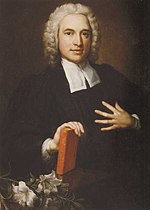
(image of Charles Wesley, courtesy Wikipedia)

Oh, for a Thousand Tongues to Sing[4]

[words by Charles Wesley]

1. Oh, for a thousand tongues to sing
My great Redeemer’s praise,
The glories of my God and King,
The triumphs of His grace!

2. My gracious Master and my God,
Assist me to proclaim,
To spread through all the earth abroad,
The honors of Thy name.

3. Jesus!–the name that charms our fears,
That bids our sorrows cease;
‘Tis music in the sinner’s ears,
‘Tis life and health and peace.

4. He breaks the power of canceled sin,
He sets the prisoner free;
His blood can make the foulest clean;
His blood avails for me.

5. Look unto Him, ye nations; own
Your God, ye fallen race,
Look and be saved through faith alone,
Be justified by grace.

6. See all your sins on Jesus laid;
The Lamb of God was slain;
His soul was once an offering made
For every soul of man.

7. Glory to God and praise and love
Be ever, ever given
By saints below and saints above,
The Church in earth and heaven.

See my other articles:

6pointMetal-smallCompare Charles Wesley’s hymn with a Hillsong song

6pointMetal-smallEntertainment vs Worship

6pointMetal-smallWorldliness in church music

Notes:


[1] ACWaller #57. Available at: http://www.christianforums.com/t7557482-6/#post61544906 (Accessed 12 October 2012).

[2] Ibid., OzSpen #58.

[3] Words available from LyricsMode at: http://www.lyricsmode.com/lyrics/h/hillsong/all_day.html (Accessed 12 October 2012).

[4] The Lutheran Hymnal, available at: http://www.lutheran-hymnal.com/lyrics/tlh360.htm (Accessed 12 October 2012).


Copyright © 2012 Spencer D. Gear. This document last updated at Date: 1 May 2016.
3d-gold-star3d-gold-star3d-gold-star3d-gold-star3d-gold-star3d-gold-star3d-gold-star3d-gold-star

Circumcision and masturbation

Customs of Central Asians. Circumcision. Photograph shows a group of men seated on the ground near a small boy who is being circumcised. Album print. Illus. in: Turkestanskii al’bom, chast’ etnograficheskaia, 1871-1872, part 2, vol. 1, pl. 71. Batga [sic] buri translated from Persian as circumcision. Photo credit: Unknown – Library of Congress, Public Domain, Wikipedia Commons

By Spencer D Gear

I read Macro Torres’ article with interest, ‘When, how & why do we continue to let this happen‘ (online), Prevent Disease, Oct 25, 2011. In this article, Torres stated:

Circumcision is one that still baffles many. When was it that men (and women) decided it was ok to actually start cutting the skin of babies’ and young boys’ penises in an attempt to curb masturbation? Again, why was there always such an interest in curbing masturbation and why resort to such barbaric rituals in an effort to reduce this natural instinct in boys? Why does it still continue today when there is absolutely no accepted and established scientific evidence for any benefits?

This article has many excellent points to make about what is happening to our environment, but it has one major flaw and that has to do with the origin and nature of circumcision. The origin of circumcision had nothing to do with cutting skin off babies’ and young boys’ penises in an attempt to curb masturbation.

This writer shows a gross lack of knowledge about how circumcision began in the Jewish nation in calling them ‘barbaric rituals’. There is a brief overview of the origin of Jewish circumcision in the BBC article, “The circumcision ceremony: Judaism and circumcision“. The BBC article rightly stated, ‘According to the Torah (Genesis 17:9-14), Abraham was commanded by God to circumcise himself, all male members of his household, his descendants and slaves in an everlasting covenant”. For the Jews, this was God’s command to them re circumcision as a sign of an everlasting covenant he made with them:

9And God said to Abraham, “As for you, you shall keep my covenant, you and your offspring after you throughout their generations. 10This is my covenant, which you shall keep, between me and you and your offspring after you: Every male among you shall be circumcised. 11You shall be circumcised in the flesh of your foreskins, and it shall be a sign of the covenant between me and you. 12He who is eight days old among you shall be circumcised. Every male throughout your generations, whether born in your house or bought with your money from any foreigner who is not of your offspring, 13both he who is born in your house and he who is bought with your money, shall surely be circumcised. So shall my covenant be in your flesh an everlasting covenant. 14Any uncircumcised male who is not circumcised in the flesh of his foreskin shall be cut off from his people; he has broken my covenant” (Genesis 17:9-14 ESV).

As a non-Jew, but a committed Christian, I can assure you from 65 years as a circumcised male that it has not had the effect of curbing masturbation.

Torres states that ‘there is absolutely no accepted and established scientific evidence for any benefits’. Really? NO EVIDENCE? Let’s check out the evidence.

Please observe some of the health benefits of circumcision. See the article, ‘Circumcision: Medical Pros and Cons’. This article stated:

“Recently, however, several large studies revealed a 60% decrease in HIV transmission in circumcised males compared to uncircumcised males”.

Professor Brian Morris provides this evidence-based appraisal of circumcision. Here is the summary:

Circumcision of males represents a “surgical vaccine” against a wide variety of infections, adverse medical conditions and potentially fatal diseases over their lifetime, and also protects their sexual partners. In experienced hands, this common, inexpensive procedure is very safe, and can be pain-free. Although it can be performed at any age, the ideal time is infancy. The benefits vastly outweigh risks.

The public health benefits are enormous, and include protection from urinary tract infections, that are common over the lifetime, inferior genital hygiene, smegma, sexually transmitted HIV, oncogenic types of human papillomavirus, genital herpes, syphilis and chancroid, penile cancer, and possibly prostate cancer, phimosis, paraphimosis, thrush, and inflammatory skin conditions such as balanitis and balanoposthitis. In women circumcision of the male partner provides substantial protection from cervical cancer, genital herpes,  bacterial vaginosis (formerly termed “gardnerella”), possibly Chlamydia (that can cause pelvic inflammatory disease, infertility, and ectopic pregnancy), and other infections.

Circumcision has socio-sexual benefits and reduces sexual problems with age and diabetes. It has no adverse effect on penile sensitivity, erectile function, or sensation during sexual arousal and is reported to enhance the sexual experience for men. Most women prefer the circumcised penis for appearance, hygiene, lower infection risk and sexual activity. At least half of all uncircumcised males will develop one or more problems over their lifetime caused by their foreskin, and many will suffer and die as a result. The benefits exceed the risks by over 100 to 1, and if fatalities are taken into account in men and their sexual partners the benefit is orders of magnitude higher than this. Given the convincing epidemiological evidence and biological support, routine circumcision should be highly recommended by all health professionals.

See Professor Morris’s articles:

Who is Professor Brian J Morris?

Professor of Molecular Medical Science
Physiology, School of Medical Sciences
Bosch Institute

F13 – Anderson Stuart Building
The University of Sydney
NSW 2006 Australia

It is not unusual to have secular people object to a quote from Genesis, calling it myth and that it can not be believed as fact. Here I mention Abraham from Genesis 17:9-14. Is Abraham a real historical person? Is Genesis a reliable historical source? I’m not a specialist in this area, so I rely on those who know this field well. I refer to two who know their product:

  • Professor Emeritus of Egyptology at the University of Liverpool (UK), Dr. K. A. Kitchen (2003) and
  • Professor of Old Testament at Gordon-Conwell Theological Seminary (USA), Dr. Walter C. Kaiser Jr (2001).

Here I present their views based on a study of history and a study of the Old Testament.

Professor Kitchen, based on his research, has answered these kinds of questions in his 500 pages of research:

Whether or not the existing Old Testament writings were composed (and their contents originated) entirely within the brief and late period of circa 400-200 B.C., or whether or not their contents are pure fiction, unrelated to the world of the Near East in circa 2000-400 B.C.

To pursue such questions, the only practical method of inquiry was to go back to those ancient times and compare the data in the Hebrew Bible with what we have from its putative world. Merely theorizing in one’s head can achieve nothing. Looking back, we do have some definite results. On the independent evidence from antiquity itself, we may safely deliver a firm “No” to both questions as posed above. Namely, the Old Testament books and their contents did not exclusively originate as late as 400-200 B.C.; and they are by no means pure fiction – in fact, there is very little proven fiction in them overall.

What can be said of historical reliability? Here our answer – on the evidence available – is more positive. The periods most in the glare of contemporary documents – the divided monarchy and the exile and return – show a very high level of direct correlation (where adequate data exist) and of reliability. That fact should be graciously accepted by all, regardless of personal starting point, and with the firm conclusion of alien, hence irrelevant, modern “agendas”….. The primeval protohistory embodies early popular tradition going very far back, and is set in an early format. Thus we have a consistent level of good, fact-based correlations right through from circa 2000 B.C. (with earlier roots) down to 400 B.C. In terms of general reliability … the Old Testament comes out remarkably well, so long as its writings and writers are treated fairly and evenhandedly, in line with independent data, open to all (Kitchen 2003:499-500).

Professor Kaiser stated:

The claims for the historical accuracy of the patriarchs, despite the rich archaeological finds in the middle of the twentieth century, have not found smooth sailing in this twentieth century ever since Julius Wellhausen (1844-1918) declared around the turn of the century that “no historical knowledge” of the patriarchs could be obtained from Genesis, for Abraham, Isaac, and Jacob were a mere “glorified mirage” projected backward into Hebrew history. However, from the 1940s to the 1960s a successful challenge was made to Wellhausen’s estimates of the historical worth of the patriarchs. Two scholars set the stories of the three ancient worthies into the background of the ancient Near East: William Foxwell Albright (1891-1971) and Cyrus Herzl Gordon (1908-2001)….

W. F. Albright, Cryus H. Gordon, and Ephraim A. Speiser mounted an impressive number of parallels between the patriarchal stories and second millennium laws and social customs. The effect was so strong that the evidence seemed to support the essential historicity of the narratives found in Genesis 12-50. A consensus did occur in identifying many of the poems in the Pentateuch as being very early, such as Genesis 49, Exodus 15; Numbers 23-24; and Deuteronomy 33.

Given this mounting evidence, Roland de Vauz declared “that these traditions have a firm historical basis,” while John Bright concluded, “We can assert with full confidence that Abraham, Isaac, and Jacob were actual historical individuals”….

It must be acknowledged that there is no direct external evidence supporting the existence of any one of the three patriarchs. However, the data does exist to demonstrate the fact that they are correctly located in the Middle Bronze setting beginning approximately 2000 B.C…. An increasingly high degree of probability and corroborating evidence continues to mount up from the external evidence to such a point that the case for the genuineness of the patriarchal stories is strong indeed (Kaiser 2001:84-85, 96).

Let’s go back to the first two chapters of the first book of the Bible, Genesis. How do we know whether these two chapters are poetic, figurative, mythological or historical? See Kaiser Jr, et al (1996:89f), Hard Sayings of the Bible for a refutation of the mythological, poetic view and support for the language containing figures of speech in affirming its recording of actual events in the space-time world. Here are a few points made:

  1. Genesis 1 and 2 do not contain the mythic, poetical style of ancient Near Eastern stories. But, like much writing, it contains figures of speech, with God depicted with hands, nostrils, etc. Bullinger lists 150 examples in Genesis 1:1-11:32 of figures of speech used.
  2. It is an error to think that because figurative language is used in Genesis 1-3 that it is not a straightforward presentation of real events.
  3. The biblical account of creation does not demonstrate the forms and substance of myth as ‘nothing has been found in the biblical narrative of creation to tie it to the mythical ancient Near Eastern cosmogonies’ (Kaiser et al 1996:89).
  4. We can’t link Genesis 1-2 to a poetic form as the the Hebrew form of the verb is the same as that used in Hebrew narratives. There are other grammatical and syntactical forms in these 2 chapters that conform to literary genre and are not those used in poetry.
  5. Gen. 1-2 provides a closely reasoned narrative of events ‘in almost a dry didactic form’ with emphasis on ‘definition, naming, evaluating and a general ordering of events. As such the accounts have more in common with narrative prose than anything else’ (Kaiser et al 1996:89).
  6. Based on the available evidence from ancient history, we can rely on the Book of Genesis as a reliable historical document.
  7. While we cannot say that Gen. 1-2 is ‘historical’ in the ordinary sense that facts can be independently verified through other sources and witnesses, ‘it certainly appears to be claiming to record actual events in the stream of happenings in our kind of space-time world’ (Kaiser et al 1996:89).

We can conclude with Professor K.A. Kitchen that “the Old Testament comes out remarkably well, so long as its writings and writers are treated fairly and evenhandedly, in line with independent data, open to all” (Kitchen 2003:500).

Notes:

Kaiser Jr., Walter C.; Davids, Peter H.; Bruce, F. F. and Brauch, Manfred T. 1996. Hard sayings of the Bible. Downers Grove, Illinois: InterVarsity Press.

Kaiser Jr., Walter C 2001. The Old Testament documents: Are they reliable & relevant? Downers Grove, Illinois /Leicester, England: InterVarsity Press.

Kitchen, K A 2003. On the reliability of the Old Testament. Grand Rapids, Michigan / Cambridge, U.K.: William B. Eerdmans Publishing Company.

Copyright (c) 2012 Spencer D. Gear. This document last updated at Date: 15 May 2018.

3d-red-star-small3d-red-star-small3d-red-star-small3d-red-star-small3d-red-star-small3d-red-star-small3d-red-star-small3d-red-star-small3d-red-star-small3d-red-star-small3d-red-star-small3d-red-star-small3d-red-star-small3d-red-star-small3d-red-star-small

Hell in the Bible

Read the Bible

(image courtesy ChristArt)

Spencer D Gear

In this book by Christopher Morgan & Robert Peterson (gen eds) 2007. Hell Under Fire: Modern Scholarship Reinvents Eternal Punishment (Zondervan), you will read how people within the church, some of whom know Greek, are reinventing the doctrine of hell with alternatives such as universalism and annihilationism. I found it to be a commentary on how presuppositions impose on the Greek text (I read and have taught NT Greek) and the text is not allowed to speak for itself.

Morgan & Peterson begin with this story:

A business was opening a new store, and a friend of the owner sent flowers for the occasion. The flowers arrived at the new business site, and the owner read the card, inscribed, “Rest in Peace.”
The angry owner called the florist to complain. After he told the florist of the obvious mistake and how angry he was, the florist said, “Sir, I’m really sorry for the mistake, but rather than getting angry, you should imagine this: Somewhere there is a funeral taking place today, and they have flowers with a note that reads, “Congratulations on your new location” (Introduction)

We are in a time when there are major attempts at scholarly and lay levels to redefine hell. Here are a few examples:

clip_image002[1] John Dominic Crossan, historical Jesus’ scholar of the Jesus Seminar: ‘‘What about heaven and hell, what about terminal rewards and punishments, what about eternity and the afterlife?… Let me be very blunt: I refuse to accept heaven from a God who could invent hell’. He continues, ‘The God of hell is a divinity to fear but not to love, to dread but not to worship, and it is morally necessary to say that loudly and clearly’. He is emphatic: ‘Hell is an obscenity…. For such a Supreme Being, Mrs Job had the only proper answer: Curse God, and die’ (Crossan 2000:201).

clip_image002[1] Layman: ‘I don’t believe God has condemned the majority of man to hell. Hell in the bible is described as eternal fire, bottomless pit, outer darkness, but for the most part simply as death’.[1]

clip_image002[1] John Stott, the late evangelical scholar, ‘In Evangelical Essentials, I described as “tentative” my suggestion that “eternal punishment” may mean the ultimate annihilation of the wicked rather than their eternal conscious torment. I would prefer to call myself agnostic on this issue, as are a number of New Testament scholars I know. In my view, the biblical teaching is not plain enough to warrant dogmatism. There are awkward texts on both sides of the debate’ (McCloughry 2006).

clip_image002[3] Mormon view: ‘LDS[2] do not believe in Hell as a place. The reason why is that revelation through Latter-Day prophets have revealed that there exists three levels of glory and then Outer Darkness. Hope that helps’.[3]

clip_image002[4] Layman: ‘Personally, I don’t believe in traditional concepts of either heaven or hell. I believe God is in all and all are in God. We are from God, and to God we will return. What this means, whether we are conscious of it, and what it is like, I don’t know. I honestly think that how we live here and now is more important than how we will live in an afterlife. My philosophy is “God has that covered, so I’m gonna focus on being the best me I can be here and now”’.[4]

clip_image002[4] Liberal theologian, the late Paul Tillich: ‘”Heaven” and “hell” are symbols of ultimate meaning and unconditional significance’ (1968 III:327).

So there are samples of doubt about hell among liberal and evangelical people with some association with the Christian perspective on life.

We run into a problem when it comes to understanding ‘hell’, especially if we have been raised on the King James Version (KJV) of the Bible.

The KJV translation of hell

We have a major problem with the King James Version and its translation of various Greek words with the same English word. I was preparing to provide teaching on this to expose the KJV translation weaknesses on this topic when I came across this article by J. Gibbons.

Gibbons has summarised this problem:

ALTHOUGH MANY translations of the Bible have been made into English (some good and some not as good), the King James Version (initially translated in 1611) is still widely used by many people (among them being this writer). When there are possible question marks about words that seem archaic, we try to supply parallel words that would be helpful in getting the meaning across. This term “hell” is one that needs our attention. The KJV scholars used the one word “hell” to represent several different words in the original Scriptures. This can be confusing unless one makes a background study as to which word is behind the word “hell” appearing in our KJV (or check out other translations). Consequently, some have misrepresented the Scriptures and have tried to teach that the grave is the only hell (and that there is no place of fire). What about this? What are the words in the original Scriptures, what do they mean, and why did the KJV translators represent these words by only one word in English? Following are gleanings, impressions and conclusions from our study on this.[5]

Greek words for the KJV’s ‘hell’ in the New Testament

Again, Gibbons provides the summary:

Three Words as “Hell”.

In the New Testament, the KJV translators used the word “hell” somewhat generically to represent three different Greek words. The Greek words are (1) gehenna, (2) hades and (3) tartaros (sic). Gehenna is found 12 times in the New Testament (Matthew 5:22,29, 30; 10:28; 18:9; 23:15,33; Mark 9:43,45, 47; Luke 12:5; James 3:6). Hades is found 11 times (Matthew 11:23; 16:18; Luke 10:15; 16:23; Acts 2:27, 31; Revelation 1:18; 6:8; 20:13,14) and tartaros (sic) 1 time (2 Peter 2:4).

Gehenna, Hell Proper.

(1) Gehenna had its origin in association with the valley of Hinnom, actually meaning this. In the Old Testament times, when Israel went into idolatry, human sacrifices took place in this valley next to Jerusalem in the worship of Molech as they would “burn their sons and daughters in the fire” (2 Kings 23:10; 2 Chronicles 28:3; Jeremiah 7:31). The valley was looked upon as being polluted and unclean, and in New Testament times was used somewhat as a city dump with continual burning, we understand. It was with that backdrop the term gehenna was adopted and applied to the place of eternal punishment. Such is its coinage and use. This is hell in what the modern usage of the term “hell” conveys.

Hades, The Unseen World.

(2) We are told that Hades, in its etymology, properly means unseen. The basic stem of the word means seen, but it has the little a privative before it, thus making it signify unseen. All behind and beyond the veil of death is unseen. Thus, it is fittingly called Hades. At death the spirit enters into the unseen world of the dead. The word itself does not necessarily specify whether this state is bad or good. By itself it is generic, but it can be more specific, according to the context and other Scripture. Interestingly, in the account of the rich man and Lazarus, it is said that in “hell” (Hades, KJV) the rich man lifted up his eyes being in torment. With his death, Jesus is said to have gone to Hades (Acts 2:27,31). (This is the word behind the KJV’s translation of “hell” here). Jesus had earlier said to the thief on the cross, “Today shalt thou be with me in paradise” (Luke 23:43). Evidently, the story of the rich man and Lazarus unveils the situation as it was (and perhaps is). The good and the bad are partitioned by a great gulf, it would seem, one being in comfort and the other in discomfort. All of this anticipates the Day of Judgment when eternal heaven and hell will begin.

Tartarus, The Abyss.

(3) Tartarus is only referred to in one place in the New Testament, 2 Peter 2:4. It is found in the words “cast them down to hell” (to send into Tartarus). It is the bottomless abyss, the confinement place of the wicked, fallen angels.

The English Word “Hell”

But what is the actual and literal meaning of the English word “hell” used repeatedly in the KJV of the Bible? This may come as a surprise to many, but the English word “hell” back in 1611 meant about the same as hades, that being covered or unseen. The Cyclopedia of Biblical Theological, and Ecclesiastical Literature (John McClintock and James Strong) that first came out in 1867, says this of the term, “Hell, a term which originally corresponded more exactly to Hades, being derived from the Saxon helan, to cover, and signifying merely the covered, or invisible place—the habitation of those who have gone from the visible terrestrial region to the world of spirits. But it has been so long appropriated in common usage to the place of future punishment for the wicked, that its earlier meaning has been lost sight of.” This does not negate the teaching of a place of future punishment and fire as seen in the word Gehenna and the umbrella word, Hades. It just throws more light on the use of the word “hell” in the King James Version.[6]

I’m grateful for this excellent summary and refer you to Gibbons’ article.

These brief definitions

Here is a brief summary of the meaning of these Greek words.

  • Sheol. OT believers knew that Sheol was visible to God (Job 26:6) and that they were in the presence and protection of God at death (Psalm 139:8).
  • Hades (Morey 1984:81-87). It is the Greek equivalent of Sheol, although it translates other Hebrew words as well. We run into problems with the mistranslation by the KJV of Hades and Sheol. The post-resurrection teaching in the NT is that the believer goes to heaven at death (present with the Lord) to await the resurrection and the final eternal state. But for unbelievers they go to Hades, a temporary place of torment, awaiting their resurrection and the eternal punishment. Regarding 2 Peter 2:9, ‘the grammar of the text irrefutably establishes that the wicked are in torment while they await their final judgment. When the day of judgment arrives, Hades will be emptied of its inhabitants, and the wicked will stand before God for their final sentence (Rev. 20:13-15). Thus, we conclude that Hades will be emptied at the resurrection, and then the wicked will be cast into “hell” (Gehenna)’ (Morey 1984:87).
  • Valley of Hinnom. It is mentioned in Josh 15:8; 18:16 and Neh. 11:30. It was the place where idolatrous Jews gave human sacrifices to pagan deities. In Christ’s day it became Jerusalem’s garbage dump. So, this garbage dump became a Jewish picture of the ultimate fate of idol worshippers (Morey 1984:87).
  • Tartarus. This is used in 2 Peter 2:4 to refer to angels and where they were cast. He was using a word that in Greek literature meant a place of conscious torment in the netherworld. It did not mean non-existence, but referred to their being reserved in the place of mental anguish and terror until the day of judgment (Morey 1984:135).
  • Gehenna. It’s the Greek equivalent of the Valley of Hinnom, so Gehenna is an appropriate description of the final, eternal garbage dump where idolators go after the resurrection. The wicked would suffer there forever. Even Arndt & Gingrich’s Greek lexicon concluded that it means ‘the place of eternal punishment’. Coon and Mills define Gehenna as ‘the place of  eternal punishment’. So Gehenna is the final place of punishment, the ultimate place of torment for the wicked. It will be eternal, conscious torment (Morey 1984:87-90).

Conclusion

The Christian believers go to be with the Lord at death, ‘Away from the body and at home with the Lord’ (2 Cor. 5:8 ESV). They await the resurrection and the final state in heaven.

By contrast, all unbelievers at death go to Hades, a temporary place of torment, and await the resurrection, at which time they will be cast by God permanently into Gehenna, the place of eternal, conscious torment.

This is the biblical teaching on hell, in spite of others wanting to change it.

Other articles

See my other articles on this topic:

clip_image004[1] Are there degrees of punishment in hell?

clip_image004[1] What is the nature of death according to the Bible?

clip_image004[1] Hell & Judgment;

clip_image004[2] Should we be punished for our sins?

clip_image004[1] Paul on eternal punishment;

clip_image004[1] Where will unbelievers go at death?

clip_image004[5]Torment in Old Testament hell? The meaning of Sheol in the OT;

clip_image004[6]Eternal torment for unbelievers when they die;

clip_image004[7]Will you be ready when your death comes?

clip_image004[1] What happens at death for believer and unbeliever?

clip_image004[1] Does eternal destruction mean annihilation for unbelievers at death?

clip_image004[10] Refutation of Seventh-Day Adventist doctrine of what happens at death;

clip_image004[11] Near-death experiences are not all light: What about the dark experiences?

References

Crossan, J D 2000. A long way from Tipperary: A memoir. New York, NY: HarperSanFrancisco.

McCloughry, R. 2006, ‘Basic Stott as a precursor to my piece’, Kenyananalyst, 2 May, available at: http://kenyananalyst.blogspot.com/2006/05/basic-stott-as-precursor-to-my-piece.html (Accessed 10 June 2007).

Morey, R A 1984. Death and the afterlife. Minneapolis, Minnesota: Bethany House Publishers.

Morgan, C & Peterson, R (gen eds) 2007. Hell under fire: Modern scholarship reinvents eternal punishment. Grand Rapids, Michigan: Zondervan Publishing House.

Tillich, P 1968. Systematic theology, 3 vols in 1 vol. Welwyn, Herts: James Nisbet & Co Ltd.

Notes:


[1] Christian Forums, Christian Apologetics, ‘Why is hell designed with fire?’ elman #18. Available at: http://www.christianforums.com/t7689415-2/ (Accessed 11 October 2012).

[2] LDS = The Church of Jesus Christ of Latter Day Saints = The Mormon Church.

[3] Christian Forums, Unorthodox Theology, ‘Why do some people think Hell isn’t real? Ran77#2. Available at: http://www.christianforums.com/t7684573/ (Accessed 11 October 2012).

[4] Christian Forums, Faith groups, Whosoever will may come – liberal, ‘Liberal Hell’, Episcoboi#2. Available at: http://www.christianforums.com/t7692297/ (Accessed 11 October 2012).

[5] J. Gibbons, ‘”Hell” in the King James Version’, available at: http://jgibbons.8m.com/HELL-in-King-James-Version.html (Accessed 11 October 2012).

[6] Ibid.


Copyright © 2012 Spencer D. Gear. This document last updated at Date: 25 January 2017.

An explanation of the ESV translation of 2 Corinthians 12:16

ESV Global Study Bible

(image courtesy Crossway Bibles)

By Spencer D Gear

Verses in the OT and NT cannot be translated in isolation from the context if we are to gain the correct meaning of a verse. After all, verse numbering came as later additions to the Scriptures. They were not there in the originals.

How is it possible to justify these words in the ESV translation of this verse, ‘I was crafty, you say’, when ‘you say’ does not appear in the original Greek?

I had some back and forth with a person on Christian Forums who did not like the ESV translation of 2 Cor. 12:16.

This person stated, ‘I do not accept Paul nor his writings’.[1] Part of my response to him was, ‘How come you are able to excise Paul’s writings from the NT? What gives you that authority? How do you know about justification by faith without Paul’s teaching in his epistles?’[2] Part of his response was, ‘I don’t believe that we are justified by faith alone. Brother, have you considered that the rest of Scripture points to justification by trust, repentance, and obedience, and not simply faith alone?’[3]

My response was:

We do not have the responsibility to test what is in the Scriptures. By the way, Deut 13:1-5 applied to the theocratic nation of Israel as v. 5 makes clear: ‘…. your God who brought you out of the land of Egypt and redeemed you out of the house of slavery’ (ESV).

And what was the penalty for a false prophet for Israel? Deut. 13:5 says that prophet “shall be put to death”. Are you advocating that false prophets in this NT era should be put to death?

By the way, what makes Paul a false prophet so that you cut out his writings from the NT?

With respect, you have stated that we are justified by trust, repentance and obedience. I note that you gave me not one reference so that I could check you out. By the way, trust is associated with faith.[4]

As the conversation progressed, he stated:

I cannot follow a man who admitted that he engaged in deception in his ministry:
2 Cor 12:16 Greek text – But be it so, I did not myself burden you; but, being crafty, I caught you with dolos/deception/guile. (cf 1Cor 9:19-23)[5]

Part of my response was:

Why do you twist what 2 Cor 12:16 in context states:

14 Here for the third time I am ready to come to you. And I will not be a burden, for I seek not what is yours but you. For children are not bound to save up for their parents, but parents for their children. 15 I will most gladly spend and be spent for your souls. If I love you more, am I to be loved less? 16 But granting that I myself did not burden you, I was crafty, you say, and got the better of you by deceit. 17 Did I take advantage of you through any of those whom I sent to you? 18 I urged Titus to go, and sent the brother with him. Did Titus take advantage of you? Did we not act in the same spirit? Did we not take the same steps? (2 Cor. 12:14-16 ESV)

Literally, it says, ‘being crafty with guile you’. The Corinthians were saying Paul was crafty and with guile. That was not Paul speaking.[6]

His challenge to this understanding was:

Sorry, but actually the ESV is twisting that verse here. There is absolutely no “you say” found in the Greek. The ESV translators added that, perhaps to save Paul.[7]

Is this person correct? Is the ESV twisting the meaning of 2 Corinthians 12:16? The following is an attempted explanation

Three English translations & the Greek version of 2 Cor. 12:16

blue-satin-arrow-small The English Standard Version, using formal equivalence translation methodology, reads, ‘But granting that I myself did not burden you, I was crafty, you say, and got the better of you by deceit’ (2 Cor. 12:16 ESV).

blue-satin-arrow-small The New Living Translation, using dynamic equivalence as a translation methodology, reads, ‘Some of you admit I was not a burden to you. But others still think I was sneaky and took advantage of you by trickery’ (2 Cor. 12:16 NLT).

blue-satin-arrow-small The New International Version, using dynamic equivalence, reads: ‘Be that as it may, I have not been a burden to you. Yet, crafty fellow that I am, I caught you by trickery!’ (2 Cor. 12:16 NIV).

blue-satin-arrow-smallHow is it possible to justify any of these translations from the Greek of 2 Cor. 12:16 (Westcott & Hort Greek text)?

To obtain an understanding of how the

  • ESV translates as, ‘I was crafty, you say’;
  • NLT translates as, ‘But others still think I was sneaky’;
  • NIV translation, ‘Yet, crafty fellow that I am’,

we turn to Simon Kistemaker’s explanation of the context.

Simon J. Kistemaker’s commentary on 2 Cor. 12:16[8]

2 Corinthians

Courtesy Best Commentaries

e.  Scurrilous Slander (12:16-18)

‘We surmise that Paul has received an oral report from a person who has recently come from Corinth and has informed the apostle about comments made by his adversaries in the church. Paul has now come to the point of directing a few remarks to the people who are slandering him in his absence.

16. Very well! [You say] that I have not been a burden to you. But [you say] I, as a crafty fellow, took you in by deceit.

‘Gentleness has now changed to candor. The apostle must address slander that can be counteracted only by confrontation. He alludes to the words spoken by his opponents and which are believed by some members of the church. He realizes that slander can change the relationship between him and the Corinthian church. Therefore, he must deal forthrightly with this evil and eradicate it.

‘Paul knows that an unwholesome sentiment exists in the church. He himself has received no money at all from the Corinthians, and they admit that he has not been a financial burden to them. And that is to his credit. Thus he writes the first words, “Very well!”

‘The next comment, introduced by the adversative but, exposes the sting of slander. The saying that Paul cannot be trusted has been circulating openly in Corinth. The background is that Paul, who refused to accept money for his services, has sent Titus to them with a request for a collection. The slanderers spread the rumor that under the guise of helping the poverty-stricken saints in Jerusalem, Paul and Titus are working to fill their own pockets. These doubters suspect that the money will not go to the poor but will remain with the apostle.

‘Paul uses the Greek term panourgos, which I have translated “crafty fellow.” It conveys the idea of a person who is “ready to do anything” to achieve his purpose.[9] This odious expression originates not with Paul but with his opponents. They use a word that is a cognate of the one the apostle writes to describe the “craftiness” of the serpent deceiving Eve (11:3). Further, they accuse Paul of deceitfully taking in Corinthians who have put their trust in him.

17. Did I take advantage of you through any of the men I sent to you?…’

Notes:


[1] Christian Forums, Christian Scriptures, Bibliology & Hermeneutics, ‘Anyone else here reads from the American Standard Version?’, netzarim (non-Pauline Messianic) #7, available at: http://www.christianforums.com/t7691817/ (Accessed 7 October 2012).

[2] Ibid., OzSpen #8.

[3] Ibid., netzarim #9.

[4] Ibid., OzSpen #10.

[5] Ibid., netzarim #36.

[6] Ibid., OzSpen #37.

[7] Ibid., netzarim #38.

[8] Simon J Kistemaker 1997. New Testament Commentary: Exposition of the Second Epistle to the Corinthians. Grand Rapids, Michigan: Baker Academic, pp. 430-431.

[9] The footnote at this point was Bauer, p. 608 (Kistemaker 1997:431, n. 64). This is a reference to the Bauer, Arndt & Gingrich Greek lexicon. In my edition of BAG, it is on p. 613 [William F. Arndt and F. Wilbur Gingrich 1957. A Greek-English Lexicon of the New Testament and Other Early Christian Literature. Chicago: The University of Chicago Press (limited edition licensed to Zondervan Publishing House)]. Arndt & Gingrich’s actual words for the translation of panourgos were ‘in our lit. never without an unfavorable connotation clever, crafty, sly lit. “ready to do anything” (1957:613).


Copyright © 2013 Spencer D. Gear. This document last updated at Date: 20 May 2016.

coil-goldcoil-goldcoil-goldcoil-goldcoil-goldcoil-gold


Is the gift of tongues an example of babbling to God?

Beyond Words

(image courtesy ChristArt)

By Spencer D Gear

I’ve heard some fairly demeaning things said about the gift of tongues down through the years. Here is one example that I encountered on the largest Christian forum in the world, Christian Forums. In a discussion on tongues in Baptist churches he said,

My old Baptist pastor said that people who do it are just leading themselves on and getting over-the-top exited (sic) and i really don’t see the point in babbling to god but objectively the bible does support it and ive (sic) known some awesome christians who do it.[1]

My response was:

“Babbling to god” is hardly a biblical way of describing one of God’s genuine gifts of the Spirit.

Could it be that you don’t understand this gift and so use this kind of put-down language, ‘Babbling to god’ – along with the lower case for ‘god’? Are you saying that the person with the gift of glossolalia is worshipping another ‘god’?[2]

Then this reply came to my post:

I would tend to agree that the practice as it is done in many Christian circles is little more than “babbling” presumably “to God.” And that is the more benign form. In some circles, there is an entire theology built around “speaking in tongues” that is dangerously exclusive and overly reliant on a very specific practice.[3]

‘Babbling to God’

How does one reply to such content? I responded[4] that I find it reprehensible that he used language such as “babbling to God” to refer to God’s supernatural gift of tongues. On occasions I speak to God in the language of tongues in my home devotions, a language that he has given me and it is by no means “babbling”. It is God’s gift to me and I use the glossolalia that he has given me to communicate with him in my prayer time.

This person obviously doesn’t understand this gift, otherwise he would not be using this disparaging kind of language.

However, I do find that many Pentecostal and Charismatic gifts allow this speaking in tongues, without interpretation, in the public gathering and this leads to unbiblical disorder. The Scriptural injunction is that “all things should be done decently and in order” (1 Cor. 14:40).

This does not happen in some of these churches that I have visited. This means that they are right out of order, based on the teaching in 1 Cor. 14. In fact, I think it could have been this kind of chaos that Paul was addressing in Corinth.

However, excesses should never be a reason to reject biblical doctrine. Extremism should tell us where to make correction and get back to biblical teaching. But cessationism is not the solution.

I’ve been off the air with my computer with a virus for the last week. I contracted it by opening an email that was from my son’s email address but it was one of those extremist virus producers who use email to catch us. I was caught by such extremism. However, it would be unrealistic of me to give up using email because of some extremist who abused the privilege.

It’s the same with the supernatural gifts of the Spirit. I will never interpret God’s amazing gifts of the Spirit through the extremism I see in some Pentecostal and Charismatic churches. They are doing things indecently and out of order (the opposite of 1 Cor. 14:40). God wants us to get back to biblical order in the decent manifestation of the supernatural gifts of the Spirit.

In fact, this biblical injunction should be happening in all Pentecostal and Charismatic groups and churches: “Let the others weigh what is said” (1 Cor 14:29).

Fake gifts

This fellow responded to me on the Forum,

Would it be fair to say that there are those who are not genuinely exercising the gift of tongues but are going through the motions for the sake of showing off or pretending to have a spiritual prowess of sorts? I would say that in church circles that overly emphasize speaking in tongues, this is quite common and is nothing more than “babbling” supposedly “to God.” If you find this opinion “reprehensible” then so be it. I just want to make sure you understand what you are calling “reprehensible”.
In short, I am not referring to “God’s supernatural gift of tongues” as babbling. I am referring to the act of pretending you have said gift as “babbling”.[5]

How should I respond to such questions and observations? This was my answer:[6]

Of course it is possible to fake a genuine gift of the Spirit. But it also is possible to fake being a Christian as well. Any who want to demonstrate spiritual prowess by faking any kind of gift are heading in the wrong direction spiritually. It is easy to fake any kind of religious experience. Let’s not focus solely on the Pentecostals or charismatics.

So could “babbling for God” be in competition with:

  1. Solemnity for God;
  2. Contemporary Christianity for God;
  3. Traditionalism for God;
  4. Evangelicalism for God;
  5. Liturgy for God, etc?

He says that ‘I am referring to the act of pretending you have said gift as “babbling”’. What criteria are you using to determine the genuine from the fake to KNOW that they are “babbling for God”? Does he have the genuine gift of the Spirit of discernment / knowledge so that he can walk into any Pentecostal or Charismatic church and he knows exactly who are exercising genuine gifts and those who are “babbling for God”?

Is speaking in tongues gibberish?

That’s how one writer stated it:

Speaking in tongues was simply, as stated, an act of communication on the part of the Spirit to help communicate and found the church movement that led us into the age that we are in now, the Church Age. Tongues was the Spirit of Christ taking hold of the ears and mouths of people and letting them understand each other in their own language without the speaker or listener speaking any specific language. READ THE BIBLE.

Seriously, take some courses in a Bible college to understand this. Read the original Hebrew and Greek texts, realizing what it meant. In Greek, which is what the new Testament was written in, in the book of Acts when the writer says “spoke in tongues” it is the phrase “mílise se pollés glósses””, which literally means, “many languages”. So you could say, they spake in MANY LANGUAGES, meaning everyone understood what was being said. It was NOT gibberish….[7]

Speaking in Tongues is not a gift that the Spirit grants these days because it’s need was fulfilled and we have moved on passed that time. We have multilingual Bibles now, there is no reason that we would have to speak in Tongues considering we can present a Bible in virtually any language now. It’s time has passed.[8]

My response was:[9]

I wish I could agree with you but I can’t. Why? The Bible disagrees with that perspective. What happened on the Day of Pentecost, Acts 2:4, with the outpouring of the Spirit was a once only experience.

However, the gift of tongues is a different gift that God continues to give. I know that from 1 Corinthians 14:1-5,

Pursue love, and earnestly desire the spiritual gifts, especially that you may prophesy. 2 For one who speaks in a tongue speaks not to men but to God; for no one understands him, but he utters mysteries in the Spirit. 3 On the other hand, the one who prophesies speaks to people for their upbuilding and encouragement and consolation. 4 The one who speaks in a tongue builds up himself, but the one who prophesies builds up the church. 5 Now I want you all to speak in tongues, but even more to prophesy. The one who prophesies is greater than the one who speaks in tongues, unless someone interprets, so that the church may be built up (ESV).

We are to earnestly desire all spiritual gifts, especially prophecy, but the genuine gift of tongues and interpretation continues. There is no place in the church gathering for any who speaks in tongues without interpretation. However, these verses teach that there is a genuine gift of tongues where one ‘speaks not to men but to God … for he utters mysteries in the Spirit’. You seem not to have experienced or want to experience this, but I can vouch for this kind of communication with God on almost a daily basis. I praise and thank God for this gift he has given me.

However, while Paul gives a preference for prophecy as a gift in the church as it ‘builds up the church’, he still gives this important teaching about tongues:

blue-arrow-small ‘I want you all to speak in tongues’ (1 Cor 14:5).

So the gift of tongues was available to NT believers. Notice the contrast:

blue-arrow-small‘The one who prophesies is greater than the one who speaks in tongues, unless someone interprets, so that the church may be built up’ (1 Cor 14:5).

So the gift of prophecy approximately equals tongues with interpretation for the building up of the church.

Conclusion

My experience is that there is such poor teaching on the correct approach to the manifestation of the gifts of the Spirit – especially tongues and interpretation – that there is too much existential chaos allowed by church leaders at the local church level that is too much like Toronto ‘blessing’ and Brownsville Pensacola ‘revival’ excesses.

The excesses should not cause us to reject the correct biblical teaching of the supernatural gifts of the Spirit that includes tongues and interpretation.

Notes:


[1] Christian Forums, Baptists, ‘What do Baptists believe about speaking in tongues?’, Blooper #171, available at: http://www.christianforums.com/t1133006-18/#post61495691 (Accessed 3 October 2012).

[2] Ibid., OzSpen #173.

[3] Ibid, dies-I #174.

[4] Ibid., OzSpen #175.

[5] Ibid., dies-I #176.

[6] Ibid., OzSpen #178.

[7] Ibid., ChrisHolland169 #150.

[8] Ibid., #157.

[9] Ibid., OzSpen #161.


Copyright © 2012 Spencer D. Gear. This document last updated at Date: 20 October 2016.


How does the Old Testament apply to Christians?

Good Book

ChristArt

By Spencer D Gear

Thoughtful Christians often ask questions like this:

How does one determine what parts of the Old Testament are directly applicable to life now? For example, does Leviticus 15 still hold true? If not, how does one explain Matthew 5:17-20? Thanks for your serious consideration of these questions.[1]

My initial response was:

Why don’t you read this brief article, ‘Why do Christians not obey the OT commands to kill homosexuals and disobedient children?‘ (CARM)

Here is explained why most of the OT is not applicable to Christians living under the New Covenant. I try to read through the entire Bible, OT and NT, every 2 years. As a NT believer, it is important for me not to demote the OT, but the rules and regulations of the Old Covenant for Israel are not applicable to me as a NT believer. As this article demonstrates, the Old Covenant is obsolete – not for NT believers (this should read: ‘the Old Covenant and its punitive punishments have been done away with; they are not for NT believers). However, the death penalty of Genesis 9:6 is affirmed by the use of the ‘sword’ for punishment by governing authorities (Rom 13:4).

However, the creation of the world, God’s revelation of his nature, the Psalms, and examples of how God acted in Covenant with his people, are important for me to understand. The Old Covenant sacrificial system was fulfilled in Christ’s sacrifice.

However, my focus is on the New Covenant. We do not need to know what in the Old Covenant applies to NT believers as it is done away with, it is obsolete.[2]

The original poster made this observation:

I tend to gravitate toward similar views to those you state, but I still am not completely comfortable meshing this with Mat 5:17-19. What do you make of these verses?[3]

This is a good question.

How do we interpret Matt 5:17-19?

Boulder

ChristArt

These verses read:

“Do not think that I have come to abolish the Law or the Prophets; I have not come to abolish them but to fulfil them. 18 For truly, I say to you, until heaven and earth pass away, not an iota, not a dot, will pass from the Law until all is accomplished. 19 Therefore whoever relaxes one of the least of these commandments and teaches others to do the same will be called least in the kingdom of heaven, but whoever does them and teaches them will be called great in the kingdom of heaven (ESV).

There seem to be three issues in this passage to help us gain a biblical understanding of how the OT relates to NT believers.[4] Was the Law or the Prophets abolished when Jesus fulfilled them? Note that it states ‘Law OR the Prophets’ and not ‘Law AND the Prophets’.

3d-red-star1. There’s a time factor here that we need to consider. These words are dealing with issues prior to Jesus’ death. While Jesus was on earth he kept the Law (of Moses). Remember what happened according to Matt. 8:4? He told the people to offer the sacrifice that Moses commanded. Jesus Himself went to Jewish festivals privately as we are told in John 7:10. What about the Passover lamb? According to Matt. 26:19, Jesus and the disciples kept the Passover.

BUT, we need to understand that prior to his death, Jesus violated the false traditions of the Pharisees. The Pharisees had developed these extra traditions around the Law (see Matt. 5:43-44). What did Jesus say to them according to Matt 15:6?

So for the sake of your tradition you have made void the word of God (ESV).

So, there is a time factor involved in Jesus’ keeping the Law and fulfilling the Law or the Prophets. It was BECAUSE OF the cross that Jesus FULFILLED the Law. We know this from verses such as Gal. 3:28: ‘There is neither Jew nor Greek … for we are all one in Christ Jesus (ESV)

3d-red-star2. We know from some (not all) references in the NT that the aspect of the Law that was done away with, dealt with OT ceremonies and types. These types from the Law of Moses were fulfilled through Jesus, our Passover lamb (see 1 Cor. 5:7). Jesus fulfilled the laws that predicted his first coming (see Hebrews, chapters 7-10). So, I think we can safely conclude that Jesus did away with the ceremonial and typological aspects of the Law of Moses. This Law was not destroyed by Jesus but it was fulfilled in Him.

3d-red-star3. In our discussion here, there can be confusion over the morality taught in the Law or the Prophets in the OT and its application to Christians. Which of the OT moral laws still applies to the NT believer? We need to understand that:

bronze-arrow-smallAccording to Rom. 8:2-3, Jesus fulfilled the moral demands of the Law on our behalf and those OT moral requirements were for the national and theocratic nation of Israel. Therefore, God’s moral principles from the OT for Israel no longer apply to us because Jesus has fulfilled them for us.

bronze-arrow-smallTo be specific (and this may alarm some), NT believers are NOT under the commands as expressed in the Ten Commandments. Why? Because they were for the Jews as is clear from the context of the Ten Commandments in Exodus 20:12 which states,

Honour your father and your mother, that your days may be long in the land that the Lord your God is giving you (ESV).

So this command (as well as the rest) of the Ten Commandments were for the people in the land of Israel, a theocratic kingdom. It is not for NT believers.

  • This should not alarm us as all but one of these ten commandments is expressed in the NT in a different context. The one commandment not to be obeyed in the NT is the keeping of the Sabbath. The moral principles of the NT are no longer for a theocratic Israelite nation. What does Paul state about those who honour their parents? ‘It may go well with you and that you may enjoy long life on the earth’ (Eph. 6:3 NIV). I find the NIV to be a more accurate translation of the Greek here than the ESV.
  • We also know that Christians are not under the commandment to worship on the Jewish Sabbath (as in Ex. 20:8-11, which was for the theocratic Israel). We know that after Jesus’ resurrection, the resurrection appearances and His ascension (all of which happened on what we call Sunday), Christians worship on Sunday instead. We know this from Acts 20:7; 1 Cor. 16:2. What was Sabbath worship according to Paul’s NT teaching in Col. 2:16-17? It was one example of an OT ‘shadow’ of the ‘substance’ which belongs to Christ.
  • There is an interesting NT comparison of the OT ten commandments and what we have in Christ in 2 Cor. 3:7, 13-14. What the OT offered was ‘carved in letters on stone’ but NOW ‘only through Christ is it taken away’ (ESV).
  • It would be an error to reject the moral principles that are in the Ten Commandments that are based on the unchanging nature of God. All of these principles, except the Sabbath (which has been changed to worship on the first day of the week), are restated in the NT. We must be careful to emphasise that NT believers are no more under the Israelite’s 10 commandments than they are under such Mosaic laws as circumcision (cf Acts 15; Gal 3) or to sacrifice a lamb in the temple.
  • However, we are bound by similar moral laws to the 9 commandments such as laws against adultery, lying, stealing, murder. Because there are similar laws in the NT does not mean we live under those OT laws. I live in the state of Queensland. The adjoining state is New South Wales. However, while many of the laws are the same in both States that does not mean that I’m living under the law of NSW. I’m a Queenslander. The comparison is to show that while there are OT and NT laws that are in agreement, often the penalties are different. Take adultery as an example. The OT law required capital punishment for this sin (Lev 20:10). In the NT, the punishment for adultery is excommunication from the church with the possibility of restoration if there is repentance (see 1 Cor 5:1-13; 2 Cor 2:6-8).

Conclusion

Therefore, as for the requirement of NT believers and what is in the OT, Jesus fulfilled the OT and we do not follow the OT moral, ceremonial or theocratic national laws. We follow what is fulfilled in Christ and what is affirmed as NT morality.

Verses 18 and 19 are covered with the above explanation.

We need to remember that even though Jesus didn’t come to destroy the Law or the Prophets, he said it was acceptable for the disciples when they broke the Jewish Law by working on the Sabbath (Mark 2:23-28). Jesus showed how he did away with the ceremonial law when he said that all meats were clean (Mark 7:18-19). We know that Jesus’ disciples rejected a considerable portion of the OT law including circumcision (Acts 15; Gal 5:6; 6:15). What did Paul state? ‘You are not under law but under grace’ (Rom 6:14 ESV). And as mentioned above, the Ten Commandments were engraved in stone but the stone has been ‘taken away in Christ’ (2 Cor 3:14).

Notes:


[1] Christian Forums, Baptists, ‘Old Testament applicability’, myles2chem #1, available at: http://www.christianforums.com/t7690807/ (Accessed 2 October 2012).

[2] Ibid., OzSpen #4.

[3] Ibid., myles2chem #6.

[4] In this explanation of Matt 5:17-18, I rely heavily on the exposition by Norman Geisler and Thomas Howe 1992. When Critics Ask: A Popular Handbook on Bible Difficulties. Grand Rapids, Michigan: Baker Books, pp. 329-331.


Copyright © 2012 Spencer D. Gear. This document last updated at Date: 29 October 2015.

6pointColored-small6pointColored-small6pointColored-small6pointColored-small6pointColored-small6pointColored-small6pointColored-small6pointColored-small

Shouldn’t we be punished for our own sins?

clip_image002

ChristArt

By Spencer D Gear

It is not uncommon to get this kind of interaction in person or on a Christian forum on the Internet:

Question is simple and I will use the Amalekite infants as an example [1 Sam 15:1-35 ESV]. Did they truely (sic) deserve to die considering they were only guilty by association? Granted some of the Amalekites deserved to die, but it seems rather cruel to kill off even the infants who were not responsible for anything. With that in mind, if infants are born with a sinful nature like all humans are, do they deserve to be thrown into hell like the rest of us according to the bible?[1]

Another replied:

The bible is not consistent. Ezekiel 18 indicates we are not responsible for our father’s sin or anyone’s sin but our own. No. Infants are not born guilty of anything and no body is thown (sic) into a place of torture by a loving God. The wages or consequences of sin is death–not life everlasting being tortured.[2]

My response was as follows:[3]

This is nothing more than your opinion. The Bible is very consistent, but our interpretations represent our major problems and your statement here is representative.
Yours is a rather short-sighted view.

Walter C. Kaiser Jr., Peter H. Davids, F. F. Bruce, and Manfred T. Brauch address this matter in Hard Sayings of the Bible (1996. Downers Grove, Illinois: InterVarsity Press, pp. 177-179). I highly recommend this source as one of the finest in dealing with tough verses in Scripture. They address this issue when responding to,

clip_image003

InterVarsity Press

Deuteronomy 24:16: Should Children Be Punished for Their Parents’ Sins?

The principle governing Israelite courts was that human governments must not impute to children or grandchildren the guilt that their fathers or forebears accumulated. In Scripture each person stands before God as accountable for his or her own sin.

While this principle is acknowledged in Deuteronomy 24:16, there seem to be cases where it was not put in practice. For example, the child born to David and Bathsheba died because of their sin (2 Sam 12:14-18). And Saul’s seven grandchildren were put to death because of Saul’s sin (2 Sam 21:5-9). How are we to reconcile these contradictory sets of facts?

Some will also bring up the fact that the sins of the fathers have an ill effect on the children to the third and fourth generations (Ex 20:5; Deut 5:9). Surely this is a direct contradiction of the principle in Deuteronomy 24:16.

But Deuteronomy 24:16 is dealing with normal criminal law. It explicitly forbids blaming the children for the sin and guilt earned by the parent. If the son deserves the death penalty, the father must not be put to death in his place, or vice versa. This point is repeated in a number of texts, such as 2 Kings 14:6, 2 Chronicles 25:4, Jeremiah 31:30 and Ezekiel 18:20.

The legal principle of dealing with each individual according to individual guilt is one side of the equation. The other side is that God has reserved for himself the right to render all final decisions. Not all situations can, or are, resolved in human courts. Some must await the verdict that God will give.

There is a third element that must be accounted for as well. This notion is difficult for Westerners to appreciate, since we place such a high premium on the individual. But Scripture warns us that there is such a thing as corporate responsibility. None of us functions in complete isolation from the society and neighborhood to which we are attached. Lines of affinity reach beyond our home and church groups to whole communities and eventually to our nation and the world in which we live.

There are three factors involved in communal responsibility in the Old Testament. First is unity. Often the whole group is treated as a single unit. In 1 Samuel 5:10-11, for example, the ark of God came to Ekron of the Philistines. Because the bubonic plague had broken out in the previous Philistine cities where the ark had been taken, the Ekronites cried out, “They have brought the ark of the god of Israel around to us to kill us and our people.” The whole group sensed that they would share in the guilt of what their leaders had done in capturing the ark of God.

Second, sometimes a single figure represents the whole group. Rather than someone who embodies the psychology of the group, this is a case of one, such as the suffering Servant of the Lord, standing in for many others.

The third factor is oscillation from the individual to the group, and vice versa. The classic example appears in Joshua 7:11, where the Lord affirms, “Israel has sinned,” even though Achan confesses, “I have sinned” (Josh 7:20).

Each situation must be evaluated to see whether it is a principle of a human court that is involved, a divine prerogative of final judgment or a case of corporate solidarity. We in the West still understand that one traitor can imperil a whole army, but we do not always understand how individual actions carry over into the divine arena or have widespread implications. Scripture works with all three simultaneously.

In the case of David and Bathsheba, it is clear that the loss of the baby was linked to the fact that David committed adultery with Uriah’s wife, though Uriah remained determined to serve David faithfully in battle. This did not involve a human court but was a matter of divine prerogative.

The story about Saul’s seven grandchildren takes us into the area of national guilt. Saul violated a treaty made with the Gibeonites in the name of the Lord (Josh 9:3-15). The whole nation was bound by this treaty made in Joshua’s day. Thus when Saul, as head of the nation, committed this atrocity against the Gibeonites, it was an act against God and an act that involved the whole nation. A divinely initiated famine devastated the land until the demands of justice were met. When David inquired into the reason for the famine, God answered, “It is on account of Saul and his blood-stained house; it is because he put the Gibeonites to death” (2 Sam 21:1).

Saul and his sons had already fallen in the battle at Mount Gilboa, but his household shared in the stigma. Only God knew why the seven grandchildren shared in the guilt; it is not spelled out in the text. Apparently they had had some degree of complicity in the matter. Because only God knew, it was up to God, not a human court, to settle such cases.

As for the commandment that has the sins of the fathers visiting the children to the third and fourth generations, we can only observe that the text clearly teaches that this happens when the children repeat the motivating cause of their parents’ sin—that is, they too hate God. But when the children love God, the effect is lovingkindness for thousands of generations!

Both individual responsibility and group or communal responsibility are taught in Scripture. We must carefully define and distinguish these types of responsibility. But in no case should the principle of courts be to blame children for the wrongful deeds of their forebears. And if God demanded that principle as a basis for fairness in human governments, should we think he would do any less in the running of his own government?

No one will ever be denied eternal life because of what his or her forebears did or did not do. Each will live eternally or suffer everlasting judgment for his or her own actions (Ezek 18). Our standard of what constitutes fairness and justice, after all, is rooted in the character of God himself.

The graciousness of God and his swift move to forgive and to forget every sin that we call upon him to cleanse is seen in Exodus 34:6?7. The theme of these verses is essentially repeated in Numbers 14:18, 2 Chronicles 30:9, Nehemiah 9:17, Psalm 86:15, 103:8, 111:4, 116:5, 145:8, Joel 2:13, Jonah 4:2 and Nahum 1:3.

But God’s grace is balanced by the last part of Exodus 34:7, which warns that “[God] does not leave the guilty unpunished.” The reverse side of the same coin that declares God’s mercy and his love speaks of his justice and righteousness. For the wicked persons who by their actions tend to second their father’s previous motions by continuing to sin boldly against God as their fathers did, with no repentance, this text again warns that the chastisement of God will be felt down to the “third and fourth generation.” However, note carefully that the full formula includes the important qualifier “of those who hate me.” But wherever there is love, the effect is extended to thousands of generations!

In this connection, it is important to note that 2 Samuel 12:14 likewise declares about David’s sin with Bathsheba, “But because by doing this you have made the enemies of the LORD show utter contempt, the son born to you will die.” While it true that David was thoroughly forgiven of his sin of adultery and complicity in murder (see Psalms 32 and 51), there were consequences to his sin that could not be halted, for they followed as inexorably as day follows night. To put it in another way, just because God knows that a mugger will accept him as Savior a number of years after a mugging, God does not, thereby, turn the molecular structure of the bat used in the mugging, and which is now descending on the head of an innocent victim, into limp spaghetti; it leaves permanent damage on the skull of its poor unsuspecting target. The case of David and Bathsheba is similar: the consequences of sin are as real as the creation of a new life that comes out of a sexual affair. This in turn gave occasion for the enemies of God to vaunt themselves and demonstrate even further contempt for God, his people, and their alleged different style of life. It was for this reason that God brought immediate judgment on David: “the son born to [him would] die.”

Notes:


[1] Christian Forums, Christian Apologetics, ‘Do infants deserve hell since they are born in a sinful nature?’ Ultima4257 #1, available at: http://www.christianforums.com/t7689287/ (accessed 22 September 2012).

[2] Ibid., Elman #2.

[3] Ibid., OzSpen #14.


Copyright © 2012 Spencer D. Gear. This document last updated at Date: 29 October 2015.

3d-red-star-small3d-red-star-small3d-red-star-small3d-red-star-small3d-red-star-small3d-red-star-small3d-red-star-small3d-red-star-small3d-red-star-small3d-red-star-small

Whytehouse designs

Can Jesus Christ’s resurrection be investigated as history?

Vacancy

(image courtesy ChristArt)

By Spencer D Gear

It is not uncommon for some to say that Jesus’ resurrection cannot be investigated as history because nobody was there to see the actual resurrection.

Please follow this discussion I had on Christian Forums with Armistead14. I’m OzSpen. Armistead14 wrote, ‘I like theology, I believe in it, but I know it’s not science or history’.[1] My response was, ‘So was Jesus’ life, death and resurrection in history or not? Can the discipline of historiography be used to investigate the actions of Jesus or not?’[2] His reply was:

Certainly historiography {I assume you mean the bible} can be used in reference to his life, possibly death, but not the resurrection. The question remains what are the historical sources. The Gospels were written 35 to 65 years after Jesus’ death, not by Matthew, Mark, Luke or John, not by people who were eyewitnesses, but by people living later. The Gospels were written by highly literate, trained, Greek-speaking Christians of the second and third generation. They’re not written by Jesus’ Aramaic-speaking followers. Also, the Gospels terribly contradict the death and ressurection (sic) process. Now, this may not be a problem with theology, but it certainly raises historic issues. Yes, we have other later secular sources and beliefs, but none prove historically that Jesus was in fact dead or his resurrection.
Certainly, you can’t use historical sources to prove the resurrection, that is theology, it is an act of God, one we accept based on faith.[3]

My response was, ‘Your statements are loaded with your presuppositions. I don’t have the time to challenge them at this point. Richard Bauckham has challenged your view on eyewitnesses in his magisterial publication, Jesus and the Eyewitnesses (Eerdmans 2006)’.[4]

He came back: ‘I’ve actually read it, but I still find it based on theology and it’s historical aspects lacking authority. We have several “saviors” in history that had followers claim they rose from the dead. Apillonius (sic) appeared to his followers after his death, do you believe their historical accounts? Anyway, take care until later’.[5]

I also stated:

Don’t you understand how dishonest this is? Luke’s Gospel directly contradicts your view on eyewitnesses as Luke tells us from where he obtained his information in Luke 1:1-4 and that incorporates

‘those who from the beginning were eyewitnesses and ministers of the word’ (Luke 1:2 ESV). What causes you to create your own information when the Gospel of Luke directly contradicts you?

In addition, John makes it very clear who wrote his Gospel. John the apostle is identified in John 21:20-23 and then John, the writer of the Gospel states, ‘This is the disciple who is bearing witness about these things, and who has written these things, and we know his testimony is true’ (John 21:24 ESV).

I find your explanations to be as misleading as some of the theological liberals I am currently reading with regard to the content of the Gospels (Crossan, Borg, Mack, Funk and the Jesus Seminar).

Why are you pumping this scepticism out on this Forum? Your assertions, without proof, amount to nothing more than your opinion.[6]

I asked him at another point, ‘So are you trying to convince me that Apollonius of Tyana is on the same level as Jesus Christ as Saviour and provided eternal salvation for you and me? Or are you yodelling?’[7] His reply was that ‘No, I’m saying how can you prove or disprove the claim of his followers that he rose from the dead. The question is one of historical claim, not based on faith’.[8] I replied:

So have you used the criteria of historicity to examine the claims of the historicity of the resurrection of Apollonius of Tyana to determine that they are equal to or superior to the claims for the historicity of the Gospel records?

We use the criteria of historicity to determine the reliability of a historical claim. Down through the years, a number of researchers have used these criteria to demonstrate the reliability of the Gospels. One example is Craig Blomberg, a solid historian and NT researcher, in The Historical Reliability of the Gospels (1987, IVP).

You are sounding more and more like a cynic towards the historicity of the NT Gospels. The facts are that Jesus was crucified, buried in a tomb, the tomb was empty on the Sunday morning, and then Jesus appeared alive and talking to people. Are you doubting this sequence?[9]

Armistead14’s response was:

I don’t doubt it based on theology and faith. I can accept the historical validation that Christ existed and died, but the resurrection is theology, not historical fact. God raising Christ is a miracle, they’re are no historical validation test to prove miracles.[10]

How does one reply to the claim that the resurrection is theology, not history, and there is not a historical way to test if miracles happened? This was my response:

You are providing your positivist bias that has been followed by some historians who have attempted to investigate Christ’s resurrection historically. You say that Christ’s resurrection is theology and you reject the resurrection as “historical fact” (your language).

Tom (N T) Wright in his massive historical investigation of the resurrection (2003) has refuted your kind of positivistic thinking . Wright, writing of a positivist historian (Marxen), stated:

‘In standard positivist fashion, it appears to suggest that we can only regard as “historical” that to which we have direct access (in the sense of “first-hand witness accounts” or near equivalent). But, as all real historians know, that is not in fact how history works. Positivism, is, if anything, even less appropriate in historiography than in other areas. Again and again the historian has to conclude, even if only to avoid total silence, that certain events took place to which we have no direct access but which are the necessary postulates of that to which we do have access. Scientists, not least physicists, make this sort of move all the time; indeed, this is precisely how scientific advances happen [he cited Polkinghorne 1994; Alden Smith]. Ruling out as historical that to which we do not have direct access is actually a way of not doing history at all’ (Wright 2003:15-16).

Wright cites Via (2002:82), saying that Via

is right to say that history moves from fragmentary evidence to full-blown reconstruction, but wrong to imply that this takes place in a kind of neutral zone free from all theological or religious presuppositions (Wright 2003:16, n. 30).

Are you telling me that an examination of historicity of an incident does not include interpretation, including theological? It is common in historical assessment to know that a record of an historical incident also includes interpretation of that incident.

As to the resurrection of Christ, while nobody was there to see the actual resurrection, there is enough evidence from the historicity of Christ’s death and being placed in the tomb, an empty tomb on the first day of the week, and the resurrection appearances of Christ to people, to conclude that he was raised from the dead.
Your view that there is “no historical validation test to prove miracles” is a positivistic statement for which there is the above rebuttal.[11]

Prior to this last post, he wrote:

For instance, all the differing stories about the women at the tomb. The woman at the tomb purchased spices in anticipation of annointing (sic) a dead body, not finding a resurrected man, but this is obvious foolish, why would they expect they could put spices on a body in a tomb whose covering stone they couldn’t remove? This makes no sense to me. The visit of the women looks like literary invention designed to create witnesses to the Empty Tomb. Maybe this is why we have so much confusion between the gospels regarding which women, number of women, what time of day, numerous issues.

The problem is all these issues make possible eyewittnesses (sic) impossible to historically validate with any probability.[12]

Here he is on his positivist bandwagon again. If we required eyewitnesses to every historical event, we would give up writing history as Tom Wright has clearly stated. This was his response:

Wright is a NT conservative scholar, not an historian, although I would imagine he has some training in the field, but like Craig he wants to insert theology as proof, that is worse than Positivism.

Positivism states that the only authentic knowledge is that which allows positive verification. It is more a belief that a model. I think you misunderstand how modern historians work. Historians for the most part

NEVER claim absolute knowledge or verification, they work based on probabilities. Historians can deem what probably happened. Sure, the more authentic info you have, the higher the probability an event happened. Compare Julius Caesar, we have a mass of real information from a mass of unbiased sources. Historians can pretty much positively agree Caesar existed. Compare that to Socrates, historians can’t say with high probability he existed.

Science and history validation use different methods for validation, not sure what your point is. Science can test over and over, history cannot. Historians can only study the people and their beliefs. Historians will use all info, including the bible, but they look for consistency to a story, if the story is full of contradictions, then they often conclude a story was made up, so the event may not have happened. For instance, the example I gave of the women coming to prepare Christ body with spices, but the tomb was sealed. It would take many men, tools and animals to unseal the tomb. The story makes no sense, so historians would dismiss these women as witnesses.

Certainly historians consider theology of the people, but to study the actual people. Again, numerous beliefs have the same claim as Christianity, risen saviors, miracles, etc. The most history can do is prove that the people existed and believed what they did. Just because a group believes something, that doesn’t make it true. If that were the case all religions could be claimed truth.

Do you know of one scientific or historic validation test you could use to prove a past miracle such as the resurrection?[13]

I replied:

N T Wright, as a NT scholar, has to deal with history. He provided historical information that refutes your positivistic view.

Nowhere have I ever stated that historians seek absolute knowledge. NEVER. Please do not try to put words in my mouth. That is a false accusation against me.

His words were, “Do you know of one scientific or historic validation test you could use to prove a past miracle such as the resurrection?” That’s your positivism again! You can’t get around the fact that historians have done this for years and years but reporting things for which there have been no direct eyewitnesses, but the evidence surrounding the situation leads to historical probability.

You are on your one-way track and you do not want to apply what Wright has stated about historicity and verification when there are no eyewitnesses.

This is an example of your bias when you state: “Compare Julius Caesar, we have a mass of real information from a mass of unbiased sources”.

ZERO historical sources are unbiased. You are living in unhistorical fairyland if you want unbiased sources.[14]

Australian historian and exegete, Dr. Paul Barnett[15], in his publication, Jesus & the rise of early Christianity, after doing the research for his book, stated:

I express my surprise at the degree to which the story of the New Testament can be recovered by standard methods of research and analysis even though the whole narrative, of course, is lost to us forever because of the unbridgeable distance of time and culture that separates us from those critical decades of the first century that witnessed the rise of Christianity (Barnett 1999:10).

An ancient historian deals with Jesus’ resurrection and miracles

At the time he wrote the following, Dr. Paul Barnett was a visiting fellow in ancient history at Macquarie University, Sydney, Australia. Barnett was also the evangelical former Anglican bishop of North Sydney, Australia. Barnett (1999:22-23) wrote about ‘history and myth’ as he examined the New Testament:

Jesus & the Rise of Early Christianity

InterVarsity Press

Are miraculous events within the New Testament to be understood as historical or as mythological? If it is understood as historical, are such miraculous events to be given the same factual weight as are the nonmiraculous events in the New Testament? For example, are we to regard as equally factual Jesus’ journey to the lakeside and the feeding of the five thousand after he arrived there?

Were all miracles in the Gospels, the book of Acts and the letters (Rom 15:19; 2 Cor 12:12) to be regarded as mythological, whether in line with Jewish or Greco-Roman myths? Alternatively, was there a small core of miracle-events to which many others have been added in embellishment? Or did Jesus perform acts that at that time were genuinely regarded as miracles but that people today would explain in more naturalistic ways?

First, any inquiry into this subject must begin as a historical investigation. Pannenberg’s remark about the resurrection of Jesus applies also to miracles. ‘Whether or not Jesus was raised from the dead is a historical question insofar as it is an inquiry into what did or did not happen at a certain time’ [Pannenberg 1967:128].

This inquiry in turn depends on a number of factors. How many and of what quality are our historical sources and how uncorrupted have they remained through the intervening years? What is their character? Are they intentionally written as history, or, to be preferred, is their information incidental and gratuitous to other authorial intent? How extensive is the accompanying detail of person, time and place? Can the sources reliability be crosschecked at other points? In short, the same investigative methodology ought to be applied to Jesus and the rise of early Christianity as to Alexander the Great and the eastward spread of Hellenism.

Next, miraculous events should be reflected upon in terms of stereotypicality or originality. If the details are similar to the stock-in-trade descriptions within existing contemporary mythological genres of that culture, serious questions will arise. On the other hand, if the accounts are atypical, the possibility of historicity is enhanced. Thus, for example, if the miracles of Jesus were described in the same terms as the miracles of Jewish “holy men” like Hanina ben Dosa and Honi “the circle-drawer,” there would be some cause for critical caution regarding the Gospels’ accounts of Jesus’ miracles. In our view, however, this is not the case. The Jewish hasids Hanina and Honi are portrayed as merely devout individuals within the Judaism of their repective (sic) times. By contrast, Jesus is presented as the intensely intentional fulfiller of the end-time purposes of God.

Only when the question of historical probability is determined does it become a philosophical issue.[16] Do I believe in a supernatural being who is capable of intruding his will into the otherwise “natural” appearance of the course of events? If my answer is negative, then I will dismiss the miracles in the New Testament as unhistorical and account for them in terms of myth. On the other hand, if my response is positive, then I may well conclude that the strength of historical evidence demands acceptance of the historicity of the events.

The view taken by this author is that the miraculous events in the New Testament are factual. The Gospels and Acts make little sense historically if the miraculous is removed. Those authors were convinced of the truth of the miracles and wrote their accounts out of that conviction. Those accounts, when subjected to the tests of rigorous historical inquiry, stubbornly resist our efforts to discredit and remove them.

‘For we did not follow cleverly devised myths when we made known to you the power and coming of the Lord Jesus Christ, but we were eyewitnesses of his majesty’ (2 Pet. 1:16).

For a useful discussion on ‘Jesus and the practice of history’, see Barnett (1997:15-28).

Note the emphasis by Dr. Paul Barnett, an ancient historian, when he stated that

the view taken by this author is that the miraculous events in the New Testament are factual. The Gospels and Acts make little sense historically if the miraculous is removed. Those authors were convinced of the truth of the miracles and wrote their accounts out of that conviction. Those accounts, when subjected to the tests of rigorous historical inquiry, stubbornly resist our efforts to discredit and remove them (1999:23).

Professor of history, Dr. Earle E. Cairns, wrote:

Rationalists and empiricists have denied their possibility [the miracles of Christ] and have sought to explain them by natural law or to explain them away as myths. The latter necessarily involves a denial of the records as historical. Miracles may be defined as phenomena not explicable by known natural law but wrought by a special intervention of Deity for moral purposes.

The possibility and probability of miracles is demonstrated by the supernatural, creative Christ and by the existence of historical records that give accounts of such miracles as historical facts. The person and work of Christ received authentication in the eyes of many in His day because of the miracles He wrought (Cairns 1981:52)

Eminent professor of church history, Philip Schaff, has assessed the historical understanding of the resurrection of Christ:

The Historical view, presented by the Gospels and believed in the Christian church of every denomination and sect. The resurrection of Christ was an actual though miraculous event, in harmony with His previous history and character, and in fulfilment of His own prediction. It was a re-animation of the dead body of Jesus by a return of His soul from the spirit-world, and a rising of body and soul from the grave to a new life, which after repeated manifestations to believers during a short period of forty days entered into glory by ascension to heaven….

Truth compels us to admit that there are serious difficulties in harmonizing the accounts of the evangelists, and in forming a consistent conception of the nature of Christ’s resurrection body…. But these difficulties are not so great as those which are created by a denial of the fact itself. The former can be measurably solved, the latter cannot (Schaff 1882:109-110).

These historians affirm the historicity of Christ’s resurrection and miracles. They can be examined with the normal means of historical investigation. We can say, as an extension of Pannenberg’s understanding, that whether or not Jesus was raised from the dead, whether or not Jesus and others performed miracles, with these matters we are dealing with a historical question if we are examining what did or did not happen at a certain time in human history.

This is not to say that there may not be some difficulties in examining this historical data, but, as Paul Barnett has stated above, ‘Miraculous events in the New Testament are factual. The Gospels and Acts make little sense historically if the miraculous is removed’ (Barnett 1999:23).

References

Barnett, P W 1997. Jesus and the logic of history. Leicester, England: Apollos (Inter-Varsity Press).

Barnett, P 1999. Jesus & the rise of early Christianity. Downers Grove, Illinois: InterVarsity Press.

Cairns, E E 1981. Christianity through the centuries: A history of the Christian church. Grand Rapids, Michigan: Zondervan Publishing House.

Pannenberg, W 1967. The revelation of God in Jesus of Nazareth, in J M Robinson & J B Cobb (eds), New frontiers in theology, vol 3, 101–33. New York: Harper and Row.

Schaff, P 1882. History of the Christian church (online), vol 1, CCEL. Available at: http://www.whitehorsemedia.com/docs/HISTORY_OF_THE_CHRISTIAN_CHURCH_01.pdf (Accessed 20 July 2012).

Via, D O 2002. What is New Testament theology? Minneapolis: Fortress.

Wright, N T 2003. The resurrection of the Son of God. Minneapolis: Fortress Press.

Notes:


[1] Christian Forums, Christian Apologetics, ‘William Laine Criag (sic)’, Armistead14 #49, available at: http://www.christianforums.com/t7685885-5/ (Accessed 22 September 2012).

[2] Ibid., OzSpen #50.

[3] Ibid., Armistead14 #51.

[4] Ibid., OzSpen #52.

[5] Ibid., Armistead14 #53.

[6] Ibid., OzSpen #62.

[7] Ibid., OzSpen #57.

[8] Ibid., Armistead14 #58.

[9] Ibid., OzSpen #61.

[10] Ibid., Armistead14 #75.

[11] Ibid., OzSpen #98.

[12] Ibid., Armistead14 #97.

[13] Ibid., Amistead14 #99.

[14] Ibid., OzSpen #103.

[15] The rear cover of this publication states that at the time of its writing, ‘Paul Barnett is Anglican bishop of North Sydney, Australia, visiting fellow in ancient history at Macquarie University, Sydney, Australia, and research professor at Regent College, Vancouver, British Columbia’.

[16] At this point Barnett’s footnote states, ‘For useful discussion on miracles and history, with particular but not exclusive interest in the resurrection of Jesus, see Stephen T. Davis, Risen Indeed (Grand Rapids, Mich.: Eerdmans 1993), pp. 1-42’ (Barnett 1999:26, n. 41).


Copyright © 2013 Spencer D. Gear. This document last updated at Date: 28 February 2018.

Flower4Flower4Flower4Flower4Flower4Flower4