Author Archives: spencer

Excuses people make for promoting the King James Version of the Bible

Closed Bible by Anonymous - Clipart of a closed Bible by Aaron Johnson
Openclipart

By Spencer D Gear

There are any number of reasons (or excuses) people make for promoting the King James Version (KJV) of the Bible and rejecting modern translations. Here is one that I recently came across:

I just looked at all the missing verses in the NIV bible! I am shocked, they even removed part of Psalms 12:6-7 where God said he would preserve his word!
I think I’ll stick with the KJV and NKJV now![1]

How does one respond to such a view? The following is my first and brief response: ‘Why are you not saying that the KJV and NKJV added these words?
You seem to be making the NIV an ogre of Bible translations’.[2]

How would the KJV promoter respond?

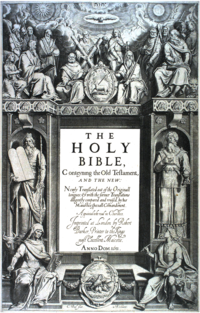
The title page's central text is:"THE HOLY BIBLE,Conteyning the Old Testament,AND THE NEW:Newly Translated out of the Originall tongues: & with the former Translations diligently compared and revised, by his Majesties speciall Comandement.Appointed to be read in Churches.Imprinted at London by Robert Barker, Printer to the Kings most Excellent Majestie.ANNO DOM. 1611 ."At bottom is:"C. Boel fecit in Richmont.".

Wikipedia

This was his rejoinder:

The KJV did not add these words, even the NWT has these words:
6 The sayings of Jehovah are pure sayings,+
As silver refined in a smelting furnace* of earth, clarified seven times.
7 You yourself, O Jehovah, will guard them;+
You will preserve each one from this generation to time indefinite.(NWT)
6 And the words of the Lord are flawless,
like silver purified in a crucible,
like gold[a] refined seven times.
7 You, Lord, will keep the needy safe
and will protect us forever from the wicked,(NIV)[3]

How should I, a supporter of modern translations, reply? [4]

Slimline Center Column Reference Bible NLT, TuTone
Tyndale House Publishers

It beats me that this person would be using the NWT of the Jehovah’s Witnesses to compare with any committee translation of the Bible. Is he a supporter of the JWs?

These are some different renditions of Psalm 12:6-7. Why are the KJV and NKJV correct and the others wrong?

Psalm 12:6-7

King James Version (KJV)

6 The words of the Lord are pure words: as silver tried in a furnace of earth, purified seven times.

7 Thou shalt keep them, O Lord, thou shalt preserve them from this generation for ever.

3d-red-star-small3d-red-star-small3d-red-star-small

Psalm 12:6-7

New King James Version (NKJV)

6 The words of the Lord are pure words,
Like silver tried in a furnace of earth,
Purified seven times.
7 You shall keep them, O Lord,
You shall preserve them from this generation forever.

3d-red-star-small3d-red-star-small3d-red-star-small

Psalm 12:6-7

New International Version (NIV)

6 And the words of the Lord are flawless,
like silver purified in a crucible,
like gold[a] refined seven times.

7 You, Lord, will keep the needy safe
and will protect us forever from the wicked,

Footnotes:

  1. Psalm 12:6 Probable reading of the original Hebrew text; Masoretic Text earth

3d-red-star-small3d-red-star-small3d-red-star-small

Psalm 12:6-7

English Standard Version Anglicised (ESVUK)

6 The words of the Lord are pure words,
like silver refined in a furnace on the ground,
purified seven times.
7 You, O Lord, will keep them;
you will guard us[a] from this generation for ever.

Footnotes:

  1. Psalm 12:7 Or guard him

3d-red-star-small3d-red-star-small3d-red-star-small

Psalm 12:6-7

New Revised Standard Version, Anglicised (NRSVA)

6 The promises of the Lord are promises that are pure,
silver refined in a furnace on the ground,
purified seven times.

7 You, O Lord, will protect us;
you will guard us from this generation for ever.

3d-red-star-small3d-red-star-small3d-red-star-small

Evangelical commentator on the book of Psalms, H C Leupold, in Exposition of Psalms  wrote of Psalm 12:6-7,

    6. David reassures himself that this will take place by recalling the general nature of God’s words as he and all of God’s saints know them: they are “pure words,” which expression removes the alloy of undependability. Many may often intend to do well and may promise help but may fall short of keeping his promise because of human frailty. Not so God. Therefore His promises may be likened to “silver defined in a smelter in the ground, purified seven times,” the very purest of the precious metal.
7. Since God may rightly be described in reference to His words as just indicated, the psalmist draws proper conclusions with regard to the situation in which he and other godly men like him find themselves. Addressing God in prayer, he expresses the confidence that God will keep His watchful eye on those that have suffered oppression (“Thou wilt regard”) and will go farther in that He will keep His protecting hand over them. The psalm here takes on a note of the more personal feelings in that the writer includes himself (“Thou wilt guard us“). This protection is offered in the face of this wicked class of oppressors above described (in this sense the word “generation” is here used), and this protection of God will be exercised for all times to come (Leupold 1959:132-133, emphasis in original).

Here we have Leupold writing his commentary in 1959, long before the translations of the NIV, ESV and NRSV, but his understanding of the Hebrew text is the same as from these translations and not the KJV and NKJV.

Interesting!

Another supporter of the KJV

This KJV promoter wrote:

What Bible did the Pilgrams (sic) bring over on the Mayflower?
What Bible has historically been used by Baptists since before America was a country?
The KJV has proven itself reliable for over 400 years.
Sure the language is antiquated, sure its out of date, sure it uses words like “ye” and “thy” but is that so hard to understand that it needs serious updating?
I wonder what people would say if William Shakespere’s (sic) works were updated into todays (sic) English?
From Romeo and Juliet:
“O Romeo, Romeo, wherefore art thou Romeo?”
Shakesphere (sic), Romeo and Juliet, Act 2, Scene 2
Would be changed to:
“Romeo, Yo! Where you be!”[5]

I provided these responses:

Do you mean to say that you know the KJV meaning of ‘superfluity of naughtiness’ (James 1:21) without consulting a commentary or another translation?…

That’s using a straw man logical fallacy as we are talking about a translation (the KJV) and not the original languages (Hebrew & Greek).[6]

A trend among these KJV supporters:

To justify support for an archaic English translation of the Bible, these promoters used these tactics:

clip_image002 The modern translations are the culprits. They delete verses from the KJV. It’s not that the original languages (earliest editions) have less words and the KJV has added to the originals.

clip_image002[1] Even a cult Bible, the New World Translation of the JWs, has the KJV verses, so the KJV verses are the accurate ones.

clip_image002[2] The KJV translation of Psalm 12:7 is the accurate translation and the modern versions (e.g. NIV) are to blame for changing the KJV.

clip_image002[3] The false claim that the Pilgrim Fathers took the KJV with them from England to the New World when it was the Geneva Bible that they used.

clip_image002[4] The false claim that translating Shakespeare’s works would be parallel to what has been done by the NIV translators to the KJV translation.

clip_image002[5] The superiority of a 1611/1769 KJV translation, based on late Greek New Testament manuscripts (the Textus Receptus), rather than modern translations that are based on, say, the United Bible Societies Greek New Testament that uses manuscripts that are much older and closer to the original manuscripts.

clip_image002[6] The KJV supporters seem to have a presuppositional bias towards the KJV, without examining the manuscript evidence for the newer translations.

References

Leupold, H C 1959. Exposition of Psalms. London: Evangelical Press 1959 – reprinted by Baker Book House in 1969.

Notes


[1] Christian Forums, Baptists, ‘I’ve started to become attached to the KJV, is there any proof that its’, yogosans14#13, 25 April 2013, available at: http://www.christianforums.com/t7740683-2/ (Accessed 25 April 2013).

[2] Ibid., OzSpen#14.

[3] Ibid., yogosans14#15.

[4] Ibid., OzSpen#21.

[5] Ibid., DeaconDean#10.

[6] Ibid., OzSpen#22.


Copyright © 2013 Spencer D. Gear. This document last updated at Date: 25 June 2018.
blue-coil-smblue-coil-smblue-coil-smblue-coil-smblue-coil-sm


Was Jesus omniscient while on earth?

Jesus Key Treasure Chest

(image courtesy ChristArt)

By Spencer D Gear

Did Jesus, as God, know everything? This is often doubted because of Jesus’ statement in Mark 13:32, ‘But concerning that day or that hour, no one knows, not even the angels in heaven, nor the Son, but only the Father’ (ESV).[1] In the context of Mark 13:24-27, we know that Jesus was referring to his second coming.

We know from verses such as 1 John 3:20 that God is omniscient: ‘For whenever our heart condemns us, God is greater than our heart, and he knows everything’. So the trinitarian God, of whom Jesus is the deity and the second person of the Trinity, ‘knows everything’. How do we match this with ‘only the Father’ knowing the day or hour of Christ’s second coming?

With some people, it is not unusual to hear this kind of statement about Jesus not being or having the attribute of omniscience:

“He knows everything” is not meant as all absolute everything.
Jesus did not know the day of his second coming. Not knowing one things make (sic) him NOT knowing everything.[2]

The Forum thread that led to this comment began with this post: ‘I’m just curious because Jesus learns and finds things out in the Gospels, which doesn’t seem like a conditional possibility for an omniscient [being]’.[3]

1. What is omniscience?

Theologian, Wayne Grudem, has defined omniscience as ‘the attribute of God whereby he fully knows himself and all things actual and possible in one simple and eternal act’ (Grudem 1999:490). R C Sproul makes these accurate observations: Because omniscience means ‘all knowledge’, such could only be true of an infinite being like God himself who possesses infinite knowledge. ‘God’s omniscience is grounded in His infinity and His omnipotence. God’s omniscience is crucial to His role as the Judge of the world’ (Sproul 1992:46). Sproul refers to this teaching in Psalm 147:5; Ezekiel 11:5; Acts 15:18; Romans 11:33-36 and Hebrews 4:13.

2. Did Jesus have omniscience while on earth?

This is often questioned because of his lack of knowledge of his second coming. How should we respond? Is it a contradiction to state that the trinitarian God has omniscience yet Jesus did not have omniscience in his incarnation? Is that the truth. Let’s take a look at biblical evidence:

(a) Jesus did demonstrate aspects of omniscience

A summary of Jesus’ omniscience is given under the heading of ‘the Son is recognized as God’ and ‘the attributes of Deity’ by theologian Henry C. Thiessen. He wrote:

As for his omniscience, we read that He knows all things (John 16:30; 21:17). He knew what was in man (John 2:24, 25). He saw Nathanael under the fig tree (John 1:49); He knew the history of the Samaritan woman (John 4:29), the thoughts of men (Luke 6:8, cf. 11:17), the time and manner of His exit out of this world (Matt. 16:21; John 12:33; 13;1), who would betray Him (John 6:66), the character and certain termination of the present age (Matt. 24:25), the Father (Matt. 11:27); and “in him are all the treasures of wisdom and knowledge hidden” (Col. 2:3). In Mark 13;32 He is said to be ignorant of the day of His return. On the basis of this statement some would have us believe that He was ignorant of many other points also. But we must remember that while He had the attributes of deity, He had surrendered the independent exercise of them. He went to a fig tree, “if haply he might find anything thereon” (Mark 11:13); He marvelled at their unbelief (Mark 6:6). All due to the fact that the Father did not allow Him to exercise His divine attributes in these instances. But He, no doubt, now knows the time of His coming (Thiessen 1949:139).

So Thiessen was convinced from the biblical evidence that Jesus did have the atrribute of omniscience but was not allowed to exercise it by the Father on some occasions during his incarnation.

(b) A view of Daniel Wallace

Daniel Wallace has written an excellent article about Jesus’ omniscience that I would recommend, “When did Jesus know?” Wallace concludes his article with this summary:

Briefly, here’s my take on things. We need to think of the divine attributes in two categories: moral attributes and amoral attributes. The moral attributes are those attributes that speak of God’s morality – justice, mercy, love, goodness, kindness, etc. The amoral attributes are those that speak of God’s sovereignty – omniscience, omnipresence, omnipotence, infinity, eternity, immutability, etc. What is interesting to observe in the Gospels is that a clear line of demarcation can be seen with reference to Jesus: he never fails to function on the level of the moral attributes, but frequently does not display the amoral attributes. In other words, the moral attributes seem to be “hard-wired” to his human consciousness, while the amoral attributes seem to be subject to the guidance of the Holy Spirit and come to the human conscious level at the Spirit’s choosing. At the same time, since he does occasionally demonstrate the amoral attributes, there is no denying his deity. Although Jesus Christ has both a human and divine nature, he is not two persons. He has one consciousness. It is not enough to say that his divine nature does not always operate at the level of his human consciousness. Why? Because it is only the amoral attributes that fit this description. It is partially because of this distinction that I hold to the impeccability of Christ—that is, that he was not able to sin (which is saying more than that he was able not to sin). Further, it is partially because of my christology that I view God’s attributes as amoral and moral instead of as communicable and incommunicable. In any event, if we recognize that Jesus functioned as a mere man in the amoral realm much if not most of the time, we can begin to understand why the scriptures can speak of him as able to relate to us. As man, he represents us to God; as God, he represents the Father to us. He is the perfect mediator, the perfect high priest, and the perfect sacrifice.

So Daniel Wallace’s view is that when Jesus was functioning as a man, he was not omniscient. However, did Jesus function with the attribute of omniscience while he was on earth? We’ll need to check the biblical evidence.

(c) Was Jesus’ incarnational omniscience laid aside?

‘The crowning jewel of incarnational texts is Philippians 2:6-11, an early Christian hymn in praise of Christ’ (Lewis & Demarest 1990:267). For an understanding of Jesus’ incarnation and omniscience, Phil 2:6-7 may have some application:

Though he was in the form of God, did not count equality with God a thing to be grasped, but made himself nothing, taking the form of a servant, being born in the likeness of men.

What does it mean to say that, in the incarnation, Jesus ‘made himself nothing’? The New American Standard Bible translates this phrase as, ‘emptied himself’ for the Greek, ekenwsen. The essence of the meaning is that

the eternal Christ chose not to regard existence-in-a-manner-of-equality-with-God a treasure to be greedily hearded. Instead, he voluntarily stripped himself (ekenwsen) of his prerogatives as the divine Son (his God-equal position) by “taking the very nature of a servant” [v. 7]…. Namely, by assuming the form and exhibiting the condition of a common slave. The text indicates that while renouncing participation in the heavenly glory, Christ retained the divine form or morphe…. The One who from eternity possessed the essence and glory of God, and who in an act of supreme self-renunciation assumed the existence of a lowly servant was in truth an authentic man among men (Lewis & Demarest 1990:267).

However, when applied to Jesus’ omniscience, we know that while the time of his second coming was the prerogative of the Father and was not known to the Son while on earth, we do know that Jesus demonstrated his attribute of omniscience during his earthly ministry. This is what the Gospels affirm about …

3. Jesus’ omniscience while on earth

matte-red-arrow-small[4]Matthew 26:21-25, ‘And as they were eating, he said, “Truly, I say to you, one of you will betray me.” 22 And they were very sorrowful and began to say to him one after another, “Is it I, Lord?” 23 He answered, “He who has dipped his hand in the dish with me will betray me. 24 The Son of Man goes as it is written of him, but woe to that man by whom the Son of Man is betrayed! It would have been better for that man if he had not been born.” 25 Judas, who would betray him, answered, “Is it I, Rabbi?” He said to him, “You have said so”’. These verses demonstrate Jesus’ omniscience.

matte-red-arrow-small Matthew 26: 31-35, ‘Then Jesus said to them, “You will all fall away because of me this night. For it is written, ‘I will strike the shepherd, and the sheep of the flock will be scattered.’ 32 But after I am raised up, I will go before you to Galilee.” 33 Peter answered him, “Though they all fall away because of you, I will never fall away.” 34 Jesus said to him, “Truly, I tell you, this very night, before the cock crows, you will deny me three times.” 35 Peter said to him, “Even if I must die with you, I will not deny you!” And all the disciples said the same’. These verses demonstrate Jesus’ omniscience.

matte-red-arrow-small Luke 5:21-22, ‘And the scribes and the Pharisees began to question, saying, “Who is this who speaks blasphemies? Who can forgive sins but God alone?” 22 When Jesus perceived their thoughts, he answered them, “Why do you question in your hearts?”’ These verses demonstrate Jesus’ omniscience.

matte-red-arrow-small Luke 6:7-8, ‘And the scribes and the Pharisees watched him, to see whether he would heal on the Sabbath, so that they might find a reason to accuse him. 8 But he knew their thoughts, and he said to the man with the withered hand, “Come and stand here.” And he rose and stood there’. These verses demonstrate Jesus’ omniscience.

matte-red-arrow-smallLuke 9:46-47, ‘An argument arose among them as to which of them was the greatest. 47 But Jesus, knowing the reasoning of their hearts, took a child and put him by his side’. These verses demonstrate Jesus’ omniscience.

matte-red-arrow-small Luke 11:17, ‘But he, knowing their thoughts, said to them, “Every kingdom divided against itself is laid waste, and a divided household falls’. This verse demonstrates Jesus’ omniscience.

4. A dominant question about Jesus not being omniscient

This is a fairly standard objection to Jesus having omniscience:

What do you do with,
32 But of that day and that hour knoweth no man, no, not the angels which are in heaven, neither the Son, but the Father. (Mar 13:32 KJV)[5]

Some of how to respond is expounded above, but here are some further pointers (there may be some overlap with what is above):[6]

a) Since Jesus is fully God (and fully man) as a member of the Triune God, he has to be omniscient (all-knowing) as that is one of the essential attributes of God himself. Since Jesus is God himself, he is omniscient.

b) There are many times when Jesus based what he said and did on his divine nature (see examples above). But there are other times when Jesus states something about himself that is based on his human nature (Mk 13:32 is one example). Scripture clearly demonstrates that Jesus may be identified according to both human and divine natures.

c) Take 1 Cor. 2:8 as an example of this apparent paradox where the rulers of this age ‘crucified the Lord of glory’. How could the omnipotent, omnipresent, omniscient Lord God of glory be crucified? It’s an oxymoron unless we understand that this is a statement from the perspective of Jesus’ human nature.

d) I, as an orthodox evangelical who has a high view of Scripture, understand the oneness of the three persons of the Trinity. In this oneness, they know all things (are omniscient). In his humiliation as a human being (see Philippians 2:6-7), God the Son did not use his divine attributes except when they were needed for his mediatorial work.

e) Therefore, Jesus’ omniscience while on earth was used in a very restricted way. That is what is happening with Mk 13:32 when Jesus’ human nature does not know the day or the hour of his second coming.

f) This is a mystery to us as human beings. How could the omniscient second person of the Trinity, while on earth, restrict the use of his divine attributes in such a way? Mystery it is, but it is a fact beyond dispute according to the biblical revelation, that Jesus is fully God but when speaking from his human nature, his omniscience is very restricted.

g) Understanding Mark 13:32 is on a parallel with understanding 1 Cor 2:8. The human Lord of glory, who was fully God, was crucified. The human Jesus, who was fully God, did not know the time and hour of his second coming.

h) We must not strip Jesus of his deity and omniscience when we don’t understand how the human Jesus did not know the specifics about his return.

i) However, those of a theological liberal persuasion, with a low view of Scripture, can easily conclude that here is a gross contradiction of Scripture in Mk 13:32. However, such a conclusion is based on a false understanding of the nature of the Trinitarian Lord God Almighty.

But I will say that our view of God has a massive impact on our understanding of Mark 13:32. It was A. W. Tozer who wrote,

What comes into our minds when we think about God is the most important thing about us…. For this reason the gravest question before the Church is always God Himself (Tozer 1961:1).

5. Conclusion

There are three possible interpretations[7] of Jesus not knowing the time of his second coming:

  1. Jesus continued to exercise some dimensions of omniscience while on earth and the full exercise of his omniscience was subject to God the Father’s parameters;
  2. Jesus never failed to function on the level of the moral attributes, but frequently does not display the amoral attributes such as omniscience as these seemed to be subject to the guidance of the Holy Spirit and come to the human conscious level at the Spirit’s choosing (Dan Wallace’s view).
  3. In his incarnation, Jesus laid aside the use of his attribute of omniscience.

I hold to number 1 until further information is received and further understanding is achieved. Why? That there were times when Jesus’ omniscience was deferred to another member of the Godhead is obvious from Jesus not knowing the time of his second coming. However, my understanding is that this is a function of omniscience in the Godhead. It is not meant to deny Jesus’ omniscience while on earth.

I will not have fullest understanding of how the Trinitarian God’s omniscience functions until I’m in his presence. I wonder if that will be an issue then.

Works consulted

Grudem, W 1999. Bible doctrine: Essential teachings of the Christian faith, J Purswell (ed). Leicester, England: Inter-Varsity Press.

Lewis, G R & Demarest, B A 1990. Integrative theology, vol 2. Grand Rapids, Michigan: Academie Books (Zondervan Publishing House).

Sproul, R C 1992. Essential truths of the Christian faith. Wheaton, Illinois: Tyndale House Publishers, Inc.

Thiessen, H C 1949. Introductory lectures in systematic theology. Grand Rapids, Michigan: Wm. B. Eerdmans Publishing Company.

Tozer, A W 1961. The knowledge of the Holy.  San Francisco: Harper & Row.

Notes:

[1] Unless otherwise stated all biblical quotes are from the English Standard Version (ESV).

[2] Christian Forums, Theology, Christian History, The Historical Jesus, ‘Was Jesus omniscient?’ Maite Els#303. Available at: http://www.christianforums.com/t7474786-31/ (Accessed 20 April 2013).

[3] Ibid., cubinity#1.

[4] I posted these references in ibid., OzSpen #310.

[5] Christian Forums, General Theology, Soteriology, ‘Questions for Synergists’, Butch5#328, available at: http://www.christianforums.com/t7742165-33/ (Accessed 6 May 2013).

[6] Ibid. This is from my response, OzSpen #327.

[7] Sceptics will want to introduce a fourth ‘interpretation’: ‘The Bible promotes a contradiction when dealing with Jesus’ omniscience vs. his limited knowledge’. However, the biblical evidence provides an antidote to the sceptics.


Copyright © 2013 Spencer D. Gear. This document last updated at Date: 3 February 2018.

designBlue-smadesignBlue-smadesignBlue-smadesignBlue-smadesignBlue-smadesignBlue-smadesignBlue-smadesignBlue-smadesignBlue-smadesignBlue-smadesignBlue-smadesignBlue-smadesignBlue-smadesignBlue-sma

Did Moses write the Pentateuch? [1]

Burning Bush

ChristArt

By Spencer D Gear

The following is an encounter I had on Christian Fellowship Forum concerning the authorship of the first five books of the Bible (the Pentateuch).

OZ: The biblical evidence is right before us of Mosaic authorship.

JP: Does that evidence include Moses referring to himself in the third person and writing about his death, burial and 30 days of mourning AFTER he died?

I believe it is from Moses’ time but not necessarily from his hand. (He was rather busy, you know.)

OZ: The Pentateuch claims in many places that Moses was the writer, e.g. Exodus 17:14; 24:4–7; 34:27; Numbers 33:2; Deuteronomy 31:9, 22, 24.
JP: It also has many places where Moses is referred to in the third person. So what? That means that Moses is reported to have written portions of “the Book of Moses.” It does not require that he wrote the whole thing. (Unless you are willing to hold to his continued, post-mortem, writing.)

OZ: Many times in the rest of the Old Testament, Moses is said to have been the writer, e.g. Joshua 1:7–8

JP: “Only be strong and very courageous, that you may observe to do according to all the law which Moses My servant commanded you”
That does not say Moses wrote the entire Pentateuch. It says he commanded Israel to keep the Law.
Joshua 8:32–34 Ditto.  Judges 3:4 Ditto.
Here’s what the Bible DOES say Moses wrote:
Ex 24:4 And Moses wrote all the words of the LORD. (The Laws)  And he rose early in the morning, and built an altar at the foot of the mountain, and twelve pillars according to the twelve tribes of Israel.
Num 33:2  Now Moses wrote down the starting points of their journeys at the command of the LORD. And these [are] their journeys according to their starting points:
Deu 31:9 So Moses wrote this law and delivered it to the priests, the sons of Levi, who bore the ark of the covenant of the LORD, and to all the elders of Israel.
Deu 31:22 Therefore Moses wrote this song the same day, and taught it to the children of Israel.

OZ: In the New Testament, Jesus frequently spoke of Moses’ writings or the Law of Moses,

JP: This is a very common and simplistic “proof.” The Torah was referred to as “The Book of Moses.” That name does not carry with it a statement of authorship. I have a “Webster’s Dictionary.” I have no misconception that it is a copy of what Noah Webster personally wrote.

OZ:   it seems likely that a sole author was responsible. Their exhaustive computer analysis conducted in Israel suggested an 82 percent probability that the book has just one author.

JP: I think Genesis is the work of a sole author. And a sole author can include more than one tradition and relating of the same story. It takes a great deal of skill and sophistication to do it well. I believe it was written by a sole author, most probably a contemporary of Moses and probably at the direction of Moses.

You seem to be rejecting out of hand, without consideration, the possibility that there could be more than one version of the creation and flood stories among these ancient people. That flies in the face of the existence of a variety of creation and flood stories among the ancient Mesopotamian people.

You also seem to be hung up on the idea that one author would, of necessity, have only one view to relate. That is not only unnecessary but, considering the text, it is unreasonable.

Further, you seem to assume that if I can see more than one tradition reflected in the text that I must agree with the whole of the documentary hypothesis, lock, stock and barrel. I do not. I think it is the result of over-analyzation combined with fertile imaginations and the need to publish.

I do see the two traditions, both representing valid recitals of the story of beginning from God’s creation of the heavens and earth through the dispersion. (Gen 1:1 – 11:9)

The dispersion is followed by a genealogy which connects the creation story to the story of the Hebrews who are the sons of Abraham, the descendant of Shem (SHem means “Name” and apparently refers to those who called upon Ha-Shem) the descendant of seth the son of Adam.

There is a felt need among many people that only Moses be allowed to be the author of the Pentateuch. It is an irrational need that flies in the face of the words of which Moses is demanded to be sole author. It is an imposition of man’s desire upon the word of God which detracts from it by restricting our understanding of His message to the views of one sect among God’s people.

Let my people go.

SG (added after this online discussion): I was rather naive in this interchange with JP as my understanding of authorship of a book of the Bible did not take into consideration that some revision can be made or editing done, but the work is still accounted to the original author (see below).

What about Moses’ death reported in the Pentateuch?

Tombstone

ChristArt

JP has a reasonable objection (see above):

It also has many places where Moses is referred to in the third person. So what? That means that Moses is reported to have written portions of “the Book of Moses.” It does not require that he wrote the whole thing. (Unless you are willing to hold to his continued, post-mortem, writing.)

I find this to be a satisfactory explanation:

It is probable that some works in the Bible are edited works…. We do not know what shape Moses left his works in. Did someone simply have to add an ending to Deuteronomy, or was there a need to put a number of pieces together? Probably we will never know the complete story.

The point is that a work is still an author’s work even if it has been edited, revised, updated or otherwise added to. I own a commentary on James by Martin Dibelius. I still refer to it as by Martin Dibelius although I know that Heinrich Greeven revised and edited it (and then Michael A. Williams translated it into English…. It is still accurate to refer to it as by Dibelius (and to put his name on the cover) because the basic work is by him.

We have received letters from various executives with a note “signed in his (or her) absence” at the bottom after the signature. The executive in question probably told his or her secretary to reply to our letter along thus and so lines and then left the rest to be completed and mailed while they were away. It still carries the executive’s authority, even if the exact wording is that of the secretary.

Therefore, when the Bible says that a certain work is by a given individual, it need not mean that the author is always responsible for every word or even for the general style. The author is considered responsible for the basic content.[2]

The Pentateuch and the JEDP theory

See my brief article, ‘JEDP Documentary Hypothesis refuted’. What is the JEDP, also known as the Documentary Hypothesis? Brian Davis explained:

The JEDP theory, also known as the Documentary Hypothesis or the Graf­-Wellhausen theory, essentially states that the Pentateuch (the first 5 books of the Old Testament) is not the work of Moses as both the Old and New Testaments claim. Rather, those books are the work of editors called redactors who compiled and wove together various myths, legends and historical events long after the time of Moses. Since Graf and Wellhausen presented it in its classic form in 1895, the theory has gained wide acceptance. The JEDP theory served as a foundation for much of the modern hyper critical views of scripture. Moreover it is taught in both liberal and secular schools with little question as to its validity….

There are many complex versions of the theory, but the basic document definitions can be outlined here. “J” represents the unknown author of a document composed from 1000 to 900 BC in South Judea. “E” represents a document composed in North Israel in 721 BC. “J” and “E” are said to have been put together and edited during the Babylonian exile in the sixth century BC. “P” stands for the “priestly document” which the theocracy in Judea created for a record of worship, genealogies, dates, and measurements. “D” stands for the Deutoronomic code supposedly written for religious reform at the time of Josiah in 621 BC. These four documents were compiled and edited as the Pentateuch.[3]

This is not the place for a detailed critique of JEDP, but a few criticisms given by R. N. Whybray, who is certainly not a conservative, are in order:

1. While those espousing the documentary hypothesis assume that the biblical writers avoided repetitions, ancient literature from the same period reveled in repetitions and doublets as a mark of literary artistry.

2. The documentary hypothesis breaks up narratives into different sources thereby destroying their inherent literary and artistic qualities.

3. The source critics assume that variety in language and style is a sign of different sources, but it could just as well be a sign of differences in subject matter that carry with them their own distinctive vocabulary and style.

4. Inadequate evidence exists to argue for a sustained unique style, narrative story line, purpose and theological point of view in each of the four main documents that are thought to be the sources for the contents and message of the Pentateuch.[4]

This we know: The Pentateuch often refers to Moses as the author (eg Ex. 17:14; 24:4; 34:27; Num. 33:1-2; Deut. 31:9). Christ and the apostles gave unequivocal support for Moses as the author of the Torah (Law), eg John 5:46-57; 7:19; Acts 3:22 [cf. Deut. 18:15]; Rom. 10:5).

Therefore, for me, the issue is signed, sealed and delivered. The Pentateuch, the first five books of the Bible, can confidently be affirmed as having been written by Moses as both Old and New Testaments confirm Mosaic authorship. This is with the proviso that even if it is edited or revised by somebody else, it is still regarded as Mosaic authorship of the five books of the Pentateuch.

Notes:


[1] This is based on an interaction I (ozspen) had with Jim Parker on Christian Fellowship Forum, Contentious Brethren, ‘Dawkins won’t debate creationists’, FatherJimParker #41, 5 June 2012, available at: http://community.compuserve.com/n/pfx/forum.aspx?msg=121081.41&nav=messages&webtag=ws-fellowship (Accessed 6 June 2012).

[2] Walter C. Kaiser Jr., Peter H. Davids, F.F. Bruce & Manfred T. Brauch 1996. ‘How do we know who wrote the Bible’, in Hard Sayings of the Bible. Downers Grove, Illinois: InterVarsity Press, p. 37.

[3] Brian Davis 2012. The J.E.D.P. theory: An explanation and refutation (online). Xenos Christian Fellowship. Available at: http://www.xenos.org/ministries/crossroads/papers/vol1no2/v1n2p13.html#sdendnote1sym (Accessed 16 March 2013).

[4] Cited in Walter C. Kaiser Jr. 2001, The Old Testament Documents: Are They Reliable & Relevant? InterVarsity Press, Downers Grove, Illinois, p.137.
Copyright © 2013 Spencer D. Gear. This document last updated at Date: 29 October 2015.

Queen Elizabeth II and Jesus silent on homosexuality

Elderly Elizabeth with a smile

Queen Elizabeth II (2007) [Courtesy Wikipedia]

By Spencer D Gear

It is time to bash Queen Elizabeth II in print because she did not mention homosexuals in her signing the new Commonwealth charter, which states: “We are implacably opposed to all forms of discrimination, whether rooted in gender, race, colour, creed, political belief or other grounds.”[1]

Journalist Patrick Strudwick made these points:

  1. ‘We extremists, who believe gay people should not be tortured or persecuted, shall be granted a new comrade: the supreme governor of the Church of England, the head of the Commonwealth, the Queen of more than a dozen countries. And then I read the detail’.
  2. ‘Fighting for gay rights? The Queen won’t even mention them. She dare not speak our name – that is, if you believe she is even referring to gay people’.
  3. ‘Jesus never mentioned homosexuality – has that dissuaded many of his followers that “love thy neighbour” does not in fact mean: “as long as his partner’s not called Steve”’?
  4. ‘No, to refrain from specification is to collude with silence, the Grand Pause that keeps lesbians and gay men invisible, suffocating in marriages of inconvenience or trapped in police cells. The hush of polite conversation is the rusty mattock of a millennium’s oppression’.
  5. ‘Of course. Stating that all humans deserve rights is “political”. How controversial it is that people should not be discriminated against. But how laughable would it be for an unelected head of state to preach equality anyway?’
  6. ‘If only the alleged intention were expressed explicitly, unequivocally. Most Commonwealth nations, injected by our colonial laws and Old Testament homophobia in the first place, need it. Desperately’.
  7. ‘Two Commonwealth countries sentence gay people to death, one tortures them with flogging, five impose life sentences and 41 of the 54 nations keep homosexuality illegal’.
  8. ‘This is why our opposition to discrimination needs spelling out’.

Let’s tackle these allegations and statements directly, according to numbers 1-8 above.

1. Gay people should not be tortured or persecuted

It is a fundamental of Christian beliefs that no people should be tortured or persecuted. All should receive this kind of love, whether gay or non-gay, no matter what the race or nation: ‘Love the Lord your God with all your heart and with all your soul and with all your mind and with all your strength.’ The second is this: ‘Love your neighbor as yourself.’ There is no commandment greater than these”’ (Mark 12:30-31 NIV).

Christians are fallible human beings who have the Saviour living in them, but they sin and do not always follow God’s commands as He intended. For that they need to seek God’s and the people’s forgiveness and repent of their evil ways.

I can hear a secularist’s objection: ‘Your God tortured and persecuted people in the Old Testament’. No, God carried out his just judgment on the people of Israel and the nations when they violated God’s laws. This is not indiscriminate torture and persecution. There is a fundamental difference between persecution and judgment. Here are a couple of examples:

a. God’s judgment on Sodom and Gomorrah

You can read about it in Genesis 18 and 19. Genesis 18:20 states, ‘Then the Lord said, “Because the outcry against Sodom and Gomorrah is great and their sin is very grave”’.

Abraham interceded for Sodom but there were not 10 righteous people he could find there (Gen. 18:32). Lot and his family escaped Sodom, but the Lord rained down judgment on Sodom and Gomorrah because of their sin (Gen 18:23-29).

God brings judgment, but it is not torture and persecution from an indiscriminate, brutal, uncaring, unfair God. He is the God of absolute justice. This is a lesson for all nations of the world in the twenty-first century. God will not tolerate sinning against his holy nature. Nations and people will be punished with God’s judgment.

b. King Jeroboam of Israel built golden calves

See 1 Kings 12 and 13. Jeroboam set up gods – golden calves – one in Bethel and the other in Dan (1 Kings 12:29). Jeroboam built an altar in these places and offered sacrifices to these gods. But a man of God ‘cried against the altar by the word of the Lord’ (1 Kings 13:2) and Jeroboam’s hand dried up (1 Kings 13:4). This was enough judgment on Jeroboam to cause him to ask the man of God, ‘”Entreat now the favour of the Lord your God, and pray for me, that my hand may be restored to me”. And the man of God entreated the Lord and the king’s hand was restored to him and became as it was before’ (1 Kings 13:6-7).

But God is a just judge. The Scriptures declare in Genesis 18:25, ‘Far be it from you to do such a thing, to put the righteous to death with the wicked, so that the righteous fare as the wicked! Far be that from you! Shall not the Judge of all the earth do what is just?”’ (ESV)

Here the one God of the world, revealed in Old and New Testaments, is declared to be the God of justice. Not one single person or nation, will receive an unjust treatment from the Lord God Almighty.

Therefore, it is not an extremist position to say gay people should not be tortured or persecuted. It is a Christian position that all people should be treated fairly and ones enemies should be loved:

“You have heard that it was said, ‘Love your neighbor[a] and hate your enemy.’ 44 But I tell you, love your enemies and pray for those who persecute you, 45 that you may be children of your Father in heaven. He causes his sun to rise on the evil and the good, and sends rain on the righteous and the unrighteous. 46 If you love those who love you, what reward will you get? Are not even the tax collectors doing that? 47 And if you greet only your own people, what are you doing more than others? Do not even pagans do that? 48 Be perfect, therefore, as your heavenly Father is perfect (Matthew 5:43-48 NIV).

2. It’s discriminatory to accuse the Queen of not fighting for gay rights

Isn’t it amazing how skewed the perspective can become of those who fight for equal rights (gay rights)? Surely one of the fundamentals of human rights is freedom of choice?

Eleanor Roosevelt with the Spanish version of the Universal Declaration of Human Rights.

Universal Declaration of Human Rights (Spanish version)

Courtesy Wikipedia

In the Preamble of The Universal Declaration of Human Rights it states:

Whereas disregard and contempt for human rights have resulted in barbarous acts which have outraged the conscience of mankind, and the advent of a world in which human beings shall enjoy freedom of speech and belief and freedom from fear and want has been proclaimed as the highest aspiration of the common people.


Article 18 of The Universal Declaration of Human Rights includes this statement: ‘Everyone has the right to freedom of thought, conscience and religion….’.

Article 19 of the Universal Declaration of Human Rights includes this statement: ‘Everyone has the right to freedom of opinion and expression; this right includes freedom to hold opinions without interference’.

The Queen, as representative of the Commonwealth countries, has signed a document that the Commonwealth countries have approved. Surely she has the right to freedom of thought, religion, opinion and expression, based on Articles 18 and 19 (above)! But she is castigated by Strudwick for her silence on gay rights issues.

The article by Patrick Strudwick stated:

according to a Palace spokesman, the charter’s words are not even the monarch’s: “In this charter, the Queen is endorsing a decision taken by the Commonwealth… The Queen does not take a personal view on these issues. The Queen’s position is apolitical”.[2]

Why can’t the Queen be granted a basic human right of freedom of speech and belief or freedom not to speak or not believe as her choice? This sounds like an awfully hypocritical stance by Strudwick, the homosexual and human rights’ advocate, who does not like the Queen’s personal silence on this issue.

Isn’t it amazing how the arguments of some advocates can be so self-defeating?

3. Jesus never mentioned homosexuality. So what?

Patrick Strudwick shows his ignorance of what Jesus said. Jesus understanding of marriage was:

“Haven’t you read the Scriptures?” Jesus replied. “They record that from the beginning ‘God made them male and female.’” And he said, “‘This explains why a man leaves his father and mother and is joined to his wife, and the two are united into one.’ Since they are no longer two but one, let no one split apart what God has joined together (Matthew 19:4-6).

Jesus did not need to mention homosexuality to affirm marriage was between a man and a woman. It is obvious Jesus supported heterosexual marriage.
However, Patrick’s point is valid that the call of Jesus’ followers to “love thy neighbour” does include all, including those males whose partner is called Steve. Too often Christians have excluded the biblical love of one’s neighbour, no matter who that neighbour is. I urge such Christians to repent.

There is an additional point. The Bible as a whole (Old and New Testaments) is inspired by God. Therefore, the New Testament does give God’s judgment on all sinners, including those who practice homosexuality:

Or do you not know that the unrighteous[3] will not inherit the kingdom of God? Do not be deceived: neither the sexually immoral, nor idolaters, nor adulterers, nor men who practice homosexuality,[4] nor thieves, nor the greedy, nor drunkards, nor revilers, nor swindlers will inherit the kingdom of God. And such were some of you. But you were washed, you were sanctified, you were justified in the name of the Lord Jesus Christ and by the Spirit of our God (1 Corinthians 6:9-11 ESV).

Here is a statement of condemnation for all sinners – the unrighteous – they will not inherit God’s kingdom. But the good news is, ‘Such were some of you’. Yes, the heterosexually immoral, idolaters, thieves, greedy, drunkards, swindlers, etc., can be changed by the power of God through salvation in Jesus Christ. Thus, those who practice homosexuality are not practicing a genetic condition, but a sinful condition, that God says can be changed: ‘Such were some of you’.

4. To be silent is to ‘collude’

That is one possible meaning. Another possible meaning is that as head of the Commonwealth, the Commonwealth countries have agreed to this charter but the Queen may not be supportive of the Commonwealth position, but she still has to sign it. I can’t read the Queen’s mind for not speaking up for ‘gay rights’, but a basic of any democracy is that the Queen has every right to say or not say what she wants regarding gay rights.

Silence does not necessarily mean collusion. It could mean an expression of her own views that she does not want to make public.

5. So it’s ‘laughable’ for the Queen to preach equality

As an unelected head or state who wants to be apolitical, why should it be ‘laughable’ for her to be silent on gay rights? So, according to Strudwick, it is controversial that people should not be discriminated against. But what does he do? He discriminates against the Queen for being silent on this occasion. That is a hypocritical and self-defeating response.

6. Explicit, unequivocal statements would oppose the Old Testament homophobia

Ah, so that is one of the issues! To speak out explicitly and unequivocally in favour of gay rights would counter the colonial laws and Old Testament homophobia – which is desperately needed. Again, this is Strudwick’s discrimination against Old Testament (and colonial) laws against homosexuality.

The Old Testament states:

Leviticus 18:22, ‘You shall not lie with a male as with a woman; it is an abomination’.

Leviticus 20:13, ‘If a man lies with a male as with a woman, both of them have committed an abomination; they shall surely be put to death; their blood is upon them’.

Homosexuality in the Old Testament was regarded as such a serious sin that it deserved capital punishment. But never let us forget that other sins also required capital punishment. See Leviticus 20:1-5; Leviticus 20:9-21;

The Christian does not live under Old Testament law, thanks to the sacrifice of Christ on the cross. See Matthew 11:13; Romans 5:13-14; 6:14; 10:4; 2 Corinthians 3:11-13; Galatians 3:19; and James 2:10.

However, the unforgiven sins of the unrighteous, including unforgiven homosexuality, has the ultimate consequence of denying eternal life to the perpetrators. See 1 Corinthians 6:9-11.

See Matt Slick’s article, ‘Leviticus 18:22, 20:13, and a “man who lies with a man”’.

7. Is it correct to execute homosexuals or make homosexuality illegal?

There are many sins mentioned in, say, 1 Corinthians 6:9-11, that are criminal offences. These include theft, being drunk, revilers (slanderers), and swindlers. However, Strudwick has a point here. To execute homosexuals is an Old Testament punishment that has been abolished since Christ’s atoning sacrifice on the cross. To torture, flog and impose life imprisonment on homosexuals is parallel to Old Testament law that has been superceded. To make homosexuality illegal has benefits when we understand some of the consequences of a homosexual lifestyle:

The Centers for Disease Prevention and Control (USA) reported (May 2012) on HIV among homosexual and bisexual men:

  • Gay and bisexual men are more severely affected by HIV than any other group in the United States.
  • Among all gay and bisexual men, blacks/African Americans bear the greatest disproportionate burden of HIV.
  • From 2006 to 2009, HIV infections among young black/African American gay and bisexual men increased 48%.

What about the prevalence of anal cancer among homosexual men? According to WebMD, ‘Gay and bisexual men are at significant risk for developing anal cancer, and testing them for the disease would save many lives, says a new study in the American Journal of Medicine [the year 2000]…. The number of cases of anal cancer is rising in gay men’. Physicians for Life reported that ‘a study which appears in the February [2007] issue of the International Journal of STD & AIDS, has found that “HIV-positive men who have sex with men are up to 90 times more likely than the general population to develop anal cancer”’.

8. Opposition to discrimination needs spelling out

This is an excellent point, but this article by Strudwick was also discriminatory towards Queen Elizabeth II. She has a right to silence because of her position, values, or any other reason that she accepts as a free person in a free society. To oppose the Queen’s silence and call it discrimination is self-defeating when Strudwick engages in discrimination towards the Queen because she does not line up with his gay rights beliefs.

Marriage cover photo

Courtesy Salt Shakers (Christian ministry)

Notes:


[1] Patrick Strudwick, ‘The Queen defending gay rights? She can’t even say the words out loud’, The Guardian, 11 March 2013, available at: http://www.guardian.co.uk/commentisfree/2013/mar/11/queen-gay-rights-commonwealth (Accessed 13 March 2013).

[2] Ibid.

[3] The ESV footnote at this point was, ‘Or wrongdoers’.

[4] The ESV footnote here as, ‘The two Greek terms translated by this phrase refer to the passive and active partners in consensual homosexual acts’.


Copyright © 2013 Spencer D. Gear. This document last updated at Date: 29 October 2015.

Is the Holy Spirit God?

Hovering Dove

(image courtesy ChristArt)

By Spencer D Gear

There are some who have doubts about the Holy Spirit being God, expressed in some of the blogs I visit on Christian Forums on the Internet. Here is but one example:

Also how come the Holy Spirit is never called God in any scripture? Look at John 10:30–“I and the father are one”.[1]

The following is my response.[2]

You don’t seem to want to believe that the Holy Spirit is God. Take your example:

‘Also how come the Holy Spirit is never called God in any scripture? Look at John 10:30–“I and the father are one”.

Yours is false teaching that “the Holy Spirit is never called God in any scripture”. Don’t you read the Book of Acts? This is what Acts 5:3-5 states:

3 But Peter said, “Ananias, why has Satan filled your heart to lie to the Holy Spirit and to keep back for yourself part of the proceeds of the land? 4 While it remained unsold, did it not remain your own? And after it was sold, was it not at your disposal? Why is it that you have contrived this deed in your heart? You have not lied to men but to God.” 5 When Ananias heard these words, he fell down and breathed his last. And great fear came upon all who heard of it (ESV).

Who did Ananias lie to? The Holy Spirit and that means that Ananias lied to God. That’s Bible, but you don’t want to believe it!

I obtained the following summary of the deity of the Holy Spirit from Norman Geisler 2003. Systematic Theology: God, Creation, vol 2. Minneapolis, Minnesota: BethanyHouse, pp. 675-676.

The Holy Spirit is given the names of Deity
The Holy Spirit is referred to as “God” or “Lord” (Acts 5:3-4), “God’s Spirit” (1 Cor. 3:16), “Lord” (1 Cor. 12:4-6), and “eternal Spirit” (Heb. 9:14).

The Holy Spirit possesses the attributes of Deity
The Holy Spirit has attributes of God such as life (Rom. 8:2), truth (John 16:13), love (Rom. 15:30), holiness (Eph. 4:30), eternality (Heb. 9:14), omnipresence (Ps. 139:7), and omniscience (1 Cor. 2:11).

The Holy Spirit performs acts of deity
The divine works of the Holy Spirit include the act of Creation (Gen. 1:2; Job 33:4; Ps. 104:30), the acts of redemption (Isa. 63:10-11; Eph. 4:30; 1 Cor. 12:13), the performance of miracles (Gal. 3:2-5; Heb. 2:4), and the bestowal of supernatural gifts (Acts 2:4; 1 Cor. 12:11).

The Holy Spirit is associated with God in prayers and benedictions
Jude 1:20 exhorts readers to “build yourselves up in your most holy faith and pray in the Holy Spirit.” The benediction of 2 Corinthians 13:14 contains all three members of the Godhead: “May the brace of the Lord Jesus Christ, and the love of God [the Father], and the fellowship of the Holy Spirit be with you all” (emphasis added). The baptismal formula of Matthew 28:19 also contains the Holy Spirit, along with the other members of the Trinity, all under one “name” (essence).

Notes:


[1] Christian Forums, Baptists, ‘Is Jesus God’, yogosans14 #242, available at: http://www.christianforums.com/t7648044-25/ (Accessed 11 March 2013).

[2] Ibid., OzSpen #255.


Copyright © 2013 Spencer D. Gear. This document last updated at Date: 1 May 2016.

Blue Greek Key With Lines Border by GR8DAN - A blue greek key based border.

The Jehovah’s Witnesses wrong translation of John 1:1

Watchtower Bible & Tract Society (world headquarters).jpg

International Headquarters, Watchtower, Brooklyn NY (Courtesy Wikipedia)

By Spencer D Gear

The New World Translation of John 1:1 reads: ‘In [the] beginning the Word was, and the Word was with God, and the Word was a god’ (emphasis added).

The Greek of John 1:1 is found HERE.

The contentious translation is ‘the Word was a god’ as the transliterated Greek into English is theos aen ho logos. Word order is not important in Greek. However, the conjugations of the verbals and the declensions of the nouns, pronouns, adjectives, etc are important for determining where the word goes in the sentence.

The JWs have violated a fundamental of Greek grammar with their translation, ‘the Word was a god’. In Greek, the subject of this sentence is made plain because it has the definite article with it, ho logos. The complement (what we call it in Australia) or the predicate nominative after the verb to be, aen, is determined by dropping the article. So the meaning is ‘The Word was the God’. Technically in Greek this is known as Colwell’s Rule for determining which is the subject and which is the predicate nominative when a sentence contains a copulative such as the verb ‘to be’.

Colwell’s Rule originally appeared in 1933 in E. C. Colwell’s article, ‘A definite rule for the use of the article in the Greek New Testament’. Please understand that it is a general rule and there are a few exceptions.

Colwell’s Rule in Greek has been defined this way: ‘In sentences in which the copula [e.g. the verb ‘to be’ in John 1:1] is expressed, a definite predicate nominative has the article when it follows the verb; it does not have the article when it precedes the verb’.

We see this rule applied in John, with the translation of 1:49, ‘You are the King of Israel’. There is no definite article before ‘King’ in the Greek. Even the New World Translation has this translation of John 1:49, ‘You are King of Israel’. If it translated consistently with the way it translates John 1:1, it should at least have this translation, ‘You are a King of Israel’.

This has been a technical translation, but it is my attempt to explain why the NWT is not consistent with Greek grammar.

Here is a sound refutation of the JW translation of John 1:1, ‘John 1:1, “The word was a god”’.


Copyright (c) 2013 Spencer D. Gear.  This document is free content.  You can redistribute it and/or modify it under the terms of the OpenContent License (OPL) version 1.0, or (at your option) any later version.  This document last updated at Date: 9 March 2013.

cubed-iron-smcubed-iron-smcubed-iron-smcubed-iron-smcubed-iron-smcubed-iron-smcubed-iron-sm

Whytehouse designs

Disadvantages of distance education – a personal perspective


Fools Not Interested

ChristArt

By Spencer D Gear

I’m pursuing a PhD (British model of dissertation only) through distance education. These are some of the disadvantages, as I see them, of pursuing distance education:

  1. Since I pursued my BA and MA in a classroom environment, I miss the interaction with people of different perspectives. The dynamic of the classroom is absent – Big Time!!
  2. Being able to ask (and get answers) from professors in an immediate context is missing. At the beginning of the academic year, I sent material through to my supervisor but it will take him 3 weeks to get to it as he is also teaching in the classroom. Getting immediate feedback is an issue.
  3. Accessing library resources is a challenge as many journals are available online but many other academic resources are not. Most resources in my technical area are not available at or through my local library. I have to travel many km (miles) to access books that I need.When a journal article is not available, I do have access to a librarian assistant who has been very helpful in tracking down most articles. However, there is the occasional article that was not found as the University did not subscribe to that journal.
  4. How can this issue of distance education be solved?
  5. Webcam and Skype could be used more effectively in interacting with other students and supervisor. More online interaction with other students could be promoted, but busy students don’t always have an interest in the small focus of my dissertation. I’m also seeking interaction at a local theological college to see if there are students and faculty interested in my topic. But that also involves considerable travel to the location of the College.
  6. Loneliness is the BIG issue for me. Doing it all alone takes a lot of discipline when I try to work 6-7 hours a day on the dissertation.
  7. I completed my dissertation and graduated in September 2015 after 5 years of research with the University of Pretoria, South Africa. My PhD is in New Testament.
Copyright © 2013 Spencer D. Gear. This document last updated at Date: 29 October 2015.

What is the origin of the pre-tribulation rapture of Christians?

Any Moment

(image courtesy ChristArt)

By Spencer D Gear

This is not a fully fledged article in support or in opposition to the pre-tribulation rapture teaching. It is designed to give an overview of some of the public discussion on the Internet in the 21st century.

In my discussing on Christian Forums, I encountered this kind of opposition to a pre-tribulation Rapture:

The rapture position being a very late opinion in church history. If it wasn’t for John Nelson Darby and his disciples we wouldn’t be talking about it today….[1]

Dean, your questions have nothing to do with the PreTrib rapture and its inventor. You are creating rabbit trails to protect your pet doctrine. Dispensationalism is a shoe horn theology where you take a passage and shoe horn it into a place, that contextually, it just doesn’t fit. You shoe horn the rapture into Revelation.

The Dispensational PreTrib Rapturism didn’t exist before 1800.[2]

Of course such provocative statements would cause a pre-tribulation Rapture proponent to respond:

Again sir, what of Enoch and Elijah?
Only Elisha knew of this.
And nobody but Moses was it revealed to about Enoch.
Were these not “secret”?
And one of the gretest (sic) secrets of all: what happened to the resurrected saints in Mt. 27:52.
Did God raise them nly (sic) to put them back in the grave?
No sir. Moses was dead and buried thousands of years before Christ, yet he was seen alive and well at the mount of transfiguration.
So here again, just because something wasn’t taught before a certain time, does not mean that its (sic) untrue or heresy.[3]

I replied to JM and Dean:

It seems to me that the eschatological differences you are having with your back and forth challenge could be related to the two major disagreements in evangelical theology over the details of future events surrounding Christ’s return. These seem to be associated with:

(1) Christ could return at any time. There are verses that indicate this (e.g. Matt 24:42-44, 50; 1 Cor 16:22; 1 Thess 5:2; Heb 10:25; James5:7-9; Rev 22:20), and

(2) There are signs that precede Christ’s return, one of which is that the Gospel must be preached to all nations (Mark 13:10. Other signs are in passages such as Mark 13:7-8; Matt 24:23-24; 2 Thess 2:1-10; 1 John 2:18.

Are these two different approaches causing the disagreement or are there some other issues. If so, what are they?[4]

1. What is the pre-tribulation rapture?

Norman Geisler provided this definition:

Pretribulationism holds that the Rapture of the church occurs before the Tribulation, during which the church, Christ’s bride, will be in heaven, standing before His judgment seat (2 Cor. 5:10) and preparing for His return to earth. Pretribulationism holds that Christ’s coming for His saints will be in the air and before the Tribulation; after the Tribulation, Christ will come with His saints and to earth to reign for a thousand years (Geisler 2005:612).

2. Others who taught pre-tribulation rapture

John Nelson Darby lived from 1800-1882 according to church historian, Kenneth Scott Latourette (1975:1185). Darby was previously an Anglican clergyman from Ireland. Was there any pre-tribulation teaching that is alleged to be prior to J N Darby? See:

  1. Margaret Macdonald (1830 Pre-trib vision);
  2. Edward Irving (1792-1834);
  3. Manuel Lacunza (AD 1731-1801). This Wikipedia article on Lacunza gives an idea of his view.

(image courtesy ALO Photography)

David MacPherson has attempted to expose some of the pre-tribulation teaching in The Incredible Cover-Up (1975) and The Great Rapture Hoax (1983). There are critiques of David MacPherson’s research, e.g. HERE.

In MacPherson’s 1983 publication there is a quote from a letter written in 1834 by Francis Sitwell who became one of the 12 apostles of the Catholic Apostolic Church (associated with Edward Irving) in 1835. The letter reads:

It is because the time of the world’s doom draweth nigh, it is because the time of the sealing is come, it is because the Lord is nigh, even at the door. It is because there is no safety where you are, because you cannot be sealed where you are, it is because if you are not sealed you must be left in tribulations, while those who have obeyed His voice shall be caught up to meet Him (Sitwell in MacPherson 1983:63).

For an overview of the historical origins of the pre-tribulation rapture, see Tim Warner, The Origin of the Pretribulation Rapture Doctrine, that gives some of the information to which I referred. Also see this article in the theological journal from Dallas Theological Seminary, Bibliotheca Sacra 159, July – September 2002, ‘A Rapture Citation in the Fourteenth Century.

I replied to JM,

You don’t seem to have liked the fact that I used Norman Geisler’s research to identify a chronological logical fallacy by claiming that the pre-trib rapture, being late in exposition, does not necessarily make it invalid. I have not used an appeal to authority as a logical fallacy. I have simply used another’s research to show the nature of a chronological fallacy when applied to the pre-trib rapture. Surely you also use another’s research to save you having to do it yourself. That is what I did and did not appeal illogically to an authority.[5]

3. Beware of denying the validity of a doctrine because of  its lateness

Historically, there could have been others before J N Darby who promoted this view. Some say that Darby got the pre-trib rapture from Edward Irving (1792-1834). Others claim it could have come from Margaret MacDonald (ca. 1830). Still others go a little bit further back to Emmanuel Lacunza (AD 1731-1801).

However, post-tribulation, premillennialist, George Eldon Ladd, wrote that

We can find no trace of pretribulationism in the early church; and no modern pretribulationist has successfully proved that this particular doctrine was held by any of the church fathers or students of the Word before the nineteenth century (Ladd 1956:31).

Norman Geisler, who is a dispensational pretribulationist, claimed that those who object to pretribulationism as a late doctrine are committing the logical ‘fallacy of chronological snobbery which wrongly argues that truth can be determined by time’ (Geisler 2005:631). His point was that time has no connection with truth as something can be new and true just as it is possible to have something that can be old and false.

He claimed that with the discovery of Ephraem of Syria’s teaching (from ca. AD 306-373), it can be established that pretribulationism was taught in the early church. Earlier in this volume, Geisler established that premillennialism was taught in the early church shortly after the time of the apostles. His view is that the imminence of Christ’s return was emphasised from the start of the church, that ‘pretribulationism is based on a realistic concept of imminence’, and that ‘there is ample New Testament evidence to support pretribulationism’ (Geisler 2005:632).

Geisler covers such material in the 17th chapter of this volume, ‘The Tribulation and the Rapture’ (Geisler 2005:597-661).

Therefore, I cannot be adamant that the pre-tribulation rapture was not taught in the early church. However, I have not been convinced to this point in time, but I have not pursued all of Geisler’s material.

For further details to challenge the pre-tribulation rapture teaching, see my articles,

References

Geisler N 2005. Systematic Theology, vol 4. Minneapolis, Minnesota: BethanyHouse.

Ladd, G E 1956. The Blessed Hope. Grand Rapids, Michigan: William B. Eerdmans Publishing Company.

Latourette, K S 1975. A History of Christianity: AD 1500 – 1975, vol 2, rev ed. New York: Harper & Row, Publishers.

MacPherson, D 1975. The Incredible Cover-Up. Medford, Oregon: Omega Publications.

MacPherson, D 1983. The Great Rapture Hoax Fletcher N. C.: New Puritan Library.

Notes


[1] Christian Forums, Baptists, ‘Rapture false doctrine’, JM #24. Available at: http://www.christianforums.com/t7716090-3/ (Accessed 1 February 2013).

[2] Ibid., JM #26.

[3] Ibid., DeaconDean #28.

[4] Ibid., OzSpen #43.

[5] Ibid., OzSpen #74.


Copyright © 2013 Spencer D. Gear. This document last updated at Date: 23 July 2019.Horizontal Clipart Green Line - Green Line Transparent Background ...

Amazing contemporary opposition to women in public ministry

Elizabeth Hooton Warren, 1600-1672 (public domain)

By Spencer D Gear

When traditional evangelicals, who are against women preachers/pastors, speak out, they can make statements like this:

Andronicus and Junia were probably not called apostles in Romans 16:7. This is the only verse where these “two men” are mentioned. They are said to be Paul’s kinsmen and fellowprisoners and were “of note among the apostles.” Does this mean, as some say, that they were noteworthy apostles? Someone could be “of note” among the apostles without being an apostle. It could mean that the apostles had noted them as significant servants of the Lord. Also, if they were apostles of note, they were some of the more important apostles. But this is the only verse of the Bible where these two men are ever mentioned. Certainly, they are not being called apostles here.”[1]

How do we respond to the claim that Junia was not a female but that Andronicus and Junia were males? This is how I replied to this post:[2]

1.  A prominent Greek lexicon

That is not how the eminent Greek lexicon of Arndt & Gingrich sees it. While it is given a masculine definite article, ho, their assessment of the Greek material is:

Junias (not found elsewhere, probably short form of the common Junianus); a Jewish convert to Christianity who was imprisoned with Paul Ro 16:7. The possibility, from a purely lexical point of view, that this is a woman’s name, Junia; ancient commentators took Andronicus and Junia as a married couple, is probably ruled out by the context (Arndt & Gingrich 1957:381).

So to be so adamant that you put in bold and underline that Andronicus and Junia are ‘two men‘ is hardly in keeping with the Greek lexical possibilities.

The late Greek exegete and commentator, Australian Leon Morris, has a different take to you. I remember hearing Leon Morris speak when he would pick up his Greek NT and exegete and expound the Scriptures as he spoke from the Greek text alone. I recommend a read of his commentary on Romans 16:7 (Morris 1988:533-534). His conclusions are:

  • Junias: The patristic commentators seem to have taken the word as feminine, Junia, and understood Andronicus and Junia as husband and wife.
  • They were Paul’s kinsfolk, probably fellow Jews.
  • They were fellow prisoners of him, in jail together or they shared the same fate as he.
  • ‘Outstanding among the apostles’ might mean that the apostles held them in high esteem or that they were apostles, and notable apostles at that. The latter understanding does more justice to the Greek construction.
  • This couple seemed to have belonged to the wider apostolic circle (the circle of apostles was wider than the 12 according to the NT).
  • As for a woman being an apostle, Morris wrote: ‘We should bear in mind Chrysostom’s comment: “Oh! how great is the devotion of this woman, that she should be even counted worthy of the appellation of apostle!”’

2.  A prominent church father

A leading Greek exegete and commentator does not agree with the view that Andronicus and Junia were ‘two men’.

John Chrysostom, Courtesy Wikipedia

The fuller quote from John Chrysostom, Archbishop of Constantinople, (with the link to his writings) is:

“And indeed to be apostles at all is a great thing. But to be even amongst those of note, just consider what a great encomium this is! But they were of note owing to their works, to their achievements. Oh! how great is the devotion of this woman, that she should be even counted worthy of the appellation of apostle!” (Chrysostom, Homily on the Epistle of St. Paul the Apostle to the Romans XXXI).

Chrysostom’s dates were ca. AD 347-407 (Cairns 1981:141). So by the 4th century his understanding was that Junia was a female apostle, and a noteworthy one at that. Could it be that Chrysostom got it correct and some have got it wrong since then? Could it be that the opposition to women in public ministry is unwarranted? Could gifted women have been closed down by the male chauvinism in the ministry? I write as a male and I’ve read a lot against women in ministry by males. I am not of that view.

3.  A minimised view of the ministry of an apostle and a response

Douglas Moo PhD, Wheaton College

Contemporary Greek exegete and commentator, Donald Moo, downplays the role of an apostle outside of the original 12 apostles of Jesus. He wrote in his commentary on Romans:

The identity of Andronicus’s “partner” is a matter of considerable debate. The problem arises from the fact that the Greek form used here Iounian, depending on how it is accented, could refer either (1) to a man with the name Junianus, found here in its contracted form, “Junias” (cf. NIV; RSV; NASB; TEV; NJB); or (2) to a woman with the name of Junia (KJV; NRSV; REB). Interpreters from the thirteenth to the middle of the twentieth century generally favored the masculine identification. But it appears that commentators before the thirteenth century were unanimous in favor of the feminine identification; and scholars have recently again inclined decisively to this same view. And probably with good reason. For while a contracted form of Junianus would fit quite well in this list of greetings (for Paul uses several other such contractions), we have no evidence elsewhere for this contracted form of the name. On the other hand, the Latin “Junia” was a very common name. Probably, then, “Junia” was the wife of Andronicus (note the other husband and wife pairs in this list, Prisca and Aquila [v. 3] and [probably], philologus and Julia [v. 15])….

In two relative clauses Paul draws the attention of the Roman Christians to the stature of this husband and wife ministry team. The first description might mean that Andronicus and Junia were “esteemed by the apostles.” But it is more natural to translate “esteemed among the apostles.” And it is because Paul calls Junia(s) an “apostle” that earlier interpreters tended to argue that Paul must be referring to a man; for they had difficulty  imagining that a woman could hold such authority in the early church….

But many scholars on both sides of this issue are guilty of accepting too readily a key supposition in this line of reasoning: that “apostle” here refers to an authoritative leadership position such as that by the “Twelve” and by Paul. In fact, Paul often uses the title “apostle” in a “looser” sense: sometimes simply to denote a “messenger” or “emissary” and sometimes to denote “a commissioned missionary.” When Paul uses the word in the former sense, he makes clear the source and purpose of the “emissary’s” commission. So “apostle” here probably means “traveling missionary” (Moo 1996: 923-924).

Has Douglas Moo overlooked something significant in the hierarchical order of the ministry of apostles after the 12 apostles of Jesus? See 1 Corinthians 12:27-31 (ESV),

27 Now you are the body of Christ and individually members of it. 28 And God has appointed in the church first apostles, second prophets, third teachers, then miracles, then gifts of healing, helping, administrating, and various kinds of tongues. 29 Are all apostles? Are all prophets? Are all teachers? Do all work miracles? 30 Do all possess gifts of healing? Do all speak with tongues? Do all interpret? 31 Butearnestly desire the higher gifts.

And I will show you a still more excellent way.

Gordan-fee

Gordon Fee PhD

Professor Emeritus, Regent College

Greek exegete, Gordon Fee, disagrees with Douglas Moo’s perspective and explains that Paul

illustrates that diversity [of ministry gifts] by means of another considerable list (cf. vv 8-10), which has several remarkable features: (1) He begins with a list of persons (apostles, prophets, teachers), whom he ranks in the order of first, second, third. (2) With the fourth and fifth items (lit. “miracles” and “gifts of healings”) he reverts to charismata, taking two from the list in vv. 8-10. These are both prefaced by the word “then,” as though he intended the ranking scheme to continue. (3) The sixth and seventh items (lit. “Helps” and “guidances”), which are deeds of service, are noteworthy in three ways: (a) they are the only two not mentioned again in the rhetoric of vv. 29-30; (b) they are not mentioned again in the NT; © they do not appear to be of the same kind, that is, supernatural endowments, as those on wither side (miracles, healings, tongues)….

That leads to the further question, Does Paul intend that all of these be “ranked” as to their role or significance in the church? To which the answer seems to be No. He certainly intends the first three to be ranked. One might argue also for the rest on the basis of the “then … then” that prefaces the next two. But that seems unlikely…. The gift of tongues … is not listed last because it is least but because it is the problem. As before, Paul includes it because it is a part of the necessary diversity; but he includes it at the end so that the emphasis on diversity will be heard first.

Why, then, does Paul rank the first three? That is more difficult to answer; but it is almost certainly related to his own conviction as to the role these three ministries play in the church. It is not so much that one is more important than the other, nor that this is necessarily their order of authority, but that one has precedence over the o0ther in the founding and building up of the local assembly….

(1) First, apostles…. It is no surprise that Paul should list “apostles” first. the surprise is that they should be on this list at all, and that he should list them in the plural…. For Paul this is both a “functional” and “positional/official” term. In keeping with the other members on this list, it is primarily “functional” here, probably anticipating the concern for the “building up” of the body that he has already hinted at in v. 7 and will stress in chap. 14. Most likely with this word he is reflecting on his own ministry in this church; the plural is in deference to others who have had the same ministry in other churches (Fee 1987:618-620).

Thus, Gordon Fee understands the role of an apostle to be the ministry gift for the founding of churches. Surely such a role is necessary and continues today! And Paul to the Romans (16:7) affirms that that can be the role of a female apostle.

Conclusion

An eminent church father of the fourth century, John Chrysostom, does not agree that Junia was a male. He not only supported the view that she was a female apostle, but also was a noteworthy apostle. He is closer to the time of the apostles than those of us in the 21st century. Did he know more about this issue of supporting women in public ministry than contemporary church folks?

The role of an apostle is hierarchically fist in order (not of authority) in the founding of local churches. This role continues in the 21st century.

See my further articles on women in ministry:

References

Arndt, W F & Gingrich, F W 1957. A Greek-English Lexicon of the New Testament and Other Early Christian Literature. Chicago: The University of Chicago Press (limited edition licensed to Zondervan Publishing House).

Cairns, E E 1981. Christianity through the Centuries: A History of the Christian Church, rev & enl edn. Grand Rapids, Michigan: Zondervan Publishing House.

Fee, G D 1987. The New International Commentary on the New Testament: The First Epistle to the Corinthians. Grand Rapids, Michigan: William B. Eerdmans Publishing Company.

Moo, D J 1996. The Epistle to the Romans. Grand Rapids, Michigan / Cambridge, U.K.: William B. Eerdmans Publishing Company.

Morris, L 1988. The Epistle to the Romans. Grand Rapids, Michigan: William B. Eerdmans Publishing Company / Leicester, England: Inter-Varsity Press.

Notes


[1] Christian Forums, Baptists, ‘Women preachers’, DeaconDean #145. Available at: http://www.christianforums.com/t7707393-15/#post62296957 (Accessed 31 January 2013). I have been interacting on this site as OzSpen.

[2] Ibid., OzSpen #148.


Copyright © 2013 Spencer D. Gear. This document last updated at Date: 29 October 2015.

#####

Open Clipart Library

Can the Sermon Be Redeemed?

clip_image002

(image courtesy ChristArt)

By Spencer D Gear

I attended a Sunday morning church service at which the pastor was preaching the second of his series on homosexuality. Last week we were given notice that today’s preaching would be from Romans, chapter 1. The passage was well chosen (Romans 1:21-32 NIV) but the preaching added to my belief that the sermon needs to be radically changed — redeemed. This sermon did not provide a clear understanding of Paul’s teaching on homosexuality in this critical passage. There was more from the preacher’s mind than the text in this talk. It could hardly be called a sermon if one looks to the biblical text for the content of a sermon.

A fog in the pulpit does that! At the beginning of the sermon, the preacher warned that he was not clear about the message, so he might transfer that in the presentation. He did not disappoint. The preacher included a few Greek terms that he found difficult to pronounce. It was obvious that he didn’t use much of his Greek knowledge from theological college.  These Greek words related to use of the words translated as “passions” or “lusts” in Romans 1 that were supposed to be associated with homosexuality.  I left the service with no biblical enlightenment on this subject of vital contemporary importance. What message was conveyed by this confusion? What’s more, it confirmed my deep disappointment with preaching in evangelical churches here in my home country of Australia.

A. Origins of the church service and sermon

Is the Sunday morning church service, including the sermon, a requirement for the contemporary church, based on biblical precedent? I have searched the Bible for anything similar to the contemporary church service. I came up with a blank. From where do the sermon and church service originate?  Some church history books seem to be light on an historical investigation of the origins of the early church at worship and the use of the sermon. [2] Does the contemporary church service look anything like that of the early church? Gene Edwards was adventurous when he stated:

Let me assume you are an American. Did you know that you have never sat in a church building and experienced an organic expression of the church of Jesus Christ? When you walk into a church service on Sunday morning, pews, pulpit, etc., you are participating in a ritual the British brought to us, back in the early 1600’s! That ritual is just not us.

Sunday church is a foreign import. Dumped on us by foreigners! And we now dump it on foreigners! Where did the British get this abominable ritual?  From Geneva, Switzerland. John Calvin did it!

The thing is man-made. Man contrived. The ritual which man concocted. An accident of church history. But today it is – you might say – more entrenched than the Bible. . .

It was boring when introduced. It is boring now. It will remain boring forever.” [3]

We experience something similar here in Australia. I am not convinced that the explanation is as simple as that, but I can support the view that contemporary experience of the Sunday morning church service “is boring now.” Surely the story is not that the church had a more open approach to worship and ministry and then along came John Calvin who changed it radically.  The difficulty comes because of the lack of historical documentation given by Gene Edwards to support his views. What was it like in the early church for the first couple of centuries after its founding? Did we have something radically different from the contemporary worship format or was it in parallel with the synagogue service for a couple of centuries after Christ’s death? It is not an easy task to discover the style of worship in the early centuries. Eminent Yale University church historian, Kenneth Scott Latourette, points to the fragmentary nature of early church records:

The precise forms of the Christian community in the first century or so of its existence have been and remain a topic of debate. . . The evidence is of such a fragmentary character that on many important issues it does not yield incontestable conclusions. . . No comprehensive or uniform pattern of church practice and government existed.  Before the first century of its existence was out, the Church began to display certain organizational features which, developed, have persisted, with modifications, into the twentieth century. [4]

The “offices and officials” in the church included deacons, elders and bishops. [5]

1.    Jewish origins

Since the historical origins of the Christian church were firmly within the Jewish culture, it is not surprising that “Christian worship and the congregational organization rest on that of the synagogue, and cannot be well understood without it.” [6]  Church historian, Philip Schaff, documents these features of the Jewish synagogue worship that probably transferred to the early worship among Jewish Christians:

a.    The synagogue had immense conservative power, being a school as well as a church; [7]
b.    The synagogue’s organisation included a president, a number of elders who were equal in rank, a reader and interpreter, one or more envoys or clerks who were called “messengers”, a sexton or beadle for the more humble and “mechanical” services. [8]
c.    Worship “was simple, but rather long, and embraced three elements, devotional, didactic, and ritualistic”; [9]
d.    The didactic and homiletical dimensions of worship were based on the Hebrew Scriptures and included a lesson from the Law (called parasha), one from the Prophets (haphthara), and a “paraphrase or commentary and homily (midrash).” [10]  The lessons from the Law and the Prophets were in the Hebrew language while the midrash was in the language of the common people, the vernacular – usually Aramaic or Greek.
e.    Since the only proper Jewish priesthood was in Jerusalem, outside of Jerusalem any Jew of age might get up and read the lessons, offer prayer, and address the congregation. Jesus and the apostles availed themselves of this democratic privilege to preach the gospel, as the fulfilment of the law and the prophets. (Luke 4:17-20; 13:54; John 18:20; Acts 13:5, 15, 44; 14:1; 17:2-4, 10, 17; 18:4, 26; 19:8. The strong didactic element . . . distinguished this service from all heathen forms of worship. [11]

f.    Jesus and his disciples worshipped in the synagogue. As long as they were tolerated, the early Jewish disciples of Christ continued this practice. We know that Paul, the apostle, preached Christ in the synagogues of Damascus, Cyprus, Antioch in Pisidia, Amphipolis, Berea, Athens, Corinth and Ephesus. In Corinth, Paul “reasoned in the synagogue every Sabbath, and tried to persuade Jews and Greeks” (Acts 18:4).

g.    For Christians who were redeemed out of Judaism, there was a natural tendency to follow Jewish patterns of worship.

The Jewish Christians, at least in Palestine, conformed as closely as possible to the venerable forms of the cultus [worship] of their fathers, which in truth were divinely ordained. . . and celebrated, in addition to these, the Christian Sunday, the death and resurrection of the Lord, and the holy Supper. But this union was gradually weakened by the stubborn opposition of the Jews, and was at last entirely broken by the destruction of the temple, except among the Ebionites and Nazarenes.[12]

2.    Gentile difference

For the Gentiles it was a very different worship experience. We know from the Corinthian example (1 Corinthians 12-14) that open ministry with opportunity for the exercise of the gifts of the Spirit that was given to all believers, was the norm for when the church gathered. These are some examples of what ministry in that Gentile congregation involved:

clip_image004 1 Cor. 12:7, “To each is given the manifestation of the Spirit for the common good.”
clip_image004[1] 1 Cor. 14:1, “Pursue love, and earnestly desire the spiritual gifts, especially that you may prophesy.”
clip_image004[2] 1 Cor. 14:26, “What then, brothers? When you come together, each one has a hymn, a lesson, a revelation, a tongue, or an interpretation. Let all things be done for building up.”

New Testament ministry, according to I Corinthians, involved the ministry of the priesthood of all believers when the church gathered. This is very different from the formal synagogue model. Therefore, has the contemporary church more in common with the synagogue model than the open ministry of the Corinthian church?  In spite of the problems in the Corinthian church, there is no indication in Paul’s correction that the church must revert from expression of the gifts of all believers to practise more formalism. I am not convinced that today’s church format must be laid at the feet of John Calvin’s Genevan model. It is more probable that we have been disobedient to the authoritative teaching of every-member ministry with I Corinthians 12-14 providing the examples.

I cannot imagine that a church that practised I Cor. 14: 26 would lack excitement, involvement of the believers, and edification of the church: “What then, brothers? When you come together, each one has a hymn, a lesson, a revelation, a tongue, or an interpretation. Let all things be done for building up.”   Philip Schaff contends that

In the Gentile-Christian congregations founded by Paul, the worship took from the beginning a more independent form. The essential elements of the Old Testament service were transferred, indeed, but divested of their national legal character, and transformed by the spirit of the gospel. . . So early as the close of the apostolic period this more free and spiritual cultus [worship] of Christianity had no doubt become well nigh universal; yet many Jewish elements, especially in the Eastern church, remain to this day. [13]

3. Worship in the early church

Schaff lists these “parts of public worship in the time of the apostles” [14];

a.    The preaching of the gospel;

b.    Reading of portions of the Old Testament with practical exhortation to repentance and conversion (see Acts 13:15; 15:21);

c.    Prayer;

d.    The song, being a form of prayer;

e.    Confession of faith.

The first express confession of faith is the testimony of Peter, that Jesus was the Christ, the Son of the living God. The next is the trinitarian baptismal formula. Out of this gradually grew the so-called Apostles’ Creed, which is also trinitarian in structure, but gives the confession of Christ the central and largest place. [15]

f.    The administration of the sacraments, baptism and the Lord’s supper;

Information concerning the different aspects of the worship “service” are difficult to piece together. A reading of the Book of Acts and the NT epistles (especially I Corinthians) reveals that

The early Christians did not think of a church as a place of worship according to the common usage of the word today. A church signified a body of people in personal relationship with Christ. Such a group met in homes (Acts 12:12; Rom. 16:5, 23; Col. 4:15; Philemon 1-4), the temple (Acts 5:12), public auditoriums of schools (Acts 19:9), and in the synagogues as long as they were permitted to do so (Acts 14:1, 3; 17:1; 18:4). The place was not as important as the matter of meeting for fellowship with one another and of worship of God. [16]

Historical information about the order and content of worship is more complete in the mid-second century. We know from Justin Martyr’s writing, First Apology, and the Didache that

The service, which was held on “the day of the sun,” started with reading of the “memoirs of the apostles” or “the writings of the prophets” for a period “as long as time permits.” An exhortation or homily based on the reading was then given by the “president.” The congregation then stood for prayer. The celebration of the Lord’s Supper followed the kiss of peace. The elements of bread and “water and wine” were dedicated by thanksgiving and prayers to which the people responded by an “Amen.” The deacons then distributed them to the homes of those unable to be present at the meeting. They finally took up a collection for aid to widows and orphans, the sick, prisoners, and strangers. The meeting was then dismissed, and all the people made their way to their homes. [17]

g. What was the nature of the sermon or homily?

Apart from the description of the apostle Paul’s teaching to the Corinthian Church (I Cor. 12-14), little is known about the nature of Christian worship until about the second century.

Philip Schaff related

The earliest description of the Christian worship is given by a heathen, the younger Pliny, A.D. 109, in his well-known letter to Trajan, which embodies the result of his judicial investigations in Bithynia. According to this, the Christians assembled on an appointed day (Sunday) at sunrise, sang responsively a song to Christ as to God, and then pledged themselves by an oath not to do any evil work, to commit no theft, robbery, nor adultery, not to break their word, nor sacrifice property intrusted (sic) to them. Afterwards (at evening) they assembled again, to eat ordinary and innocent food (the agape).

This account of a Roman official then bears witness to the primitive observance of Sunday, the separation of the love-feast from the morning worship (with the communion), and the worship of Christ as God in song.

Justin Martyr, at the close of his larger Apology, describes the public worship more particularly, as it was conducted about the year 140. After giving a full account of baptism and the holy Supper . . . he continues:

On Sunday a meeting of all, who live in the cities and villages, is held, and a section from the Memoirs of the Apostles (the Gospels) and the writings of the Prophets (the Old Testament) is read, as long as the time permits. When the reader is finished, the president, in a discourse, gives an exhortation to the imitation of these noble things. After this we all rise in common prayer. At the close of the prayer . . . bread and wine with water are brought. . .

Reading of the Scriptures, preaching (and that as an episcopal function), prayer, and communion, plainly appear as the regular parts of the Sunday worship; All descending no doubt from the apostolic age. [18]

Parts of worship included “the reading of Scripture Lessons from the Old Testament with practical application and exhortation passed from the Jewish synagogue to the Christian church.” [19]

The sermon consisted of

A familiar exposition of Scripture and exhortation to repentance and a holy life, and gradually assumed in the Greek church an artistic, rhetorical character. Preaching was at first free to every member who had the gift of public speaking, but was gradually confined as an exclusive privilege of the clergy, and especially the bishop. Origen was called upon to preach before his ordination, but his was even rather an exception. The oldest known homily, now recovered in full (1875), is from an unknown Greek or Roman author of the middle of the second century, probably before A.D. 140 (formerly ascribed to Clement of Rome). He addresses the hearers as “brothers” and “sisters,” and read from a manuscript. The homily has no literary value, and betrays confusion and intellectual poverty, but is inspired by moral earnestness and triumphant faith. It closes with this doxology: “To the only God invisible, the Father of truth, who sent forth unto us the Savior and prince of immortality, through whom also He made manifest unto us the truth and the heavenly life, to Him be the glory forever and ever. Amen. [20]

The evidence concerning the content of the early church’s teaching / preaching / sermonising is scant. We do not have enough information concerning its structure and actual content. However, this we do know: The church at Corinth was given one of the clearest examples of what should happen when the church gathers as a community of believers. (See I Cor. 12-14.) This we do know: The Corinthians had problems with division among them and following favourite preachers (see I Cor. 3:1-9). However, when they met together as believers of the Corinthian assembly, it was open ministry for all who were gifted by the Holy Spirit. It should be nothing less for today’s church. Believers who meet together for worship and ministry need to be open for every-member ministry as the Holy Spirit leads. This is very different to what happens in the contemporary Australian church where most believers are mute. We are being cheated as we fail to function as God requires.

4.    The church in the house

Christian worship in the early centuries “was very simple, strongly contrasting with the pomp of the Greek and Roman communion; yet by no means puritanic.” [21] The Gentiles and the Jews (who were no longer welcome in the synagogue) held their public worship, not in a building that was called the house of the Lord, but

Until about the close of the second century the Christians held their worship mostly in private houses, or in desert places, at the graves of martyrs, and in the crypts of the catacombs. This arose from their poverty, their oppressed and outlawed condition, their love of silence and solitude, and their aversion to all heathen art. The apologists frequently assert, that their brothers had neither temples nor altars (in the pagan sense of these words), and their worship was spiritual and independent of place and ritual. . . Justin Martyr said to the Roman prefect: The Christians assemble wherever it is convenient, because their God is not like the gods of the heathen, inclosed (sic)  in space, but is invisibly present everywhere. Clement of Alexandria refutes the superstition, that religion is bound to any building. . .

The first traces of special houses of worship occur in Tertullian, who speaks of going to church, and in his contemporary, Clement of Alexandria, who mentions the double meaning of the word ekklesia

…. After the middle of the third century the building of churches began in great earnest. [22]

Open ministry, allowing for all who are gifted by the Holy Spirit to function with the assembly gathers, is limited in large gatherings. The house church, however, makes such opportunities possible. Has the church building and the larger gathering inhibited proper biblical functioning when the church gathers? I believe so.

B.  Fog in the pulpit, confusion in the pew

My experience at the church service on this Sunday morning is not an isolated one. From liberal, evangelical, Pentecostal and charismatic churches of many persuasions, I observe that the problem is in epidemic proportions. What are the problems? When it comes to teaching and preaching God’s Word, I am speaking of preachers who don’t know how to exegete the Scriptures to prepare for preaching. They fail to expound the Scriptures so that I understand the main theme of the passage with clarity and take home applications that are relevant to where I live and work.

The pastor who failed to speak clearly on the topic of homosexuality from Romans 1 is preaching a series on the Sermon on the Mount (Matt. 5-7) and the “fog” continues. He waffles around some themes associated with the text, fails to grab my attention or that of my wife, and then forgets about a sound exposition of the content of that passage. I am not convinced that he knows how to do it, but the issue is deeper. Does he even want to expound the text properly? I have spoken with him about this lack of exposition; he listened, but nothing has changed. The fog returns for every sermon.

Perhaps you are saying, “Why don’t you go elsewhere?” That could be an option but the fog exists in most of the other churches as well. I live in a regional Australian city of 40,000 people (65,000 if the surrounding district is included). There is one church where the Word is expounded with clarity, but the worship service is hyper conservative and very boring. However, that service seems to be the only viable option in my area.

1.    Is exegesis blasphemy?

This message is a plea for all preachers (pastors and laity) to treat the biblical text with seriousness when they preach and teach. Exegesis is not a swear word or a blasphemous assault on the Messiah.  When Paul urged Timothy to “preach the word”, that’s exactly what he meant for all preachers in the entire church age – preach the Word of God. The message proclaimed from the Scriptures needs to be illustrated and applied for a contemporary audience, but it must be based on a sound exegesis of the passage. Exegesis literally means a “narration” or “explanation.” Only the verbal form, “I exegete” (exegeomai) appears in the New Testament and literally means “to lead out of.” [23] In Luke and Acts it “always means to relate or to tell.” [24]
As applied to the Scriptures, exegesis deals with

The historical investigation into the meaning of the biblical text. Exegesis, therefore, answers the question, What did the biblical author mean?

It has to do with what he said (the content itself) and why he said it at any given point (the literary context). Furthermore, exegesis is primarily concerned with intentionality: What did the author intend  his original readers to understand? [25]

No preacher in the Western world has any excuse for not knowing how to approach exegesis. Books such as Gordon Fee’s, New Testament Exegesis [26] are essential tools for preachers who need to know “how to use certain key tools and how to wrestle with the basic components of exegesis.” [27] To make exegesis even more attainable, Fee has included a 20-page summary, “Short Guide for Sermon Exegesis,” [28] that offers a step-by-step procedure for busy pastor-teachers. Douglas Stuart has produced a similar volume for the Old Testament. [29]

2.    Three types of preaching?

It seems reasonable to examine briefly three different types of sermons that are delivered in the contemporary church.

clip_image006  a.    The topical sermon

This is the type of sermon that addresses a certain topic. That topic could be one of a mountain of options – sexuality, ethical issues, theological topics such as propitiation, redemption, heaven and hell. Topical sermons

Are more or less loosely connected with a Biblical phrase, clause, sentence, verse, or scattered assortment thereof. . . Those sermons whose alleged strength is that they speak to contemporary issues, needs, and aspirations often exhibit the weakness of a subjective approach. [30]

I have no major contention with a topical preacher who preaches from the Bible with a sound understanding of what the Bible actually says about a chosen topic. This requires an expounding of the meaning of many texts, gathering them together to follow the one theme, and then the adding of illustrations and applications. I have not heard many preachers who do this well. There are exceptions.  C. H. Spurgeon was one of them. He was an outstanding preacher, but “not a pure expositor. He frequently preached topically. He was a great writer of sermons and was masterful in his prose and [in] his insights, plus he possessed tremendous creativity.”[31]

Walter Kaiser begs to differ about the value of topical sermons:

So strong is this writer’s aversion to the methodological abuse he has repeatedly witnessed – especially in topical messages – that he has been advising his students for some years now to preach a topical sermon only once every five years – and then immediately to repent and ask God’s forgiveness! [32]

clip_image006[1]  b.    The exegetical sermon

Exegesis deals with the meaning of a biblical text to its biblical author and the reasons why the author said what he or she said. Preachers who have been known to present this material exegetically can bore their listeners to sleep.  Gordon Fee warns that “exegetical sermons are usually as dry as dust, informative perhaps, but seldom prophetic or inspirational. Therefore, the ultimate aim of the biblical student is to apply one’s exegetical understanding of the text to the contemporary church and world.” [33] Kaiser is just as emphatic: “Nothing can be more dreary and grind the soul and spirit of the Church more than can a dry, lifeless recounting of Biblical episodes apparently unrelated to the present.” [34]

Preachers who want to communicate with people are warned against bombarding a congregation with “a dry, lifeless recounting of Biblical episodes apparently unrelated to the present.” [35]

The preacher must become very competent at exegesis in his or her preparation of a sermon but is urged never to preach an exegetical sermon. Exegesis is designed to come to life in the expository sermon.

clip_image006[2]  c.    The expository sermon

Expository preaching is the urgent need of today but not everyone will agree. In fact, some want us to abandon preaching altogether. Preaching social action, psychology and counselling find a ready audience. However, Paul, the apostle, did not recoil from preaching the Word of God: “So I am eager to preach the gospel to you also who are in Rome” (Rom. 1:15). Why should this be? Hebrews 4:12 gives the reason: “For the word of God is living and active, sharper than any two-edged sword, piercing to the division of soul and of spirit, of joints and of marrow, and discerning the thoughts and intentions of the heart.”

Also, biblical fidelity means that we are obligated to “preach the word” (2 Tim. 4:2). Simply stated, “expository preaching attempts to present and apply the truths of a specific biblical passage. . . Expository preachers are committed to saying what God says. . . Such preaching puts people in immediate contact with the power of the Word.”[36] Haddon Robinson provides this definition:

Expository preaching is the communication of a biblical concept, derived from and transmitted through a historical, grammatical, and literary study of a passage in its context, which the Holy Spirit first applies to the personality and experience of the preacher, then through him to his hearers.[37]

The preacher’s task must be to preach the Word of God. He or she must ask, “Am I using the Scriptures to support my ideas or am I allowing the Scriptures to speak for themselves and bend my thoughts to that of the Scriptures?”[38]  John MacArthur, Jr. expressed his personal preference for expository preaching:

One of the reasons I preach verse by verse is because I could never produce such inspiring, clever, creative, topical sermons week in and week out as he [Spurgeon] did. He had an immensely creative imagination. I just don’t have that, nor do many other preachers that I know. Where creativity is strong, so is the danger that it can turn a preacher away from the exposition of Scripture. We need to guard against this without suppressing legitimate creativity.[39]

MacArthur concludes that “preaching verse by verse through books of the Bible is the most reasonable way to teach the whole counsel of God.”[40]My concern is with the lack of content in preaching in Australia today. Expository preaching will redress this serious situation.

From the pulpit today in evangelical and Pentecostal/charismatic churches, we too frequently have preachers who present psychology, sociology, current events and rambling about something that the preacher has read recently. But coming away from the sermon with a clear understanding of what the preacher has said about what the Scripture means, is something that I am finding extremely difficult to apprehend. It is quite a while since I heard a memorable sermon. This is a challenge to me as an occasional preacher.  Just in case you think that mine is an isolated situation, I urge you to take a random sample of a number of the churches in your city or region. See if there is a fog emanating from the pulpit (often disguised as hype and entertainment). Check out the listeners after the service for

(1)    Their knowledge of he main theme preached,
(2)    Their memory of the main points stated from the biblical text, and
(3)    The changes they will be implementing, with God’s help, in their lives this week – based on the challenge to application from the sermon

clip_image006[3]  d.    Did you notice?

I hope you noticed what I did in this section. I dealt with topical, exegetical and expository sermons. I have argued from the contemporary experience of the church. This section, “Three Types of Preaching” is not driven by a biblical agenda. It is based on what I observe being preached in the church today. Wouldn’t it be better to go to the Scriptures for examples of preaching, exhortation and exegesis?

3. Why the crisis in contemporary preaching?

We seem to be stuck with oratory or entertainment from the pulpit (some preachers run the entire service, including the children’s story).  A Christian I know attended a church where the pastor was performing “acrobats” (well, prancing & dancing around) on the platform while he preached.  He tripped and fell backward off the platform.  It’s a blessing that he did not sustain severe physical damage to himself.  I long for some solid input from the pulpit that challenges me with the word of God, applies it to my life situation, but is not an invention from the mind of the pastor. I’m tired of psychological theory and practice masquerading as preaching. I have heard zilch on a biblical understanding of what happened on September 11, 2001 in the USA. Are my expectations for preachers and preaching too high? Or has preaching slipped to such a low ebb in this and other parts of the world that it needs to be redeemed?

Twenty years ago, Walter Kaiser Jr., lamented:

Nowhere in the total curriculum of theological studies has the student been more deserted and left to his own devices than in bridging the yawning chasm between understanding the content of Scripture as it was given in the past and [in] proclaiming it with such relevance in the present as to produce faith, life, and bona fide works.[41]

Why is there this crisis in contemporary preaching? These are observations and not definitive conclusions.

a.    From the preacher’s perspective

  • Are the gifted making themselves available? Is the teaching gift being recognised by the church?  I know of a deacon in a local church who is being forced to preach.  He doesn’t want to preach and listening to him confirms that his gift is not preaching.
  • A low view of Scripture often manifests itself in oratory, entertainment or shear boredom from the speaker;
  • The view of the preacher’s task from theological college, peers and reading influences his approach to preaching;
  • We live in a mass media culture. Can the preacher compete? Has the preacher lost his or her authority?

Haddon Robinson asks some penetrating questions:

In the face of society’s scorn – or being relegated to a box labeled PRIVATE and SPIRITUAL – many preachers struggle with the issue of authority. Why should anyone pay attention to us? What is the source of our credibility? In such a climate, how can we regain the legitimate authority our preaching needs to communicate the gospel with power and effect.[42]

b.    A view from the pew

  • Who says that there is a crisis?
  • Too many lack a teaching gift and the churches put up with a low standard. Is the shortage of pastors in some denominations causing acceptance of a standard of preaching that would otherwise be unacceptable?
  • The expectations in the pew are low. The local church knows no better. They’ve grown used to this standard. Or, they have never known any better standard since they became Christians. Unless people grew up knowing good preaching, they would not come to expect any better. Could it be that people are leaving the church in the Western world and elsewhere because of factors such as these:

The Protestant church sermon, pews, rows, pulpits and the paraphernalia of the ensuing ritual [are] lifeless, boring and spiritually killing! Vast multitudes of God’s people – from one end of this planet to the other – will  stop gathering, out of utter boredom! Millions have already. Millions more join their ranks every year.[43]

  • There is widespread biblical illiteracy in the pew.
  • To “equip the saints for the work of ministry” (Eph. 4:12) is a forgotten practice for many pastor-teachers. We must return to the biblical mandate of equipping believers for the ministries that God has given them. Obviously this relates to honing the gifts that God has already given to believers. This is for the purpose of “building up the body of Christ, until we all attain to the unity of the faith and of the knowledge of the Son of God” (Eph. 4:12-13).
  • Since quality preaching is in such short supply these days from the pastor-teacher role in my part of the world, it is rare for the laity to be equipped for solid preaching. We urgently need a return to equipping gifted believers for the practice of preaching. However, a pastor-teacher’s modelling through his own preaching would be exemplary for lay preachers.

c. Is there any help or hope for the sermon?

When I ask, “Can the sermon be redeemed?” what do I mean by “redeemed”? I use it in two senses:

1. Can the sermon, in a practical sense, be rescued from its present demise into personal opinions, psychologised banter, general irrelevance, speaking around the topic, and hype?

2.    This is a plea for a return to preaching

That explains precisely what the Word of God says about the issues of our day, the concerns of our lives, and the destines of our souls. . . [It] offers a voice of authority not of human origin, and promises answers not subject to cultural vagaries.[44]

This definition by Bryan Chapell was particularly referring to “expository preaching,” but its application could just as easily be applied to those who want to preach topical sermons that are Bible-based.   Of the 15 evangelical and Pentecostal/charismatic churches my wife and I have visited (we’ve been a member of one of them for most of that time) over the last 8 years in our city (this covers most of the churches that say they believe the Bible), only one seriously and consistently expounds the Word of God. These expositions are excellent in covering biblical content but often don’t seem to connect with today’s generation.

William Hendriksen confirms the need for preaching to be vibrant and God-focussed: “Genuine heralding or preaching is lively, not dry; timely, not stale. It is the earnest proclamation of news initiated by God. It is not the abstract speculation on views excogitated[45] by man.”[46] Walter Kaiser agrees: “Nothing can be more dreary and grind the soul and spirit of the Church more than can a dry, lifeless recounting of Biblical episodes apparently unrelated to the present.”[47]   Paul, to the Ephesian elders, in Acts 20 said that he had “not hesitated to preach anything that would be helpful to you but have taught you publicly and from house to house” (v. 20). That which was “helpful” was “the whole will/counsel of God” (v. 27). Should such a goal be less stringent for today’s preachers?

My homiletics courses at Bible college and seminary encouraged me to give time for thorough preparation of exegesis and exposition using solid homiletical principles. The organisation of the sermons I have heard over the last few years has been poorly structured, as a general rule. This means that I go away with few means to remember the thoughts of the sermon. I look for an introduction, structure, conclusion, with sound content that attempts to communicate. But it is often missing in most of the churches my wife and I have visited.

I guess a sermon at a local church a few weeks ago capped it off. My wife called it “a nice little psychological talk, but it was an insult to call it a sermon.” The pastor was trying to show how men need to understand women to be able to communicate effectively in marriage. The leader of the service read I Peter 3:7, “Likewise, husbands, live with your wives in an understanding way, showing honor to the woman as the weaker vessel, since they are heirs with you of the grace of life, so that your prayers may not be hindered” (ESV).  This was the only Bible verse read in the entire service. The pastor never even attempted to draw out what the verse was saying. There was no structure, but lots of homespun humour from the pastor’s own marriage wrapped in current psychobabble of what women need from men in marriage. But forget about exposition, structure and preaching for biblical change!

d.    Surely it’s not that difficult

From my first homiletics class in Bible College in the early 1970s, through years as a full-time Christian counsellor, pastor of two churches, and now a doctoral student in theology, I have preached regularly. However, I’m at the point of exasperation in my locality in finding a preacher who faithfully:

1.    Begins with a biblical text and proclaims what it says;
2.    Finds the main theme of the message and expounds it;
3.    Gives an outline that helps me grasp the main points of the sermon and lets me know where the preacher is heading;
4.    Uses illustrations to help me better understand the main points; and
5.    Applies the message to me personally, driving home a challenge

Although a knowledge of the original languages of the Bible helps preachers prepare accurate exegesis, it is not absolutely essential to biblical preaching. A preacher can still prepare sound, connecting and challenging biblical preaching (expository or topical). All one needs is half a dozen literal and paraphrased versions of the English Bible (e.g. NASB[48], RSV[49], NRSV[50], ESV[51], NIV[52], GNB[53], REB[54], NJB[55]) to show the variations in meaning or interpretation of certain words, grammar and syntax.  For pastors who want to improve their public speaking skills, there are local groups such as Rostrum and Toastmasters Clubs that will provide helpful practice and critique for all public speakers. I highly recommend that pastors mix with people in these groups and learn the process of how to communicate with a cutting edge in their public presentations.

C.    Preachers and laity must change

If we are to see a return to biblical preaching, whether that be expository or topical, it will require a movement by both preachers and laity.  Preachers need to be convinced of their biblical responsibility before God.

1.    Preach the Word

It will take a serious commitment by preachers to preach the Word, as per 2 Timothy 4:2, “Preach the word; be ready in season and out of season; reprove, rebuke, and exhort, with complete patience and teaching.” There will also be the need for the people of God to demand this of their preachers, since it is a biblical imperative.  What does it mean to “preach“? Here in 2 Tim. 4:2, the Greek word verb is kerusso. It is one of the most common words in the New Testament for preaching and means “to proclaim as a herald.” It appears over 60 times in the NT (see Matt. 3:1; Mark 1:14; Acts 10:42; 1 Cor. 1:23; 2 Tim. 4:2). Kerusso “stresses the activity of preaching”, while its synonym, euaggelizesthai (to announce good news, to evangelise) “accents the glorious nature of the message proclaimed.”[56]

There has been “considerable debate as to what the word of God means in [1 Tim.4:5 and here in 2 Tim. 4:2].” Gordon Fee does not see it as referring to the Old Testament but in the Pastoral Epistles, “the word of God invariably refers to the gospel message (2 Tim. 2:19; Titus 1:3; 2:5; cf. 1 Tim. 5:17; 2 Tim. 2:15; 4:2). If this is the case here [2 Tim. 4:2], it reflects the idea of believers’ having come to know the truth (v. 3).”[57]   “Preach the word” refers

generally [to] the divinely authorized proclamation of the message of God to men. It is the exercise of ambassadorship.… The herald brings God’s message. Today in the work of ‘heralding’ or ‘preaching’ careful exposition of the text is certainly included. But genuine heralding or preaching is lively, not dry; timely, not stale.

It is the earnest proclamation of news initiated by God. It is not the abstract specularion on views excogitated by man. [58]

“The preacher is not to air his own opinions but to proclaim God’s eternal, authoritative Word of truth.”[59]  In preaching the word of God, the preacher will:

  • Do it “in season and out of season.” This means he will “stay with the task whether it is convenient or not” for him, or, more probably, he will stand by what he has proclaimed “whether or not the preaching comes at a convenient time for the hearers.”[60]
  • “Reprove” those who are in error.[61]
  • “Rebuke” or warn those who do not heed the correction.[62]
  • “Exhort” or “admonish” means to urge them on. “Hand in hand with pertinent rebuke there must be tender, fatherly admonition.”[63]. The admonishing (lit. calling aside) is “for the purpose of encouraging, comforting, exhorting, entreating, appealing to.”[64]

Isn’t this a marvellous balance! Those committing error must be corrected; those who do not heed the correction are warned, but it must all be done with a fatherly comforting and encouragement. This is biblical Christianity in action – correction with tenderness!

2. Cutting a straight path with the word of truth

There is an added conviction that is needed for preaching the Word. Second Timothy 2:15 affirms this call: “Do your best to present yourself to God as one approved, a worker who has no need to be ashamed, rightly handling the word of truth.“  “Rightly handling” is the Greek, orthotomounta, a present participle of orthotomeo, meaning continuous action.  What kind of action?  It’s the only use of the word in the New Testament, but found in the Septuagint (LXX) of the Old Testament in Prov. 3:6 and 11:5. In Prov. 11:5, it is used with hodos (way) “and plainly means ‘cut a path in a straight direction’ or ‘cut a road across country (that is forested or otherwise difficult to pass through) in a straight direction’, so that the traveler may go directly to his destination.”[65] Therefore, “rightly handling the word of truth” (2 Tim. 2:15) perhaps means “guide the word of truth along a straight path (like a road that goes straight to its goal), without being turned aside by wordy debates or impious talk.”[66]

Gordon Fee, therefore, is justified in stating that “rightly handling” (“correctly handles”, NIV) the word is

A metaphor that literally means ‘to cut straight.’ There has been considerable speculation regarding the metaphor itself, as to what kind of ‘cutting’ (wood, stones, furrows) may have been in mind. Most likely the original sense of the metaphor has been lost, and the emphasis simply lies in doing something correctly. Hence the NIV is perfectly adequate[67] with its translation “correctly handles.”

What is the “word of truth”? Paul is urging Timothy, not to “correctly interpret Scripture but that he truly preach and teach the gospel, the word of truth, in contrast to the ‘word battles’ (v. 14) and ‘godless chatter’ (v. 16, NIV) of the others.”[68]

Ralph Earle disagrees, claiming that Paul is warning preachers “against taking the devious paths of deceiving interpretations in teaching the Scriptures.”[69]

3.  The attitude of this preaching

The preacher must do this with “complete patience and teaching.” The “complete patience” or “great patience” (NIV) is necessary because of what will happen among the people who hear him: “For the time is coming when people will not endure sound teaching, but having itching ears they will accumulate for themselves teachers to suit their own passions, and will turn away from listening to the truth and wander off into myths” [2 Tim. 4:3-4].   This was a solemn warning to the preachers and people of the first century. It is just as current 2,000 years later.

I heard error preached from the pulpit at a church I visited. He taught that:

  • Jesus was not God on earth. He was human and the Holy Spirit came upon him.
  • Christians have no sinful nature and do not sin.
  • We do not sin “in the spirit man.”
  • When Jesus became sin for us on the cross, this gave an opening for Satan to get in and Satan killed Jesus on the cross.

What should I do? On the basis of Scripture, I knew my obligation before God. As a Christian minister of the gospel, I had the elder’s responsibility “to give instruction in sound doctrine and also to rebuke those who contradict it” (Titus 1:9). First Tim. 4:16 exhorts me: “Keep a close watch on yourself and on the teaching.”   I sought counsel from three godly pastors and church leaders. Their advice was to visit the pastor who preached the false doctrine and gently confront him with the biblical evidence, demonstrating his error.   I met with the pastor to share my concerns. This was his response:

  • Even though I presented his views, word-for-word from the cassette tape of the message, he would not admit his unorthodox doctrine. As I presented the biblical evidence to refute him, he agreed with me, but did not admit that he was teaching any error. He said that I would understand him better if I heard the context — the messages before and after this one. I disagreed, saying that context does not correct the error that he preached on this one day that I visited his church.
  • I believe he was confused because of his exposure to other heretical doctrines that he is hearing and reading. He made statements like, “We do not sin in the spirit man.” Much of his theology seems to be filtered through a particular aberration of trichotomy (body, soul and spirit) and its implications for the believer. In spite of the preference by some people (listeners) for myths, unsound teaching and “itching ears” for more error to “suit their own passions” (2 Tim. 4:3-4), the preacher must continue “teaching” God’s truth.

William Hendriksen states that this combination of “complete patience and teaching” means “with utmost longsuffering and with most painstaking teaching-activity.”[70] A similar combination of words is in 2 Tim. 2:24, where the Lord’s servant must be “able to teach, patiently enduring evil.”

4.    Initial training and refresher courses in biblical preaching for pastors and laity

It is time for pastor-teachers to take seriously their ministry “to equip the saints for the work of ministry” (Eph. 4:12). Equipping the believers for their ministry seems to have been lost from many congregations. Shouldn’t it be the role of theological colleges and local churches to train pastors in effective sermon preparation and presentation, and follow up with refresher courses for pastors?   The need is desperate for pastors who know how to preach the Word and “rightly divide the word of truth.”   Is this not considered an important requirement for any preacher, by both preacher and people? It is time for the people in the pew to require a higher standard from the pulpit. Are their expectations too low, or are they timid in expressing their views?

5.    Pastors will need to make a time commitment

If there is to be a change in the quality of what comes from the pulpit, it will mean a motivational and time commitment by the pastor-teacher to these areas:

a.    Solid exegesis. Tell us what the text means. This takes time and study.

b.    Preachers must want to learn how to expound the Word of God.

c.    The pastor must see the need to feed the people on the meat of the Word and not just milk. However, Paul’s warning to the Corinthians needs local church application: 1 Cor. 3:2-3 says, “I fed you with milk, not solid food, for you were not ready for it. And even now you are not yet ready, for you are still of the flesh. For while there is jealousy and strife among you, are you not of the flesh and behaving only in a human way?”
There is a pastoral need to help people deal biblically with their lives so that they are ready for “meat” in preaching. Preaching with purpose should address such issues.

d.    As a practical suggestion, pastors need a focus group to give feedback to him or her on the impact of preaching – content and communication.  A pastor-teacher could take time at the end of one sermon a month to receive honest feedback from the listeners for the last month of his sermons? This may be painful for some pastors. This is a practical way to make preaching more than one-way communication.

e.    Christian denominations should hold theological colleges accountable for solid training in homiletics and the colleges should offer preaching courses in cities and towns across the state at least once a year. These should be offered at strategic cities/towns across Queensland. We have a desperate need to train biblical preachers.

6.    It will take . . .

a.    Preachers and teachers in the church who are committed to the authority of Scripture more than the importance of one’s own opinion. Preaching to be popular with a larger audience is another danger.
b.    Preachers who know their Lord intimately and burn with the desire to communicate His Word accurately, but with a connection to the real world of their listeners (congregation).
c.    Exegesis, explanation, illustration and application by preachers. This is what is needed to expound any text. The hour is late. We need desperate Christians who require much better preaching by their pastor-teachers and pastor-teachers who are committed to what the Word of God requires of preachers.
d.    Church fellowships (ecclesia) that need to take seriously what the Scriptures require in testing the content of what is delivered by way of ministry in the congregation:

  • 1 Thess. 5:19-21, “Do not quench the Spirit. Do not despise prophecies, but test everything; hold fast what is good.”
  • John 4:1, “Beloved, do not believe every spirit, but test the spirits to see whether they are from God, for many false prophets have gone out into the world.”

7.    There is no excuse for any preacher in the Western world

We have an abundance of resources, including self-help Greek and Hebrew language courses, commentaries, and extensive theological volumes. Now the world-wide-web gives wide access to online material in the English-speaking world.  Preachers in cities and towns, especially in regional Australia, should attempt to share resources as most required books and journals for solid exegesis and exposition are not found in the local public library.

John MacArthur Jr. is very generous in giving permission to use his sermons.  But it is permission with a condition.  He wrote:

I am careful in my books to document my sources, but too many references to sources would be distracting. A balance is the ideal.  We cannot document every thought in our sermons.  On the other hand, we should give credit where due.  Pastors sometimes ask me if they can use my material.  I have given blanket permission for anyone to use my sermons and preach them in whole or in part if they wish, and I do not want any credit as the source.  If what I say has value to someone, I am honored for him to use it for God’s glory.  The truth is all His.

Yet if someone re-preaches one of my sermons without enriching it by going through the discovery process, that sermon will inevitably be flat and lifeless.  The great Scottish preacher, Alexander Maclaren once went to hear another man preach, a young man with a reputation for being a gifted preacher.  Much to Maclaren’s surprise, the young man said at the outset of his message, ‘I’ve had such a busy week that I had no time to prepare a sermon of my own, so I’m going to preach one of Maclaren’s.’  He did not know Maclaren was in the audience until Maclaren greeted him afterward.  He was very embarrassed and became even more so when Maclaren looked him in the eye and said, “Young man, I don’t mind if you are going to preach my sermons, but if you are going to preach them like that, please don’t say they are mine.”

To rely too heavily on the sermons of others robs one of the joy of discovering biblical truth for himself. [70a]

What’s the condition?  If we use John MacArthur Jr.’s sermons, we must prepare further by “enriching it by going through the discovery process.”  Well said, John!

8.    Yes the sermon can be redeemed, but it will take…

  • Change of desire and motivation by both preacher and people. The changes include those suggested above.
  • A repudiation of the Greek mindset of oratory and a return to preaching that is biblically sound, interacts with people, offers challenges to live a practical Christian life, and applies the message to people where they live. I cannot see that happening without a deep knowledge of God and his Word among the people of God. Will it take a heaven-sent revival before people and preachers desire this change?

D.    But wait a minute!

I’m interested in hearing from pastor-teachers and their views on what it means to preach the Word of God, to be consistent interpreters, and to communicate with this generation. How do preachers check if they are biblical in their sermons? What are they doing to ensure that they communicate this theology and exposition with ordinary people?  How can this accomplish the exhortation of James, “but be doers of the word, and not hearers only, deceiving yourselves” (1:22)?   There’s a more penetrating question: With the western world’s view of the contemporary pastor-preacher-sermoniser, have we created a monster that has no New Testament precedent? The radical Gene Edwards observed:

A ‘pastor’, standing behind a pulpit preaching sermons to a group of people seated in pews in a building with stained-glass windows, has absolutely no Scriptural justification whatsoever. You will never find such a scene in all first century literature.[71]

If a preacher is to obey the Word of God, is he or she to practise the role of the twenty-first century sermoniser, or is something more revolutionary needed?

The word “pastor” (Greek poimen), as applied to a church role, appears just once in the entire New Testament (see Eph. 4:11). Of course it can refer to a literal shepherd of sheep or Jesus, “the good shepherd” (see Matt. 9:36; 25:32; John 10:11, 14, 16). But where is the job description for a 21st century preacher-pastor that we see across the world?

Even though the word,” pastor,” appears only once in the New Testament,

Never, anywhere, is that office clearly explained. It is not defined, and there is no illustration of it anywhere in first century literature. Certainly the Scripture contains nothing similar to this modern day thing called “our pastor.”[72]

From his research, Gene Edwards concluded that

The pulpit was invented during the Reformation. Actually, the structure itself could be found in just about any Roman Catholic cathedral even before the Reformation. . . With the Protestant takeover came the end of the mass and the birth of the sermon. . . Is the present day position of

Pastor Scriptural? Of course not! The present day concept of the pastor originated no further back than the Reformation. A pastor has less

Scriptural foundation than the pulpit he leans on. Martin Luther unwittingly invented the modern pastor.[73]

If we read the Book of Acts and I Corinthians, chapters 12-14, we see a picture of the early church that in no way resembles what is practised today. To get back to biblical functioning as the ecclesia,

It cannot be reformed.

It cannot be returned to the principles and practice of the first century. Why? Because [twenty-first][74] century Christianity cannot be changed that radically; there is no way to revise a practice this far off course! No, the present religious system cannot be helped – it can only be abandoned.[75]

It would be closer to New Testament function if we took Edwards’ advice and abandoned most of our current views of church practice and started all over again, based on New Testament views of church life.  John Stott started and concluded his book on the subject of preaching with the statement, “Preaching is indispensable to Christianity.”[76] He also believes “that nothing is better calculated to restore health and vitality to the Church or to lead its members into maturity in Christ than a recovery of true, biblical, contemporary preaching.”[77]

The latter statement sounds a bit over the top when he emphasises that “nothing is better” to “restore health and vitality to the church” than preaching. What about a comprehensive biblical view of the priesthood of all believers (e.g. I Cor. 14:26)? How about pastor-teachers who “equip the saints for the work of ministry, for the building up of the body of Christ” (Eph. 4:12)? Surely we can’t minimise the importance of discipleship (Matt. 28:19-20) and the place of trials in Christian growth (James 1:2-4). What about the practice of Christian community among believers?   With enthusiasm, I endorse the call to “preach the Word” and for all believers to engage in a ministry of “rightly handling the word of truth.” But I cannot join with John Stott in the view that “nothing is better” to restore the church to health and vitality than a “recovery of true, biblical, contemporary preaching.”  More radical surgery is needed!

E. Conclusion

This has been a plea for the sermon to be redeemed.  Based on the quality of sermons heard in local churches in the State of Queensland, Australia, where I live, such a call is long overdue. But is it a biblical emphasis?  The cause of the disease in our churches is much deeper than the nature of preaching – but the sermon does need some radical reconstruction if it is to survive in the local church.   The New Testament views of church life and function have been lost.

Gene Edwards is on target: “When you see what the Christians of the first century were really like and what they really did, then you will suddenly realize that nothing we practice today can be found in the Scripture.”[78]  This is too harsh when he says “nothing” we practice in the church service is the same as what happened in the early church.  Surely there was prayer, manifestation of the supernatural gifts of the Spirit (as in some churches today), and teaching!

Redeeming the sermon is an urgent need in many churches today.  Teaching the word of God is of primary importance for knowledge and growth.  However, a better model would be to get back to that of  I Corinthians 12-14 and the opportunity for the participation of all gifted believers when the church gathers.  The biblical approach for public meetings is every-member ministry: “When you come together, everyone has a hymn, or a word of instruction, a revelation, a tongue or an interpretation. All of these must be done for the strengthening of the church” (I Cor. 14:26).

If you believe there is no room for mute believers in the public meeting of the church, you might like to consider this further at, “The gifts of the Spirit in the public meeting.”

The finest book I have ever read on Bible-based sermon preparation (homiletics) has been Bryan Chapell’s, Christ-Centered Preaching (see below for details).  Bryan is a teacher of preachers and President of Covenant Theological Seminary, St. Louis, Missouri.


clip_image008(image courtesy Baker Academic) clip_image010(photo of Bryan Chapell, courtesy Covenant Theological Seminary

A radical renovation is needed!

Endnotes:

1. I am an independent researcher who completed his PhD in New Testament in 2015. I live in Brisbane, Qld., Australia.
2. An example of the neglect of historical investigation of the early church’s view of worship and the sermon would be Bruce L. Shelley, Church History in Plain Language. Waco, Texas: Word Books, 1982. There is one page on “the worship of the early church” in Earle E. Cairns, Christianity Through the Centuries: A History of the Christian Church. Grand Rapids, Michigan: Zondervan Publishing House, 1981, p. 83. However, one needs to grant some degree of latitude to the content of a one-volume book that covers 2,000 years of church history.  However I consider the nature of what happens when the church gathers to be of vital importance to church life today.
3. Gene Edwards, How To Meet. Sargent, GA: Message Ministry, 1993, pp. 9-10.
4. Kenneth Scott Latourette, A History of Christianity: Volume I: to A.D. 1500. New York: Harper & Row, Publishers1975, p. 115.
5. Ibid.
6. Philip Schaff, History of the Christian Church (8 vols. in 3 vols). (no place, no date). A P & A, Vol. 1, p. 211.
7. Ibid., p. 212.
8. Ibid.
9. Ibid.
10. Ibid., p. 213.
11. Ibid.
12. Ibid.
13. Ibid.
14. Ibid., pp. 214-215.
15. Ibid., p. 215.
16. Earle E. Cairns, p. 83.
17. Ibid.
18. Schaff, Vol. 2, p. 103.
19. Ibid., p. 104.
20. Ibid.
21. Ibid., p. 93.
22. Ibid.
23. Walter C. Kaiser, Jr., Toward an Exegetical Theology: Biblical Exegesis for Preaching and Teaching. Grand Rapids, Michigan: Baker Book House, 1981, p. 43. See the verbal form in John 1:18;Luke 24:35; Acts 10:8; 15:12, 14; 21:19.
24. A. C. Thiselton, “Explain, Interpret, Tell, Narrative,” in Colin Brown (Ed.), The New International Dictionary of New Testament Theology (3 vols.). Exeter: The Paternoster Press, 1975, Vol. 1, p. 576.
25. Gordon D. Fee, New Testament Exegesis: A Handbook for Students and Pastors (Rev. Ed.). Louisville, Kentucky: Westminster/John Knox Press, 1993, p. 27.
26. Ibid.
27. Ibid., p. 17.
28. Ibid., ch. 3, p. 145 ff.
29. Douglas Stuart, Old Testament Exegesis. Philadelphia, PA: Westminster Press, 1980.
30. Kaiser, pp. 18-19.
31. John MacArthur, Jr. and The Master’s Seminary Faculty, Rediscovering Expository Preaching. Dallas: Word Publishing, 1992, p. 340.
32. Kaiser, p. 18.
33. Fee, p. 27.
34. Kaiser, p. 19.
35. Ibid.
36. Bryan Chapell, Christ-Centered Preaching: Redeeming the Expository Sermon. Grand Rapids, Michigan: Baker Books, 1994, p. 22.  This book is now in its second edition (2005).
37. Haddon W. Robinson, Biblical Preaching: The Development and Delivery of Expository Messages. Grand Rapids, Michigan: Baker Book House, 1980, p. 20.
38. Suggested by ibid., p. 20.
39. MacArthur, p. 340.
40. Ibid., p. 341.
41. Kaiser, p. 18.
42. Haddon Robinson, “What Authority Does a Preacher Have Anymore,” in Bill Hybels, Stuart Briscoe and Haddon Robinson, Mastering Contemporary Preaching (pp. 17-26). Portland, Oregon: Multnomah, 1989, p. 19.
43. Edwards, How To Meet, p. 4.
44. Chapell, p. 11.
45. It means “to think out in great detail; devise; contrive,” William Morris (Ed.), The Heritage Illustrated Dictionary of the English Language. Boston: American Heritage Publishing Co., Inc, and Houghton Mifflin Company, 1975, p. 458.
46. William Hendriksen, I & II Timothy & Titus (New Testament Commentary). Edinburgh: The Banner of Truth Trust, 1957/1960, p. 310, emphasis in original.
47. Kaiser, p. 19.
48. New American Standard Bible.
49. Revised Standard Version.
50. New Revised Standard Version.
51. English Standard Version.
52. New International Version.
53. Good News Bible.
54. Revised English Bible, which is a revision of the New English Bible.
55. New Jerusalem Bible. Four translations are presented in parallel form for the entire Bible in The Complete Parallel Bible: Containing the Old and New Testaments with the Apocryphal/Deuterocanonical Books. New York/Oxford: Oxford University Press, 1993. The translations included are: New Revised Standard Version, Revised English Bible, New American Bible (not to be confused with the New American Standard Bible) and the New Jerusalem Bible.
56. R. A. Bodey, “Preacher, Preaching,” in Merrill C. Tenney (Gen. Ed.), The Zondervan Pictorial Encyclopedia of the Bible (Vol. 4). Grand Rapids, Michigan: Zondervan Publishing House, 1976, p. 844.
57. Gordon D. Fee, 1 and 2 Timothy, Titus (New International Biblical Commentary). Peabody, Massachusetts: Hendrickson Publishers, 1988, pp. 100-101.
58. Hendriksen, p. 309, emphasis in original.
59. Ralph Earle, “1, 2 Timothy,” in The Expositor’s Bible Commentary (Vol. 11), Frank E. Gaebelein (Gen. Ed.). Grand Rapids, Michigan: Zondervan Publishing House, 1978, p. 411.
60. Fee, 1 and 2 Timothy, Titus, p. 285.
61. Ibid.
62. Ibid.
63. Hendriksen, p. 311.
64. Ibid., p. 166.
65. William F. Arndt and F. Wilbur Gingrich (a translation and adaptation of Walter Bauer’s work in German) [BAG], A Greek-English Lexicon of the New Testament and Other Early Christian Literature. Chicago: University of Chicago Press/Zondervan Publishing House, 1957, “orthotomeo,” p. 584.
66. Ibid.
67. Fee, 1 and 2 Timothy & Titus, p. 255.
68. Ibid.
69. Earle, p. 402.
70 Hendriksen, p. 311.
70a. John MacArthur, Jr. and the Master’s Seminary Faculty, Rediscovering Expository Preaching.  Dallas: Word Publishing, 1992, p. 339.  This is from MacArthur’s chapter, “Frequently Asked Questions about Expository Preaching.”  After saying, ” I am careful in my books to document my sources,” MacArthur did not footnote his reference to Alexander Maclaren.
71. Gene Edwards, The Early Church. Goleta, California: Christian Books, 1974, pp. 2-3.
72. Ibid., p. 226.
73. Ibid.
74. Since he wrote in 1974, Edwards word was “twentieth” century.
75. Edwards, The Early Church, pp. 1-2.
76. John R. W. Stott, Between Two Worlds: The Art of Preaching in the Twentieth Century. Grand Rapids, Michigan: William B. Eerdmans Publishing Company, 1982, ch. 1, p. 15, epilogue, p. 338.
77. Ibid., p. 338.
78. Edwards, The Early Church, p. 4, emphasis in original.


Copyright © 2013 Spencer D. Gear. This document last updated at Date: 3 May 2016.

clip_image011[8]clip_image011[9]clip_image011[10]clip_image011[11]clip_image011[12]clip_image011[13]clip_image011[14]clip_image011[15]

Whytehouse Designs