Author Archives: spencer

Was Judas saved and then lost?

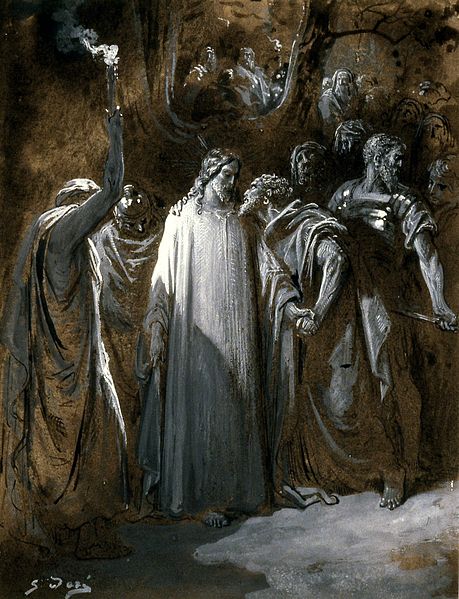
File:Gustave Doré - Study for "The Judas Kiss" - Walters 371387.jpg

Gustave Doré – Study for “The Judas Kiss” (courtesy wikimedia commons)

By Spencer D Gear PhD

Judas Iscariot and Peter were both picked by Jesus specifically to cast out devils, heal the sick, and preach the gospel (Matthew 10:1-27). I would not expect Jesus to choose men who were not in the kingdom and were not promoters of the kingdom of God.

Jesus placed his public approval upon these men when he picked them to be His Apostles and commissioned them to preach His gospel. This is a very important series of verses (Mt 10:1-27): note v 20, especially, ‘For it is not you who speak, but the Spirit of your Father speaking through you’ (ESV).

So God’s Spirit was speaking through all 12 apostles, including Judas. Therefore Judas was of such a spiritual ranking that God’s Spirit spoke through him. Even though this is prior to Jesus’ death on the cross, it is made clear that the Spirit was working in and through Judas. In New Testament terms, he was a saved man.

Was Judas chosen for the kingdom of God and then lost his status or was Judas never ever chosen by Jesus for the kingdom? Or, was Judas chosen for destruction and damnation as ‘one of you [Judas] is a devil’?

What better place to start than with the Scriptures?

Good Book

ChristArt

 What do the Scriptures state?

Judas was first numbered among the Twelve apostles (Lk 6:13, 22:3; Acts 1:16-17). Acts 1:17 is clear about Judas’ role: ‘He was numbered among us and was allotted his share in this ministry’. Therefore, this issue is unquestioned: Judas was ‘chosen’ by Christ Himself, and as the apostle Judas was one of the 12 chosen by Jesus (Lk 6:13; 22:3).

Luke 22:3: ‘Then Satan entered into Judas called Iscariot, who was of the number of the twelve’ (ESV). That’s very clear. He was one of the twelve apostles chosen by Jesus.

John 6:70, Jesus asks the rhetorical question to His twelve apostles, ‘Did I not choose you, the Twelve? And yet one of you is a devil?’

Matt. 26:23-24 He answered and said, ’He who has dipped his hand in the dish with me will betray me. The Son of Man goes as it is written of him, but woe to that man by whom the Son of Man is betrayed! It would have been better for that man if he had not been born’.

In Luke 12:32 Jesus says to His disciples, “Fear not, little flock; for it is your Father’s good pleasure to give you the kingdom.”
This Scripture states that Matthias’ place was ‘to take the place in this ministry and apostleship from which Judas turned aside to go to his own place (Acts 1:25).
Jesus Himself provided the answer in John 17:12, ‘While I was with them, I kept them in your name, which you have given me. I have guarded them, and not one of them has been lost except the son of destruction, that the Scripture might be fulfilled’.

Matthew 27:3-5, ‘Then Judas, which had betrayed him, when he saw that he was condemned, repented himself, and brought again the thirty pieces of silver to the chief priests and elders, Saying, I have sinned in that I have betrayed the innocent blood. And they said, What is that to us? see thou to that. And he cast down the pieces of silver in the temple, and departed, and went and hanged himself’ (KJV).

The words ‘repented himself’ here (from the King James Version) are not the best possible translation of the underlying Greek. The Greek word means ‘regret’ or ‘remorse’ but it does not necessarily imply a change like the word for ‘repentance’ does. The World English Bible translates Matthew 27:3 as, “Then Judas, who betrayed him, when he saw that Jesus was condemned, felt remorse, and brought back the thirty pieces of silver to the chief priests and elders” (WEB).

‘Then they [Judas was there] that were in the ship came and worshipped him, saying, Of a truth thou art the Son of God’ (Matthew 14:33 KJV).

Here we learn that Judas, with the others, was an unbeliever, and then the Lord Jesus adds in John 6:70-71 these words, “Jesus answered them, Have not I chosen you twelve, and one of you is a devil? He spake of Judas Iscariot the son of Simon: for he it was that should betray him, being one of the twelve.”
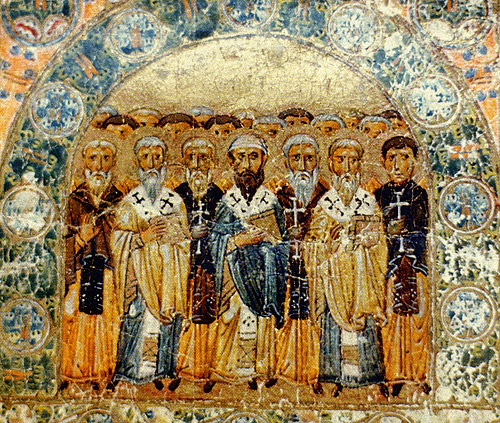
Church Fathers (courtesy Wikipedia)

Let’s check out a few of the church fathers

Irenaeus (ca AD 125-202),[1] bishop of Lyons in Gaul about the year AD 180, wrote in Against Heresies (about AD 185), of Judas [2]

who was expelled from the number of the twelve, and never restored to his place…. but Judas was deprived [of his office], and cast out, while Matthias was ordained in his place….

But Judas having been once for all cast away, never returns into the number of the disciples; otherwise a different person would not have been chosen to fill his place. Besides, the Lord also declared regarding him, Woe to the man by whom the Son of man shall be betrayed; Matthew 26:24 and, It were better for him if he had never been born; Mark 14:21 and he was called the son of perdition John 17:12 by Him. (Against Heresies, 2.20.2, 5).

Chrysostom (ca AD 347-407),[3] was born and ministered in Antioch, Syria, and was the golden-mouthed expositor and orator. He wrote, ‘For Judas too was a child of the kingdom, and it was said to him with the disciples, You shall sit on twelve thrones; Matthew 19:28 yet he became a child of hell’ (Homily 26 on Matthew).

Ambrose of Milan (ca AD 340-397), [4] administrator and preacher, said, ‘For both Saul and Judas were once good…. Sometimes they are at first good, who afterwards become and continue evil; and for this respect they are said to be written in the book of life, and blotted out of it’ (cited from The Works of John Fletcher, p. 137).

St Augustine of Hippo (ca AD 354-430),[5] philosopher and theologian, in his Tractate 62 (John 13:26-21) had quite a bit to say about Judas and his condition. This is but a sample:

It was after this bread, then, that Satan entered into the Lord’s betrayer, that, as now given over to his power, he might take full possession of one into whom before this he had only entered in order to lead him into error. For we are not to suppose that he was not in him when he went to the Jews and bargained about the price of betraying the Lord; for the evangelist Luke very plainly attests this when he says: Then entered Satan into Judas, who was surnamed Iscariot, being one of the twelve; and he went his way, and communed with the chief priests. Luke 22:3-4. Here, you see, it is shown that Satan had already entered into Judas. His first entrance, therefore, was when he implanted in his heart the thought of betraying Christ; for in such a spirit had he already come to the supper. But now, after the bread, he entered into him, no longer to tempt one who belonged to another, but to take possession of him as his own.

But it was not then, as some thoughtless readers suppose, that Judas received the body of Christ. For we are to understand that the Lord had already dispensed to all of them the sacrament of His body and blood, when Judas also was present, as very clearly related by Saint Luke; Luke 22:19-21 and it was after this that we come to the moment when, in accordance with John’s account, the Lord made a full disclosure of His betrayer by dipping and holding out to him the morsel of bread, and intimating perhaps by the dipping of the bread the false pretensions of the other. For the dipping of a thing does not always imply its washing; but some things are dipped in order to be dyed. But if a good meaning is to be here attached to the dipping, his ingratitude for that good was deservedly followed by damnation (Tractate 62.2-3).

So Augustine regarded Judas as a man of ‘false pretensions’. Thus, it is inferred that Judas was not a genuine believer when he was tempted to betray Jesus. Irenaeus regarded Judas as being cast away from the 12, never to return. For Chrysostom, Judas was a child of the kingdom who became a child of hell. He was written in the book of life was Ambrose’s perspective and then Judas was blotted out of the book of life – he lost his salvation.

So for these church fathers, some believed Judas was never saved and was a pretender, but for others, Judas was saved and lost again.

A heretical forgery, a Gnostic gospel, ‘the Gospel of Judas‘, was found in the 1970s in an Egyptian cave.


Green Salvation Button

Tut tut says the Calvinist: Satan could not enter a believer

I was engaged in some interaction on Judas’ godly status or otherwise, on a Christian forum. One fellow, a Calvinist, responded: ‘Satan can enter believers? More heresy’.[6]

My response was:[7]

I do wish your presuppositions wouldn’t blind you to the facts recorded in the Gospels. Another person wrote:

Yes, he was a believer. Even Calvinists will tell you unbelievers want nothing to do with the gospel, the kingdom, and the King Himself. If he wasn’t a believer, he would have turned away from Jesus just as other disciples did. Judas fell away when Satan entered him.[8]

So what did one of these posters do? He labelled my post as ‘heresy’ because he believes that ‘Judas fell away when Satan entered him’
Let’s check out the Gospel facts. In Matthew 10, we note these Gospel details in the authoritative Scriptures:

  • ‘These twelve [including Judas] Jesus sent out, instructing them’ (Matt 10:5). How did Jesus describe these 12?
  • ‘Behold, I am sending you out as sheep in the midst of wolves’ (Matt 10:16). So Jesus regarded Judas as one of his ‘sheep’.
  • ‘For it is not you who speak, but the Spirit of your Father speaking through you’ (Matt 10:20). So all of the 12, including Judas, had the Holy Spirit of YOUR heavenly Father speaking through them. So, for Judas, God was HIS Father.

What happened later to Judas? ‘Then Satan entered into Judas called Iscariot, who was of the number of the twelve’ (Luke 22:3).

Earlier, in response to another post, the person claimed: ‘I have my view. But if you believe that Satan can inhabit believes (sic), then you believe a heresy’.[9]

My reply was:[10]

That is a false claim in relation to Judas, as I showed in the thread on that forum.

Why must this person impose his own presuppositions on the biblical text and make it mean what it does not say? In hermeneutics (biblical interpretation), this is called eisegesis.

Judas was elected by Jesus as one of the 12, sent out to preach by Jesus and cast out demons, and the heavenly Father was Judas’s Father. The Spirit of the Father spoke through Judas. Then Satan entered Judas.

These are biblical facts and not heretical facts.

Based on these facts and those I have provided, this Calvinistic poster was engaging in eisegesis, but he called a poster a promoter of heresy because he believes Satan entered Judas and that can’t happen to a believer. However, the facts as recorded in the Gospels are that Satan entered Judas. I’m sticking with the biblical facts when I maintain that Judas was chosen by Jesus as one of the 12 to enter the kingdom, but he fell away when he allowed Satan to enter him and he denied association with Jesus – three times.

Scarlet Salvation Button

Calvinists refuse to accept loss of salvation

Calvinists have large problems with Judas being chosen as an apostle and then losing his chosen status when Satan entered him. Why? They are unable to accommodate anyone losing his/her salvation. It doesn’t fit with the presuppositions of a TULIP view of salvation.

Matthew Slick, a Calvinist, explained the P of the acronym, ‘Perseverance of the saints’:

You cannot lose your salvation. Because the Father has elected, the Son has redeemed, and the Holy Spirit has applied salvation, those thus saved are eternally secure. They are eternally secure in Christ. Some of the verses for this position are John 10:27-28 where Jesus said His sheep will never perish; John 6:47 where salvation is described as everlasting life; Romans 8:1 where it is said we have passed out of judgment; 1 Corinthians 10:13 where God promises to never let us be tempted beyond what we can handle; and Phil. 1:6 where God is the one being faithful to perfect us until the day of Jesus’ return.[11]

For an alternative – from an Arminian perspective – regarding salvation, see Brian Abasciano and Martin Glynn’s response to TULIP, represented by the acronym FACTS:

Freed by Grace (to Believe)
Atonement for All
Conditional Election
Total Depravity
Security in Christ

This view by Abasciano and Glynn provides this explanation of ‘security in Christ’:

  • Since salvation comes through faith in Christ, the security of our salvation continues by faith in Christ.
  • Just as the Holy Spirit empowered us to believe in Christ, so he empowers us to continue believing in Christ.
  • God protects our faith relationship with him from any outside force irresistibly snatching us away from Christ or our faith, and he preserves us in salvation as long as we trust in Christ.
  • Arminians have differing views of whether Scripture teaches that believers can forsake faith in Christ and so perish (the traditional view, held by most Arminians), or whether God irresistibly keeps believers from forsaking their faith and therefore entering into eternal condemnation (as unbelievers).[12]

Conclusion

The biblical evidence – as articulated above – points to Judas being chosen by Jesus, being a member of God’s kingdom and then losing his salvation when Satan entered him and he denied Jesus. I cannot conclude otherwise from an inductive study of Scripture.

Judas Iscariot (right), retiring from the Last Supper, painting by Carl Bloch, late 19th century (courtesy Wikipedia)

Works consulted

Cairns, E E 1981. Christianity through the centuries: A history of the Christian church. Grand Rapids, MI: Zondervan Publishing House.

Notes


[1] Lifespan dates are from ‘St Irenaeus, Bishop of Lyons: Biography’, Christian Classics Ethereal Library. Available at: http://www.ccel.org/ccel/irenaeus (Accessed 29 December 2013).

[2] These details of Irenaeus are from Cairns (1981:110), who stated that he ‘was born in Smurna, had been influenced by Polycarp’s preaching while Polycarp was bishop of Smyrna’. Against Heresies is his ‘greatest work’ and ‘was done in the field of polemics writing against Gnosticism’ (Cairns 1981:10).

[3] Lifespan dates are from Cairns (1981:141).

[4] Lifespan dates are from Cairns (1981:145).

[5] Lifespan dates are from Cairns (1981:146).

[6] Hammster#22. 13 October 2013, Christian Forums, General Theology, Soteriology, ‘Does Matthew 13:11 support election and reprobation?’ Available at: http://www.christianforums.com/t7779586-3/ (Accessed 27 December 2013).

[7] Ibid., OzSpen#29.

[8] Ibid., Ask Seek Knock#20.

[9] Ibid., Hammster#25.

[10] Ibid., OzSpen#30.

[11] Matthew J Slick 2012. Calvinist Corner, ‘The five points of Calvinism’ (online). Available at: http://www.calvinistcorner.com/tulip.htm (Accessed 28 December 2013).

[12] ‘Security in Christ (Article 5)’ 2013, An Outline of the FACTS of Arminianism vs. The TULIP of Calvinism, February 28. Society of Evangelical Arminians. Available at: http://evangelicalarminians.org/an-outline-of-the-facts-of-arminianism-vs-the-tulip-of-calvinism/#ASC (Accessed 28 December 2013).


Copyright © 2014 Spencer D. Gear. This document last updated at Date: 18 November 2015.

Secular historian confirmed Christian martyrs by Nero in first century

Wien- Parlament-Tacitus.jpg

Modern statue representing Tacitus
outside the Austrian Parliament Building

(courtesy Wikipedia)

By Spencer D Gear

Secular historian, Tacitus (ca. AD 56-120)[1], wrote his Annals and included details of the Neronian persecution in AD 64.[2] This writing was ‘perhaps fifty years after the event, and therefore not to be accepted without question’ (Latourette 1975:85). Tacitus wrote:

Consequently, to get rid of the report, Nero fastened the guilt and inflicted the most exquisite tortures on a class hated for their abominations, called Christians by the populace. Christus, from whom the name had its origin, suffered the extreme penalty during the reign of Tiberius at the hands of one of our procurators, Pontius Pilatus, and a most mischievous superstition, thus checked for the moment, again broke out not only in Judaea, the first source of the evil, but even in Rome, where all things hideous and shameful from every part of the world find their centre and become popular. Accordingly, an arrest was first made of all who pleaded guilty; then, upon their information, an immense multitude was convicted, not so much of the crime of firing the city, as of hatred against mankind. Mockery of every sort was added to their deaths. Covered with the skins of beasts, they were torn by dogs and perished, or were nailed to crosses, or were doomed to the flames and burnt, to serve as a nightly illumination, when daylight had expired. Nero offered his gardens for the spectacle, and was exhibiting a show in the circus, while he mingled with the people in the dress of a charioteer or stood aloft on a car. Hence, even for criminals who deserved extreme and exemplary punishment, there arose a feeling of compassion; for it was not, as it seemed, for the public good, but to glut one man’s cruelty, that they were being destroyed (Tacitus, Annals 15.44).

How many Christians were martyred in the city of Rome during the Neronian persecution of AD 64? It was an ‘immense multitude’, according to a secular historian, Tacitus.

Works consulted

Latourette, K S 1975. A history of Christianity: To A.D. 1500, vol 1, rev ed. New York: Harper & Row, Publishers.

Notes


[1] Lifespan date from N S Gill, ‘Tacitus’, Ancient/Classical History, available at: http://ancienthistory.about.com/od/historianstacitus/a/Tacitus.htm (Accessed 18 January 2014).

[2] Latourette wrote that ‘the most famous of the early persecutions [of Christians] was that in Rome in A.D. 64…. Tradition, probably reliable, reports that both Peter and Paul suffered death at Rome under Nero, although not necessarily at this time. Peter’s remains are supposed now to lie under the high altar in the cathedral which bears his name in what were once the gardens of Nero. It may have been that the persecution of Nero spread to the provinces’ (Latourette 1975:85).

 
Copyright © 2014 Spencer D. Gear. This document last updated at Date: 12 November 2015.

The dangers of anal sex and fisting

Sex On The Brain

(courtesy publicdomainpictures.net)

By Spencer D Gear

Anal sex is intercourse via the anus/rectum rather than using the vagina. It is sexual activity that involves inserting the penis in the rear end (anus) rather than the front end (vagina).

What is fisting? ‘Fisting is a type of sexual activity that involves using the whole hand (fist) to penetrate the body. People engage in both vaginal fisting — inserting the hand inside the vagina — and anal fisting, inserting the hand into the rectum’ (Elizabeth Boskey 2011, Fisting: Sexually Transmitted Diseases [STDs]).

In a reply on a Christian forum, I wrote:

I cannot begin to tell you what happens with anal sex and the diseases caused.

There are practical reasons why God tells Christians to avoid fornication, adultery, sex outside of marriage.

And we haven’t dealt with what God says that happens when a man and a woman join in sex – the effects of bonding. But that’s for another time.

There are biblical and practical reasons why God forbids sex outside of marriage – porneia.[1]

A mature Christian responded:

I just wanted to add, you mentioned anal sex. This is growing in popularity among the younger generation that doesn’t seem to have a clue how physically destructive and dangerous this is.

Our family had a huge discussion on this very subject. My sister who is a counselor talked very frankly to all the young people in our family about how it became such a common practice among heterosexuals and the disastrous physical effects it has on the body.[2]

How should I reply? Be honest, avoid the topic, or give a compromised position that will not cause offense? I chose the line of honesty and gave a[3]

A.  Warning rather than falling victim

If people find this topic too offensive (what follows), I or the moderators can delete it. But I thought that we needed to get back to grassroots here. Warning might be better than becoming a victim. I can put the topic on my homepage and give a link to those who want to visit it.

The topic I have introduced is not new to the medical, psychological and counselling professions. I speak as a long-term counsellor and counselling manager who has recently retired.
For some of the evidence and the danger of anal/rectal sex, I recommend a read of,

You’ll appreciate that this is not a disease restricted to the homosexuals as I know of heterosexuals who are getting into the practice as well. As a counsellor, I’m deeply concerned at what people don’t know about anal intercourse and the damage of fisting.

B.  Vaginal vs. anal intercourse and the dangers

Here’s a graphic of the rectum and anus:

clip_image001
Courtesy WebMD

God made the vagina with thick walls for sexual penetration. The rectum and its entrance, the anus, are not designed by God for sexual penetration. Therefore, anal/rectal sex is at a higher risk of disease as medical experts tell us. I’m not inventing this.
God knew what he was about when his law restricted sexual intercourse to a man and woman and in the place that God made for such sexual activity.

Then there is the added problem that comes with ‘fisting’ in vagina and rectum. See the article, ‘Sexual trauma associated with fisting and recreational drugs‘.

These may not be nice topics to discuss, but I have to be honest in exposing the consequences of what is happening in our sexualised society.

I don’t enjoy having to deal openly with this kind of topic. I’m grieved that people get into it without knowing the consequences. One doesn’t have to be a Christian to know of the harm that anal/rectal intercourse and fisting do to the human body.

There are disgusting photos online of fisting action.

C.  Is anal sex safe?

I went to WebMD Sexual Health Center and the article, ‘Anal sex safety and health concerns’ and learned that anal sex is risky sexual activity:

An estimated 90% of men who have sex with men and as many as 5% to 10% of sexually active women engage in receptive anal intercourse.

Often referred to simply as anal sex, anal intercourse is sexual activity that involves inserting the penis into the anus. People may engage in anal intercourse, which has health risks, because the anus is full of nerve endings, making it very sensitive. For some recipients of anal sex, the anus can be an erogenous zone that responds to sexual stimulation. For the giving partner, the anus may provide a pleasing tightness around the penis.

While some people find anal sex enjoyable, the practice has downsides and requires special safety precautions.

Anal sex has a number of health risks. Anal intercourse is the riskiest form of sexual activity for several reasons, including the following:

6pointLight-smallThe anus lacks the natural lubrication the vagina has. Penetration can tear the tissue inside the anus, allowing bacteria and viruses to enter the bloodstream. This can result in the spread of sexually transmitted infections including HIV. Studies have suggested that anal exposure to HIV poses 30 times more risk for the receptive partner than vaginal exposure. Exposure to the human papillomavirus (HPV) may also lead to the development of anal warts and anal cancer. Using lubricants can help some, but doesn’t completely prevent tearing.

6pointLight-smallThe tissue inside the anus is not as well protected as the skin outside the anus.Our external tissue has layers of dead cells that serve as a protective barrier against infection. The tissue inside the anus does not have this natural protection, which leaves it vulnerable to tearing and the spread of infection.

6pointLight-smallThe anus was designed to hold in feces. The anus is surrounded with a ring-like muscle, called the anal sphincter, which tightens after we defecate. When the muscle is tight, anal penetration can be painful and difficult. Repetitive anal sex may lead to weakening of the anal sphincter, making it difficult to hold in feces until you can get to the toilet. However, Kegel exercises to strengthen the sphincter may help prevent this problem or correct it.

6pointLight-smallThe anus is full of bacteria. Even if both partners do not have a sexually-transmitted infection or disease, bacteria normally in the anus can potentially infect the giving partner. Practicing vaginal sex after anal sex can also lead to vaginal and urinary tract infections.

Anal sex can carry other risks as well. Oral contact with the anus can put both partners at risk for hepatitis, herpes, HPV, and other infections. For heterosexual couples, pregnancy can occur if semen is deposited near the opening to the vagina.

Even though serious injury from anal sex is not common, it can occur. Bleeding after anal sex could be due to a hemorrhoid or tear, or something more serious such as a perforation (hole) in the colon. This is a dangerous problem that requires immediate medical attention. Treatment involves a hospital stay, surgery, and antibiotics to prevent infection.

Surely this should be sending a strong message to avoid anal sex. The anus and rectum were not made for penetration. The vagina is.

As for fisting, get the gist of the feisty, fantastic, outlandish way of abusing your body – sexually. Become an advocate for healthy living and give up the practice and recommendation of sexual fisting.

D.  A feisty response

One fellow got rather feisty when I provided a link to this article on Christian Fellowship Forum.  He wrote:

You cited a single article by a doctor as your soul scientific reference — completely without peer review, then launched into an opinion piece based on nothing more than your personal opinion about a subject you’re not qualified to write about with any authority.

Bring in real scientific studies and facts, then your credibility will rise (‘Five things I wish Christians would admit about the Bible’, George #130).

My response was (ozspen #165):

For heaven’s sake, I was writing a popular level article on fisting and the dangers of anal intercourse and I cited an article that was written by Elizabeth Boskey, written or reviewed by a board-certified physician that dealt with the dangers of this activity. It was not written for an academic audience to provide peer-reviewed research articles. However, the information is consistent with the peer-reviewed articles I have read down through my 34 years as a counsellor and counselling manager.

It’s time he got with the programme of why I have a homepage and the nature of my audience. In addition, he is as capable as I to Google peer-reviewed articles that deal with the dangers of anal intercourse. But no, he spoofed at my article because it didn’t provide peer-reviewed information. That was not its purpose. My homepage audience, based on the feedback I receive, is not interested in peer-reviewed material . They want the practical facts of the dangers of such risky sexual behaviour as anal intercourse and fisting.

In this article, The dangers of anal sex and fisting, I included information from the Cancer Health Center which concluded that ‘Gay Men Should Be Checked for Anal Cancer, Experts Say‘. I provided a link to an article by John Riggs MD on ‘The health risks of gay sex‘. ‘The Gay Bowel Syndrome‘ provided details of the problem and then had a bibliography that provided links to peer-reviewed articles.

As for peer-reviewed journals that document this problem with anal intercourse, see:

  1. Prevalence of Unprotected Anal Intercourse among Men Who Have Sex with Men in China: An Updated Meta-Analysis;
  2. Anal sex practices in heterosexual and male homosexual populations: A review of population-based data (Anal sex is known to be an important risk factor for anal cancer);
  3. Anal sex among young people and implications for health promotion: A qualitative study in the UK (British Medical Journal);
  4. A qualitative assessment of health seeking practices among and provision practices for men who have sex with men in Malawi (It found that men who have sex with men (MSM) in Malawi have a disproportionate burden of HIV compared to other adults)
  5. A systematic review of HIV interventions for black men who have sex with men (MSM) (It found that Black men who have sex with men (MSM) are disproportionately burdened by HIV/AID);
  6. Anal sex and associated HIV-related sexual risk factors among female sex workers in Andhra Pradesh, India (Anal sex is associated with STI symptoms, a factor for HIV risk. HIV intervention programmes need to educate female sex workers about the risks associated with anal sex).

Notes:

[1] Christian Fellowship Forum, Christian Morals, ‘Shacking up before marriage’, ozspen #39, available at: http://community.compuserve.com/n/pfx/forum.aspx?tsn=33&nav=messages&webtag=ws-fellowship&tid=122551 (Accessed 28 November 2013).

[2] Ibid., Noelle #43.

[3] Ibid., ozspen #46.

 
Copyright © 2013 Spencer D. Gear. This document last updated at Date: 12 November 2015.

Should Mark 16:9-20 be in the Bible?

Papyrus Roll Clip Art

clker.com

By Spencer D Gear

One fellow claimed there were only three options and he put it into a poll:

Poll: Should the resurrection account of Mark 16:9-20 be removed from the bible?

Be advised that this is a public poll: other users can see the choice(s) you selected.

Poll Options

Should the resurrection account of Mark 16:9-20 be removed from the bible?

yes

no

I do not know

View poll results

His assessment was:[1]

Should the resurrection account of Mark 16:9-20 be removed from the bible?


Many new bible versions question whether Mark 16:9-20 should be in the bible. This is done in footnotes or the use of single or double brackets around the passage. As far as I know not a single bible actually leaves out the passage, which contains the description of the resurrections of the Lord Jesus, a record of the apostles and some others seeing Him, words that Jesus Christ spoke and a declaration of His ascension into heaven.

In 1 Corinthians 15:1-4, Paul declares that gospel of salvation as the crucifixion, burial, and resurrection of Jesus Christ the Lord. So the resurrection, as the apostles as eyewitnesses, should be in the Gospel according to Mark.

Here is the passage from the King James Bible: Mark 16:9-20

9 Now when Jesus was risen early the first day of the week, he appeared first to Mary Magdalene, out of whom he had cast seven devils.
10 And she went and told them that had been with him, as they mourned and wept.
11 And they, when they had heard that he was alive, and had been seen of her, believed not.
12 After that he appeared in another form unto two of them, as they walked, and went into the country.
13 And they went and told it unto the residue: neither believed they them.
14 Afterward he appeared unto the eleven as they sat at meat, and upbraided them with their unbelief and hardness of heart, because they believed not them which had seen him after he was risen.
15 And he said unto them, Go ye into all the world, and preach the gospel to every creature.
16 He that believeth and is baptized shall be saved; but he that believeth not shall be damned.
17 And these signs shall follow them that believe; In my name shall they cast out devils; they shall speak with new tongues;
18 They shall take up serpents; and if they drink any deadly thing, it shall not hurt them; they shall lay hands on the sick, and they shall recover.
19 So then after the Lord had spoken unto them, he was received up into heaven, and sat on the right hand of God.
20 And they went forth, and preached every where, the Lord working with them, and confirming the word with signs following. Amen.
Should the resurrection account of Mark 16:9-20 be removed from the bible?

He asked for those who voted ‘yes’ to reply. I did:[2]

I voted ‘yes’

Why? I voted in the affirmative because my research has found that some of the earliest MSS (manuscripts) do not include Mark 16:9ff. I support the statement that precedes these verses in the ESV, ‘Some of the earliest manuscripts do not include 16:9-20’.
In addition, I believe this section teaches false doctrine. It seems to have an apocryphal flavour. This false doctrine includes:

  1. Baptismal regeneration (Mk 16:16);
  2. Picking up serpents with their hands and drinking deadly poison will not hurt people (16:18).
  3. ‘They will lay their hands on the sick, and THEY WILL recover’ (16:18). We know that there is no guarantee that laying hands on the sick will lead to recovery from sickness. That is the Lord’s sovereign work.

There are 4 actual endings in the MSSs from v 9ff. Which one do you support?

The long ending, Jerome told us, was in Greek copies in his day.

There are 17 non-Markan words in Mk 16:9ff and the lack of a smooth transition from 16:8-16:9 indicates that there are features in 9ff that were added by someone who knew something of a form of Mark’s Gospel that ended abruptly at 16:8 and he/she wanted a smoother conclusion.

There is an Armenian MSS of the Gospels copied about AD 989 that contains 2 words at the end of v 8 and before vv 9-20. They are Aristion eritsou (‘of the Presbyter Aristion’). Some have interpreted this to refer to Aristion, a contemporary of Papias in the early 2nd century. Papias has been traditionally understood to be a disciple of the Apostle John (this information from Bruce Metzger 1991:227). Could it be that Aristion added these words?

So there are a number of reasons why I reject Mark 16:9-20 as being in the original text.

You are wrong!

Here is his response to my post:[3]

Mark 16:16 is not baptismal regeneration at all. It is baptism by the Holy Spirit. The verse itself shows that.
Paul in Acts 28 did have viper bite him and it had no effect. This is string evidence that Mark 16:9-20 is indeed original.
Paul also laid his hands on someone who recovered in Acts 28. This is string evidence that Mark 16:9-20 is indeed original.
These signs do disappear in the New Testament but that too matches Mark 16:9-20.
The rest of your response is full of assumptions and presuppositions.
Your extraordinary claim that all English Bibles are in error must be proved beyond all doubt.

My reply was:[4]

He claimed: ‘Mark 16:16 is not baptismal regeneration at all. It is baptism by the Holy Spirit. The verse itself shows that’.

My response: The context doesn’t indicate Spirit baptism but ‘whoever believes and is baptized will be saved’.

He claimed: ‘Paul in Acts 28 did have viper bite him and it had no effect. This is string evidence that Mark 16:9-20 is indeed original’.

My reply was that Paul’s being bitten by a viper in Acts 28:3f and not being killed, is very different theology from ‘picking up serpents with their hands; and if they drink any deadly poison, it will not hurt them’.

He claimed: ‘Paul also laid his hands on someone who recovered in Acts 28. This is string evidence that Mark 16:9-20 is indeed original.’

My response was that laying hands on a person and that person is healed is different from the theology of Mk 16:18, ‘They WILL lay their hands on the sick, and they WILL recover’. Many people have had pastors and elders lay hands on the sick and pray for them and they HAVE NOT recovered from that sickness. I’m one such person. Healing from laying hands on the sick is not guaranteed. That’s determined by the sovereign God and there is no guarantee THEY WILL recover.

He came again: ‘These signs do disappear in the New Testament but that too matches Mark 16:9-20.’

Not according to Mk 16:17, ‘These signs will accompany those who believe’. It is expected that there will be ‘those who believe’ from the time of Jesus to the time of his second coming. See also John 14:12.

His view was, ‘The rest of your response is full of assumptions and presuppositions.’

Yes, I have presuppositions, but I try to back them with evidence. Let’s not overlook that both of us operate from presuppositions.

He claimed, ‘Your extraordinary claim that all English Bibles are in error must be proved beyond all doubt.’

My response was: I have never made such a statement. You have misrepresented my view.

Options for Mark 16:9-20 being in canon of Scripture

At one point this fellow stated: ‘Yes, no, or I do not know does indeed covers (sic) all choices’ (of his poll re Mk 16:9-20 being included in the Bible).[5]

My response was:[6]

These could be some of the choices:

  • Yes
  • No
  • I do not know
  • Some oldest MSS do not include 16:9-20;
  • Early MSS & other ancient witnesses don’t have 16:9-20;
  • There is serious doubt about whether 16:9-20 belongs in Mark;
  • Some ancient versions add 16:9-20; others leave it out.

These are but examples. There are more than 3 options.

Some further points

These are some further points I made:

clip_image002 The statement was made by another, ‘Paul in 1 Corinthians 15:1-4 declares that the gospel of salvation includes the crucifixion, burial, and resurrection of Jesus Christ. Therefore the gospel according to Mark must have it. It would never have been accepted if it did not have it’.[7]

My response was:[8]

This is circular reasoning. Just because 1 Cor 15:1-4 declares the gospel of salvation involving Jesus’ death, burial and resurrection, that does not place a requirement on what should appear in Mark’s version of the resurrection.

What God has permitted for Mark 16:1-8 to be Mark’s version of the resurrection and what is in the other gospels, is what God provided in his authoritative Scripture.
I Cor 15:1-4 does not dictate the extent of what should be in Mark when the other details of the death, burial and resurrection of Jesus are in the FOUR Gospels.
It is circular reasoning to require that 1 Cor 15 dictates what should be in Mark.

clip_image002[1]’We need to be clear on something about Jesus’ resurrection. We have no record of any eyewitnesses who saw the actual resurrection of Jesus. Not a single person saw the resurrection – based on the NT evidence.

We do have evidence of people who spoke with, touched, and ate with Jesus after his resurrection. But that is not the same as these people being eyewitnesses of Jesus’ resurrection’.[9]

clip_image002[2] A person wrote:[10]

The Bible gives warnings about adding to or taking away from the Bible.

Deuteronomy 4:2
New American Standard Bible (NASB)
2 You shall not add to the word which I am commanding you, nor take away from it, that you may keep the commandments of the Lord your God which I command you

Deuteronomy 12:32
New American Standard Bible (NASB)
32 “[a]Whatever I command you, you shall be careful to do; you shall not add to nor take away from it.

Revelation 22:18
New American Standard Bible (NASB)
18 I testify to everyone who hears the words of the prophecy of this book: if anyone adds to them, God will add to him the plagues which are written in this book.

My brief reply was:[11]

Proof texting does not help this discussion for these reasons:

1. You quote 2 verses from Deuteronomy about not adding to the Word. But what does the New Testament do? It ADDS to the Word of the OT. There are issues of interpretation that must be dealt with to understand what’s going on here. Quoting from Deut without this discussion is not helpful.

2. Then you quote Rev 22:18, which is a common one for questioning those who discuss whether or not Mk 16:9-20 should be in or out of Scripture. But you did not discuss these matters:

  • Rev 22:18 was written at the end of a single book when it was composed. It was not in the canon of Scripture when originally written. Therefore, how can it relate to the entire OT and NT when it seems more likely to apply only to the Book of Revelation? There needs to be questions around this question rather than providing proof texts.
  • Also, how do you know what is the exact content of the canon of Scripture to know that one is adding to or subtracting from it? Does the canon include Mk 16:9-20 or is it an addition? This question of bibliology needs to be pursued. This is not possible with proof texting.
  • I find that proof texting leaves too many questions unanswered – and especially in a discussion like this.

A fellow replied:[12]

That makes two doubting Thomases?
Then he said to Thomas, “Put your finger here; see my hands. Reach out your hand and put it into my side. Stop doubting and believe’ (John 20:27).

My response was:[13]

Sounds like there are 3 of us.

I’m one who wants to be honest with the evidence from the Gospels. We have records of eyewitnesses who walked and talked with Jesus AFTER his resurrection and BEFORE the ascension. But, to my knowledge, there was not a single witness to his actual resurrection.

In many ways I’m pleased about that as such people could have found it difficult to maintain their humility. However, we have all the evidence in the NT that the Lord wanted us to have.

Works consulted

Metzger, B M 1992. The text of the New Testament. New York/Oxford: Oxford University Press.


Notes:


[1] SavedByGraceThruFaith#1, Christian Forums, Christian Apologetics, ‘Should the resurrection account of Mark 16:9-20 be removed from the bible?’ 27 December 2013. Available at: http://www.christianforums.com/t7795110/ (Accessed 2 January 2014).

[2] Ibid., OzSpen#6.

[3] Ibid, SavedByGraceThruFaith#19, available at: http://www.christianforums.com/t7795110-2/,

[4] Ibid., OzSpen#21, available at: http://www.christianforums.com/t7795110-3/.

[5] Ibid, SavedByGraceThruFaith#5, http://www.christianforums.com/t7795110/.

[6] Ibid., OzSpen#27, http://www.christianforums.com/t7795110-3/.

[7] Ibid., SavedByGraceThruFaith#8, http://www.christianforums.com/t7795110/.

[8] Ibid., OzSpen#27, http://www.christianforums.com/t7795110-3/.

[9] Ibid., OzSpen#25.

[10] Ibid., SharolL#20, http://www.christianforums.com/t7795110-2/.

[11] Ibid., OzSpen#29.

[12] Ibid., SkyWriting#30.

[13] Ibid., OzSpen#31, http://www.christianforums.com/t7795110-4/#post64776358.

 
Copyright © 2014 Spencer D. Gear. This document last updated at Date: 12 November 2015.

How to get people to read Internet posts and email

Internet  Clip Art

clker.com

(courtesy )

Are there any techniques of the advertising trade that could help to attract people to read your posts to your homepage and Internet forums? Will these same tactics improve the rate of reading of email you send?

Do you suspect that many people don’t read your posts on the Internet? Do you have a hunch that your email often makes it to the delete bin rather quickly?

I contribute to a large forum, Christian Forums, and to the theological area. I’m of the view that many posts are not read because they are in directories that have official theological labels such as Soteriology; Paterology, Christology & Pneumatology; Ecclesiology; Hamartiology; etc. This is not the language of everyday folks. It is for theology buffs.

What can you do to prevent your posts from being consigned to the no-read file? Or email to the delete bucket?

How to get people to the first step: Read it


I came across this article in The Brisbane Times, ‘How to get people to read your emails‘. I found these principles just as important for Internet posts as for email and other writing. These are the same principles I used when writing advertising copy for radio and TV quite a few years ago.

Why don’t you take a read of this article? To give you a taste of the principles, the first two are:

  1. Use punchy subject lines;
  2. Write newsy no-nonsense copy.

There are 6 points that are easy to read and could be adapted quite easily to Internet forums and email.

What do you think is the sixth point?

Some examples of punchy subject lines

Let’s try a few examples of punchy subject lines in that Internet forum:

clip_image002 ‘Soteriology’ deals with the Christian teaching on salvation. Some punchy lines on this topic could be:

  • Bloody cure for bloody crimes;
  • Why would God waste his time?
  • Save the criminals.

clip_image002[1] ‘Hamartiology’ is the Christian teaching on sin. Could these be some punchy lines for an Internet forum?

  • It’s worse than you think.
  • All of us have the criminal in us.
  • Sinful stupidity.
  • Self-esteem nonsense.

clip_image002[2] Christian apologetics should provide plenty of opportunities for punchy subject lines. Let’s try a few:

  • Who made God?
  • Why doesn’t God stop all of the crap in the world?
  • Why does a loving God let paedophiles rape children?
  • Jesus’ resurrection is fanciful nonsense.

In these kinds of topics, there are plenty opportunities for ‘newsy no-nonsense copy’ to provide answers to these provocative topics. I consider that Christian Forums should drop its fancy theological names. Change

  • Soteriology     clip_image004 Salvation
  • Paterology      clip_image004[1] God the Father
  • Christology      clip_image004[2] Jesus Christ
  • Pneumatology clip_image004[3] The Holy Spirit
  • Ecclesiology    clip_image004[4] The Church
  • Hamartiology clip_image004[5] Sin


Conclusion

The principles stated in this article from The Brisbane Times are very simple and could be used by anyone. But there is a challenge: How does a person use these principles to gain clout with email and Internet posts? That will take practice and I recommend using a group experience to bounce ideas off people to help refine the methodology.

Anyone can improve his/her email and Internet forum titles, but it will take quite a bit of practice to make these principles work for you. I find them very practical and important in gaining clout in communication.

Email Clip Art

(courtesy  clker.com)

Copyright © 2014 Spencer D. Gear. This document last updated at Date: 12 November 2015.

What’s the meaning of Matthew 24:34?


Explosions (courtesy Wikipedia)

By Spencer D Gear

This is a rather tricky verse that has caused lots of debates over the years. Matthew 24:34 states: ‘Truly, I say to you, this generation will not pass away until all these things take place’ (ESV).

It has created a number of challenges with interpretation, so much so that it has been included in this wonderful resource that is now available as a pdf document online: Gleason L. Archer 1982. Encyclopedia of Bible Difficulties. Grand Rapids, Michigan: Regency Reference Library (Zondervan Publishing House). Available online at: http://www.sent2all.com/Archer-Introduction%20to%20Bible%20Difficulties.pdf

The following comments on Matt 24:34 are on pp 343-344 of Archer (1982):

Did Jesus mean in Matthew 24:34 that all the signs of His second coming were really fulfilled before His generation passed away?

Matthew 24:34 reports our Lord as saying, “Truly I say to you, this generation [genea] will not pass away until all these things take place” (NASB). What things? The rise of false teachers and prophets, the persecution and martyrdom of believers, and all the horrors of the Great Tribulation will occur (vv. 9-22). Also, there will be false Christs, deceitful miracles, and strange phenomena in the heavens (vv. 23-29). Then at last the “sign of the Son of Man” (v.30) will appear in the heavens; and all the world will witness His return to earth with power and great glory, when he sends forth His angels to gather together all the “elect” from every part of the earth.

Obviously these apocalyptic scenes and earth-shaking events did not take place within the generation of those who heard Christ’s Olivet discourse. Therefore Jesus could not have been referring to His immediate audience when He made His prediction concerning “this genea.” What did He mean by this prophecy?

There are two possible explanations. One is that genea (“generation”) was used as a synonym of genos (“race,” “stock,” “nation,” “people”). This would then amount to a prediction that the Jewish race would not pass out of existence before the Second Advent. Whatever other races would die out before that event—and most of the races contemporaneous with Jesus of Nazareth have in fact died out already–the Jewish race, however persecuted and driven from one country to another, would survive until our Lord’s return. No other nation has ever managed to live through all the dispersions and persecutions and uprooted conditions to which the Jews have been subjected. Yet they live on until this day and have reestablished their independence in the State of Israel. Although this meaning for genea is not common, it is found as early as Homer and Herodotus and as late as Plutarch (cf. H.G. Liddell and R. Scott, A Greek-English Lexicon, 9th ed., [Oxford: Claredon, 1940], p. 342).

The other possibility is that genea does indeed mean “generation” in the usual sense of the word, but refers to the generation of observers who witness the beginning of the signs and persecutions with which the Tribulation will begin. Many of these will live to see the Lord Jesus come back to earth, as Conqueror and Judge, with great power and glory. This interpretation has the merit of preserving the more common and usual meaning of the word. But it suffers from the disadvantage of predicting what would normally be expected to happen anyway. Whether the Tribulation will last for seven years or for a mere three and a half years, it would not be so unusual for most people to survive that long. Seven years is not a very long time to live through, even in the face of bloody persecution.

Perhaps it should be added that if the Olivet Discourse was originally delivered in Aramaic (as it probably was), then we cannot be certain that the meaning of this prediction hinged entirely on the Greek word used to translate it. Genea and genos are, after all, closely related words from the same root. The Aramaic term that Jesus Himself probably used (the Syriac Peshitta uses sharbeta’ here, which can mean either “generation” or “race”) is susceptible to either interpretation, and thus could mean the Jewish “race” rather than the circle of Christ’s own contemporaries.

Copyright © 2015 Spencer D. Gear. This document last updated at Date: 13 June 2019.

What’s the meaning of ‘propitiation’ in 1 John 2:2?

Through the cross

(image courtesy ChristArt)

By Spencer D Gear

There has been controversy for centuries in Christian circles over whether Christ died for the sins of the whole world or only for the sins of those elected to salvation – the believers. One Bible helps to clarify this. Or, does it?

First John 2:1-2 (ESV) states:

My little children, I am writing these things to you so that you may not sin. But if anyone does sin, we have an advocate with the Father, Jesus Christ the righteous. He is the propitiation for our sins, and not for ours only but also for the sins of the whole world.

In this verse, the Greek noun used that the ESV translates as ‘propitiation’ is hilasmos, while the NIV translates as ‘atoning sacrifice’. There has been much debate among Greek scholars as to the meaning of the noun form which is found in one other place in the NT and that’s in 1 John 4:10. The verbal form is in a few other verses.

In the early stages of this article, I’m relying heavily on I Howard Marshall’s commentary and its summary of the controversy (Marshall 1978:117-120).

Here are some of the issues with this word:

1.  When it is used outside of the Bible, it conveys the meaning of ‘an offering made by a man in order to placate the wrath of a god whom he has offended. It was a means of turning the god from wrath to favorable attitude’ (Marshall 1978:117).

2.  However, in the Septuagint (the Greek version of the OT) – the LXX – the meaning has been debated. Westcott and Dodd argued that in the OT, ‘the scriptural conception … is not that of appeasing one who is angry, with a personal feeling, against the offender; but of altering the character of that which from without occasions a necessary alienation, and interposes an inevitable obstacle to fellowship’ (in Marshall 1978:117). Therefore, they concluded that

3.  In secular sources, the word means ‘propitiation’ (placating an offended person), but in the Bible it means ‘expiation’ (a means of neutralising and cancelling sin (Marshall 1978:117). However, neither of these words is in common use in the English language so modern translations offer a paraphrase. The NIV and NRSV use, ‘atoning sacrifice’, which tries to combine two ideas: an atonement for sin and an offering to God (a sacrifice). The TEV used ‘the means by which our sins are forgiven’ while the NEB used ‘the remedy for the defilement of our sins’, the latter seeming to be closer to the meaning of expiation (Marshall 1978:117-118). The ESV, NKJV and NASB retain ‘propitiation’.

4.  L Morris and D Hill objected to the Westcott and Dodd interpretation and showed that in the OT ‘the idea of placating the wrath of God or some other injured party is often present when the word-group in question is used…. The meaning in the present passage would then be that Jesus propitiates God with respect to our sins [the Greek preposition peri]. There can be no real doubt that this is the meaning’ (Marshall 1978:118).

5.  In 1 John 2:1, the thought of Jesus as our advocate [NIV: ‘One who speaks to the Father in our defense – Jesus Christ, the Righteous One’] is of one who is pleading the cause of the guilty sinners before a judge in order to obtain pardon for ‘acknowledged guilt’. ‘In order that forgiveness may be granted, there is an action in respect of the sins which has the effect of rendering God favorable to the sinner. We may, if we wish, say that the sins are cancelled out by the action in question. This means that the one action has the double effect of expiating the sin and thereby propitiating God. These two aspects of the action belong together, and a good translation will attempt to convey them both’ (Marshall 1978:118).

6.  How does one find an English word that combines expiation and propitiation? ‘Atoning sacrifice’ is an attempt but I find that it de-emphasises the propitiation too much. I can’t see a way around this except for a preacher to make sure he/she explains 1 John 2:1-2 together and that needs to include both the advocate and the propitiation. A ‘propitiatory advocate’ could be a way around that, but the English language is too clumsy to put it that way as many people don’t understand the meaning of ‘propitiatory’ because it is not used in contemporary English in my part of the world.

Some other views on the meaning of propitiation

Leon Morris (courtesy Wikipedia)

1. Leon Morris refers to hilasmos related words in Rom 3:25, Heb 2:17 and 1 John 2:2; 4:10. His exegesis of the word indicates that it means,

the turning away of wrath by an offering…. Outside the Bible the word group to which the Greek words belong unquestionably has the significance of averting wrath…. Neither [C H] Dodd nor others who argue for “expiation” seem to give sufficient attention to the biblical teaching….

The words of the hilaskomai group do not denote simple forgiveness or cancellation of sin which includes the turning away of God’s wrath (e.g. Lam. 3:42-43)….

The whole of the argument of the opening part of Romans is that all men, Gentiles and Jews alike, are sinners, and that they come under the wrath and condemnation of God. When Paul turns to salvation, he thinks of Christ’s death as hilasterion (Rom 3:25), a means of removing the divine wrath. The paradox of the OT is repeated in the NT that God himself provides the means of removing his own wrath. The love of the Father is shown in that he “sent his Son to be the propitiation for our sins” (1 John 4:10)….

The consistent Bible view is that the sin of man has incurred the wrath of God. That wrath is averted only by Christ’s atoning offering. From this standpoint his saving work is properly called propitiation (Morris 1984:888).

(Henry C Thiessen, photo courtesy www.pinterest.com)

2. Henry Thiessen wrote that

the New Testament represents Christ’s death as appeasing God’s wrath. Paul says, God set Him forth as a “propitiatory” (sacrifice) (Rom. 3:25); and Hebrews represents the mercy seat in the tabernacle and temple of the “propitiatory (place) (9:5). John declared that Christ is the “propitiation” for our sins (1 John 2:2:4:10); and Hebrews declares that Christ “propitiates” the sins of the people (2:17) (Thiessen 1949:326)

Thiessen quotes W G T Shedd in support of this view – based on the Old Testament:

The connection of ideas in the Greek translation appears therefore to be this: By the suffering of the sinner’s atoning substitute, the divine wrath at sin is propitiated, and as a consequence of this propitiation the punishment due to sin is released, or not inflicted upon the transgressor. This release or non-infliction of penalty is ‘forgiveness’ in the biblical representation (Shedd II:391, in Thiessen 1949:326).

Wayne Grudem 2011.jpgWayne Grudem (photo courtesy Wikipedia)

3. Wayne Grudem’s assessment was:

Romans 3:23 tells us that God put forward Christ as a “propitiation” (NASB) a word that means “a sacrifice that bears God’s wrath to the end and in so doing changes God’s wrath to favor.” Paul tells us that “That this was to show God’s righteousness, because in his divine forbearance he had passed over former sins; it was to prove at the present time that he himself is righteous and that he justifies him who has faith in Jesus” (Rom. 3:25-26). God had not simply forgiven sin and forgotten about the punishment in generations past. He had forgiven sins and stored up his righteous anger against those sins. But at the cross the fury of all that stored-up wrath against sin was unleashed against God’s own Son.

Many theologians outside the evangelical world have strongly objected to the idea that Jesus bore the wrath of God against sin.[1] Their basic assumption is that since God is a God of love, it would be inconsistent with his character to show wrath against the human beings he has created and for whom he is a loving Father. But evangelical scholars have convincingly argued that the idea of the wrath of God is solidly rooted in both the Old and New Testaments: “the whole of the argument of the opening part of Romans is that all men, Gentiles and Jews alike, are sinners, and that they come under the wrath and the condemnation of God.”

Three other crucial passages in the New Testament refer to Jesus’ death as a “propitiation”: Hebrews 2:17; 1 John 2:2; and 4:10. The Greek terms (the verb hilaskomai, “to make propitiation” and the noun hilasmos, “a sacrifice of propitiation”) used in these passages have the sense of “a sacrifice that turns away the wrath of God – and thereby makes God propitious (or favorable) toward us.” This is the consistent meaning of these words outside of the Bible where they were well understood in reference to pagan Greek religions. These verses simply mean that Jesus bore the wrath of God against sin.

It is important to insist on this fact, because it is the heart of the doctrine of the atonement. It means that there is an eternal, unchangeable requirement in the holiness and justice of God that sin be paid for. Furthermore, before the atonement ever could have an effect on our subjective consciousness, it first had an effect on God and his relation to the sinners he planned to redeem. Apart from this central truth, the death of Christ really cannot be adequately understood (Grudem 1994:575).

4. There was no reference to ‘propitiation’ or ‘expiation’ in Paul Tillich’s Systematic theology (Tillich 1968).

Rudolf Bultmann Portrait.jpgRudolph Bultmann (courtesy Wikipedia)

5. What of Rudolph Bultmann’s view of propitiation? Ben C Blackwell of Dunelm Road’s summary of Bultmann’s view was in,Bultmann on Paul’. He states:

For those under faith Bultmann (following in his methodology of doing word studies) begins by discussing “righteousness” as the Jewish eschatological pronouncement of right relationship at the judgment.  However, with the advent of Christ, righteousness is now a present reality experienced by believers, and it is in Romans 5-8 that Paul shows the Jews how an eschatological righteousness can be seen as present.

Bultmann then moves on to the concept of grace and the salvation-occurrence of Christ.  Just as God’s wrath is active and eschatological, so his grace must also be and it is found in the death-and-resurrection of Christ and our experience of it.  He lays out metaphors/explanations of this salvation-event in Paul’s understanding:

  • Propitiatory sacrifice – juristic (but meaning of resurrection is not highlighted pg. 300)
  • Vicarious sacrifice – instead of us, in place of us – very similar to propitiatoryl
  • Redemption – redeemed, ransomed – freedom from punishment/guilt of sin but also powers of the Age;
  • Participation into death of divinity through sacraments – like Mystery Religions;
  • Participation into incarnation-death-resurrection/exaltation – like Gnostics

It is this last category that Bultmann focuses after this point.  Since the incarnation and resurrection didn’t historically happen, believers are joining in the cosmic relationship with the cosmic Gnostic Redeemer by faith, which is a self-surrender, an utter reversal of one’s previous self-understanding.  This process is appropriated to the individual through the proclamation of the word.  Bultmann explains: “The union of believers in one soma with Christ now has its basis not in their sharing the same supernatural substance, but in the fact that the in the word of proclamation of Christ’s death-and-resurrection becomes a possibility of existence in regard to which a decision must be made, in the fact that faith seizes this possibility and appropriates it as the power that determines the existence of the man of faith” (302).  By entering into this cosmic union, the eschatological event is replayed in individual lives–it it the eschatological Now found in the proclamation of the word and sacraments.

I hope this helps to clarify the fact that both Old and New Testaments affirm the necessity of a blood sacrifice to appease the wrath of God. Jesus’ death was that propitiatory sacrifice for the sins of the whole world (1 John 2:2). However, that propitiation is only potential until a person chooses to believe in Jesus to receive God’s propitiation.

Works consulted

Grudem, W 1994. Systematic theology. Leicester, England: Inter-Varsity Press / Grand Rapids, Michigan: Zondervan Publishing House.

Marshall, I H 1978. The New International Commentary on the New Testament: Epistles of John. Grand Rapids, Michigan: William B. Eerdmans Publishing Company.

Morris, L 1984. Propitiation. In W A Elwell (ed), Evangelical dictionary of theology, 88. Grand Rapids, Michigan: Baker Book House.

Thiessen, H C 1949. Introductory lectures in systematic theology. Grand Rapids, Michigan: Wm. B. Eerdmans Publishing Company.

Tillich, P 1968. Systematic theology (3 vols combined). Digswell Place, Welwyn, Herts: James Nisbet & Co Ltd.

Notes


[1] Grudem’s footnote was: ‘See the detailed linguistic argument of C. H. Dodd, The Bible and the Greeks (London: Hodder and Stoughton, 1935), pp. 82-95. Dodd argues that the idea of propitiation was common in pagan religions but foreign to the thought of Old Testament and New Testament writers (Grudem 1994:575, n. 11).


Copyright © 2013 Spencer D. Gear. This document last updated at Date: 29 April 2016.

Was Judas Iscariot saved and then lost?

Judas

ChristArt

A person wrote on a Christian forum, ‘Satan can enter believers? More heresy’.[1]

My reply was as follows:[2]

I do wish this person’s presuppositions wouldn’t blind him to the facts recorded in the Gospels. A person who was denounced as promoting heresy, wrote:

Yes, he [Judas] was a believer. Even Calvinists will tell you unbelievers want nothing to do with the gospel, the kingdom, and the King Himself. If he wasn’t a believer, he would have turned away from Jesus just as other disciples did. Judas fell away when Satan entered him.[3]

So what did this person do but label his post as ‘heresy’ because he believes that ‘Judas fell away when Satan entered him’

Gospel facts

Let’s check out the Gospel facts. In Matthew 10, we note these Gospel details in the authoritative Scriptures:

Flower2 ‘These twelve [including Judas] Jesus sent out, instructing them’ (Matt 10:5). How did Jesus describe these 12?

Flower2 ‘Behold, I am sending you out as sheep in the midst of wolves’ (Matt 10:16). So Jesus regarded Judas as one of his ‘sheep’.

Flower2 ‘For it is not you who speak, but the Spirit of your Father speaking through you’ (Matt 10:20). So all of the 12, including Judas, had the Holy Spirit of YOUR heavenly Father speaking through them. So, for Judas, God was HIS Father.

What happened later to Judas? ‘Then Satan entered into Judas called Iscariot, who was of the number of the twelve’ (Luke 22:3).
So the biblical record provides these facts about Judas:

designBlue-sma He was called as one of the 12, ‘whom he also named apostles’, and appointed the 12 that ‘he might send them out to preach and have authority to cast out demons’ (Mk 3:13-15). Is this fellow daring to say that Jesus sent out Judas to preach and cast out demons and Judas was not a believer? That really is stretching my Gospel imagination!

designBlue-smaHe was one of Jesus’ sheep;

designBlue-sma The Spirit of the heavenly Father spoke through Judas;

designBlue-sma God the Father was Judas’s God.

designBlue-sma Then Satan entered into Judas (and the rest is history).

It is entirely biblical to say that a believer who was chosen by Jesus, who was one of Jesus’ sheep, who had the Spirit of the Father speaking through him, eventually allowed Satan to enter him.

It is preposterous that this person could state that a poster on a Christian forum is promoting heresy when the Scriptures declare these facts, including the fact of Satan entering Judas – a called one, follower, preacher and exorcist for Jesus.

Notes


[1] Christian Forums, General Theology, Soteriology, ‘Does Matthew 11:13 support election and reprobation?’ Hammster#22, available at: http://www.christianforums.com/t7779586-3/ (Accessed 13 October 2013).

[2] OzSpen#29, ibid.

[3] Ask Seek Knock#20, ibid.

 
Copyright © 2013 Spencer D. Gear. This document last updated at Date: 12 November 2015.

Where are the expositors in Pentecostal-charismatic churches?

Empty Joy

(courtesy ChristArt)

By Spencer D Gear

Bill Muehlenberg of Culture Watch, a cultural apologist in Australia, wrote a provocative and needed article, ‘On Expository Preaching’.[1] I encourage you to read this brief article. In it, he stated:

Our churches today are therefore filled with people who are biblically illiterate. A good part of the reason – and blame – for this is because our pulpits are not feeding the people. We have far too many topical sermons and way too little actual preaching of the text itself.

One of my favourite Old Testament professors, Walter Kaiser was a real stickler for “keeping the finger on the text”. He knew the value of expository preaching, and the need to be text-orientated, not topic-orientated. I once heard him say this: “I preach a topical sermon once every five years – then repent of it immediately!”

David Hunt, a Bible teacher in his local church in Brisbane, provided some feedback on Bill Muehlenberg’s article:[2]

Thanks for your helpful article Bill. I agree wholeheartedly that we need more expository preaching. I’d be interested in yours & others comments: I’ve NEVER heard an expository sermon in a Charismatic church. I serve the Lord as a Bible teacher in an Evangelical church, but over the years have visited Charismatic churches (eg. Hillsong in Sydney & Brisbane). I’ve never heard a preacher in one of those churches teach verse-by-verse through a passage. Instead, the norm is a topical message with a few Bible verses thrown in. Interested in others’ observations.


Why expositions are absent in many charismatic churches?

clip_image001Aeron Morgan (courtesy Christian Witness Ministries)

My response was:[3]

I agree that there are few expositors in charismatic ranks. I’ll include Pentecostals also in my comments. One of the finest Pentecostal expositors I’ve heard in Australia was my friend and colleague, the late Aeron Morgan (formerly Toowoomba AoG and principal of Commonwealth Bible College – AoG – when it was at Katoomba NSW). Aeron was a Welshman and an outstanding Pentecostal expositor. From 1977-1980, I was on the faculty of Commonwealth Bible College when Aeron was principal. I also was there from 1985-87.

However he was one of the Lord’s special preachers, in my view. He went to be with the Lord in 2013.

Aeron wrote:

I am disturbed and distressed by the trends away from the Scriptural position and the more existential climate now apparent on the neo-Pentecostal Church scene. I make an effort to speak to this as a serious concern….

There is observed an increasing readiness to accept all manner of strange teachings and questionable manifestations as being of God, the naïve and mindless validating of all kinds of weird and abnormal phenomena, without the applying of any Biblical test to them. This is most serious and needs addressing urgently (Morgan 2005:39, 45).

Aeron wrote of ‘the abnormal conduct of misguided Charismatics’, which is a gentle and mild way to describe the chaotic behaviour that I encountered in that charismatic house church in Brisbane (Morgan 2005:172). He wrote:

It appears that in recent times something of this dubious conduct has taken place where people have witnessed in the meetings certain behaviour with others which has been claimed to be the work of the Holy Spirit, and consequently they in turn have given themselves to ‘manifesting’ in a like manner. It has not been a work of the Holy Spirit, but the result of psychological manipulation, autosuggestion, and in some instances what appears to have been certain hypnotic influence. This is very serious, for it reveals two things:

(a) How easily many people are accepting teachings and practices on the strength of what they are told or witness, without any discernment.

(b) It shows up the serious lack of discernment and judgment of these things by those leaders who profess to be “full of the Holy Ghost”. It can only be described as gross irresponsibility on the part of those who ought to know better. Their failure cannot be excused. It must be condemned. Such persons are not fitted for the role of leadership. Leaders in Christ’s Church are to be “Watchmen”, considering as a divine obligation the spiritual welfare of His people before any personal interest (Morgan 2005:177-178).

What is your view?

I would be interested in knowing why there is not an expository emphasis in Pentecostal-charismatic circles. I have my theories that need to be tested with evidence. These include:

(1) The teaching of expository preaching is in decline in our theological colleges. If the colleges are not convinced of its benefits, the skill will not be passed on.

(2) Too often expository preaching is viewed as ‘dry as dust’ preaching that some charismatics may see as contrary to Spirit-inspired preaching. It doesn’t have to be that way. One of the finest texts on expository preaching is Bryan Chapell’s, Christ-Centered Preaching: Redeeming the Expository Sermon (2005). I recommend it highly.

(3) Some Pentecostal-charismatic preachers I’ve met and heard consider that expository preaching is too legalistic and they prefer Spirit-anointed ad-lib around topics and occasional verses. That’s what a few have told me. I need to add that some of the worst preachers I’ve heard are among those who ad-lib around topics and don’t seem to deal with the meat of the Word. Some of these are very incompetent presenters whose skills could be improved by attending a Rostrum Club or a Toastmasters Club.

(4) For me this is the BIG issue. I have serious questions about whether some of these topical preachers have as high a view of Scripture as they do of the Holy Spirit’s ability to influence ad-lib preachers. Their doctrine of the Holy Spirit (pneumatology) seems to be one of the major reasons for not using expository teaching.

I’d be interested in hearing what others think on why there is a demise of expository preaching with charismatic-Pentecostals. But that down-turn is just as great with the evangelical Baptists, Wesleyan Methodists, Brethren, and Churches of Christ churches that I’ve visited in my region of northern Brisbane.

I, as a convinced evangelical charismatic, am committed to being an expositor of Scripture whenever I’m asked to preach. I’m an independent research living in Brisbane, Qld, Australia and am currently writing a PhD dissertation in NT (dissertation only in the British system) so have to restrict my preaching activities for a time.

(Google public domain)

It’s a sin to bore God’s people with God’s word

Back in 2010 when Bill Muehlenberg first uploaded this article, I responded with the following comment:[4]

I applaud your call to get back to preaching expositionally as a primary means of getting the church back to solid grounding in Scripture. My wife and I will not regularly attend a church that does not engage in expository preaching. But it is getting more difficult to find such as the seeker-sensitive philosophy does not want to favour such an approach. However, a warning must be given not to bore God’s people with such expositions.

At the time of writing this response, I attended Fraser Coast Baptist Church (Hervey Bay, Q, Australia) where Pastor Steve Sauvageot was an excellent expository preacher. As the time of this writing, he was preaching through the Book of Ephesians. One of the keys to Steve’s expositions is that he not only expounds the text, but also makes application to the people, which is a strong point that you have made in your advocacy of expository preaching. The senior pastor is a gifted expositor, but his two associates are NOT and that led me to write this article, “It’s a sin to bore God’s people with God’s wordafter I heard these other two preach. I’m convinced that all preachers can be taught to be expositors without denying their unique gifts.

In my response to Bill Muehlenberg, I wrote: One of the expository texts you recommended, Bryan Chapell (2005), is the one I most highly recommend and is the basic text I use when training others in expository preaching. Chapell wrote that ‘the technical definition of an expository sermon requires that it expound Scripture by deriving from a specific text main points and subpoints that disclose the thought of the author, cover the scope of the passage, and are applied to the lives of the listeners’ (Chapell 2005:132).

I pray that the pastors who read your website will understand that the critical importance of the need to “preach the Word” (2 Tim. 4:2) will help get evangelicals back on track with foundational biblical theology.

I have also written an article with the title, ‘It’s a sin to bore God’s people with God’s word‘.

Works consulted

Chapell, B 2005. Christ-centered preaching: Redeeming the expository sermon, 2nd edn. Grand Rapids, Michigan: Baker Academic).

Morgan, A 2005. The biblical testing of teachings and manifestations. Spring Lake, MI: Dust & Ashes Publications.

Notes


[1] Bill Muehlenberg, Culture Watch, 25 July 2010. Available at: http://www.billmuehlenberg.com/2010/07/25/on-expository-preaching/ (Accessed 17 November 2013).

[2] Response was on 13 November 2013 at: http://www.billmuehlenberg.com/2010/07/25/on-expository-preaching/ (Accessed 17 November 2013).

[3] Posted by Spencer Gear, 17 November 2013.

[4] Spencer Gear, 25 July 2010, available at: http://www.billmuehlenberg.com/2010/07/25/on-expository-preaching/comment-page-1/ (Accessed 25 December 2013).

 
Copyright © 2013 Spencer D. Gear. This document last updated at Date: 12 November 2015.

Who hardened Pharaoh’s heart?

Stone Heart

(courtesy ChristArt)

By Spencer D Gear

Does God deterministically, fatalistically harden any people so that they are unable to respond to God? This has become a very controversial topic in Calvinistic-Arminian discussions, as will be evident as this article unfolds.

It is expected that:

cubed-iron-sm A Calvinist would favour God deterministically causing the hardening of Pharaoh’s heart: ‘while it is said, for instance, that God hardened the heart of Pharaoh, it is also said that Pharaoh hardened his own heart (Ex. 8:15; 8:32; 9:34). One description is given from the divine viewpoint, the other is given from the human viewpoint. God is ultimately responsible for the hardening of the heart in that He permits it to occur, and the inspired writer in graphic language simply says that God does it; but never are we to understand that God is the immediate and efficient cause’ (Loraine Boettner, Unconditional election, Reprobation).

cubed-iron-sm An Arminian to agree to God and Pharaoh working together on the hardening of Pharaoh’s heart. An example is:

‘The same is true of God in his dealings with Pharaoh. God did not change Pharaoh’s heart to make him want to kill the Hebrews. Pharaoh already wanted to kill them. What God did was give Pharaoh the courage to follow through with what he already desired to do. Pharaoh was an evil man, but he was also timid and fearful of the Hebrews and their God. God simply gave Pharaoh the tenacity to follow through with the desires of his evil heart (Wesleyan Arminian, March 9, 2011).

What happened to Pharaoh? Who was it that hardened Pharaoh’s heart? We have two contrasting sets of verses that we will examine in this table:

Who hardened Pharaoh’s heart?

God hardened Pharaoh’s heart Pharaoh’s heart was hardened Pharaoh hardened his own heart
Exodus 4:21, ‘And the Lord said to Moses, “When you go back to Egypt, see that you do before Pharaoh all the miracles that I have put in your power. But I will harden his heart, so that he will not let the people go”’ (ESV).[1]Ex 7:3, ‘But I will harden Pharaoh’s heart, and though I multiply my signs and wonders in the land of Egypt’.

Ex 9:12, ‘But the Lord hardened the heart of Pharaoh, and he did not listen to them, as the Lord had spoken to Moses’.

Ex 10:1, ‘Then the Lord said to Moses, “Go in to Pharaoh, for I have hardened his heart and the heart of his servants, that I may show these signs of mine among them’.

Ex 10:20, ‘But the Lord hardened Pharaoh’s heart, and he did not let the people of Israel go’.

Ex 10:27, ‘But the Lord hardened Pharaoh’s heart, and he would not let them go’.

Ex 11:10, ‘Moses and Aaron did all these wonders before Pharaoh, and the Lord hardened Pharaoh’s heart, and he did not let the people of Israel go out of his land’.

Ex 14:4, ‘And I will harden Pharaoh’s heart, and he will pursue them, and I will get glory over Pharaoh and all his host, and the Egyptians shall know that I am the Lord.” And they did so’.

Ex 14:8, ‘And the Lord hardened the heart of Pharaoh king of Egypt, and he pursued the people of Israel while the people of Israel were going out defiantly’.

Exodus 7:13-14, ‘Still Pharaoh’s heart was hardened, and he would not listen to them, as the Lord had said. Then the Lord said to Moses, “Pharaoh’s heart is hardened; he refuses to let the people go’.Ex 7:22, ‘But the magicians of Egypt did the same by their secret arts. So Pharaoh’s heart remained hardened, and he would not listen to them, as the Lord had said’.

Ex 9:7, ‘And Pharaoh sent, and behold, not one of the livestock of Israel was dead. But the heart of Pharaoh was hardened, and he did not let the people go’.

Exodus 8:15, ‘But when Pharaoh saw that there was a respite, he hardened his heart and would not listen to them, as the Lord had said’.Ex 8:32, ‘But Pharaoh hardened his heart this time also, and did not let the people go’.

Ex 9:34-35, ‘But when Pharaoh saw that the rain and the hail and the thunder had ceased, he sinned yet again and hardened his heart, he and his servants. 35 So the heart of Pharaoh was hardened, and he did not let the people of Israel go, just as the Lord had spoken through Moses’.

1 Samuel 6:6, ‘Why should you harden your hearts as the Egyptians and Pharaoh hardened their hearts? After he had dealt severely with them, did they not send the people away, and they departed?’

Romans 9:17-18, ‘For the Scripture says to Pharaoh, “For this very purpose I have raised you up, that I might show my power in you, and that my name might be proclaimed in all the earth.” 18 So then he has mercy on whomever he wills, and he hardens whomever he wills’.

Do we have contradictory messages here?

clip_image002 The Lord hardened Pharaoh’s heart.

clip_image002[1] Pharaoh’s heart was hardened.

clip_image002[2] Pharaoh hardened his own heart.

Let’s check out these charges.

A. Determinism or choice?

This is how it played out on a large Christian forum to which I have contributed since 2005. A Lutheran wrote:

Been going around with Calvinist(s) for almost 3 decades regarding Rom.9:21. They assert the sovereignty which from the same fallen lump of humanity decreed and shaped some to salvation and decreed and shaped some to damnation where I assert such a sovereignty which is contrary to God’s very nature as agape does not exist.[2]

I replied, ‘Have you had any discussions with them of the Hebrew thinking on the potter and the clay in Rom 9:21 and the parable of the potter and clay in Jeremiah 18?’[3] The Lutheran responded:

Our Lord had an uncomfortable discussion with me, ie, I didn’t construe Rom.9:21 with Jer.18. Good job! The unlimited power of God over mankind is exercised according to man’s conduct, not according to a decretum absolutum or unchangeable determination.

Most of my discussions have been with modern Lutherans, ie, against their post-1930 unionized modernization; however God impacted one Calvinist, not so recent, with the true interpretation of agape a little over 5 years ago and he’s available of course, ie, haven’t done too well with our Christian brothers Calvinist.[4]

My comeback was:[5]

You have taken some of your language from Keil & Delitzsch’s commentary on Jeremiah 18:6-10:

In Jer 18:6-10 the Lord discloses to the prophet the truth lying in the potter’s treatment of the clay. The power the potter has over the clay to remould, according to his pleasure, the vessel he had formed from it if it went wrong; the same power God possesses over the people of Israel. This unlimited power of God over mankind is exercised according to man’s conduct, not according to a decretum absolutum or unchangeable determination. If he pronounces a people’s overthrow or ruin, and if that people turn from its wickedness, He repeals His decree (Jer 18:7.); and conversely, if He promises a people welfare and prosperity, and if that people turn away from Him to wickedness, then too He changes His resolve to do good to it (Jer 18:9.) [in my hard copy edition it is Keil n d:295, emphasis added]

So are you saying that you have had some success in presenting this view of the potter and the clay with Lutherans? It is interesting that you have not had a similar response with brother Calvinists. Any idea why?

B. Potter and clay connection

I find the Jewish thinking of the potter and the clay between Rom 9:21 and Jeremiah 18 to be significantly strong and helped me in my hermeneutics of Romans 9.

I was originally alerted to this potter and clay connection between Rom 9:21 and Jeremiah 18 by Norman Geisler in his comments on Rom 9:21. He wrote:

The image this conjures up in a Western mind is often a deterministic, if not fatalistic, one where they have no choice but are overpowered by God…. However, a Hebrew mind would not think this way, knowing the parable of the potter from Jeremiah 18. For in this context the basic lump of clay will either be built up or torn down by God, depending on Israel’s moral response to God. For the prophet says emphatically, ‘If that nation I warned repents of its evil, then I relent and not inflict on it the disaster I had planned’ (18:8). Thus, the unrepentant element of Israel becomes a ‘vessel for dishonour’ and the repentant group a ‘vessel for honour’ (Geisler 1999:90, emphasis in original).

The Luther’s response was that he did borrow his statement from Keil and Delitzsch’s commentary. Then he stated,

A Calvinist prior to the last one was a young 30 year old, I’m well over 70, and he was in profound shock when I put forward just a simple old outdated Lutheran definition of agape: The object intelligently understood with a higher divine intelligent purpose where both Calvinist and modern Lutherans reject of course. A few days latter he contacted me saying he couldn’t find fault thus opened up Rom.8 & 9 where he become ‘floored’ having to sit down. My point over a simple interpretation,, ie a paradigm shift would send them to an early grave.[6]

Гончар - клипарт в векторе / векторное изображение


(Courtesy: vector-images)

C. Jewish understanding of the potter and the clay

As a result of this link that I understand between the meaning of God and nation as the potter and the clay in Jeremiah 18 – and its application to Romans 9:21 – I was engaged in various interactions with Calvinists on this forum. They did not want to accept that the potter and the clay in the Jewish worldview did not mean that God the determinist was in action with no thought of human responsibility by way of response. The following are some gleanings from what I wrote:[7]

clip_image004 The God who can absolutely choose the nations of Jacob (Israelites) over Esau, who could absolutely choose the incarnation and passion-resurrection, is absolutely able to affirm that ‘if that nation, concerning which I have spoken, turns from its evil, I will relent of the disaster that I intended to do to it’ (Jer 18:8 ESV)

This God can absolutely choose to grant salvation to these: ‘If you confess with your mouth that Jesus is Lord and believe in your heart that God raised him from the dead, you will be saved’ (Rom 10:9 ESV). He is utterly able to involve human beings in the choice.

clip_image004[1] The simple point I was raising in comparing Rom 9:21 with Jeremiah 18 was to show how a Jew (Paul) would understand the potter and the moulding of the clay analogy. God moulding the clay would not take place without the nation (the clay) also being involved. See Jeremiah 18:8, ‘and if that nation, concerning which I have spoken, turns from its evil, I will relent of the disaster that I intended to do to it’ (ESV). If the nation turns from evil (human responsibility), God would relent and not send the disaster that He intended.

There is no autocratic determinism in God’s actions in the Jewish thinking re potter and clay. Paul was a Jew and was coming from this framework of the potter and the clay of Jeremiah 18.[8]

clip_image004[2] You are still missing my point. Perhaps I’m not communicating with clarity.

Paul, as a Jew, would not be using the potter and clay example without his the Jewish (God’s) understanding of the clay’s responsibility (as in Jeremiah 18) in the hands of the potter.

God did not let Israel off the hook as the potter. If the clay (Israel) responded, God would relent from his threatened disaster. He was not a deterministic God in action according to Jeremiah 18.

Therefore, Romans 9 is written from within the Jewish framework/worldview that Paul endorsed. No matter who the audience was, the potter and clay analogy was not written as a deterministic potter with the clay not responding to arrive at the final result. That’s how it was for the Jewish worldview.

What you seem to be promoting here (and many Calvinists that I interact with try to do it) is a Western world imposition of determinism of God’s actions in Romans 9.

The Jews do not see the potter and the clay that way, as Jeremiah 18 demonstrates. It matters not whether Paul is addressing individuals or nations. The Jewish worldview was that God and human responsibility (whether national or individual) go together. In my understanding, it’s our Western world that wants to see determinism here.[9]

clip_image004[3] I do pay attention to the details when I read Scripture and that applies to the Hebrews’ worldview of the potter and the clay. There was no deterministic God in action (that seems to be Western thinking), but the God who requires human responsibility, whether that be nation or individual.

Your presuppositions seem to be clouding your understanding of God, the potter, and the nation or individual as the clay. God is not the determinist in the Jewish understanding of the potter and the clay.[10]

clip_image004[4] This is a red herring.

You want me to go on your tangent when you don’t seem to want to understand the Israelite worldview and God’s understanding that he gave them of the potter and the clay throughout the OT and especially in Jeremiah 18.

God hardened Pharaoh’s heart at the same time as Pharaoh hardened his own heart.

To further understand God, the potter, and the nation/human being as the clay from a Jewish worldview (which was the apostle Paul’s background) – the sovereignty of God and the human responsibility of human beings – see the article, ‘Who Hardened Pharaoh’s Heart?‘ by Dave Miller & Kyle Butt.[11]

clip_image004[5] No matter how much I go over and over this in stating the Jewish (and Paul’s Jewish) worldview on the potter and the clay, exemplified in Jeremiah 18, you don’t seem to want to understand what I’m saying about what that means for Romans 9:21 and the Jewish view of the potter and clay.

The image you seem to be wanting me to see is something coming out of the Western mindset of God, the determinist, with your language, ‘he can make anything he wants’.

That is not how the Hebrews understood the potter and the clay analogy from Jeremiah 18 and this applied to how Paul used the analogy in Rom 9:21.

In the Jeremiah 18 example, the nation of Israel would be built up or torn down, depending on its response to God. Jeremiah 18:8 makes this clear: ‘And if that nation, concerning which I have spoken, turns from its evil, I will relent of the disaster that I intended to do to it’ (ESV).

So, God the potter is not God the determinist with Israel. God’s will for the nation is determined by whether it turns from evil or not. If it – taking human responsibility – turns from evil, God will relent.

That’s God’s understanding of the potter and clay example and that’s how Paul understands it as a Jew who is writing. He would not see it as God the determinist. Human co-operation was part of the plan of God.

This has been God’s requirement since the beginning of time when he did not deterministically require man to sin. God commanded the man, ‘You may surely eat of every tree of the garden, but of the tree of the knowledge of good and evil you shall not eat, for in the day that you eat of it you shall surely die’ (Gen 2:16-17 ESV).

God did not command: ‘You have only one option – you must eat of the tree of the knowledge of good and evil’.

The potter and the clay analogy, from God’s perspective, is not a promotion of determinism. A human moral response is required.
You ask: ‘Do you see the difference between Paul’s analogy and Jeremiah’s analogy being two different times in the Potter’s creation process?’

No, I don’t. That’s because for the Jewish worldview from which Paul writes, God is not the determinist. God requires human response, whether that be national or personal.[12]

clip_image004[6] I observed: ‘God does not harden Pharaoh’s heart without Pharaoh hardening his own heart.’.[13] A reply was, ‘How about in Exodus 4:21? Had Pharaoh hardened his heart already?[14]

clip_image004[7] I replied:[15]

That is but one example [Exodus 4:21] of a summary of the actions regarding Pharaoh’s hardening of his heart.
Justin Taylor has provided this summary of ‘
the hardening of Pharaoh’s heart’:

Here is a quick run-down of the key biblical data:

  • Three times Yahweh declares that he will harden Pharaoh’s heart (Ex. 4:21; 7:3; 14:4).
  • Six times Yahweh actually hardens Pharaoh’s heart (Ex. 9:12; 10:1; 10:20; 10:27; 11:10; 14:8).
  • Seven times the hardening is expressed as a divine passive with Yahweh as the implied subject, i.e., Pharaoh’s heart “was hardened” by Yahweh (Ex. 7:13; 7:14; 7:22; 8:19; 9:7; 9:35; 14:5).
  • And three times we are told that Pharaoh hardened his own heart (Ex. 8:15; 8:32; 9:34).

Most certainly let God be God. I agree wholeheartedly. But we need the elements of God’s revelation that he has supplied in the above verses and not one verse only that you supplied of Ex 4:21.

clip_image004[8] The Lutheran contributor provided this helpful insight:

Just to bring a little more clarity: Rom.9:18 via Mr. Chemnitz, Matthias Loy, and Keil summarized: Ten times Exodus reports that Pharaoh hardened himself; then, only in consequence of this self-hardening, we read ten times that God hardened this self-hardened man.

Then Mr. Loy wraps up with something like after five plagues Pharaoh hardened his heart progressively; then after the sixth God’s hardening set in (Exod.9:12). After the seventh it is again Pharaoh (Exod.9:35); then it is God who hardened, but now in complete tragedy (Exod.10:20, 27; 11:10; 14:4, 5).

I agree with all the former, and personally accountable for any discripancies (sic) in Exod., ie, my backyard.[16]


D. God and human beings collaborate in causation

clip_image004[9]You do not seem to understand how the Jewish worldview understood the potter and clay analogy. God was not the determinist who acted without human response and responsibility. God’s method started in the Garden of Genesis 2 and it will not change throughout human history.

That’s what the potter and clay analogy teaches, but a Western worldview wants to make it mean a deterministic God, but Jeremiah 18 makes it clear that that is not how Yahweh understands his actions in human history, whether on nations or individuals.[17]

clip_image004[10] A Calvinist wrote:

The NEB[18] reads thus,

8:15 He became obdurate
8:32 Once again Pharaoh became obdurate
9:34 So Pharaoh remained obstinate

***These do NOT necessarily infer that Pharaoh hardened his own heart.***
The NEB seems to be more in line with the English sub-text of the Online Hebrew Interlinear which does not indicate that Pharaoh acted upon himself. In fact, 9:34 in the Interlinear suggests that Pharaoh remained obstinate because YHWH was adding to his sin and making his heart hardened.

and he [YHWH] is adding to the sin of [Pharaoh] and he [YHWH] is making heavy heart-of-him [Pharaoh] Brackets mine.[19]

My reply[20] was that Keil & Delitzsch’s OT commentary, based on the Hebrew, does not agree with this New English Bible translation that he was promoting. Keil & Delitzsch state regarding Exodus 8:15,

‘Though Jehovah had thus manifested Himself as the Almighty God and Lord of the creation, Pharaoh did not keep his promise; but when he saw that there was breathing-time … relief from an overpowering pressure), literally, as soon as he “got air” he hardened his heart, so that he did not hearken to Moses and Aaron’ (Keil & Delitzsch n d:482).

Whether the language is ‘obdurate’ or ‘hardened’, the issue does not change. God did not make Pharaoh’s heart obdurate/hardened without the free choice of Pharaoh hardening his own heart. We know that ‘Pharaoh’s heart was hardened’ or ‘grew hard’ (Ex 7:13) the more that God pressured Pharaoh.

We know that the same sun that hardens clay also melts wax. God hardened Pharaoh’s heart in a like manner. If Pharaoh had received God’s warnings and acted on them, his heart would not have been hardened.

clip_image004[11] Part of what Lutheran commentator, R C H Lenski, wrote about Romans 9:18 was:

‘Ten times Exodus reports that Pharaoh hardened himself; then, only in consequence of this self-hardening, we read ten times that God hardened this self-hardened man…. The door of mercy is not shut at once on the self-hardened so that they crash into the locked door with a bang. We might rush to close it thus. God’s mercy closes it gradually and is ready to open it wide again at the least show of repentance in answer to his mercy; and not until all the warnings of the gradually closing door are utterly in vain does the door sink regretfully into its lock.

In Exod. 4:21 the Lord tells Moses the final outcome: “I will harden his heart”; and “all those wonders” refers to all of them that Moses was to do before Pharaoh. After five plagues Pharaoh hardened his heart progressively: then after the sixth God’s hardening sets in (Exod. 9:12). After the seventh it is again Pharaoh (Exod. 9:35); then it is God who hardened but now in complete tragedy (Exod. 10:20, 27: 11:10; 14:4,5). The history of his hardening certainly speaks for itself. Pharaoh wanted none of the mercy for himself and for his own nation and with all his might intended to block the plans of that mercy with regard to Israel. The case of the Jews was even worse, for all the mercy was covenanted to be theirs, and they did not only refuse it and crucify the Christ but intended to prevent all other men from receiving this mercy (Matt. 23:13)’ (Lenski 1936:617).

clip_image004[12] [21]The prediction that God would harden Pharaoh’s heart was before the hardening happened (Ex 4:21).

Exodus 4 and 7 give some reasons why God would harden Pharaoh’s heart after Pharaoh hardened his own heart.

When you leave out Pharaoh’s responsibility in what he did to Israel and to God and in the hardening of his own heart, you leave out a valuable part of the biblical evidence and make God a determinist.

Since Genesis 2, we know that God gives human beings, starting with the first man, the ability to say yes or no to God. It started with God giving man the ability to affirm or reject the tree of the knowledge of good and evil. This God-given ability is affirmed throughout the OT and the NT.

The unchanging God has not changed his view on the need of human beings to respond to or reject God. A classical OT example is in Joshua 24:15,

But if serving the Lord seems undesirable to you, then choose for yourselves this day whom you will serve, whether the gods your ancestors served beyond the Euphrates, or the gods of the Amorites, in whose land you are living. But as for me and my household, we will serve the Lord.” (NIV, emphasis added)

From Genesis to Revelation, God has not changed his theology on the responsibility of human beings to respond to God’s commands before He announces the final decision.
If God were the determinist, it would have been determined in Genesis 2 and the first man would have had no choice. It wasn’t.

clip_image004[13] A person stated: ‘If this be the case, then please explain Ex 5:7-9 and Moses’ recognition of God as the causal agent in 5:22’.[22]

My response was:[23]

I find this to be such a basic question with a straight forward answer. The sovereign God of the universe causes many things to happen, but He does not do it without human involvement.

I write this on 22 November 2013, the 50th anniversary of the assassination of USA president, John F Kennedy. Was it God who deterministically caused it or was Lee Harvey Oswald involved in the cause?[24]

Did God deterministically cause the September 11 2001 disaster in the USA or were human beings involved in the cause?

Did God deterministically cause the slaughter of Australian, New Zealand and other soldiers on the Gallipoli Peninsular on 25 April 1915 in World War I, or were soldiers and others the cause of the slaughter?

Did God deterministically cause the hardening of Pharaoh’s heart or was Pharaoh involved in the cause of his own hardening? God works with human beings to bring about God’s ultimate decisions in the world. God hardened Pharaoh’s heart, but he did not do it without Pharaoh’s hardening his own heart and resisting God.

See the article, ‘An exegetical and theological consideration of the hardening of Pharaoh’s heart in Exodus 4-14 and Romans 9(G K Beale, Gordon-Conwell Theological Seminary’ (Trinity Journal, 5NS, 1984, pp. 129-154) for further insight into this controversial topic.

Works consulted

Geisler, N 1999. Chosen but free. Minneapolis, Minnesota: Bethany House Publishers.

Keil, C F n d. Commentary on the Old Testament: Jeremiah, Lamentations, in C F Keil & F Delitzsch, Commentary on the Old Testament, vol 8 (2 vols in 1). Grand Rapids, Michigan: William B Eerdmans Publishing Company. Jeremiah available online at: http://www.studylight.org/com/kdo/view.cgi?bk=23

Keil, C F & Delitzsch, E n d: Commentary on the Old Testament: The Pentateuch, vol 1 (3 vols in 1). Grand Rapids, Michigan: William B. Eerdmans Publishing Company.

Lenski, R C H 1936. Commentary on the New Testament: The interpretation of St. Paul’s epistle to the Romans. Peabody, Massachusetts: Hendrickson Publishers (limited edition, based on 1936 Lutheran Book Concern; assigned 1945 to The Wartburg Press, assigned 1961 to Augsburg Publishing House).

Notes


[1] Unless otherwise stated, all Bible quotations are from the English Standard Version of the Bible (ESV).

[2] Christian Forums, General Theology, Soteriology, ‘Romans 9’, shturt678 #341, 19 November 2013, available at: http://www.christianforums.com/t7785192-35/ (Accessed 22 November 2013, emphasis in original).

[3] Ibid., OzSpen #343.

[4] Ibid., shturt678 #344.

[5] OzSpen #366, available at: http://www.christianforums.com/t7785192-37/ (Accessed 22 November 2013).

[6] Ibid, shturt678 #367.

[7] This is beginning at ibid., OzSpen #369. There will be quite a bit of repeat in these responses as some Calvinists do not want to accept this view, so they raise all kinds of red herrings to try to distract me onto their way of thinking. I maintained my stance of God who is not the fatalistic, deterministic, autocrat who makes personal salvation decisions without the participation of human beings and their free will.

[8] Ibid., OzSpen #372.

[9] OzSpen #376, http://www.christianforums.com/t7785192-38/.

[10] OzSpen #378, http://www.christianforums.com/t7785192-38/

[11] Ibid., OzSpen #379.

[12] OzSpen #382, http://www.christianforums.com/t7785192-39/.

[13] Ibid., OzSpen #383.

[14] Ibid., Charis kai dunamis #384.

[15] Ibid., OzSpen #386.

[16] Ibid., shturt678 #389, emphasis in original.

[17] Ibid., OzSpen #393, http://www.christianforums.com/t7785192-40/ (Accessed 22 November 2013).

[18] NEB = New English Bible.

[19] The Boxer #391, available at: http://www.christianforums.com/t7785192-40/.

[20] Ibid., OzSpen #398.

[21] Ibid., OzSpen #414, http://www.christianforums.com/t7785192-42/#post64536294 (Accessed 22 November 2013).

[22] Ibid., Charis kai Dunamis #413.

[23] Ibid., OzSpen #416, http://www.christianforums.com/t7785192-42/#post64536294 (Accessed 22 November 2013).

[24] See Stephen Smith 2013. ‘Accused JFK assassin is arrested, then gunned down’ (CBS News, November 24, 2013, available at: http://www.cbsnews.com/news/jfk-assassination-suspect-lee-harvey-oswald-is-arrested-then-gunned-down/ – accessed 24 December 2013).

 
Copyright © 2013 Spencer D. Gear. This document last updated at Date: 12 November 2015.