Author Archives: spencer

How do we know Matthew wrote his Gospel?

(3rd century AD papyrus of Matthew 26, courtesy Wikipedia)

By Spencer D Gear

In a discussion of the origin of the Gospels, it is not unusual to hear statements like this from an unbeliever: ‘And there absolutely is reason to believe that Christianity is wrong concerning the historicity, authenticity, inspiration, and authority of the NT, not mention the entirety of the Bible (at least depending on your version of Christianity).[1]

Part of a Christian’s response was: ‘Regarding authenticity, Christianity teaches that certain persons wrote the Bible at certain times. As it pertains to this discussion, the Gospels were written by those whose names are on them, all followers of Christ, prior to A.D. 100. In fact, all the NT was written prior to A.D. 100’.[2]

I asked concerning the Gospels written by followers of Christ: ‘Would you please provide evidence to support this statement?’[3] A rather dogmatic reply came:

The authors names are in bold type
Matthew

1 2 3 4 5 6 7 8 9 10 11 12 13 14 15 16 17 18 19 20 21 22 23 24 25 26 27 28
Mark
1 2 3 4 5 6 7 8 9 10 11 12 13 14 15 16
Luke
1 2 3 4 5 6 7 8 9 10 11 12 13 14 15 16 17 18 19 20 21 22 23 24
John
1 2 3 4 5 6 7 8 9 10 11 12 13 14 15 16 17 18 19 20 21[4]

This sounds like a reasonable, though somewhat cynical, response as the beginning of each Gospel in English translations has something like, ‘The Gospel according to Matthew’, ‘The Gospel according to Mark’, etc. Most people accept that this is what the original text states. But is that the case?

My response was:[5]

Gospel of Matthew: Original or not?

That doesn’t answer the issue of the origin of, say, ‘The Gospel according to Matthew’. Was that statement in the original text?

Let’s use Matthew as an example. The language that appears at the beginning of my ESV copy of Matthew, ‘The Gospel according to Matthew’, was not in the original text. It is tradition that tells us that Matthew is its author. This article by Olugbenga Olagunju, ‘Provenance [source] of the Gospel of Matthew‘, explains this. The traditional view is that

the apostle Matthew wrote a Gospel in Hebrew or Aramaic…. This tradition stems from the testimony of Papias, bishop of Hierapolis in Phrygia (died c. A.D. 130). The record of Papias’s statement about Matthew survives only in Eusebius (Hist. Eccl. 3.39.16). It reads, “Matthew collected (synetaxato) the oracles (ta logia) in the Hebrew language (Hebraidi dialekto), and each interpreted (hermeneusen) them as best he could.” On first analysis the tradition of Papias appears to say that the apostle Matthew wrote a Gospel in Hebrew or Aramaic, and various translations were made of this work. So it was apparently understood, with minor modifications, in the early churches (McKnight 1992:527).

Eusebius’s statement about Papias and Matthew is: ‘But concerning Matthew he writes as follows: So then Matthew wrote the oracles in the Hebrew language, and every one interpreted them as he was able’ (Eusebius, Ecclesiastical History, 3.39.16).

This fellow’s response to me was, ‘Where are you going with this “original text” statement?’[6] My reply was, ‘From where do we obtain the evidence that Matthew wrote ‘The Gospel according to Matthew’? Was it stated in the first document that Matthew wrote – the original text?’[7]

His comeback was: ‘When did you find it necessary to have evidence to believe Gods (sic) word, I’ve been reading the same bible for over 40 years and have never doubted its contents’.[8] How do you reply to someone who keeps repeating the same idea that God’s Word says Matthew wrote it. My response was:[9]

‘The Gospel according to Matthew’ is not in the original text of God’s Word. We receive that understanding from the tradition handed down to us from Papias.

You can ‘never doubt its contents’, as I do, but we have to be truthful about the ‘contents’. The title, ‘The Gospel according to Matthew’, is not in the contents of God’s word. We have to be careful not to attribute to Scripture what is not there in the original text. We know from Papias’s statement that the people of his day were unsure who wrote Matthew. The text obviously didn’t say so, but he knew from other sources that the original was written by Matthew in Hebrew or Aramaic. But this information is not enshrined in the absolute authority of Scripture in the original manuscripts.

I’ve believed God’s word for 53 years, but my study of Scripture and its background has helped me to learn that the title, ‘The Gospel according to Matthew’, is from Papias. It is not from the original Scripture. That does not make the content of the Gospel any less authentic.

Conclusion

Traditionalists who have been reading the Bible for many years and have accepted the title, ‘The Gospel according to Matthew/Mark/Luke/John’, as in Scripture, find it nigh impossible to reject that view that this title is not a part of Scripture as I’ve been trying to show this fellow.

Therefore, the evidence points to the fact that the heading, ‘The Gospel according to Matthew’, in our New Testaments is based on tradition, starting with Papias (now Papias’s statement is only available in Eusebius’s writings and he died ca. 339),[10] and is not stated directly in the original Greek text. There would be no point in Papias making such a statement if it was clearly stated in the original text that Matthew wrote the Gospel.

Works consulted

Cairns, E E 1981. Christianity through the centuries: A history of the Christian church. Grand Rapids, MI: Zondervan Publishing House.

McKnight, S 1992. Matthew, Gospel of, in Green, J B; McKnight, S; Marshall, I H (eds), Dictionary of Jesus and the Gospels, 526-541. Downers Grove, Illinois / Leicester, England: InterVarsity Press.

Notes


[1] Christian Forums.net 2014, ‘A statement from a recently turned non-Christian’, Blue-lightning#7. Available at: http://christianforums.net/Fellowship/index.php?threads/a-statement-from-a-recently-turned-non-christian.53564/ (Accessed 19 February 2015).

[2] Ibid., Free#10.

[3] Ibid., OzSpen#53.

[4] Ibid., turnorburn#54.

[5] Ibid., OzSpen#55.

[6] Ibid., turnorburn#56.

[7] Ibid., OzSpen#57.

[8] Ibid., turnorburn#58.

[9] Ibid., OzSpen#59.

[10] Christian historian, Earl Cairns, gave the lifespan dates for ancient church historian, Eusebius of Caesarea, as ‘ca. 265 – ca. 339’ (Cairns 1981:143).

Copyright © 2015 Spencer D. Gear. This document last updated at Date: 30 July 2019.

Image result for clipart horizontal line

Salvation is a work of God and human beings: More misinformation about Arminianism

Image result for Jacobus Arminius public domain

(images in public domain)

By Spencer D Gear

It’s not unusual to hear of people who are confused over the differences between Arminians and Calvinists. Too often there are misrepresentations of Arminianism (often by Calvinists) such as these:

  1. Arminian theology is not Reformed and is the opposite of Calvinistic theology.
  2. It is possible to develop a ‘hybrid’ of Calvinism and Arminianism.
  3. To be an Arminian is to promote heresy. It is not an orthodox evangelical theology.
  4. At the centre of Arminianism is belief in free will.
  5. Arminians deny the sovereignty of God.
  6. Arminians promote human-centred theology.
  7. Arminianism is not a theology of grace.
  8. Predestination is not one of the beliefs of Arminians.
  9. Arminian theology denies salvation by grace alone through faith alone.
  10. Arminians believe in the governmental theory of the atonement, i.e. ‘God forgives sinners without requiring an equivalent payment’.[1]

Each of these 10 myths has been addressed and challenged by Roger E Olson in Arminian theology: Myths and realities (Olson 2006). However, in formal theological and lay-level discussions, these issues are raised. I struck one in an online forum.

Theological differences: Calvinism, Arminianism and Lutheranism

What are the differences of beliefs among Calvinism, Arminian and Lutheran beliefs? This was a good question asked on a Christian forum.[2] An immediate reply from a Calvinist was:

Arminians are syncretists meaning they believe salvation is both a work of God and man. You will here (sic) them say things like “I asked God into my heart” or “I accepted Jesus.” Calvinists & Lutherans are Monergists meaning they believe God does all the work in salvation. You may hear them say they have been regenerated.[3]

Falsehood in that statement[4]

What is false about that declaration? She stated that ‘Arminians are syncretists meaning they believe salvation is both a work of God and man’. Does she know the difference between syncretists and synergists? Could she be referring to synergism and not syncretists?

It is disappointing in this, her first post on this forum, that she provided not one piece of evidence to support her claim that Arminians ‘believe salvation is both a work of God and man’. This is false as a reading of James Arminius will tell us.

In his exposition on ‘The Justification of man before God’, James Arminius wrote:

I believe that sinners are accounted righteous solely by the obedience of Christ; and that the righteousness of Christ is the only meritorious cause on account of which God pardons the sins of believers and reckons them as righteous as if they had perfectly fulfilled the law. But since God imputes the righteousness of Christ to none except believers, I conclude that, in this sense, it may be well and properly said, to a man who believes, faith is imputed for righteousness through grace, because God hath set forth his Son, Jesus Christ, to be a propitiation, a throne of grace, [or mercy seat] through faith in his blood (Works of James Arminius, vol 1, IX).

Arminians believe that sinners are declared righteous only through the work of God and Christ. Arminians do not conclude that salvation is both a work of God and man. Arminius declared:

I am not conscious to myself, of having taught or entertained any other sentiments concerning the justification of man before God, than those which are held unanimously by the Reformed and Protestant Churches, and which are in complete agreement with their expressed opinions (Works of James Arminius, vol 1, IX).

There is much false information in the public market place about the beliefs of Arminianism. If anyone is interested in some clarification on this topic, I recommend Roger E. Olson, Arminian Theology: Myths and Realities (Olson 2006).

To accept the gift of faith is a work

Image result for picture of gift public domain

(image courtesy pinstake.com)

The response back was to correct her misspelling of ‘syncretist’ for ‘synergist’. Then she stated:

What Jacob Arminius wrote and what Arminians today claim to believe are probably quite different; just as, I, being a Calvinist, do not agree with all of what John Calvin wrote.

I grew up in an Arminian church and was a staunch anti-Calvinist until a few years ago. Most of the people in my life are staunch Arminians. They will all claim that salvation is by grace through faith in Christ alone. However, they will say that you must “accept” this gift. If we have to accept anything, we are doing a work thus being a synergistic.

However, there are many different flavors of Arminians out there today just as there are many flavors of Calvinists. What I will say is that I have yet to meet one who does not hold to a synergistic idea by what they claim whether they admit to it or not.[5]

I could not allow this to go unchallenged as there are several misrepresentations here:

  • Arminius vs Arminians today;
  • To accept a gift is to do a work for salvation;
  • What is synergism?

Salvation is not attained by human beings[6]

My rejoinder was to her statement, ‘What Jacob Arminius wrote and what Arminians today claim to believe are probably quite different’. This is way too broad a statement and she has provided no examples to support her claim. To know what a chunk of evangelical Arminians believe today, I suggest a visit to a site such as the ‘Society of Evangelical Arminians‘ where you will find many Arminians who support the general thrust of Jacob/James Arminius’s theology. I, as a Reformed Arminian, am one of those, although not a member of that Society.

The terms, ‘synergism’ and ‘monergism’ have different shades of meaning. Synergism is a theological understanding which believes that there is human participation in salvation. It does not indicate that salvation is attained by human beings. That would be an heretical view. There are heretical forms of synergism in Pelagianism and semi-Pelagianism (Olson 2006:17). Roger Olson maintains that ‘Arminianism is evangelical synergism as opposed to heretical, humanistic synergism…. Arminian synergism … affirms the provenience of grace to every human exercise of a good will toward God, including simple nonresistance to the saving work of Christ’ (Olson 2006:18). Olson, an Arminian, writes that

Monergism is also a broad and sometimes confusing term. Its broadest sense points to God as the all-determining reality, which means that everything in nature and history is under the direct control of God. It does not necessarily imply that God causes all things directly, but it does necessarily imply that nothing can happen that is contrary to the will of God, and that God is intimately involved (even if working through secondary causes) in everything, so all of nature and history reflect God’s primary will…. Monergism especially means that God is the sole determining agency in salvation. There is no cooperation between God and the person being saved that is not already determined by God working in the person through, for example, regenerating grace’ (Olson 2006:18-19, emphasis in original).

Matt Slick, a Calvinist, defines monergism as ‘the teaching that God alone is the one who saves. It is opposed to synergism which teaches that God and man work together in salvation. Cults are synergistic. Christianity is monergistic’ (CARM: Monergism). Slick is wrong about ‘cults are synergistic’ and ‘Christianity is monergistic’. The facts are that evangelical Arminians believe in a synergistic view of salvation. Cults may also do that, but that is not the point of my brief article. His view of Calvinistic Christianity is that it is THE Christianity and it is the one that is monergistic, which he considers is the correct view.

Pelagianism denies original sin and considers that people have the human ability to live spiritual lives. Semi-Pelagianism is a modified form of Pelagianism in that it modifies the Pelagian original sin view that sinful human beings have the ability to initiate salvation by responding in good will toward God. I, as a Reformed Arminian, consider those two theological systems to be heretical. See my article, Calvinist misrepresents the Reformed.

In my library I have a few Arminian theologies, including the works of James Arminius, and they include the fact that God’s grace initiates justification. Henry Thiessen is one of those and he wrote:

Justification thus originates in the heart of God. Realizing not only our lack of righteousness, but also our inability to attain to it, He in His kindness decided to provide a righteousness for us. It was His grace that led Him to provide it; He was under no obligation whatsoever to do it. In His grace He had regard to our guilt and in His mercy, to our misery (Thiessen 1949:365).

This person online said of Arminians, ‘I have yet to meet one who does not hold to a synergistic idea’. But what kind of synergistic idea? The heretical Pelagian or semi-Pelagian, evangelical Arminian, etc? To which shade of synergism are you referring?

She said, ‘They will say that you must “accept” this gift. If we have to accept anything, we are doing a work thus being a synergistic’. In my understanding that is a misunderstanding of synergism and of works. In my 53 years of being a Christian, I have heard a number of Calvinists want to include ‘accepting the gift of faith’ as a work. That is not the common understanding of salvation by works, which is a view promoted by some cults or false religion that teach that entrance into eternal glory (or whatever they call it) is attained at least in part by doing a certain list of good deeds or serving the church or organisation with some time or money. That is not the same as accepting a gift that is offered.

See the Roman Catholic article, ‘Why does the Church teach that works can obtain salvation?

If someone were to ask you, ‘What must I do to be saved?’ what would be your answer?

Arminians include Pelagians and Semi-Pelagians?


(A 17th century Calvinist print depicting Pelagius;

image courtesy Wikipedia)

How would this lady reply to my exposition? This is what she wrote:

The reason I didn’t “provide any examples to support my claim” is because I didn’t come here to argue or debate. The original poster asked what the difference between the different beliefs were and I gave him a very general, over-simplified explanation. If the OP [original post] wanted a full explaination (sic) with every nuance and flavor, I’m sure he/she knows better than to get that info from a forum thread.

I have never heard of a “Reformed Arminian.” I must admit that sounds like an oxymoron but I’ll also admit that the more I learn, the more I realize I don’t know. You learn something new every day. clip_image001

As far as which kind of synergistic idea I was talking about, I would say both Pelagian and Semi-Pelagian. I’ve met Arminians who hold to both but never one that holds to a mongergistic (sic) view of salvation.

If someone were to ask me “What must I do to be saved?” I would probably tell them to believe in the Lord Jesus Christ and repent of their sins. However is someone asked my “How is a person saved?” I would tell them that God regenerated a person whom He has chosen from before time. He gives that person “spiritual eyes” to see Jesus for who He really is, to see their own sin and need for a Savior, and gives them the ability to believe and repent. But the work of salvation was already completed before the person was aware [6a].

Her ideas include:

  • She didn’t want to debate Arminianism.
  • She is so misinformed about Arminianism that she does not know what a Reformed Arminian is.
  • To her, Arminianism is synergism and includes Pelagian and Semi-Pelagian Arminianism.
  • Salvation needs an explanation of regeneration, election and predestination.
  • Salvation for that person was completed before the person was aware.

Misinformation continues from a Calvinist[7]

There is considerable misinformation here that needs correction.

She stated that she didn’t come to the forum for a debate. However, when she makes a statement such as, ‘Arminians are syncretists [she has since corrected this to mean synergists] meaning they believe salvation is both a work of God and man’ (as stated in #2) she is asking for a debate whether she says so or not. Why? Because to say that Arminians believe that ‘salvation is both a work of God and man’ is not what I as a Reformed Arminian and other Arminians believe (as in the Society of Evangelical Arminians).

She stated that ‘I have never heard of a “Reformed Arminian” I must admit that sounds like an oxymoron….’ Jacobus Arminius was a minister of the Dutch Reformed Church to his dying day, so he was Reformed theologically and regarded his view as Reformed. A Reformed Arminian is one who accepts the soteriology (doctrine of salvation) and other doctrines as expounded by Arminius. Therefore, to use Reformed as only referring to Calvinism is not true. Reformed Arminianism is sometimes called Classical Arminianism. See Roger E Olson’s article, ‘Another Calvinist Misrepresentation of Arminianism‘.

If you want to know more, Stephen Ashby has a summary article online, ”A Reformed Arminian view‘. Ashby presented a Reformed Arminian view of eternal security in Four Views of Eternal Security (Zondervan) – Ashby’s exposition begins on p. 135.

clip_image003(image courtesy Zondervan)

She stated that ‘I’ve met Arminians who hold to both [Pelagian and semi-Pelagian] but never one that holds to a mongergistic view of salvation’. To the contrary, ‘Arminianism is God-centered Theology‘.

Could it be that she is unable to see God-centred theology in Arminianism’s synergism because she doesn’t seem to have read extensively in The Works of James Arminius? If she did, she would find that Arminius believed salvation was the work of God.

What must I do to be saved? When the Philippian jailer asked Paul this question, Paul told him what to DO: ”(You) believe in the Lord Jesus and you will be saved, you and your household’ (Acts 16:31) and then Paul spoke the word of the Lord to him and those with him. This was followed by the jailer and his household being baptised (Acts 16:33). We have no direct indication of what Paul said when he spoke the word of the Lord to them, but he ‘rejoiced along with the entire household that he had believed in God’ (Acts 16:34). There is no mention in this text of Paul’s preaching regeneration, election and predestination in order for the jailer to be converted to Christ.

Here is a summary of ‘The FACTS of Salvation: A Summary of Arminian Theology/the Biblical Doctrines of Grace‘.

I recommend the article by Roger E Olson, ‘What’s wrong with Calvinism?‘ (Patheos, March 22, 2013).

Works consulted

Enns, P 2008. The Moody handbook of theology, rev & enl. Chicago, IL: Moody Publishers.[8]

Thiessen, H C 1949. Introductory lectures in systematic theology. Grand Rapids, Michigan: Wm. B. Eerdmans Publishing Company.

Notes


[1] Governmental theory described by Paul Enns (2008:333). It was promoted by Dutch jurist, Hugo Grotius (1583-1645).

[2] Christian Forums, ‘Differences between Arminian, Calvinist, and Lutheranist?’, Constantine I #1, 11 March 2015. Available at: http://www.christianforums.com/t7869796/ (Accessed 15 March 2015).

[3] Ibid., kristea516 #2.

[4] This is my response to kristea at ibid., OzSpen#18.

[5] Ibid, kristea#26.

[6] Ibid, OzSpen#27.

[6a] Ibid., kristea516#28.

[7] Ibid, OzSpen#30.

[8] The original edition was published in 1989.


Copyright © 2015 Spencer D. Gear. This document last updated at Date: 1 May 2016.

Why does God allow floods to devastate Australia?

Marcia 2015-02-19 2032Z.png

Severe Tropical Cyclone Marcia at peak intensity on 19 February, 2015 (image courtesy Wikipedia)

By Spencer D Gear

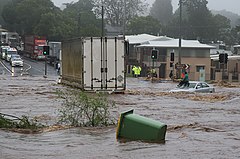
Why does God allow such devastation as we are seeing in Queensland with Cyclone Marcia through central Queensland (ABC News, 23 February 2015) and the floods of December 2010 – January 2011? Here are some photos of the flood devastation in Queensland from the Bundaberg News-Mail.

image

Bundaberg, Qld. floods, December 2010

The secular media blame it on “mother nature”. The Daily Telegraph, Sydney, 8 January 2011 (NSW’s towns bracing for floods), stated:

MOTHER nature has unleashed its fury in the state’s north with 18 rivers expected to break their banks by tomorrow night as the Queensland floodwaters run south.

ABC News, Australia, 5 January 2011, “Qld floods damage Australia’s economic performance”, reported:

The Queensland floods are hurting the nation’s Gross Domestic Product (GDP) by wiping as much as $9 billion off export revenues.

Operations at at least 40 coal mines in central Queensland’s Bowen Basin have been disrupted because of the floods, crops have been damaged and grazing lands are under water.

The state is responsible for more than half of Australia’s coal exports, 45 per cent of meat and a quarter of fresh food exports.

Royal Bank of Canada (RBC) senior strategist Sue Trinh says the economic impact of the floods could be the biggest of all the natural disasters Australia has experienced.

But who’s to blame for this? Federal politician, Joe Hockey, opposition treasury spokesman, told  ABC news that

“Australia is a rich-enough nation to be able to handle the worst of mother nature – floods, droughts, you name it, all the horrible events that occur on a regular basis at this time of year.”

Some pointed things have been stated about “mother nature” and disasters around the world, but especially amidst the Queensland floods of early 2011:

Who sends the rains? Is it “mother nature” or God Himself? God is very clear about telling us in the Christian Scriptures.

This raises the theological issue of theodicy – a defence of the goodness and omnipotence of God in the midst of evil.

Here are some of my thoughts to point towards a conclusion:

  1. God sends rain on the just and the unjust (Matt. 5:45).
  2. There is the problem of evil and disaster that originated in Genesis 3 with Adam and Eve and the fall into sin. All of creation is suffering from this disobedience. Are flood disasters the outcome of evil in our world? Does God send the cyclones, tornadoes and typhoons to remind us of judgment to come?
  3. God sends the rain, but human beings in their desire for prosperity (or greed), cluster around rivers and build houses in low-lying areas. Could it be that God sends the rain and human beings create the human conditions  so that floods devastate?

I posted comment #3 on Christian Fellowship Forum and Richard W. responded (#37):

Though not theologically satisfying, I think this is a huge part of the problem.

When you build on a flood plain you can expect to be flooded out from time to time. Smart people don’t build in flood plains. Smart insurance companies charge a mighty premium to insure anything in a flood plain. Smart governments do not zone flood plains for residential or commercial industrial purposes. But people still build there, and insurance is cheap backed by the government, and the snow melts and the rain comes.

Floods are often classified as hundred year floods, or five hundred year floods, or thousand year floods. Somehow the hundred year floods are now commonplace and I’ve seen some five hundred year floods and a thousand year flood. Pretty good for being only a little over half a century old myself.

I’m pretty sure the cause of these ‘rare’ floods is that marshes have been drained, farms have been turned into malls with massive parking lots, and every house has a paved driveway and a sidewalk. The water has to go somewhere. The marsh that once held the surplus is no longer there. The water flows downstream. Each upstream city or town or hamlet puts up a levee to protect itself from the flood, pushing the water downstream faster. Who’s to blame? Farmers want higher yield on more acres, so they install drainage ditches. Not so much now as this unsustainable practice now has legal roadblocks that restrict drainage a bit. But almost everything built in the past 100 years has been done at the expense of natural habitat that would soak up considerable water. We have inadvertently engineered floods to be worse than ever.

A flood from 100 years ago could still be quite an event. But now it’s a human made problem. New Orleans was an inevitability. Big floods down the Mississippi this spring are another inevitability. Fargo, on the Red River (which runs North into Canada) looks like it will also an inevitability. At least Fargo is looking at a solution of diverting the river into areas where it has more space to spread out. And they have forbidden rebuilding in many parts of the city. Fargo downtown flooded out a few years back and most of it burned when electrical fires started and spread uncontrollably. Crazy city, but at least they are looking for higher ground AND looking to let the river expand as it wants to, and the government is trying to force the reversal of many old drainage ditches. This are is vital because it is prime wheat growing land that feeds hundreds of millions of people.

The wake up calls have been given. Some people are actually waking up. Rain needs to soak in, and the little bits of excess need to go downstream. We screwed that up and it’s time to fix that before we see too many more thousand year floods. Theologically, God makes the rain to fall on the good and the evil, but the evil have not been good stewards of the land, causing misery and pain and death. Had we been good, we would have farmed with nature, not against nature, and we would not be blaming God for terrible floods.

Another respondent to Christian Fellowship Forum, Jim Parker (#50) also made some interesting, but similar, points to Richard. Jim was responding to my question, “Why does God allow such devastation as we are seeing in Queensland with the floods of December 2010 – January 2011?”

Perhaps it would be more to the point to ask why people insist on building cities on flood plains.

San Francisco was destroyed by a massive earthquake because it is built on a major earthquake fault. So they rebuilt it on the major earthquake fault.

People build homes along the Russian River north of San Francisco. About every 5-7 years their homes are destroyed by floods. They rebuild.

I have a friend who lives in the Florida Keys. The houses there have no ground floor because when huricanes come through they would be flooded. The first floor is 12 feet in the air resting on stilts.

People know the dangers of the places where they build cities and they choose to rebuild them after they are destroyed by “natural disasters” which, having happened once, should be sufficient data to decide to move somewhere else.

But when they don’t and another flood or earthquake just like the last one happened they ask, “Why did God allow this?”

“Watermark” in New Farm Park is red steel sculpture commemorating the 1974 Brisbane flood (courtesy Wikipedia)

I remember when my wife and I lost all that we owned in the Brisbane flood of 1974. I was in theological college and we were living in our caravan (called a trailer in North American lingo), 20 feet long on the banks of the Brisbane River at Graceville, a western Brisbane suburb, where the College was located. The entire college was located in a very low-lying area on the river bank and was devastated. As a result, we lost car and caravan which were parked alongside the College. But it was because of our stupidity of having a caravan and car in a flood-prone zone that we lost it. Never again have we built or located near a flood zone.

4.  We do know that there will be an increase in disasters as we approach the second coming of Christ (we don’t know when that will be). Luke 21:23-30 (NLT) states:

“How terrible it will be for pregnant women and for nursing mothers in those days. For there will be disaster in the land and great anger against this people. They will be killed by the sword or sent away as captives to all the nations of the world. And Jerusalem will be trampled down by the Gentiles until the period of the Gentiles comes to an end.

“And there will be strange signs in the sun, moon, and stars. And here on earth the nations will be in turmoil, perplexed by the roaring seas and strange tides.  People will be terrified at what they see coming upon the earth, for the powers in the heavens will be shaken. Then everyone will see the Son of Man coming on a cloud with power and great glory. So when all these things begin to happen, stand and look up, for your salvation is near!”

Then he gave them this illustration: “Notice the fig tree, or any other tree. When the leaves come out, you know without being told that summer is near” (New Living Translation).

5.  Does God send judgment to people and nations in this life because of the sinfulness of humanity in those nations?

What happened in Noah’s day? The description was that “the earth was corrupt in God’s sight, and the earth was filled with violence” (Gen. 6:11 ESV). When God saw this corruption, he told Noah, “I have determined to make an end of all flesh, for the earth is filled with violence through them. Behold, I will destroy them with the earth” (Gen. 6:13).

God’s judgment happened in this life because of the corruption of humanity in Noah’s time. Why should God think any differently of Haiti’s earthquake or Australia’s floods? What have these countries done to promote sinfulness and corruption?
I think there is enough biblical evidence to support God’s judgment of people and nations.

6.  Tragedy may cause us to re-evaluate priorities.

Tragedy, whether through cyclones, floods, earthquakes or other devastation, may jolt us to rethink and change priorities. If we build in flood-prone zones near a river, losing many possessions may cause us to see the damage that a materialistic philosophy can do. I’m reminded of that Jesus said about wealth on earth:

Do not store up for yourselves treasures on earth, where moths and vermin destroy, and where thieves break in and steal. But store up for yourselves treasures in heaven, where moths and vermin do not destroy, and where thieves do not break in and steal. For where your treasure is, there your heart will be also (Matt. 6:19-21 NIV).

7.  There are reasons why God allows Christians to suffer.

To understand this biblical teaching, I recommend the article, “Ten reasons for suffering in the Christian life”. I’m not convinced that all suffering is caused by sin or disobedience. The Christians who have suffered persecution, whether in the southern Sudan, under Hitler, Idi Amin, Pol Pot, Stalin, etc., did not commit sin but suffered for being Christian believers. What happened to them is what Jesus predicted:

If the world hates you, keep in mind that it hated me first. If you belonged to the world, it would love you as its own. As it is, you do not belong to the world, but I have chosen you out of the world. That is why the world hates you (John 15:18-19 NIV).

As a personal example, when I was a child at age 6, 10 and 12, I suffered 3 bouts of rheumatic fever that left me with a leaking mitral heart valve. Since 1983 I have had five open-heart surgeries (1983, 1987, 1988, 2003, 2013) to insert mechanical valves to correct this abnormality. To my knowledge, the rheumatic fever was not caused by my personal sin, but is a consequence for my being born in sin as a result of Adam & Eve’s fall into sin (Genesis 3).

8. Does the Book of Job shed some light?

On Christian Fellowship Forum, I shared some information about the Queensland floods of 2010-11 and received this reply on the topic, “Why does God allow floods to devastate?” from lrschrs (Chris) at #5 (I have corrected his spelling errors):

I think that the book of Job gives us the best answer to the question, that is, We Do Not Know, but God does know what He is going on about, and we should be silent before Him in worship, wonder, and praise.

That God has ordained the weather to be what it is is true, there are no things outside His loving providence and thus we can be confident even when all around us fails, as Habakkuk noted, no mad molecule, no runaway nature, He does have the whole world in His hands, and He holds us, and holds us dear. [Hab. 3:17-19].

That sin has entered the world is true, though how it effects such things I think is more indirect, for while all nature groans in an effect of sin how this is so is not revealed to us, Rom. 8:18-22.

One aspect of sin in the world is the lack of wisdom that builds things on flood plains or in denial of the common droughts of an area, and then wonders why we have wet or dry weather as usual. We build below sea level and wonder why things get wet at times.

Another reason can be divine judgment and blessing on a society, though here we are told not to be hasty and judge by appearances, for we don’t know all in any case, Luke 13:4. Here we need to avoid the twin errors or naturalism, an impersonal cosmos, on one hand, and moralism, or a world of simplistic this for that, on the other. The world is not a mechanical system but a system of mechanisms that is open to the personal providence of God and directed toward the ends He has appointed for all things.

I think all talk of ‘mother nature’ is foolish, for nature does not do anything, that is, act on choices it makes, but it only happens in accord with its construction and direction.

But in the end I think we have to rest in God and in what can be called the ‘mystery of providence’, we simply do not know why some things go as they do and others as they do, Maybe we can see some hints at times, like buildings in foolish places leave us good grounds to consider human folly at work, but in the end we must be silent before His works, adore the Lord even in hard times, for He knows what He is doing, and get on with our calling to comfort the afflicted and help the neighbor

I responded to Chris (I’m ozspen #12):

I agree that the Book of Job causes us who believe in the sovereign Lord to say that we do not know the answers for the Haiti earthquake, the Pike River mine disaster in New Zealand and the floods in Australia.

You and I can understand this as believers and accept this from the sovereign hand of the Lord. However, unbelievers see this as a God who is an evil so-and-so who would bring such devastation.

How do you respond to unbelievers? To say, “We do not know the answers”, could be cause for them to not believe in this kind of God – become agnostic or atheistic towards him.

What is your response to Aussies who say, “Your God doesn’t give a damn about ordinary people. Look what he has done with the floods at Chinchilla, Dalby, Theodore, Rockhampton, Bundaberg, Maryborough and Gympie. He’s a monster”.

To say, “Go to the Book of Job and you will see that we do not know”, is hardly a satisfactory answer to questioning Aussies who want to know the nature of this horrific God who would do this to people.

How would you reply?


Trapped woman on a car roof during flash flooding in Toowoomba 2.jpg

A woman trapped on the roof of her car awaits rescue during the Toowoomba flash flood (Dec 2010-Jan 2011, courtesy Wikipedia)

What if Mother Nature’s fury is the curse?

If there is no God and the devastating floods that are happening in Queensland are due to the inanimate Mother Nature, why are we bad-mouthing Mother Nature? Qld premier, Anna Bligh, has stated that “Mother Nature is unleashing something shocking” in the Toowoomba disaster.

If this devastation is to be blamed on Mother Nature, whatever he, she or it might be, if there is no God then why is she and others griping about these things? If God is not in charge of these things, then he must be just as frustrated as we are.

Surely, the floods in Qld should be pointing us to a higher purpose in life than what we are acknowledging. I haven’t heard or read this kind of response: “We have been ignoring God, kicking Him out of our lives for so long. It’s about time He got our attention to focus on ultimate issues in life”.

God has promised that he will not strike the earth again like he did in Noah’s day (see Genesis 8:21). Jesus Christ warned us that before Christ’s second coming  there would be strange signs in the sun, moon and stars, along with roaring seas and strange tides. People would be terrified by what they see on the earth (see Luke 21:25-28).

If there is no God who sends the rain on the just and the unjust, why are we kicking up such a stink about the actions of Mother Nature?

These  floods should be a wake-up call about ultimate issues for all, not just Queenslanders. This kind of a response to a “Mother Nature” cause, will not be appreciated by those who interpret life emotionally.

Disasters and God’s judgment

I received an email with the content of this blog (below) under the heading, “Japan denounced Israel exactly 1 year before earthquake and tsunami”. This blog appeared at Armageddononline.com #257:

Ron Reese from 5 Doves has discovered that ON MARCH 11TH, EXACTLY ONE YEAR AGO, JAPAN DENOUNCES ISRAEL!!! http://www.mofa.go.jp/announce/annou…3/0311_01.html

Exactly 1 year ago March 11, 2010…The exact day of the 9.0 earthquake in Japan hit a year later in 2011.
Genesis 12:3 “I will Bless those who Bless (Israel), and Curse Those Who Curse you.”

Remember, America forced Israel to remove 8,000 Israeli’s from their homes in Gaza, then came Katrina where America lost 800,000 houses in Louisiana, Mississippi, Alabama.

Japan demanded that Israel not build 1,600 housing units in east Jerusalem. After the 9.0 earthquake Japan may have to rebuild 1.6 million homes.

God is not mocked! Pay attention America!

A more detailed comment by Ron Reese is in, ‘Ron Reese (15 March 2011) “On March 11th, exactly one year ago, Japan denounces Israel!!!

What are we to make of those who want to link Japan’s actions (sins?) against Israel with the earthquake and tsunami that hit Japan on 11th March 2011?

Jesus will not allow us to draw the conclusion that the Japanese, because of their response to Israel, are any more sinful than we are. This is clearly stated in Luke 13:1-5:

There were some present at that very time who told him about the Galileans whose blood Pilate had mingled with their sacrifices. And he answered them,  “Do you think that these Galileans were worse sinners than all the other Galileans, because they suffered in this way? No, I tell you; but unless you repent, you will all likewise perish. Or those eighteen on whom the tower in Siloam fell and killed them: do you think that they were worse offenders than all the others who lived in Jerusalem? No, I tell you; but unless you repent, you will all likewise perish” (ESV).

To paraphrase Jesus for Aussies today, based on Luke 13:1-5: There are people present today who speak about the Japanese who denounced Israel one year before the tsunami. Jesus answers these who see this as judgment against Japan: “Do you think that these Japanese are worse sinners than all Australians because they acted in this way? No, says Jesus. I tell you: but unless you repent, you will all likewise perish”.

We do not have the right to pronounce that the earthquake, tsunami and the nuclear meltdown are God’s judgment on Japan – based on Luke 13:1-5. Providing judgment is God’s job and he will do it in our time. God has told us (Luke 14) that we all are sinners who need to repent and the Japanese crisis should be a reminder that all sinners need to repent.

One of the ways of responding to doubters of the biblical text and its teaching is to use …

The Judo Technique

I learned this when I was studying Jim Kennedy’s gospel presentation in Evangelism Explosion.

Often as you begin presenting the gospel, the person will say something like, “I don’t believe the Bible.  You’ll have to convince me some other way than referring to the Scriptures.”  Many people are devastated by this objection.  What happens to them?  Their attempt to share Christ fizzles.

This need not be the case.  I want to encourage you to use this objection as a springboard into the gospel itself.  The Apostle Paul, when he preached in Greek cities that had no background in the Bible, appealed to the Scriptures even though the people who listened to him did not believe the Bible.

He proclaimed to them and the Holy Spirit used the proclamation to save some who then came to believe the Bible to be true.  When we witness, our primary function is to proclaim the gospel, not defence of the Bible.  BUT when people object to the Bible, we DO NEED good answers to respond.  And there ARE EXCELLENT answers.

The judo technique works like this.  The objection, “I don’t believe the Bible,” is quite an easy one to deal with.  Don’t use the approach of a boxer who meets the blow head on and tries to overwhelm the opponent with counter punches.  Instead use the technique of the judo expert. The force of the opponent’s blow is used to throw the opponent.

Here’s how it works in presenting the gospel.  The person who objects, “I don’t believe the Bible,” usually has some university education, or has been exposed to some course in the Bible, or biblical criticism or something like that.

There is often some intellectual pride that says or infers something like this: “I used to believe those fairy tales when I was in kindy, but now I am an educated person and am far above believing those things.”  It is this intellectual pride that can be used to turn this objection into an opportunity for presenting the gospel.  I suggest this kind of dialogue with the person who objects.

“You don’t believe the Bible, John?  That’s very interesting and it certainly is your privilege not to believe it, and I would fight for that right on your part.  However, if the Bible is true then obviously you must accept the consequences.

“But I would like to ask you a question.  The main message of the Bible, which has been unquestionably the most important literary work in human history, is how a person may have eternal life.  So what I would like to know is: What do you understand that the Bible teaches about how a person may have eternal life and go to heaven?”

He may say that he does not believe in eternal life.  To this you might say, “I’m not asking you what you believe, but I am asking you what you understand.  It would be a rather unintellectual approach to reject the world’s most important book without understanding even its main message, would it not?  What do you understand that the Bible teaches as to how a person may have eternal life?  What is your understanding about what the Bible teaches on this subject?”

My experience is that over 90% will respond by saying that it is by keeping the Ten Commandments or following the Golden Rule or imitating the example of Christ, doing good, or something like that.

You might respond something like this: “That is just what I was afraid of, John.  You have rejected the Bible without even understanding its main message, for your answer is not only incorrect, but it is diametrically opposite to what the Bible teaches.  Now, don’t you think that the more intellectual approach would be to let me share with you what the Scriptures teach on this subject and then you can make an intelligent decision whether to reject or accept it?”

Now the tables have been completely turned.  Instead of being superior to the Scripture and even above listening to it, he now finds himself ignorant of even its basic message.  Now he must decide whether to listen to the message of the Scriptures or be found to be not only ignorant but also some obscure person who opposes intellectual advancement — and wants to remain in his ignorance.

This is the last thing in the world that his intellectual pride will allow him to be.  So, very often he will give you permission to tell him the gospel.  It is at this point that you pray with vigour that the Holy Spirit will take the gospel, which is the power of God to salvation, and use it to awaken him from the deadness because of sin.

Bundaberg, Qld. floods, December 2010

image


God is sovereign. As the Creator of all things visible and invisible, He is the owner of all, has an absolute right to rule over all, and He exercises this authority in the universe (Henry C. Thiessen 1949:173).

See: 1 Chronicles 29:11; Psalm 115:3; Isaiah 45:9; Ezekiel 18:4; Daniel 4:35;  Matthew 20:15; Romans 9:14-24; 11:36; Ephesians 1;11; 1 Timothy 6:15; Revelation 4:11.

Works consulted

Thiessen, H C 1949. Introductory Lectures in Systematic Theology. Grand Rapids, Michigan: Wm. B. Eerdmans Publishing Company.


Copyright © 2016 Spencer D. Gear. This document last updated at Date: 20 June 2016.
.

Anti-women in ministry juices flowing

pond5.com (public domain)

By Spencer D Gear

What is the New Testament view of women in ministry?

1 Corinthians 14:26 permits open ministry by both men and women: ‘Well, my brothers and sisters, let’s summarize. When you meet together, one will sing, another will teach, another will tell some special revelation God has given, one will speak in tongues, and another will interpret what is said. But everything that is done must strengthen all of you’ (NLT). So such ministry is available to ‘brothers and sisters’.

But when Paul wrote to Timothy (who was in Ephesus) he said: ‘I do not let women teach men or have authority over them.[1] Let them listen quietly’ (1 Tim 2:12 NLT). Women are not to teach men and have authority over them seems to be the clear teaching of this verse.

Is Paul confused and contradictory or is there something else going on here? We do know from Acts 2:17 what happened on the Day of Pentecost with the outpouring of the Holy Spirit: “‘In the last days,” God says, “I will pour out my Spirit upon all people. Your sons and daughters will prophesy. Your young men will see visions, and your old men will dream dreams”’ (NLT). There will be ministry, including prophecy, for both men and women. Galatians 3:28 confirms that there is no sectarianism in Christianity, ‘There is no longer Jew or Gentile,[2] slave or free, male and female. For you are all one in Christ Jesus’ (NLT).

How do these Scriptures play out with leading Bible teachers of today? Let’s check two of them who take opposing views.
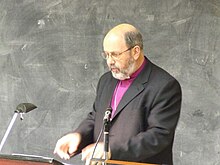
NTWright071220.jpg

N T Wright 2007 (courtesy Wikipedia)

N T Wright, a prominent evangelical exegete and historian of Christian origins from the UK, wrote about women in ministry: ‘I believe we have seriously misread the relevant passages in the New Testament, no doubt not least through a long process of assumption, tradition, and all kinds of post-biblical and sub-biblical attitudes that have crept in to Christianity’ (Wright 2004).

John F. MacArthur Jr..JPG

John F MacArthur Jr 2014, aged 75 (courtesy Wikipedia)

On the contrary, John MacArthur Jr, a renowned USA evangelical expositor, adopts an opposite view:

‘Women may be highly gifted teachers and leaders, but those gifts are not to be exercised over men in the context of the church. That is true not because women are spiritually inferior to men but because God’s law commands it. He has ordained order in His creation—an order that reflects His own nature and therefore should be reflected in His church. Anyone ignoring or rejecting God’s order, then, weakens the church and dishonors Him’ (MacArthur 2013).

So which is it? Are women open to any ministry in the church or are they restricted so that they cannot exercise authority over men and this includes preaching to men?

Could the tradition against women having authority over men (including preaching to them) be labelled as the orthodox view? Is the pro-women in ministry perspective, advocated by N T Wright and this writer, the heterodox (heretical) perspective?

Watch the argumentation that follows.

Juices flowing

Image result for pouring juice public domain

pond5.com (public domain)

On the local level here in Australia, it doesn’t take much for the anti-women in ministry juices to start flowing along with the pro-women in ministry voices. On one blog, all it took was a recommendation to a church in Brisbane and it was off and running. The context was an article on ‘Whatever Happened to Teaching in the Churches?’ by Bill Muehlenberg (17 Feb 2015). This was an excellent article that confronted this problem of the decline in teaching in many churches. Bill began the article with a stimulating observation:

Once the regular teaching of the Word of God, of doctrine, of theology, and its application in the Christian life was a mainstay of any evangelical church. It was pretty much the core activity. Yet there seems to be such a dearth of good, solid teaching in so many churches today.

Instead of proper instruction in which believers are fed with the solid meat of the Word, with emphasis on biblical doctrine and proper exposition of key biblical themes and teachings, all we seem to get in so many churches today are topical sermons.

These are often little more than pep talks with one or two verses thrown in along the way. Most of our Sunday morning sermons tend to be feel-good, how-to chats, emphasising how the Christian can be successful, happy, confident, and have a good time.

We promise folks their ‘best life now’ and give them motivational speeches, upbeat homilies, and the like. The systematic instruction and teaching of the Word of God, its core doctrinal truths, and basic Christian doctrines are almost never heard any more in so many churches today.

In the Comments section, I responded to the article:[3]

Here in Brisbane my wife and I attend a church with solid expository preaching but the services are ho-hum boring. They could easily send me to sleep. The pastor does not know how to get and retain people’s attention with his teaching (he preaches through books of the Bible).

As for the reason for this, thank Bill Hybels, Rick Warren and the seeker-sensitive marketing approach. I engaged in an email exchange with a pastor of such a church locally and he told me that I would find his church too contemporary. I visited once. It is not that being modern is the problem; it’s the lack of biblical content. There was no Bible reading in the entire service and to call the topical ditty a sermon is to redefine the word.

My nephew and his family attend one such church in my suburb of another denomination and his 8-year-old son told me, ‘We get a concert every week’.

Turning it around will take a revival, I believe.

But then the comments took a different turn. This is how the provocative juices got started with one woman’s comment, ‘I can’t find one in Brisbane also. It grieves me’.[4] Another woman’s response was: ‘Hi Sharon, Here are the details of a biblically solid church in Brisbane. I highly recommend them www.mcc777australia.org/mcca_brisbane_102.html’.[5]

That got Sharon’s juices flowing:

Thanks Ella for the link. When I clicked on it, it appears that there is a woman pastor. Is that correct? If so, that is a heresy and one of the main reasons why it is difficult to find a church that will actually preach what the bible teaches. Have a look at your bible, at the biblical role of women and who is allowed to teach in a church meeting. I too had to have an education by the HS [Holy Spirit] on this topic. It led to a lot of repentance on my behalf.[6]

So, according to this person, to be a woman pastor is to commit ‘heresy’ and her anti-heresy, traditional view, comes from ‘an education by the Holy Spirit’. However, there was no definition of heresy provided and how pro-women in ministry is heresy.

What is heresy?

(Courtesy Hendrickson Publishers)

Gerhard Nordholt’s summary of the New Testament Greek understanding was that in 1 Corinthians there is a distinction between haireseis and schismata. While schismata split the church through personally motivated disputes, there is an eschatological dimension added by the haireseis. ‘Haireseis are the results of the schismata’ and, according to 2 Peter 2:1, the activities of false teachers lead to haireseis. Passages such as Titus 3:10, Matthew 18:15-20 and 2 John 10 demonstrate how to deal with heretics (Nordholt 1975:534-535).

Thus, in New Testament times, the Christian understanding of heresy was that it referred to: (1) Dissensions and destructive opinions that were, (2) Contrary to the teachings of the ekkl?sia; (3) Schisms led to heresies; (4) Thus, haireseis (plural) had an eschatological-dogmatic dimension that attacked the church’s foundational doctrines. Here dogmatic refers to doctrines that are officially and authoritatively confirmed. (5) Therefore, in the New Testament, the standard by which to assess hairesis (singular) is the content of the Scriptures. Those in the Roman Catholic and Orthodox Church tradition would include Tradition and Scripture as standards for judging heretical doctrines (see Wilhelm 1910).[7]

Gillian Evans in her more recent analysis of the history of heresy provided a brief summary of the classification of the three main senses in which heresis was used in early Christian Greek:

One took it to mean just a ‘way of thought’, and that could be used of the Christian faith itself, with no pejorative connotations. In another sense it could mean a system or ‘school’ of thought, as distinct from a separate community or schism. Its third sense is … [how – SDG] heresis began to be used for a ‘false teaching’ which purported to be true faith for Christians. Therein lay its danger, for it could mislead the faithful. (Evans 2003:65-66)

Evans stated that this evolution of the understanding of the meaning of ‘heresy’ underlies many of the difficulties she discussed in her study. In the early years of the Christian church these heresies included those dealing with issues imported from ancient philosophy (including allegorical interpretation and the nature of the Trinity), the incarnation, Christology (including the God-man relationship of Jesus), dualism (evil versus good), ministerial succession of the Catholic church, discounting the need for divine assistance in salvation (Pelagianism), the Easter controversy, transubstantiation, the Iconoclast controversy, separation over confessional identity, heresies associated with a prominent figure or hierarchies (examples being Marcionites, Arianism, Pelagianism), and the Inquisition (Evans 2003:65-89).

Therefore, a heresy is a teaching that attacks one of the foundational doctrines of the Christian faith. Harold O J Brown in his extensive study on Heresies (Brown 1984) assessed that

”heresy” came to be used to mean a separation or split resulting from a false faith (1 Cor. 11:19; Gal. 5:20). It designated either a doctrine or the party holding the doctrine, a doctrine that was sufficiently intolerable to destroy the unity of the Christian church. In the early church, heresy did not refer to simply any doctrinal disagreement, but to something that seemed to undercut the very basis for Christian existence. Practically speaking, heresy involved the doctrine of God and the doctrine of Christ – later called “special theology” and “Christology” (Brown 1984:2-3).

So some kind of skirmish or division (schismata), whether that be over baptism, the nature of the Lord’s supper, eschatological differences, or women in ministry would not be regarded as heresy in the early church.

The challenge

I did not think it was helpful to let this kind of comment go unchallenged, so I responded:

I urge you not to accuse women in ministry, even pastoral ministry, as engaged in the promotion of a heresy. Here’s an article by N T Wright that deals with some of the controversial passages and concludes differently from your position that it is ‘heresy’. See N T Wright, ‘Women’s Service in the Church: The Biblical Basis’, ntwrightpage.com/Wright_Women_Service_Church.htm[8]

I expected a reply but not with this kind of twist. The juices were flowing with a different emphasis:

Hi Spencer, I have heard it all before and I still disagree because there are quite a few holes in his arguments. I have written extensively on this in my blog but if you want an expert, have a listen to David Pawson.

As for me, like many Christian woman (sic), I embrace biblical womanhood and throughly (sic) enjoy it for what it is. I fasted and prayed over this issue for 3 years before it all became clear. Never been happier. I will still call it heresy. You have to do biblical gymnastics to make the other way make sense.

Most men I know have never really fasted or prayed over it – maybe because it doesn’t really effect their obedience to the Lord. The women I know who have… they seem to end up at the same position as myself.[9]

God and logic

(Courtesy Apologetics 315)

Before getting into an examination of Sharon’s approach, it is important to examine the place of logic in the life of a Christian believer. Did God invent logic or is it from some secular source? Norman Geisler & Ronald Brooks present some challenging material in their publication, Come Let Us Reason (Geisler & Brooks 1990). Brooks tells of his first logic teacher, Howard Schoof, whose exhortation was, ‘The next best thing besides godliness for a Christian is logic’. Brooks’ comment was, ‘Clean living and correct thinking make a potent combination’ (Geisler & Brooks 1990:7).

What is logic? Geisler & Brooks state that ‘Logic really means putting your thoughts in order…. Logic is a way to think so that we can come to correct conclusions by understanding implications and the mistakes people often make in thinking’. They continue,

Simply put, you can’t avoid studying logic, so you might as well know what you’re doing. It is the basis of all other studies. It is the basis for all math and science. Even music, from Bach to the Beach Boys, is based on logic. Without it, there could be no rational discussion of anything; writing would be impossible. How can you put a sentence together without a logical order?… The only way to avoid logic is to quit thinking, because logic is the basis of all thought (Geisler & Brooks 1990:11, 13, emphasis in original).

So, what happens when a person uses logical fallacies?

Notice the approach

Sharon used this kind of reasoning:

1. ‘I have heard it all before and I still disagree because there are quite a few holes in his arguments’.

There is not one specific example given here but generalisations of ‘heard it all before’ and ‘quite a few holes in his arguments’. This is committing a question begging logical fallacy. This is fallacious logic because simply assuming that the conclusion is true (directly or indirectly) – hearing it all before and holes in the argument – does not provide evidence for the conclusion that rejects women in pastoral ministry. Here the assumption is made that hearing it all before and the alleged holes in the arguments are evidence to support her view. This is not true when no evidence has been provided.

She appealed to generalities and did not deal with the specifics from N T Wright’s article that was pro-women in ministry. She failed to give her biblical reasons.

2. ‘As for me, like many Christian woman (sic), I embrace biblical womanhood and throughly (sic) enjoy it for what it is’.

This commits an ‘appeal to belief’ logical fallacy. As this link demonstrates, ‘This line of “reasoning” is fallacious because the fact that many people believe a claim does not, in general, serve as evidence that the claim is true’. Sharon’s appeal to ‘many Christian women’ to demonstrate her point is a pointless argument since she has not demonstrated her case or rebutted N T Wright’s pro-women position. However, to be fair to her, doing this on another person’s blog is nigh impossible. She could have said something like, ‘I disagree with these points made by Wright. Here are some links to my and other articles where I address these’.

Her statement, ‘I embrace biblical womanhood’. So who defines ‘biblical womanhood’? Sharon does, and her following comments tell us from where she obtained this understanding. So who is correct? N T Wright, Sharon Stay, Spencer Gear or David Pawson? Sharon’s statement seems to commit the ‘appeal to authority’ logical fallacy.

3. ‘I have written extensively on this in my blog[10] but if you want an expert, have a listen to David Pawson’.

Now she has committed the appeal to authority logical fallacy as she has written extensively about this topic on her blog. So is she a specialist in defining ‘biblical womanhood’ and how it ought to function in the church? Then she appeals to the ‘expert’, David Pawson. However, she gives no link to or statement about where I would find his exposition on women in ministry. Why would David Pawson’s[11] exposition be any more authoritative and exact in biblical terms and exposition than that of N T Wright?[12]

4. ‘I fasted and prayed over this issue for 3 years before it all became clear. Never been happier’.

My response to her was: ‘We can’t have a logical conversation when you generalise like this, present yours as the elevated spiritual position (prayer and fasting), and denigrate men as not complying with your spirituality’.[13]

This commits another logical fallacy, appeal to consequences of a belief. It is an erroneous line of reasoning because the consequences of belief that come after prayer and fasting do not tell us whether the belief is true or false. That decision needs to be reached by an examination of the biblical text. This controversy over women in ministry would not have arisen if it were not for differing interpretations of the biblical text. So, it’s an issue of hermeneutics, not whether one prays and fasts over this issue.

5. ‘I will still call it heresy. You have to do biblical gymnastics to make the other way make sense’.

Here Sharon has committed another logical fallacy, appeal to ridicule. It is false reasoning because mocking a pro-women in ministry position by labelling it as ‘heresy’ does not provide the evidence to demonstrate that it is false. She has not told us what constitutes heresy and how the pro-women view stacks up as heretical theologically.

6. ‘Most men I know have never really fasted or prayed over it – maybe because it doesn’t really effect (sic) their obedience to the Lord. The women I know who have… they seem to end up at the same position as myself’.

Here she has committed another logical fallacy, faulty generalisation or leaping to a conclusion. Sharon has committed this fallacy because she has not observed enough men to come to her conclusion. Her statistical sample is from ‘most men I know’. This is not a statistically large enough sample to reach a valid conclusion. This is an unrepresentative sample. Therefore, the reasoning is fallacious. Determining men’s views on women in ministry by using ‘most men I know’ as the sample, is not the way to go about gathering data for one’s position. A better way would be to engage in careful examination (exegesis) of the biblical text.

The God of logic

Dr Michael C Labossiere has stated that ‘a fallacy is, very generally, an error in reasoning. This differs from a factual error, which is simply being wrong about the facts. To be more specific, a fallacy is an “argument” in which the premises given for the conclusion do not provide the needed degree of support’ (The Nizkor Project: Fallacies).

The Nizkor Project: Remembering the Holocaust (Shoah)

An objection that could be raised is that to use logic is to use a secular, naturalistic approach and we do not need that with God. To make that kind of statement that opposes God and logic, one has to use logic.

‘Logic is unavoidable…. The Gospel of John begins with the statement, “in the beginning was the Logos.” The basis of all logic is that some statements are true and others are false. If this word about God is not a logical word, then what is it? The whole idea of theology is that rational statements can be made about God. Even someone who says the opposite has just made a rational (although untrue) statement about God. Logic is undeniable’ (Geisler & Brooks 1990:15-16).

So to live in reality, where we need to use logic, we understand that God is the God who created logic. After all, Scripture affirms this of Jesus, the Word, ‘All things were made through him, and without him was not any thing made that was made’ (John 1:3 ESV). Therefore, God made logic. He made us with the ability to communicate and that requires the absolute necessity of engaging in logical discussions.

What happens when we use logical fallacies?

If logic is a way to arrive at correct conclusions or valid inferences, then logical fallacies, whether formal or informal, are mistakes in thinking. A formal fallacy deals with the form of an argument – the way we think. An informal fallacy relates to the meanings of the terms we use. These can be either unclear or misleading or they could be irrelevant to the topic (Geisler & Brooks 1990:13). I highly recommend this publication for a Christian view of logic.

We know God is interested in correct thinking because he tells us that part of our growth in Christ involves,

22 to put off your old self, which belongs to your former manner of life and is corrupt through deceitful desires, 23 and to be renewed in the spirit of your minds, 24 and to put on the new self, created after the likeness of God in true righteousness and holiness (Eph 4:22-24 ESV, emphasis added).

This is further emphasised in Romans 12:2, ‘Do not be conformed to this world, but be transformed by the renewal of your mind, that by testing you may discern what is the will of God, what is good and acceptable and perfect’ (ESV, emphasis added).

The God who created logic is concerned that Christians be transformed by the renewal of the mind. In the context of Eph 4:22-24, that refers to getting rid of the corrupt and deceitful desires of one’s former lifestyle and being renewed by thinking righteous, holy and godly thoughts. However, these are in accordance with logical thinking about God.

A logical fallacy is a defect in reasoning. I have heard them by politicians, public speakers (including preachers), and on the internet. When I view Aussie politicians being interviewed on TV, I hear them avoid the journalist’s question to go with ‘the message’, which is what he/she wants to promote. Very often this means changing the topic and not answering the question, which is using a red herring logical fallacy. The media are good at doing this also by pumping a false view of the politician’s view that can be a straw man logical fallacy. This fallacy trumps up a distorted version of the politician’s view, so the journalist is not attacking the politician’s view but a fabricated, journalist-invented version of this.

What happens when we use the illogic of logical fallacies? We are using faulty logic to try to make our case, but it amounts to an failure to have a reasonable conversation. We need to call attention to speakers who use this tactic. Know the prominent logical fallacies. The Nizkor Project has listed and explained some of the most prominent ones (based on the work of Dr. Michael C. Labossiere). For those who want a Christian approach, see Geisler & Brooks (1990).

How that person responded

How did Sharon respond to my statement about her generalisations and denigration of men? She wrote:

I wasn’t trying to speak in generalities – what I was trying not to do was have a large, lengthy discussion on Bill’s site, back and forth. This is far too lengthy a topic to discuss on someone else’s site. That is why I referred you to my site. You can click on my name and it will lead you there (when people post who have a website their name is a link to their website.) clip_image001

I also wasn’t trying to take the elevated view as you call it. I simply stated the facts as I know them – that most christian (sic) men I know have not fasted or prayed on this issue and when I asked them why they believed what they did, they couldn’t give a logical answer that correlates with all that scripture has to say. Most just told me to accept it!

When I asked a senior lecturer at Malyon (Baptist Bible College) why he believed in women pastors (he had just preached on this topic but completely ignored Timothy and Corinithians (sic)) he told me that it was because the words of Paul are to be put on a lower level to the words of Jesus. According to him, Paul apparently had it wrong. He must not agree with “all scripture being inspired by God”…I went home and cried that day at the apostasy in the church.

So that has been my experience. My husband and I are in agreement on this issue. He leads in our family.

I think we all need to keep praying for unity with God on this issue as it seems to me we can’t all be right when our opinions differ so much. That was why I started the prayer and fasting in the first place. It was not to elevate myself into a higher spiritual position. It more like 3 years of weeping and fasting and praying for the church in our nation, agonising over the state it is in. Begging God to reveal truth to me. He did. That’s all. There is a lot more I need to learn but what I have learnt I will share and speak out.[14]

After this comment about the Baptist Malyon College in Queensland, I contacted my son who is an MDiv graduate of that college about this senior lecturer at Malyon who devalued the words of Paul. My son’s reply was, ‘John Sweetman [principal of Malyon] has gone on record plenty of times as having a complementarian view of marriage but an egalitarian view of ministry’.

Another traditional dynamic

Another woman offered what was a consoling anti-women, but accommodating view:

Sharon, I agree with you wholeheartedly, however what do you do when the men aren’t there? Isn’t it better to have a woman preacher who speaks the word of God in truth than leaving a vacuum? God is the law maker and sometimes we need to allow that He will work with what He has as in the case of Deborah being the judge of Israel. But of course wherever there is a woman pastor filling the gap our prayer needs to be, “Lord, provide a godly man to take her place”.
Thankfully we are in a church where the minister preaches faithfully to the word of God, though I haven’t heard a sermon on Mat 19 in a long time.
Many blessings[15]

Sharon’s response was:

Thanks Ursula. Deborah is often brought up as a justification for women being pastors. However Deborah though a prophetess, was not the leader of the ‘church’ at the time. Hers was a governmental position – the levitical system was still ruling the ‘church’ or worship, in the line of Aaron.
You see the same with Miriam, another prophetess often quoted to justify women overseers of the church. She too was not leading the worship. It remained with the Priestly Levites who were all men.
It was the same for all the women prophetesses in the O.T. At no point were the women running the sacrifices etc.

In the NT it’s the same – the role of prophetess is outside the role of church leadership. That is why both exist simultaneously. You can have a prophetess and have men leading the church. They are not mutually exclusive as some teach.
Many women in NT times, opened their homes for church meetings to be held there, but they did not actually lead the services and oversee the church. The NT is quite clear that a ‘husband of but one wife’ was to oversee the church. Women primarily were to be busy in the home, raising the children and teaching other women how to love their husbands and children.[16]

There are issues with this kind of traditional response, so I chose to challenge her:[17]

I must be reading a different Bible to yours. Judges 4:4-6 (ESV) states,

‘Now Deborah, a prophetess, the wife of Lappidoth, was judging Israel at that time. 5 She used to sit under the palm of Deborah between Ramah and Bethel in the hill country of Ephraim, and the people of Israel came up to her for judgement. 6 She sent and summoned Barak the son of Abinoam from Kedesh-naphtali and said to him, “Has not the Lord, the God of Israel, commanded you, ‘Go, gather your men at Mount Tabor, taking 10,000 from the people of Naphtali and the people of Zebulun’.

Therefore, Deborah, the prophetess, most certainly had a leadership role in judging Israel.

You state, ‘Many women in NT times, opened their homes for church meetings to be held there, but they did not actually lead the services and oversee the church’. How do you know that? That doesn’t explain the possibility of Junias/Junia being a female apostle (Rom 16:7 NIV).

You state that ‘the NT is quite clear that a ‘husband of but one wife’ was to oversee the church. Women primarily were to be busy in the home, raising the children and teaching other women how to love their husbands and children’.

Let’s check out how ‘quite clear’ it really is. The elder must be the ‘husband of one wife’ is from 1 Tim 3:2 (KJV, ESV, NASB, NET), but the NIV translates as ‘faithful to his wife’ and the NLT, ‘He must be faithful to his wife’; REB, ‘faithful to his one wife’. The Greek is literally ‘to be of one wife husband’. There could be four different meanings of this statement. The issue in Ephesus (where Timothy was when Paul sent this letter) was promiscuity (marital infidelity and a low view of marriage, see 4:3; 3:4-5) and not polygamy. When we examine the context, Paul is talking about an overseer’s character qualities in 1 Tim 3:2-5. So the meaning leans towards that of the NIV, NLT, REB since they are dynamic equivalence (meaning-for-meaning) translations.

She has adopted the standard English translation of 1 Timothy 3:2, ‘husband of but one wife’, without doing the hard exegetical work to understand the meaning of this statement. Gordon Fee states that these four possible options in deciding the meaning of this statement are:

1. ‘Requiring that the overseer be married’;

2. ‘It prohibits polygamy’;

3. ‘It could be prohibiting second marriages’;

4. ‘It could be that it requires marital fidelity to his one wife (cf. NEB: “faithful to his one wife”)’ (Fee 1988:80, emphasis in original).

Fee favours the latter meaning because

in this view the overseer is required to live an exemplary married life (marriage is assumed), faithful to his one wife in a culture in which marital infidelity was common, and at times assumed. It would, of course, also rule out polygamy and divorce and remarriage, but it would not necessarily rule out the remarriage of a widower (although that would still not be the Pauline ideal; cf. 1 Cor. 7:8-9, 39-40). Although there is much to be said for either understanding, of the third option, the concern that the church’s leaders live exemplary married lives seems to fit the context best – given the apparently low view of marriage and family held by the false teachers (4:3; cf. 3:4-5) (Fee 1988:80-81, emphasis in original).

Conclusion

In my encounter with Sharon (see above), I picked up her use of 6 logical fallacies. Is this a serious issue when she presents so much illogic in her argumentation? It is detrimental because it is impossible to have a logical conversation with a person who uses logical fallacies. When people logical fallacies in speech or writing, I find it is important to draw this to their attention. That’s why I recommend that you get to know major logical fallacies that people use. See the link to the Nizkor Project above.

The additional issue for this advocate of silence of women in leadership positions over me is dogmatism about what she claims is her correct view. She claims that the pro-women in ministry view is heresy and of herself she says ‘I embrace biblical womanhood’ (inferring that I don’t). Also, ‘‘I fasted and prayed over this issue for 3 years before it all became clear’, which makes her spiritual exercises superior to those who obtain a view of women in ministry through, say, exegesis of the text. When she complained about men she knows who ‘have never really fasted or prayed over it – maybe because it doesn’t really effect (sic) their obedience to the Lord’, she not only exalts her superior spirituality but also has judged the men’s motivation as it doesn’t affect their obedience to God. This is a strange and condescending emphasis.

I have heard Sharon’s kind of view many times down through the years, but her elevation of her own spirituality in arriving at this decision came out of left field for me. Anyone who claims that we need prayer and fasting to arrive at a view of ‘biblical womanhood’ is taking a different tack to the exegesis I’ve encountered on this topic.

Sharon has the additional problem that she used the general term of speaking to a senior lecturer at Malyon College and his denigration of Paul, without mentioning who he was and in what circumstances he said this. There is no way for me to check who said this, under what circumstances, and whether that is what he said and believes.

Her calling the pro-women in ministry view a heresy is contrary to the view of the church of the first century and its understanding of heresy. As Harold Brown put it, ‘In the early church, heresy did not refer to simply any doctrinal disagreement, but to something that seemed to undercut the very basis for Christian existence’ (Brown 1984:2).

Other links

This is a range of my articles on women in ministry (there may be a repeat of information in some of them):

Works consulted

Brown, H O J 1984. Heresies: The image of Christ in the mirror of heresy and orthodoxy from the apostles to the present. Garden City, New York: Doubleday & Company, Inc.

Evans, G R 2003. A brief history of heresy. Oxford: Blackwell Publishing.

Fee, G D 1988. 1 and 2 Timothy, Titus (New International Biblical Commentary), W Ward Gasque (NT ed). Peabody, Massachusetts: Hendrickson Publishers.

Geisler, N L & Brooks, R M 1990. Come let us reason: An introduction to logical thinking. Grand Rapids, Michigan: Baker Book House.

MacArthur, J 2013. Can women exercise authority in the church? Grace to You (online), August 29. Available at: http://www.gty.org/blog/B130829/can-women-exercise-authority-in-the-church (Accessed 23 February 2015).

Nordholt, G 1975. ????????, in Brown, C (ed) The new international dictionary of New Testament theology, vol 1:A-F, 533-535. Exeter, Devon, U.K.: The Paternoster Press.

Wilhelm, J 1910. Heresy. In The Catholic encyclopedia (online), vol 7. New York: Robert Appleton Company. Available at New Advent http://www.newadvent.org/cathen/07256b.htm (Accessed 7 August 2014).

Wright, N T 2004. Women’s service in the church: The biblical basis (online). A conference paper for the Symposium, ‘Men, Women and the Church’, St John’s College, Durham, September 4. Available at: http://ntwrightpage.com/Wright_Women_Service_Church.htm (Accessed 23 February 2015).

Notes:


[1] The footnote at this point was, ‘Or teach men or usurp their authority’.

[2] The footnote was, ‘Greek Jew or Greek’.

[3] Spencer Gear, 17 February 2015, 4pm, available at: http://billmuehlenberg.com/2015/02/17/whatever-happened-to-teaching-in-the-churches/ (Accessed 22 February 2015)

[4] Ibid., Sharon Stay, 17 February 2015, 8pm.

[5] Ibid., Ella Gathercole, 18 February 2015, 7am.

[6] Ibid., Sharon Stay, 18 February 2015, 7pm.

[7] Wilhelm’s (1910) article on ‘heresy’ is recommended for an insightful assessment of the issues historically and with a practical dimension – even though the article is a century old.

[8] Ibid., Spencer Gear, 19 February 2015, 7am.

[9] Ibid., Sharon Stay, 19 February 2015, 8pm.

[10] Sharon’s blog is called, ‘He Leads Me’ (Accessed 23 February 2015).

[11] David Pawson is a British Bible teacher and author. See: http://davidpawson.org/.

[12] N T Wright is a British New Testament scholar and professor, Anglican clergyman. See: http://ntwrightpage.com/. At the time of writing this article, he was Professor of New Testament and Early Christianity at the University of St. Andrews, St. Andrews, Scotland (Accessed 22 February 2015).

[13] Spencer Gear, loc cit, 20 February 2015, 10am.

[14] Sharon Stay, loc cit, 20 February 2015, 7pm.

[15] Ibid., Ursula Bennett, 20 February 2015, 9am.

[16] Ibid., Sharon Stay, 23 February 2015, 7am.

[17] Ibid., Spencer Gear, 23 February 2015, 1pm.

Copyright © 2015 Spencer D. Gear. This document last updated at Date: 13 July 2019.

They don’t give a journalistic hoot about persecuted Christians!

clip_image002

(courtesy ChristArt)

By Spencer D Gear

The Bible Society Australia has drawn attention to this absence of reporting Christian persecution by publishing this article by Patrick Sookhdeo in which he stated: ‘In a world where mainstream media largely ignore the plight of Christians, we must make sure we stay informed. We must advocate politically for believers in need, and we must share with them the material blessings God has given us. Above all, we must pray continually (1 Thess 5:17)’ (‘A prayer for the persecuted church’, 28 December 2013).

Could you imagine the following newsworthy story appearing without Christians contacting a secular newspaper or news outlet here in Australia (my home country) or in the country where you live? What will it take to get the news media to quit their biases against reporting the abuse that is happening to Christian minorities worldwide?

What about this travesty of justice?

Christians forced to convert to Buddhism in rural Nepalese village

This report comes from the Barnabas Fund, 12 February, 2015:

A Buddhist monk visiting the predominantly Christian Borang village in Nepal’s Dhading district forced all the Christian villagers to convert to Buddhism and ordered them to stop all Christian worship. Two of the church’s leaders refused to obey the orders and were attacked in response.

clip_image004Nepali Christians gather to worship
stewie811 / CC BY-NC-SA 2.0

Commissioned by a political leader from the RPP Hindu nationalist party, a Buddhist monk came to the village to preach Buddhism. All of the Christian villagers were locked inside a hall and forced to listen to the Buddhist teachings and to accept Buddhism. They were asked to bow down before a statue, go around the village carrying Buddhist scriptures on their heads, and to place Buddhist flags on their houses.

Refusing to obey the orders, the pastor and elder of the church were attacked. Although the church elder managed to escape, the pastor was captured and beaten for three days. He was then forced to place his finger print on a document stating that he would stop running the church and that he would not report the incident to police authorities or leave the village.

Led by the Buddhist monk, a group of assailants attacked the church on 1 February. They destroyed the furniture and church building and tried to set fire to it. They also attacked the pastor’s home, cutting off the electricity and phone lines. Not allowed to use the phone or leave the village, the pastor is still in Borang. Local Christians told Barnabas Fund today that they are particularly concerned about the health of the church pastor since there is no information about his current condition. The church was unable to meet the following Saturday, the normal day for worship services across Nepal.

Although local police were sent from Setung to the village to find out what happened, the locals, under pressure from the attackers, reported that there had been no problems. The police then returned to Setung without reporting the incident.

Although Nepal is over 80% Hindu, Buddhism holds close ties to the majority religion; the birthplace of its founder is said to be in Lumbini, southern Nepal. Dhading district, however, has the highest number of Nepali Christians, with some villages almost entirely Christian.

Can you imagine that kind of story appearing in our Australian secular media without a Christian prompt? I’ve been so concerned at this lack of coverage that on 23 January 2015, I sent this letter via email to the editor of the Brisbane Times .

Dear Editor,

I read the Brisbane Times online every morning and I’ve read plenty about the Charlie Hebdo magazine terrorism and the killing of 12 people in Paris. But I’ve not heard the same kind of news coverage about what else is happening in other countries as a result of the Charlie Hebdo cartoon of Muhammad. It could be that I have missed your coverage because I could miss some of your news stories. However, could it be that Zinder and Niamey, cities in Niger, are not as large on the news radar as Paris?

However, I think it’s time that you gave extensive coverage to the violence that is happening in other countries as a result of the Charlie Hebdo cartoon. Here is but one example that has reached me via email.

In two days of targeted riots that began on 16 January 2015, violence across the northern African country of Niger has left ten people dead and over 70 churches are reported to have been destroyed. The rioters were protesting against the publication of a cartoon of Muhammad on the front cover of the French Charlie Hebdo magazine in France. More riots and protests occurred across many Muslim-majority countries, including many former French colonies.

Following Friday prayers on 16 January, hundreds of mainly young Muslim extremists took to the streets in Zinder, Niger’s second largest city, burning and destroying all of the city’s churches, as well as the homes of Christians.

The next day, more than 55 churches, pastors’ homes, Christian schools and Christian organisations were burned or destroyed in the capital city, Niamey, as rioters targeted Christians and French-related businesses.

Ten people have been killed in the weekend attacks, one of whom was burned inside a church. And more than 200 Christian families are now being housed in military camps. The army has been deployed and the homes of Christians have been identified and secured. With the authorities overwhelmed by the scale of the violence, Christians have been told to stay together, just in case.

I obtained this information from the Barnabas Fund. If you want further details, including an interview, please contact:

BARNABAS FUND
PO BOX 3527,
LOGANHOLME, QLD 4129

I also gave him the phone and fax numbers and the email address.

No response

Perhaps it is not surprising that I did not receive a response to this email from the editor and a search by Google has not found any of my letter published online. Reporting of the persecution of Christians around the world does not seem to be a favourite topic for the secular media.

More information from Dr Patrick Sookhdeo

clip_image005

Dr Patrick Sookhdeo (public domain)

Dr Sookhdeo is the international director of the Barnabas Fund. He has a range of articles dealing with persecution of Christians on his own website: Patrick Sookhdeo. In his article, War on Christians (1 Peter 5:8-10), Dr Sookhdeo states:

The world has stood by and looked on. Leaders have condemned but procrastinated. Now the call is to arms: to bomb, to obliterate the Islamic State. But what of the Christian community? They have met with much sympathy. Many politicians and media commentators have expressed their concern for Christians, but still no decisive action has been taken to save them. The real problem is that the Christians have no power, and because of this they are deemed irrelevant. They have no weapons, therefore they are deemed to be no threat. They have no oil, so they have no economic weight. For some politicians it seems better that the Christians should leave the Middle East, for then at least they would not be a complication in the situation.

Patrick Sookhdeo did get mass media coverage in 2004 with The Age newspaper, Melbourne, ‘Islam, the West and the need for honesty’ (October 16). Part of this story, read,

Both sides face hard choices if further slaughter is to be prevented, an outspoken Anglican cleric and authority on radical jihadists tells Tony Parkinson.

According to Patrick Sookhdeo, it is time for plain speaking. If the world is not to become a sectarian slaughterhouse, Western and Islamic societies need to address with honesty the hard choices they face.

“I think the West has made a strategic mistake in seeking to distinguish al-Qaeda and Osama bin Laden from the rest of Islam, by arguing they are extremists, and therefore cannot be authentic Muslims,” he says. “This is highly questionable.

“Bin Laden and his people come from an Islamic tradition where jihad is a cardinal principle in the fight against unbelievers. The fact is they have had tremendous backing from Muslims worldwide, many of whom regard bin Laden as a hero.

“In dealing with Islam, you have to tell the truth, and you have to meet it head on. You have to expose and confront the twisted interpretations that encourage, for example, suicidal terror.”

Sookhdeo is an Anglican clergyman based in Britain. He is also an international authority on jihadist ideology, a former Muslim, an author and a lecturer to British and NATO military officers on radical Islam. With many Muslims claiming their religion is being distorted by terrorists and the West, some of his views are controversial, or easily distorted. But during a visit to Australia this week, Sookhdeo insisted that honest dialogue was essential and the need for change urgent. Modern Muslim societies must rethink the more literal interpretations of the Koran, he argues, particularly the elevation of the 7th century edicts of Muhammad at Medina over the prophet’s earlier and more peaceable revelations at Mecca.

What about the Christian community? What will it take for Christian leaders to get off their procrastinating backside and act to deal with what is happening to the Christian communities that are being persecuted?

When will the Australian secular mass media determine that abuse of Christians (persecution) cannot be tolerated any longer and that they will expose this abuse whenever possible, whether it is in Niger, Pakistan, India or Kenya?

pink-arow-small Patrick Sookhdeo, ‘Yes, I criticise certain aspects of Islam, but don’t call me a bigot’ (The Guardian, 27 October 2011).

pink-arow-smallPlight of Middle Eastern Christians’, Rebecca Armstrong, ABC North West Queensland’ (17 October 2013).

pink-arow-small Patrick Sookhdeo, ‘The myth of moderate Islam’ (The Spectator, 30 July 2005).

Please pray for the persecuted church but don’t forget to act for them

snowflake-bronze-smallChristian-run rehab centre in Kazakhstan fined and shut down for three months’ (12 Feb 2015);

snowflake-bronze-smallFears of increased anti-Christian violence as Nigeria’s presidential election looms’ (12 Feb 2015);

snowflake-bronze-smallConditional release for Iranian Christian convert’ (10 Feb 2015);

snowflake-bronze-smallWestern procrastination could put Iraqi Christian lives at risk: comparable with 1939 Jewish refugee refusal’ (5 Feb 2015).

How many of you have contacted your local federal MP to ask what he or she could do in parliament to deal with the persecution issues in many countries? What could the Department of Foreign Affairs do? Imagine a debate on this issue in the Australian federal parliament? Or am I dreaming?

In a comment on the ACL (Australian Christian Lobby) site, Craig Kirk wrote:

Christian Persecution is certainly a world problem, I do a little bit presenting topics on the Persecuted Church in my church on a monthly basis. The persecution is pandemic and in some countries is genocide, unfortunately our liberal press do very little covering this Human Rights Atrocity, in many ways apathy in the West is a shame. The Situation is similar to the atrocities suffered by the minorities in Europe during the 1930- 1940’s while the West remained quiet (‘Persecution of Christians: Dr Patrick Sookhdeo speaking at Barnabas Fund event in Sydney’, 25 Sept 2012).

Copyright © 2015 Spencer D. Gear. This document last updated at Date: 29 August 2020.

The Coalition’s NBN lemon

clip_image002

Fibre to the premises design (courtesy Wikipedia)

By Spencer D Gear

If I were in charge of building a new highway from Brisbane to my hometown of Bundaberg, Qld., Australia, I’d want it to be the best bitumen highway for the 21st century all the way – 373 km or 232 miles (courtesy travelmath).

Imagine if it was bitumen for about 360 km of the road and a dirt, corrugated road for the remaining 13km. Well that’s the parallel we have with the Coalition government’s National Broadband Network (NBN) Internet plan. This is a statement about that plan:

The new NBN model will now see the massive infrastructure project rolled out to 26 per cent of premises with direct fibre connections by 2020, while a further 44 per cent would have fibre to the node — which uses Telstra’s existing copper network for the final few hundred metres to homes. Thirty per cent would get a service using hybrid fibre coaxial pay-TV cables (Mitchell Bingemann, ‘Coalition orders “technology mix” to officially replace Labor’s NBN plan’, The Australian, April 09, 2014).

While this article said the Coalition model would cost less than the Labor plan, the facts for this model are that 44% of people will be receiving fibre to the node and the remaining copper network will be used to the house. It is like a bitumen highway for all but 13km of the trip from Brisbane to Bundaberg.

It was put brilliantly by a person who wrote to the Brisbane Times on the topic of ‘TPG declares dial-up dead’ (January 16, 2015):

3rd world internet and this mob think leaving the copper in place with some fibre bits will make a difference? a bit like building a freeway that ends in cobbles and dung at the exit for the last couple of km home, or a bullet train that stops while you change for the horse towed tram on the last bit .. you still can’t get even ADSL where we live on coast 200km south of Sydney, the plug in USB stick aerial on my roof works now and again at snail speeds if not too many people are on it (amateur hour, 16 January 2015).

Savings at a galloping slow pace

BUT, Malcolm Turnbull, Minister of Communications, and the one responsible for the government’s roll-out of the NBN, tells us that

the NBN Co’s Strategic Review published in December 2013 found that if we had continued the project under the settings in Labor’s plan, typical household broadband bills would have increased by up to 80 per cent or $43 per month. And that is the inevitable consequence of a more expensive network (‘Why Labor Got It Wrong on Broadband in the Bush’, Malcolm Turnbull, 12 December 2014)

clip_image003

(NBN Co wireless outdoor antenna, courtesy Wikipedia)

Mitchell Bingemann summarised the differences between Labor and the Coalition on the NBN:

While Labor’s model proposed to roll out super-fast optic fibre to premises for 93 per cent of Australian homes, the Coalition’s strategic review into the NBN found that model would have needed $29bn more in peak funding than the $44bn forecast because of cost blowouts and revenue targets that were never achievable.

In that review it was estimated that in total, Labor’s plan would have cost $73bn and missed its 2021 deadline by three years (source HERE).

It’s a lemon

clip_image004

(courtesy Healthmad, public domain)

Before the Coalition won the federal election to government on 7th September 2013 (The Sydney Morning Herald, Sept 12, 2013), there was this provocative interchange that was reported by The Australian newspaper (online), ‘Coalition NBN policy is a lemon: critics’, 9 April 2013:[1]

RMIT University telecommunications expert and senior lecturer Mike Gregory said the policy wasn’t a sensible answer to Australia’s communications needs.

“This is the biggest lemon in Australia’s history,” Dr Gregory told AAP.

“What they are trying to do is offer us a bag of lollies by saying we can do it cheaper and faster, but what we are really being sold is a lemon.”

The coalition’s NBN would cut costs by using Telstra’s copper network from the node to premises in city and most rural areas – bypassing Labor’s plan to roll out optic fibre cable all the way.

“We will build fibre-to-the-node and that eliminates two-thirds of the cost,” Mr Abbott told reporters in Sydney.

Conclusion

When new fibre cable directly to the house is not there for 44% of houses we are being sold a bummer of an NBN. I consider this to be a foolish plan that will offer a large chunk of Aussies a stingy broadband Internet service. They will have a horse and sulky service for the last few kilometres at the end of the freeway.

A friend who is an IT professional told me that he is livid about what the Coalition is doing to super fast broadband services that are needed for the 21st century.

It’s a lemon of a plan, a sour end to what could have been a sweet, powerful National Broadband Network, because:

  • It is like allowing an old road, suitable for an old, old truck, to be allowed to continue when the road needs a super fast highway for the 21st century.
  • It’s like a freeway that ends in cobbles and dung;
  • It’s like having a bullet train that stops at the end so that passengers can be towed to their destination on a horse drawn tram.

(Single by the Mojo Singers, courtesy Wikipedia)

You can do better than that. Is it going to take a change of government to achieve a super fast communications highway, all the way from Brisbane to Bundaberg – and without 10 km of dirt track – and then all around the country?

clip_image006

Partial map of the Internet based on the January 15, 2005 data found on opte.org. Each line is drawn between two nodes (courtesy Wikipedia)

Notes


[1] Accessed 21 January 2015.


Copyright © 2015 Spencer D. Gear. This document last updated at Date: 21 November 2015.

The heresy of women preachers?

Bishop Katharine Jefferts Schori was elected in 2006 as the first female Presiding Bishop in the history of the Episcopal Church and also the first female primate in the Anglican Communion (photo courtesy Wikipedia)

By Spencer D Gear

Go to one of the conservative Christian forums[1] on the Internet and raise the issue of women in teaching ministry in the local church. If you support women in this kind of ministry, as I do, expect a tirade of invective (covered with Christian jargon) from traditionalists who oppose women teaching men in the local church. I experienced this when I participated in two threads on Christian Forums: (1) ‘Women’s pastors’,[2] and (2) ‘Can women hold office in the church even pastors’. There were so many inflammatory comments in these 2 threads that the moderators of the forum closed the threads permanently after many posts.

One person stated that liberal theology was associated with a more liberal view of women in ministry. I asked him, ‘Are you affirming that those who support women in ministry are promoting “liberal ideology”’? A person responded, ‘I would answer in the affirmative. Liberalism has risen mainly out of the 19th century, it denies the authority of the Word of God, and it is heresy’.[3] Since I’m a supporter of women in teaching ministry, even female pastors, he accused me of promoting theological liberalism, denying the authority of Scripture, and heresy.

My response was:

I do not deny the authority of the Word of God. I support the inerrant Scripture. I am not promoting heresy when I support women in ministry because I’m convinced – THROUGH EXEGESIS – that God has not excluded women from preaching and teaching ministries. I am NOT a heretic; I do NOT promote false doctrine. I come to a position different from your traditional view of women in ministry.

Are you telling me on this forum that I’m a heretic because of my support for women in ministry?[4]

Inerrancy is the biblical doctrine that teaches that ‘being wholly and verbally God-given, Scripture is without error or fault in all its teaching, no less in what it states about God’s acts in creation, about the events of world history, and about its own literary origins under God, than in its witness to God’s saving grace in individual lives’ (The Chicago Statement on Biblical Inerrancy, Short Statement #4).

A controversial verse

One verse seems to be used as a shot-gun approach of conservative Christians. It is First Timothy 2:12, which states: ‘I do not permit a woman to teach or to assume authority over a man; she must be quiet’ (NIV). This is the verse that the traditionalists use to close down the teaching of women over men.

International Greek scholar, exegete and specialist in biblical criticism, Dr Gordon D Fee, in his commentary on the Pastoral Epistles, wrote of 1 Timothy 2:12:

Verse 12, which begins with Paul’s own personal instruction (I do not permit; better, “I am not permitting,” implying specific instructions to this situation), picks up the three items from verse 11 and presents them with some further detail. I am not permitting a woman to teach corresponds to a woman should learn. Teaching, of course, is where much of the problem lay in the church in Ephesus [where Timothy was located]. The straying elders are teachers (1:3; 6:3); the “worthy” elders, for whom Timothy is probably to serve as something of a model (4:11-16; cf. 2 Tim. 2:2), are “those whose work is teaching” (5:17). Indeed, Paul calls himself a teacher in these letters (2:7). But he is here prohibiting women to teach in the (house-) church(es) of Ephesus, although in other churches they prophesy (1 Cor. 11:5) and probably give a teaching from time to time (1 Cor. 14:26), and in Titus 2:3-4 the older women are expected to be good teachers of the younger ones.

Part of the problem from this distance is to know what “teaching” involved. The evidence from 1 Corinthians 12-14 indicates that “teaching” may be presented as a spiritual gift (14:6, 26); at the same time, some in the community are specifically known as teachers (cf. Rom. 12:7), while more private instruction is also given (Acts 18:26; here by a woman). Given that evidence and what can be gleaned from the present Epistles, teaching most likely had to do with instruction in Scripture, that is, Scripture as pointing to salvation in Christ (cf. 2 Tim. 3:15-17). If that is what is being forbidden (and certainty eludes us here), then it is probably because some of them have been so terribly deceived by false teachers, who are specifically abusing the OT (cf. 1:7; Titus 3:9). At least that is the point Paul will pick up in verses 14 and 15 (Fee 1988:72-73, emphasis in original).

So, no matter how many supporters of the traditional interpretation that may be included, there are others who disagree. Gordon Fee is one of them and so am I. N T Wright is another (see below). I’m encouraged to know that there are others in the evangelical community who support women in ministry.

What does 1 Timothy 2 teach?[5]

While I affirm the inerrancy of Scripture in the original manuscripts, I find it difficult to determine from the New Testament where ‘ordination’ of either men or women is taught, as experienced in our 21st century church. Where is the language of ordination to the pastorate in the NT?

First Timothy 2:8 reads, ‘I desire then that in every place the men should pray, lifting holy hands without anger or quarreling’ (ESV). What the ESV has translated as ‘then’ is the Greek connective ouv, meaning, ‘therefore’. This means that the sentence of 2:8 is linked to what precedes it and what is said in v. 8 goes back to the subject of the paragraph that begins in 1Tim 2:1 (‘I urge that supplications, prayers, intercessions, and thanksgivings be made for all people, for kings’ etc. God desires all to be saved (2:4).

So in v. 8, Paul is saying to Timothy in Ephesus and dealing with what is happening in the Ephesian house church(es), (this is my paraphrase): Therefore, while we are dealing with prayer, God’s desire for all people to be saved, one God and Jesus the one mediator (v 5), Jesus who gave his life as a ransom (v 6) and Paul appointed as a preacher and apostle (v7), therefore while we’re dealing with the subject of prayer, I urge that people pray with lifting up holy hands and ‘without anger or quarrelling’ (v. 8). This was the demeanour in prayer in Judaism and early Christianity.

Where should that be happening? It is to be everywhere in and around Ephesus (1 Tim 1:3) in the house-churches – everywhere where believers were gathered in Ephesus.

Please remember that when this book was written there was no NT canon of Scripture. However, the book could have circulated to other churches in the region around Ephesus. First Timothy was written to Timothy to deal with a particular church or group of churches dealing with various situations. There was false doctrine being taught in Ephesus (1 Tim 1:3). The ESV reads, ‘that you may charge certain persons not to teach any different doctrine, nor to devote themselves to myths and endless genealogies, which promote speculations….’ It does not say that these are specifically men or women who are doing this. They are ‘certain persons’. In 6:3 it is ‘anyone’ who ‘teaches a different doctrine’. However, 2:12 indicates something was happening with women and their domineering authority and these women had to be quietened down. Their false teaching had to cease.

First Timothy 1:6 refers to ‘certain persons’ who have ‘wandered away into vain discussion, desiring to be teachers of the law’ (1:6-7).

Who were some of these wondering off into false doctrine, getting into vain discussion, desiring to be teachers? Could they have been the women spoken about in 1 Tim 2:12 who had a domineering authority and were usurping authority (not church authority as the word used is authentein and not exousia)?  What had to be done with these women promoting false doctrine? They had to learn quietly and with submissiveness (2:11) and were not to teach but to remain quiet (2:12).

This is not a closing down of all women down through the ages from preaching and teaching men (the traditional view) but is a practical issue to deal with the false doctrine being perpetrated in the house church(es) in Ephesus.

Another slant: Opposing what Paul said

This was an interesting approach to oppose women in ministry:

I think those who are opposing what Paul said [1 Tim 2:11-15] should read that article I posted earlier.[6] It seems those who are opposing are weighing in the internal evidence which there is none. If Paul meant something other then (sic) what he wrote in scripture there would be evidence to the contrary but there isn’t. Scripture clearly prohibits women teaching spiritually above men. It’s a bitter pill to swallow and I know people have a hard time with scriptures like that but the Bible can be a source of comfort and a source of seriousness and we have to accept that.[7]

How should I respond?[8]

I don’t understand why this person is putting it that I am ‘opposing what Paul said’ when in fact I am AGREEING with what Paul said. I’m disagreeing with his interpretation because I do not see it as being consistent with the exegesis, context and culture Paul was addressing in Ephesus (for the 1 Tim 2:11-15 passage).

He stated that there is no internal evidence (Is he referring to 1 Tim 2?). There is a stack of internal evidence that I have provided in both of these threads on the two related topics.

He stated:

If Paul meant something other then (sic) what he wrote in scripture there would be evidence to the contrary but there isn’t. Scripture clearly prohibits women teaching spiritually above men.

I do wish he would differentiate between what Paul stated in Scripture and his interpretations – his hermeneutics (interpretation) and mine. The way he has written this indicates that his is the only correct interpretation and mine is contrary evidence, so it cannot be accepted. That is not the case. We weigh the evidence and come to different conclusions.

I support the inerrant Scripture but have rejected the traditional interpretation against women in ministry – for exegetical, contextual and cultural reasons.

He stated that ‘Scripture clearly prohibits women teaching spiritually above men’. No it doesn’t. In the Ephesian church of 1 Timothy 2:12, it states that women must not authentein (the only time the word is in the NT), i.e. not have domineering authority over a man but must have a quiet demeanour. The context seems to indicate that women could have been involved in disruptive behaviour, including the promotion of heresies (perhaps Gnostic-related or Diana-related) and these women were told to ‘learn quietly with all submissiveness’. The examples of Adam and Eve in 2:13-14 and the woman being deceived suggest that women in Ephesus were being deceived and they had to be told not to teach but to remain quiet. She must ‘learn quietly with full submissiveness (2:11).

The fellow online stated: ‘I know people have a hard time with scriptures like that’. No, I have a hard time with his conservative, traditionalist interpretation of Scriptures like that because I do not find it to be consistent with the exegesis, context and culture of Ephesus.

I urged him not to place his view as the only correct one in opposition to those who disagree with his position as ‘I think those who are opposing what Paul said’. I am one who is opposing what he said. I’m not opposing what Paul said. I’m agreeing with Paul’s teaching, but that is contrary to this person’s teaching.

Let’s get this clear. I have a very high view of Scripture and in 1 Tim 2:11-15 I’m agreeing with Paul’s teaching.

Extremism

The Salvation Army logoThe Salvation Army logoThe Salvation Army.svg

(image courtesy Wikipedia)

There are some extremist views that arise when discussing this topic. Here is one that I encountered. He stated that this ‘is part of the reason why I will not give to the salvation army. Almost all the heretical groups in modern history were started by women. Both Booths hated the God of the Bible, Calvinism and vehemently wrote and spoke against Him’.[9]

My response was that this is an inflammatory statement. This biographical piece, ‘Founders William & Catherine Booth’, refutes his view. Since the Booths were not Calvinists, does that make their views heretical?

I’m not a Calvinist. Does that make my views heretical also? Do I not worship the God of the Bible because my theological conclusion is not that of his Calvinism? Is he telling all those who are not Calvinists, including all the non-Calvinists on Christian Forums.com that they are not worshipping the God of the Bible and are thus heretics?

He wrote: ‘You folks can twist and skew and spew all the nonsense that you want to justify an unbiblical position’ of supporting women in teaching ministry. I consider that this also is flaming others and me. The citation is no longer available online at that Christian Forum. It seems as though the moderators could have removed it as it violates their ‘flaming’ code.

Examples of women in ministry

A standard line by traditionalists is that we must use 1900 years of teaching on the subject (against women in ministry) to define orthodoxy. One fellow wrote: ‘Interesting, the view point that was not heretical for 1900 years is now supposedly “heresy”’.[10] The same person spoke of ‘your inconsistent hermeneutic and lack of appreciation of 2000 years of Church Tradition’.[11] He continued:

If we go by what the Scripture says, how the earliest Christians that actually read and wrote in Koine Greek interpreted, and how Christian tradition for nearly 2,000 years interpreted until people 50 years ago thought they knew better than all those people read the same Bible, then know women should not be ordained pastors.[12]

The Nizkor Project: Remembering the Holocaust (Shoah)

(image courtesy The Nizkor Project)

This argument, based on 1900-2000 years of practice commits a logical fallacy: Appeal to common practice. In this Nizkor Project link it is stated this way:

The Appeal to Common Practice is a fallacy with the following structure:

1. X is a common action.

2. Therefore X is correct/moral/justified/reasonable, etc.

The basic idea behind the fallacy is that the fact that most people do X is used as “evidence” to support the action or practice. It is a fallacy because the mere fact that most people do something does not make it correct, moral, justified, or reasonable.

Today we can see examples of women in ministry. Dr Marianne Meye Thompson is George Eldon Ladd Professor of New Testament at Fuller Theological Seminary. I’m encouraged to know that there are others who have investigated the role of women in ministry and have come to a different conclusion to the traditionalists. But the more important issue is, ‘What does the Bible teach?’

Church of the Nazarene in Australia

Church of the Nazarene in Australia

From its inception, the Church of the Nazarene has recognised from Scripture and history that God calls women to preach and pastor. Brad Mercer has expounded on this in his article, ‘Women in Ministry and the Church of the Nazarene’ (Mercer 2013). In this article Brad states the Church of the Nazarene’s stance clearly:

From its very beginning the Church of the Nazarene has recognized from both Scripture and history that God calls women to preach, to pastor, and to other positions of leadership. Many Christians today contend that the Bible teaches the opposite, that women are forbidden by Scripture to preach, or to pastor, or be in any positions of authority over men in the Church….

In light of the opposition to women in ministry from some branches of evangelical Christianity, the General Assembly of the Church of the Nazarene adopted an official statement in 1993. This simply put into writing as official policy what had been practiced in the Church from its inception.

904.6. Women in Ministry
We support the right of women to use their God-given spiritual gifts within the church. We affirm the historic right of women to be elected and appointed to places of leadership within the Church of the Nazarene. (1993) [From the Manual, the official statements of doctrine and polity of the Church of the Nazarene] (Mercer 2013).

Nazarene researcher, Richard Houseal (2003), has presented an analysis of ‘Nazarene Clergy Women: A Statistical Analysis from 1908 to 2003’. How is it that you have ‘certified membership’ in the Church of the Nazarene when you have this resistance to what the Church of the Nazarene affirms, the promotion of women in ministry?

In the Baptist denominations in the States of Victoria and New South Wales, Australia, women are ordained to ministry – pastoral ministry. See:

However, as for my home state of Queensland, it has reached a different conclusion. As of 2009: ‘Queensland Baptists has decided that women will not be accepted as candidates for ordination'(Registration and Ordination Guidelines, Adopted by the Board of Queensland Baptists, 25 June 2009, section 5.4, Assembly 22.05.2009).

Carolyn Osiek’s research has uncovered support for silence and non-silence of women in ministry in the early church fathers. See: ‘The Ministry and Ordination of Women According to the Early Church Fathers‘.

Elizabeth Hooton (1628-1671) was the first Quaker woman preacher and she lived in the 17th century. That’s a long time before the last 50 years.

William and Catherine Booth (evangelists and pastors) founded the Salvation Army in the UK. Catherine was a co-founder, a prominent woman in ministry who was gifted by God. Today there are Salvation Army female officers around the world who are functioning – yes, functioning – as women pastors.

clip_image001Photo of Catherine Booth, co-founder of the Salvation Army (image courtesy Wikipedia)

See ‘The Women in Leadership‘ emphasis in the Salvation Army in Australia.

The fact is that Catherine Booth is a female example, NOT of somebody who called herself a pastor. She was one with an evangelistic-pastoral gift as the co-founder of the Salvation Army. No matter how some want to brush aside God’s gift of women to public ministry, Catherine Booth is an example of how defining away the supposed ministry doesn’t work. If there was anyone who was a demonstration of a female Christian woman in active ministry among men and women, it was Catherine Booth. History demonstrates it. It is too late to try to convince me that ‘a woman can call herself a pastor but that doesn’t make her one either. It is a deception and biblically impossible’.

Mission work around the world would be in a sad state if women missionaries were prevented from ministering publicly to women AND men. I’ve seen situations where conservative Western congregations have a very strict view of women missionaries not allowed to minister publicly in a mixed congregation when they return home on furlough, but when these same women return to the mission fields, it is straight back into mixed ministry. This is hypocritical. If it is good enough for mixed ministry in Africa, it surely is good enough for mixed ministry in Australia.

The issue does get down to biblical interpretation and I’m of the view that for too long women have been silenced in ministry because of a traditional, but distorted, understanding of certain Scriptures.

Here is another example that is trotted out in this controversy: It is claimed in some churches that women must be absolutely silent in public ministry to a mixed congregation because 1 Cor 14:33b-34 states, ‘As in all the churches of the saints, the women should keep silent in the churches. For they are not permitted to speak, but should be in submission as the Law also says’ (ESV).

How is it possible to have women to ‘keep silent in the churches’ when the very same book of 1 Corinthians 11:4 speaks of ‘every wife who prays or prophesies with her head uncovered dishonours her head’ (ESV). The context is wives (who are women) prophesying in the church publicly. Women can’t prophesy with their mouths shut. We either have a contradiction (which I don’t think it is) between 1 Cor 14:33b-34 and 1 Cor 11:4 or we have the ‘silence’ of women in 1 Corinthians 14 to be addressing an issue specific to the Corinthian church.

However, I emphasise that even though 1 Corinthians is addressing issues in the Corinthian Church, it has broad application – yes, application – if those kinds of issues are happening in any churches from the first to the twenty-first century. However, the issues of 1 Cor 14:33-34 are not designed to close down all women in ministry for all time in any church anywhere in the world.

John MacArthur Jr’s view

John F. MacArthur Jr..JPGJohn F MacArthur Jr (photo courtesy Wikipedia)

You may be interested in John MacArthur’s traditional view against women in ministry from 1 Timothy 2. See: God’s High Calling for Women, Part 4.

MacArthur, in expounding on 1 Tim 2:11-12, stated in this article:

Silence, you’ll remember, refers to not teaching.  It refers to not teaching.  Subjection refers to not ruling.  That is, women in the church are not to be the teachers when the church assembles itself in its constituted worship, women are not to be the teaching persons, and they are not to be the ruling ones.  The context makes it very clear that that’s what he has in mind because verse 12 says, “I permit not a woman to teach,” and therein does he define the kind of silence he’s talking about, nor to usurp authority, and therein does he define the kind of subjection he is talking about.  In the assembly of the church women are not to teach and preach, and they are not to rule.  Now, there’s no doubt that that’s exactly what he is saying.  Obviously in Ephesus some were seeking to do both of those things and that’s why he has to deal with this….

It does not mean that women cannot teach the Word of God to children or other women.  It does not mean they cannot speak out for God the gospel of Jesus Christ on every occasion that they are given.  It does not mean that cannot contribute in a Sunday-school class, or in a Bible study, or in a home fellowship meeting.  What it is saying is that in the duly constituted worship and service of the church, there is to be clear line of distinction between the role of men and women that God wants established as His pattern, and that is that men do the leading, and the teaching, and the praying, and the preaching, and women learn in silence with all subjection.

The major problem I have with MacArthur’s exposition on women in ministry is circular reasoning (begging the question fallacy). Before he begins his exposition on 1 Timothy, we know what his view as a conservative expositor is on women in ministry (no women in public ministry among a mixed audience) and that is where he concludes (no women in public ministry among a mixed audience). We can’t have a logical discussion when this kind of logical fallacy is used.

A better understanding by N T Wright

NTWright071220.jpg (N T Wright, photo courtesy Wikipedia)

Why don’t you take a read of this article by N T Wright (2004) for an alternate view: ‘Women’s Service in the Church: The Biblical Basis’. In this challenging and thought provoking article, Wright wrote of 1 Timothy 2:12,

The key to the present passage, then, is to recognise that it is commanding that women, too, should be allowed to study and learn, and should not be restrained from doing so (verse 11). They are to be ‘in full submission’; this is often taken to mean ‘to the men’, or ‘to their husbands’, but it is equally likely that it refers to their attitude, as learners, of submission to God or to the gospel – which of course would be true for men as well. Then the crucial verse 12 need not be read as ‘I do not allow a woman to teach or hold authority over a man’ – the translation which has caused so much difficulty in recent years. It can equally mean (and in context this makes much more sense): ‘I don’t mean to imply that I’m now setting up women as the new authority over men in the same way that previously men held authority over women.’ Why might Paul need to say this?

There are some signs in the letter that it was originally sent to Timothy while he was in Ephesus. And one of the main things we know about religion in Ephesus is that the main religion – the biggest Temple, the most famous shrine – was a female-only cult. The Temple of Artemis (that’s her Greek name; the Romans called her Diana) was a massive structure which dominated the area; and, as befitted worshippers of a female deity, the priests were all women. They ruled the show and kept the men in their place.

Now if you were writing a letter to someone in a small, new religious movement with a base in Ephesus, and wanted to say that because of the gospel of Jesus the old ways of organising male and female roles had to be rethought from top to bottom, with one feature of that being that the women were to be encouraged to study and learn and take a leadership role, you might well want to avoid giving the wrong impression. Was the apostle saying, people might wonder, that women should be trained up so that Christianity would gradually become a cult like that of Artemis, where women did the leading and kept the men in line? That, it seems to me, is what verse 12 is denying. The word I’ve translated ‘try to dictate to them’ is unusual, but seems to have the overtones of ‘being bossy’ or ‘seizing control’. Paul is saying, like Jesus in Luke 10, that women must have the space and leisure to study and learn in their own way, not in order that they may muscle in and take over the leadership as in the Artemis-cult, but so that men and women alike can develop whatever gifts of learning, teaching and leadership God is giving them.

Is my view egalitarianism in disguise?

A fellow made this accusation against me: ‘You probably don’t really care about how the vast majority of interpreters for all time have viewed the subject. You are more concerned about modern notions of egalitarianism than the view that is in simple terms presented in the Bible’.[13]

My response was:[14] I am not the slightest bit interested in ‘modern notions of egalitarianism’ – a secular approach to egalitarianism. I’m interested in the equality of men and women before God.

I support a high view of Scripture and I try to engage in careful exegesis of the text, including culture and context. When I pursue this approach, I come out with a version of women in ministry that is different from the one that is promoted by traditionalists.

I’m very concerned that God’s gifts should be allowed to function and not be closed down by faulty hermeneutics. I find it interesting that you claim that I’m interested in modern notions of egalitarianism. I wonder what the interpreters of the traditional way would have thought about the history of interpretation when Martin Luther promoted justification by faith and nailed his 95 theses to the church door at Wittenberg. I wonder what had been taught in the centuries preceding Luther about justification by faith.

This person’s accusation of egalitarianism did not come through dialogue with me on whether I supported egalitarianism. It came by his imposition by assertion about what he thought my views were. He, in his judgmental view, arrived at a totally wrong understanding of my view.

I’m not going to allow the traditional teaching against women in ministry in the centuries prior to my lifetime to stop me from carefully examining the biblical text to find what it states in the inerrant text (in the autographa). I’m excited about what I’m finding from the biblical text that contradicts the traditional view. It gives me insights into how Martin Luther might have felt after he discovered in Scripture justification by faith after centuries of a different interpretation.

Conclusion

I’m of the view, from a careful exegetical and contextual examination of 1 Tim 2:11-15, that it has been used as a defining section of the NT to close down all women in public ministry among men. Instead, it was addressed to a specific circumstance in the Ephesian Church. It was never meant to apply to all women in ministry since the time of Christ’s passion-resurrection, but to all women who were promoting false doctrine. By application, the same should apply to men who promote false teaching. They should be silenced in the church by not being permitted to teach.

In addition, N T Wright has summarised the other influence at Ephesus so well. There was a dominant religion in Ephesus with the biggest Temple associated with a female-only cult. The Temple of Artemis (called Diana by the Romans) dominated the area. The worshippers of a female deity were assisted by priests who were all women. The women domineered the men. It would be strange for Paul to write to Timothy about an issue in the Ephesian Church and not raise the matter of Diana in the Ephesian culture and the problem with the female deity and female priests. Wright has nailed it: ‘I believe we have seriously misread the relevant passages in the New Testament, no doubt not least through a long process of assumption, tradition, and all kinds of post-biblical and sub-biblical attitudes that have crept in to Christianity’ (Wright 2004).

I’m not going to allow the traditional teaching against women in ministry in the centuries prior to my lifetime stop me from carefully examining the biblical text to find what it states in the inerrant text (in the autographa). I’m excited about what I’m finding from the biblical text that contradicts the traditional view. It gives me insights into how Martin Luther might have felt after he discovered in Scripture justification by faith after centuries of a different interpretation.

This is a range of my articles on women in ministry (there may be a repeat of information in some of them):

3d-red-star-small Anti-women in ministry juices flowing

3d-red-star-small Women in ministry in church history

3d-red-star-small Women in ministry: an overview of some biblical passages

3d-red-star-small Women in ministry in I Corinthians: A brief inquiry

3d-red-star-small Women wrongly closed down in ministry

3d-red-star-small Amazing contemporary opposition to women in public ministry

3d-red-star-small The heresy of women preachers?

3d-red-star-small Women bishops – how to get the Christians up in arms!

3d-red-star-small Are women supposed to be permanently silent in the church gathering?

3d-red-star-small Must women never teach men in the church?

Works consulted

Fee, G D 1988. W W Gasque (NT ed).1 and 2 Timothy, Titus (New International Biblical Commentary). Peabody, Massachusetts: Hendrickson Publishers.

Mercer, B 2013. Women in Ministry and the Church of the Nazarene, The Voice (online), March 25. Christian Resource Institute. Available at: Women in Ministry and the Church of the Nazarene (Accessed 23 December 2014).

Wright, N T 2004. Women’s service in the church: The biblical basis, a conference paper for the Symposium, ‘Men, Women and the Church’ (online). St John’s College, Durham, September 4. Available at: Women’s Service in the Church: The Biblical Basis by N.T. Wright (Accessed 16 December 2014).

Notes


[1] Christian Forums.com and Christian Forums.net are two examples.

[2] I participated in these 2 threads as OzSpen in Christian Forums.com.

[3] abacabb3#109, Christian Forums, Baptists, ‘Can women hold office in the church even pastors?’ Available at: http://www.christianforums.com/t7856346-11/ (Accessed 7 January 2015).

[4] Ibid., OzSpen#113.

[5] Some of this material is in ibid., OzSpen#119.

[6] Here James is referring to the article, ‘Women pastors / preachers? Can a woman be a pastor or preacher?’ for which he provided the link in ibid., James is Back#154.

[7] Ibid., James is Back#167.

[8] This is my response at ibid., OzSpen#173.

[9] This post was by twin54 but at the time of preparing this article, I was unable to locate his original citation. It may have been deleted by the moderators because of its inflammatory nature. Here I’m quoting what he stated as OzSpen#284, Christian Forums, Baptists, ‘Women’s pastors’. Available at: http://www.christianforums.com/t7856138-29/ (Accessed 8 January 2014).

[10] Ibid., abacabb3#86.

[11] Ibid., abacabb3#100.

[12] Ibid., abacabb3#155.

[13] Ibid., abacabb3#163.

[14] Ibid., OzSpen#164.


Copyright © 2015 Spencer D. Gear. This document last updated at Date: 30 May 2018.

Israel wiped off the map[1]

Where is Israel? (Image courtesy The Tablet)

By Spencer D Gear

Would you believe that one of the world’s largest publishers, HarperCollins (Zondervan is one of its subsidiaries), has excluded the nation of Israel in atlases sold to schools in the Middle East? You can read some details at, ‘Israel missing from HarperCollins atlases sold to Middle East schools‘ (Brisbane Times, January 3, 2015).

This article states:

For months, publishing giant HarperCollins has been selling an atlas it says was “developed specifically for schools in the Middle East.” It trumpets the work as providing students an “in-depth coverage of the region and its issues.” Its stated goals include helping kids understand the “relationship between the social and physical environment, the region’s challenges [and] its socio-economic development.”

Nice goals. But there’s one problem: Israel is missing.

There’s Syria. There’s Jordan. There’s Gaza. But no mention of Israel. The story was first reported by a Catholic publication, the Tablet.

The article also states that one branch of HarperCollins, Collins Bartholomew, ‘that specialises in maps, told the Tablet that it would have been “unacceptable” to include Israel in atlases intended for the Middle East. They had deleted Israel to satisfy “local preferences”‘.

This sounds like political correctness gone amuck that a controversial, but significant, Middle Eastern nation is not even mentioned in this atlas.

Now HarperCollins did issue an apology according to this article:

HarperCollins regrets the omission of the name Israel from their Collins Middle East Atlas,” HarperCollins UK said on its Facebook page. “This product has now been removed from sale in all territories and all remaining stock will be pulped. HarperCollins sincerely apologises for this omission and for any offence it caused.

The book

The atlas is titled, Collins Primary Geography Atlas For The Middle East (Amazon). However, when this writer went to the HarperCollins Publishers website to locate this publication, the only message found was, ‘0 results found’. It seems that the book has been withdrawn from publication.

One reviewer of the book on the Amazon.com website stated: ‘Did not purchase this map, but saw graphic of the relevant area with the state of Israel left out. This stunt vitiates the reputation of HarperCollins as a publisher of anything. There is no explanation for this behavior that would excuse this egregious lack of editorial judgement’ (Marshall E. Poole). He gave the book a #1 rating, which is the very worst rating possible. Another reviewer wrote: ‘I look forward with interest to HarperCollin’s upcoming atlas tailored to “local preferences” for the Russian market. Sorry, Ukraine; so long, Baltic nations, etc….’ (contranym). Again a #1 rating. The majority of the Amazon.com ratings were #1, which should be sending an anathema warning to the publisher. It should be getting the message.

The Times of Israel has written an article to address this issue, ‘HarperCollins erases Israel from atlases‘. Part of the article states,

Bishop Declan Lang, chairman of the Bishops’ Conference of England and Wales Department of International Affairs, told The Tablet that the maps will harm peace efforts.

“The publication of this atlas will confirm Israel’s belief that there exists a hostility towards their country from parts of the Arab world. It will not help to build up a spirit of trust leading to peaceful co-existence,” he said.

Customs officials in one Gulf nation previously did not allow the school atlases into the country until the labeling of Israel had been crossed out by hand, according to The Tablet.

Israel the nation

Why should the nation of Israel be recognised on a map of the Middle East in the 21st century?

On May 14, 1948, David Ben-Gurion, the head of the Jewish Agency, proclaimed the establishment of the State of Israel. U.S. President Harry S. Truman recognized the new nation on the same day.

Although the United States supported the Balfour Declaration of 1917, which favored the establishment of a Jewish national home in Palestine, President Franklin D. Roosevelt had assured the Arabs in 1945 that the United States would not intervene without consulting both the Jews and the Arabs in that region. The British, who held a colonial mandate for Palestine until May 1948, opposed both the creation of a Jewish state and an Arab state in Palestine as well as unlimited immigration of Jewish refugees to the region. Great Britain wanted to preserve good relations with the Arabs to protect its vital political and economic interests in Palestine….

Despite growing conflict between Palestinian Arabs and Palestinian Jews and despite the Department of State’s endorsement of a trusteeship, Truman ultimately decided to recognize the state Israel (Milestones: 1945-1952, Creation of Israel, 1948, U. S. Department of State, Office of the Historian).

Is Israel a secular or religious nation?

According to this article from the Brisbane Times,  eliminating Israel from the atlas of the Middle East was following a deliberate strategy: ‘to satisfy “local preferences”‘, and those preferences were not to affirm Israel as a nation on the geographical face of the globe.

It is a common view that I’ve heard bandied about the mass media that Israel is a secular nation. Is that the case? This article from the Jerusalem Center for Religious Affairs, ‘How Religious are Israeli Jews?‘ indicates that about 20% are considered secular Jews. The article has some interesting figures about the religious vs the secular Jews in Israel.

It begins with this observation about the common mass media view :

For years, reporting from Israel and the comments of those Israelis whom the reporters cover or interview has suggested that Israeli Jews are divided into two groups: the overwhelmingly majority who are secular and a small minority who are religious. While figures, even percentages, were not always stated, it was generally assumed that 80 percent of Israelis fell into the secular camp and were being religiously coerced in one way or another by the religious 20 percent. Why do you think many Christians could be pro-Israel??

The issue raised in this article points to censorship of the geography of a prominent nation in the Middle East.

Since I’m an Aussie, I have written to HarperCollins Australia (email) about this censorship. I do hope that all who read this brief article will send a brief email or letter to HarperCollins in your country to complain about what it has done with this exclusion of Israel from a Middle Eastern map.

Significant questions

No matter how much HarperCollins apologises, this leaves me with some significant questions:

  • What would cause any publisher to wipe a country entirely off the map – annihilate it geographically?
  • What influences would cause a publisher to do this?
  • How could a publisher send an atlas to editors for final editing and this exclusion is not noted or corrected?
  • Is this politically correct speech in action?
  • What does this say about what this publisher could do in other publications? Can the publisher be trusted with accuracy in other publications?

At least one branch of the publisher has admitted, according to the Brisbane Times’ article, that ‘it would have been “unacceptable” to include Israel in atlases intended for the Middle East. They had deleted Israel to satisfy “local preferences”‘. Why is it ‘unacceptable’ when the existence of the nation of Israel is a fact?

Notes


[1] I have posted some of this information to 3 Christian forums: (1) Christian Forums.net, End Times, ‘Israel erased from maps’, OzSpen#43. Available at: http://christianforums.net/Fellowship/index.php?threads/israel-erased-from-maps.57401/page-3#post-1035995 (Accessed 3 January 2015). (2) Christian Fellowship Forum, ‘Israel obliterated’, ozspen#1. Available at: http://forums.compuserve.com/discussions/Christian_Fellowship_Forum/Contentious_Brethren/Israel_obliterated/ws-fellowship/123834.1?nav=messages (Accessed 3 January 2015). (3) Christian Forums.com, ‘Israel gone missing’, OzSpen#1. Available at: http://www.christianforums.com/t7859133/ (Accessed 3 January 2015).


Copyright © 2015 Spencer D. Gear. This document last updated at Date: 4 June 2016.

Where do Scriptures say Christians can be lost?

(courtesy sweetclipart.com)

By Spencer D Gear

If you want to find yourself in the midst of a Christian bun fight, raise the issue of once-saved-always-saved and the Arminian vs Calvinistic views and you can guarantee a start. It may not finish.

A fellow who believes in once-saved-always-saved (eternal security) challenged a poster on a Christian forum:

Show me in scripture where God ever lost one of His own.
Now if you want, we can continue to play these games.
But it still boils down to the fact that nowhere in scripture does it show God has ever lost one of His sheep to Satan, or ever let one saint slip from His hand.
I ask that you show me, where God lost one of His saints, prove it from scripture.[1]

Was he prepared for this kind of response?

A fellow, with an excellent knowledge of NT Greek, answered the challenge with some needed but technical language, to show in Scripture where God speaks of losing his own. He wrote:

John 15:6. “If anyone does not abide in Me, he is thrown away as a branch and dries up; and they gather them, and cast them into the fire and they are burned.”

The Gospel According to John explicitly teaches that our salvation is conditional upon our abiding in Christ, and the Greek word translated ‘abide’ in English is the Greek word mene meaning to ‘abide,’ ‘remain,’ and ‘stay’ and is used in twelve of the New Testament books with these meanings. But before we go any further with this, we need to address the construction of conditional sentences in New Testament Greek.

There are the four kinds of conditional sentences found in the Greek New Testament:

1. The supposition of a fact. Example: For if the dead are not raised, not even Christ has been raised; (1 Cor. 15:16). In this kind of conditional sentence we find the conditional Greek particle ei used with the verb in the indicative mood in the protasis (the “if” clause), and either the indicative mood or the imperative mood (or the subjunctive mood in the case of a prohibition) in the apodosis (the “then” clause).

2. The supposition of a possibility. Example: If anyone is willing to do His will, he will know of the teaching, whether it is of God or whether I speak from Myself. (John 7:17). In this kind of conditional sentence we find the conditional Greek particle ean used with the verb in the subjunctive mood in the protasis, and either the indicative mood or the imperative mood (or the aorist subjunctive with ou me in the apodosis.

3 The supposition of an uncertainty. Example: who ought to have been present before you and to make accusation, if they should have anything against me. (Acts 24:19).

In this kind of conditional sentence we find the conditional Greek particle ei  used with the verb in the optative mood. There are no examples in the New Testament where this kind of conditional sentence is used having both the protasis and the apodosis.

4 The supposition of something contrary to fact. Example: If God were your Father, you would love Me. (John 8:42). In this kind of conditional sentence we find the conditional Greek particle  [ei] used with the verb in the protasis and the Greek particle an used with the verb in the apodosis with the indicative mood used in both the protasis and the apodosis.
With this information in mind, let’s look at the conditional sentences that we find in John 15:1-10:

John 15:4. “Abide in Me, and I in you. As the branch cannot bear fruit of itself unless it abides in the vine, so neither can you unless you abide in Me.” Although it is not apparent from this English translation, this verse does include a conditional clause and we find the conditional Greek particle ean  used with the verb in the subjunctive mood in the protasis. (Compare Young’s Literal Translation of the Bible, “remain in me, and I in you, as the branch is not able to bear fruit of itself, if it may not remain in the vine, so neither ye, if ye may not remain in me.”)

John 15:6. “If anyone does not abide in Me, he is thrown away as a branch and dries up; and they gather them, and cast them into the fire and they are burned.” Here we find the conditional Greek particle ean used with the verb in the subjunctive mood in the protasis and in the indicative mood in the apodosis.

John 15:7. “If you abide in Me, and My words abide in you, ask whatever you wish, and it will be done for you”. Here we find the conditional Greek particle ean used with the verb in the subjunctive mood in the protasis, and the indicative mood in the apodosis. Therefore, we have a supposition of a possibility – His disciples may or may not abide in Him. It depends upon them and their choices. If they choose to slip away – they slip away, and according Jesus, their slipping away is a possibility – and hence the warning!

John 15:10. “If you keep My commandments, you will abide in My love; just as I have kept My Father’s commandments and abide in His love.” Here we find the conditional Greek particle ean used with the verb in the subjunctive mood in the protasis and in the indicative mood in the apodosis. The significance of this is that subjunctive mood in the protasis indicates that, in the mind of the speaker (Jesus), our keeping His commandments is a supposition of a possibility. Therefore it is not a question of who keeps us from falling, but a question of whether or not we continue to obey Christ and thereby continue to abide in Him. The choice, according to these words of Jesus, is ours.

John 15:16. “You did not choose Me but I chose you, and appointed you that you would go and bear fruit, and that your fruit would remain, so that whatever you ask of the Father in My name He may give to you.” We have no conditional clauses in this verse, but the verb that we are studying (translated here “remain” rather than “abide”) is in the subjunctive mood, the mood expressing a probability rather than a certainty. It is also worth pointing out that the mood of the several other verbs in this verse, hence:

John 15:16. “You did not choose (indicative) Me but I chose (indicative) you, and appointed (indicative) you that you would go (subjunctive) and bear (subjunctive) fruit, and that your fruit would remain (subjunctive), so that whatever you ask (subjunctive) of the Father in My name He may (subjunctive) give (subjunctive) to you.”

John 15:1. “I am the true vine, and My Father is the vinedresser.
2. “Every branch in Me that does not bear fruit, He takes away; and every branch that bears fruit, He prunes it so that it may bear more fruit.
3. “You are already clean because of the word which I have spoken to you.
4. “Abide in Me, and I in you. As the branch cannot bear fruit of itself unless it abides in the vine, so neither can you unless you abide in Me.
5. “I am the vine, you are the branches; he who abides in Me and I in him, he bears much fruit, for apart from Me you can do nothing.
6. “If anyone does not abide in Me, he is thrown away as a branch and dries up; and they gather them, and cast them into the fire and they are burned.
7. “If you abide in Me, and My words abide in you, ask whatever you wish, and it will be done for you.”

The word “abide” in verse 4 is in the subjunctive mood; Jesus is telling his disciple that unless they remain in him, they cannot bear fruit.

The word “abide” in verse 5 is in the imperative mood; Jesus is commanding His disciple to abide in him.

The word “abide” in verse 6 is in the subjunctive mood; Jesus is telling his disciple that if anyone does not remain in him, they are cast into the fire and are burned. This is a very stern warning in vivid language to those individuals who are in Christ that the consequence of failing to obey His command to remain in Him is to be dried up and burned like a dried up branch of a vine.

The word “abide” in verse 7 is in the subjunctive mood in both of its occurrences in this verse; Jesus is telling his disciple that if they (the you is plural) abide in Him and His words abide in them, they are to ask (imperative mood and hence a command) for whatever they wish and it will be done for them.

In these verses, the word “if” means “if,” not “since,” and the promises found in these verse, both the good and the bad, are conditional upon the disciples, individually, continuing to abide (remain) in Christ, and His words continuing to abide (remain) in them.

How do we continue to abide in Christ? Jesus answered that question for us, “If you keep My commandments, you will abide in My love; just as I have kept My Father’s commandments and abide in His love.” (v. 10).[2]

Conclusion

This poster has nailed the issue. Christian salvation is only guaranteed for those who continue to abide in Christ. Continuing faith in Jesus is a condition of continuing salvation – and thus, eternal life.

See also my articles:

Based on the above evidence, decide for yourself whether the biblical evidence confirms or denies that some Christians can fall away from the faith. Also, see Carl Wieland’s, ‘Death of an apostate’ (i.e. Charles Templeton). Templeton in the 1940s was a colleague of Billy Graham in Youth for Christ.

clip_image001

(Courtesy Worldcat)

Michael Patton has written this sad but challenging article, ‘Billy Graham and Charles Templeton: A Sad Tale of Two Evangelists’.

I recommend the article by Roger E Olson, ‘What’s wrong with Calvinism?‘ (Patheos, March 22, 2013).

Notes


[1] Christian Forums, 16 November 2014, ‘OSASers choose to reject Jesus’ warnings about losing salvation!’, DeaconDean#152. Available at: http://www.christianforums.com/t7842244-16/#post66634768 (Accessed 16 November 2014).

[2] Ibid., PrincetonGuy#155.

Copyright © 2014 Spencer D. Gear. This document last updated at Date: 20 December 2018.

Why does God allow pain and suffering?

File:Ebola virus virion.jpg

Ebola virus virion (image courtesy commons.wikimedia)

By Spencer D Gear

If you are suffering from heart disease, cancer, epilepsy, or the beginning stages of dementia, perhaps you have questions like I have. Why is there so much suffering and evil in the world? During 2014 we have seen around the world some horrific evil and suffering. I’m thinking of:

clip_image001The Peshawar school slaughter in Pakistan

In this slaughter by the Taliban, 145 people were killed in this military-run school on 16 December 2014. NBC News in the USA reported in ‘Death “All Around Me”: Victims Relive Pakistan School Massacre’:

Pakistan was plunged into mourning Tuesday after Taliban militants in suicide vests laid siege to a school, massacring 132 children and 10 teachers during eight hours of sheer terror. In total, 145 people were killed, including three soldiers, officials said.

Peshawar government high school (photo courtesy Commons.wikimedia)

clip_image001[1] The Ebola outbreak in West Africa

BBC News Africa reported on 23 December 2014, ‘Ebola: Mapping the outbreak’:

The Ebola outbreak in West Africa was first reported in March 2014, and has rapidly become the deadliest occurrence of the disease since its discovery in 1976.

In fact, the current epidemic sweeping across the region has now killed more than all other known Ebola outbreaks combined.

Up to 21 December, 7,580 people had been reported as having died from the disease in six countries; Liberia, Guinea, Sierra Leone, Nigeria, the US and Mali.

(image courtesy commons.wikimedia)

clip_image001[2] Malaysia Airlines MH370 disappeared off the face of the earth on 8 March 2014 on a flight from Kuala Lumpur to Beijing. BBC News reported on ‘Missing Malaysia plane MH370: What we know’.

File:Malaysia Airlines MH370 origin destination atc radar water bodies.png

Malaysia Airlines MH370 original destination (image courtesy commons.wikimedia)

clip_image001[3] Then terrorism came to my home country of Australia with the siege and deaths at the Lindt Chocolatw Café, Martin Place, Sydney. See: ‘As it happened: Tributes flow for Sydney siege victims killed in Martin Place Lindt cafe shootout’ (ABC News, 16 December 2014).

File:(1)Lindt Cafe siege two days later 008a.jpg

Lindt Cafe siege two days later (photo courtesy commons.wikimedia)

But we could tell of much more evil and suffering in our world.

Does suffering have a purpose?

A Christian medical doctor wrote this on a Christian forum in the UK to which I once was contributing:

Suffering teaches us what it feels like to suffer so that we are better able to understand and help others when they are suffering (II Corinthians 1:3,4).

As a doctor, I have theoretical knowledge about many illnesses; but actually being ill gives you a completely different kind of knowledge. Instead of being a spectator, you become a patient and suddenly you can see and understand things that were previously invisible or incomprehensible to the professionals trying to help you. And so for almost every significant medical condition there exists a patient support group, through which people can share their experiences and give each other practical and emotional help.

In the UK, many charities have been started as the result of an individual going through a period of suffering, and thus becoming aware of a need. When it comes to motivation, there is nothing like personal experience!

Dr Mary Verghese (1925-1986) was training to be an obstetrician in India when a road accident left her paralysed from the waist down. As a result of this, she became acutely aware of the lack of help for the many disabled people in India, and she went on to become one of the country’s first specialists in disability and rehabilitation. (You can read her story in the book Take my hands by Dorothy Clarke Wilson).[1]

My personal encounter with pain

My response was:[2]

Sometimes the reason for pain and suffering is not always readily discernible. I suffered 3 bouts of rheumatic fever when I was aged 6, 10 and 12 – the most excruciating pain of the knees and ankle joints I have ever encountered. The memory remains today and I’m approaching older age. It was so severe that the hospital had to put a metal hoop over my legs so that not even a sheet could touch my legs as that would exacerbate the pain. I was not allowed to sit up. Now that was a challenge for a child.

As a result I have had leaking mitral and aortic valves of my heart all my life. I now have had 5 open heart surgeries since 1983 (the last in March 2013) to insert mechanical mitral and aortic valves, and repair the tricuspid valve. I’ve had to deal with multiple medications, including warfarin, and regular INR blood tests since 1983.

The primary biblical help I can get for this suffering is in James 1:2-4,

Count it all joy, my brothers [and sisters], when you meet trials of various kinds, for you know that the testing of your faith produces steadfastness. And let steadfastness have its full effect, that you may be perfect and complete, lacking in nothing (ESV).

It is designed to bring me as a Christian to maturity and faithfulness in my Christian faith. It is not designed to make me angry with God, but I sure understand the consequences of original sin. Oh, how I long for that sweet relief that ‘away from the body and at home with the Lord’ will bring.

I know the purpose is maturity. But I do have moments when the going gets so tough with breathlessness as I walk.

File:Mitral Karboniks-1 bileafter prosthetic heart valve.jpg

Mitral artificial (prosthetic) heart valve

This file is licensed under the Creative Commons Attribution-Share Alike 3.0 Unported license.

It’s a tough call

What is the origin of evil? If God is sovereign, does He cause it or allow it? You may have a loved one who suffered or is suffering. You may be suffering personally. These are important questions to you and to me. I don’t find a lot of churches addressing them as there are some tough issues here.

God did not create the world the way it is today. His original world was perfect (Gen. 1:31; Eccl. 7:29). The repulsive evil in our world came about by the fall of Adam into sin (Gen. 3). We cannot blame God for the ugly sin in our world. God gave Adam the free will to choose: ‘You must not eat from the tree of the knowledge of good and evil, for when you eat from it you will certainly die’ (Gen 2:17 NIV). He chose evil. See Genesis 3:4-7:

“You will not certainly die,” the serpent said to the woman. “For God knows that when you eat from it your eyes will be opened, and you will be like God, knowing good and evil.”

When the woman saw that the fruit of the tree was good for food and pleasing to the eye, and also desirable for gaining wisdom, she took some and ate it. She also gave some to her husband, who was with her, and he ate it. Then the eyes of both of them were opened, and they realized they were naked; so they sewed fig leaves together and made coverings for themselves (NIV).

I’ve written elsewhere on the issue of pain and suffering. Why don’t you take a read?

clip_image003 God sovereign but not author of evil

clip_image003[1] Did God create evil?

clip_image003[2] Is God responsible for all the evil in the world?

clip_image003[3] Isaiah 45:7: Who or what is the origin of evil?

clip_image003[4] September 11 & other tragedies: Why doesn’t God stop it?

clip_image003[5] Can God do anything and everything?

clip_image003[6] Turning trash into treasure (James 1:2-4)

Ukraine 1922 (image ‘Human suffering’,courtesy  commons.wikimedia)

Notes


[1] Deborah#15, September 23, 2014, UK Christian Web, ‘Reasons why Christians suffer’. Available at: http://www.christian-forum.co.uk/index.php?topic=12674.15 (Accessed 2 October 2014).

[2] Ibid., OzSpen#17, 2 October 2014.


Copyright © 2014 Spencer D. Gear. This document last updated at Date: 14 May 2016.